

Kelsey Carries Well Richards' Legacy
January 9, 2020
By Tom Kendra
Special for Second Half
Kelsey Richards is constantly compared to her older sisters, which doesn’t bother her one bit.
 “They were both amazing players, so I’ll take it,” Kelsey said with her big smile, which is on display seemingly everywhere – except during her basketball games.
“I feel like it’s my time. It’s my time to show my senior leadership and my love for Christ as we play.”
Kelsey, a 6-0 senior, like older sisters Taylor and Allyson before her, is a fifth-year varsity starter for Fruitport Calvary Christian, a school of just 72 students which the Richards girls – with the help of their father and 10th-year coach Brad Richards – have transformed into a Division 4 powerhouse in West Michigan.
Fruitport Calvary has averaged 20 wins per season over the past nine years, with seven consecutive Alliance League championships and six straight MHSAA District titles. In five of those seasons, Calvary’s tournament run ended at the hands of state power Mount Pleasant Sacred Heart in Regional Finals.
But last year, the Eagles flew south for Regionals and Kelsey scored 21 points as they broke through with a 49-46 victory over Mendon for the school’s first-ever Regional championship in any sport. Calvary lost in the Quarterfinals to eventual Division 4 champion Adrian Lenawee Christian.
“It’s just a real blessing,” Coach Richards explained after a lopsided victory Tuesday night over visiting Hudsonville Libertas Christian. “We put God first, family second and basketball third. This school has allowed us to do all three of those things at one time, and we are so thankful for that.”
This year, the Eagles are off to a 6-2 start, with losses coming against Division 3 opponents Muskegon Western Michigan Christian and Hart, and the most notable win 50-46 over Division 2 Central Montcalm last week at the Cornerstone University Holiday Tournament. Richards matched her jersey number with 33 points in that game.
Fruitport Calvary will be shooting for its 51st consecutive Alliance League victory when it opens conference play Friday night at Byron Center Zion Christian.
 The first constant for the Eagles over the past nine years is an ultra-aggressive style of play, using relentless full-court pressure to break teams down. As a result, Calvary gets to the free-throw line often, with the goal every game to make more free throws than the other team attempts.
The second constant is the dominating play of the Richards sisters.
Taylor Richards put Calvary girls basketball on the map before graduating in 2014. She remains the school’s all-time career leader in points (2,455), rebounds (1,541) and assists (381). Taylor went on to a standout career at Cornerstone University in Grand Rapids and now coaches eighth-grade girls basketball at Northern Hills Middle School.
Allyson Richards had an amazing prep career of her own, graduating in 2017 as the school’s second-leading career scorer (1,951) and rebounder (1,167). She is now a junior forward for Cornerstone, but has played less than half the team’s games this season due to injuries.
Kelsey, who like her sisters has the ability to play every position on the court, is moving up the school’s record book. The two-time all-stater has scored 1,879 points and needs just 73 to surpass Allyson for second place on the school record list.
Some of Calvary’s best seasons came when the Richards sisters played together. While the three never played varsity at the same time, Taylor and Allyson played together for three years, while Allyson and Kelsey played together for two years.
Kelsey has not had a sibling on the roster for the past three years, but filling that void admirably has been 6-0 senior Lizzie Cammenga. Richards and Cammenga are the only seniors on Calvary’s 10-player roster, and both are fifth-year varsity players and returning all-staters, who can play any position based on the opponent. (Schools with fewer than 100 students may play eighth graders on high school teams, although only their statistics from grades 9-12 count toward MHSAA record book consideration.)
“This team is a joy to coach,” explained Brad Richards, who previously coached girls basketball for 12 years at Ravenna and was named The Associated Press Class C state Coach of the Year in 2002. “Lizzie and Kelsey are our leaders, but all of these girls come from great families and are self-motivated to keep getting better.”
The final piece of the Richards basketball puzzle is younger brother Bradley, a 6-foot-3 seventh grader at Calvary. Coach Richards is considering switching over to boys basketball after this season for the opportunity to coach his son.
Richards retired from teaching history at Ravenna in 2018, which gives him more time to devote to coaching, his second career as a realtor and now an unexpected “mid-life adventure” which has made him a national television figure.
 Richards is one of the researchers in “The Curse of Civil War Gold,” a series which premiered on The History Channel in the spring of 2018 and has reached an estimated 24.2 million viewers.
The show theorizes that Union soldiers confiscated millions of dollars in Confederate gold and silver during the final stages of the Civil War, then carried out a plot to smuggle the loot back to Michigan using the railway system and then laundered it through the banking system. According to a lighthouse keeper's deathbed confession years later, part of the stolen Confederate treasury was put into a train car on a barge and pushed off a ferry into Lake Michigan.
“It’s been a lot of fun and people from all over come up to me and talk about it,” said Richards, who has traveled as far away as Utah and Georgia to do research. “I am grateful to be a part of this project. I've been blessed by the Lord through this mid-life adventure.”
On the court, Kelsey and her father are focused on getting better each game to try and make another postseason run.
Kelsey is much happier talking about her teammates than herself, pointing out the improvement of the team’s other three starters – junior Kyra Hamilton, sophomore Cate Anhalt and freshman McKena Wilson.
“Each of the teams I’ve played on has been very different, but I’ve been really surprised how well some of our younger girls have played this year,” said Kelsey, noting Anhalt’s improved shooting and Wilson’s ability to stay calm in pressure situations.
Kelsey does plan to break one family tradition by not going to Cornerstone University, opting instead to play basketball at Spring Arbor College, an evangelical Christian school near Jackson. Brad played basketball at Cornerstone, her mother, Joy, played volleyball there and her two older sisters played basketball – but she chose a different path.
“I felt very comfortable when I visited Spring Arbor and I really like the girls on the team and Coach (Ryan) Frost,” said Kelsey, 17, who plans to sign with Spring Arbor on Jan. 28.
But first, she is determined to make the most of her final prep basketball season and the final five months of high school, where she is one of just 14 seniors.
“I really enjoy that we are small, because we are more like a family here,” said Kelsey, who runs track in the spring. “As big as basketball is for me, I really love being a chapel leader at school and a worship leader for youth group. A lot of people know me as a basketball player, but that part of my life is really important to me.”
 Tom Kendra worked 23 years at The Muskegon Chronicle, including five as assistant sports editor and the final six as sports editor through 2011. E-mail him at [email protected] with story ideas for Muskegon, Oceana, Mason, Lake, Oceola, Mecosta and Newaygo counties.
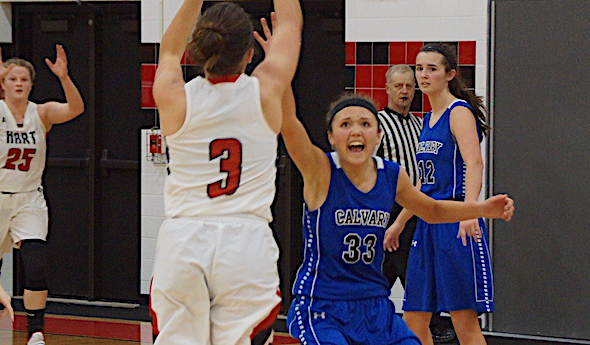
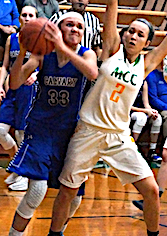
PHOTOS: (Top) Kelsey Richards defends during a game earlier this season against Hart. (Middle) Richards works to get past a Muskegon Catholic Central defender last season. (Below) The Richards children, from left: Kelsey Richards, Allyson Richards (junior at Cornerstone), Bradley Richards (6-3 seventh grader at Fruitport Calvary Christian) and Taylor Richards (Cornerstone graduate). (Action photos courtesy of Dr. Tom Watkins; family photo courtesy of the Richards family.)
Breslin Bound: Girls Report Week 3
December 17, 2012
By Geoff Kimmerly
Second Half editor
As a general rule, basketball teams evolve plenty between the first games of December through the final regular-season contests in February.
But these pre-break matchups matter just as much in the win-loss columns. And a number of games are being played right now that will surely make a difference as this season draws to a close.
This week's report includes some of the teams that have came out on the winning ends of key December battles. (Results and records based on those reported to Score Center at MHSAA.com)
1. Inkster (4-0) – The Vikings are a regular at Breslin Center and made the Class A Semifinals last season, so another great start is hardly surprising. But it's proof why Inkster remains a force – last week’s wins were 51-45 over improved Detroit Mumford and 57-51 over always-powerful Detroit Pershing.
2. Waterford Our Lady (3-1) – The reigning Class D champion has bounced back quickly from an opening-night loss to West Bloomfield. Last week, Our Lady beat Livonia Ladywood 50-38 and Mount Pleasant Sacred Heart by the same score.
3. Detroit Martin Luther King (3-0) – This is another team always in the Class A mix, and it got a big win Saturday – 56-48 over returning Class A Semifinalist Ann Arbor Huron, which earlier in the week had defeated Detroit Country Day 65-58. King also beat Detroit East English 61-7.
4. Johannesburg-Lewiston (5-0) – The Cardinals lost only two regular-season games last season, both times to Ski Valley Conference rival Gaylord St. Mary. But they got a little bit of revenge last week with a 50-48 win over St. Mary after also beating East Jordan 57-43.
5. Holt (5-0) – The Rams are again setting up nicely to contend in the strong Capital Area Activities Conference Blue. They beat nonleague foe St. Johns 52-48 and then Lansing Everett 48-39 to keep early pace with other frontrunners Grand Ledge and East Lansing.
6. Napoleon (5-1) – Napoleon’s 15-7 finish in 2011-12 included splits against Michigan Center and Grass Lake. The Pirates got an early upper hand on both last week, beating Michigan Center 49-45 and Grass Lake 47-42.
7. Traverse City St. Francis (4-1) – The Gladiators opened last season 14-1, with that lone loss to Cadillac – which they beat last week 55-50. St. Francis also defeated Kalkaska 44-36 on Friday.
8. Pewamo-Westphalia (3-2) – The Pirates got off to a rough start with opening-week losses to Class B Williamston and Lakewood. But back in familiar territory in the Central Michigan Athletic Conference, they've won three straight – including 51-42 last week over returning Class D Semifinalist Portland St. Patrick.
9. North Farmington (3-1) – The Raiders are coming off a 10-12 season that included a pair of losses to Pontiac. But North Farmington earned the early edge this time with a 59-58 win over Pontiac, followed by a 58-48 win over West Bloomfield.
10. Powers North Central (5-1) – After opening with a 13-point loss to returning Class D Semifinalist Crystal Falls Forest Park, North Central hasn't fallen again. The Jets beat Stephenson 62-51 and Munising 50-22 to get nearly halfway to last season’s win total of 11.
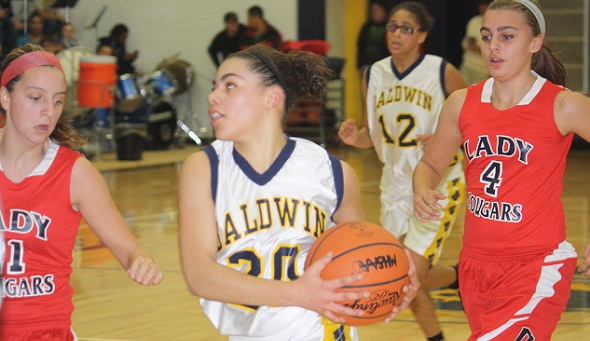
PHOTO: Big Rapids Crossroads (in red) defeated Baldwin on Thursday to move to 4-0 this season. (Click to see more at HighSchoolSportsScene.com.)