

Lakes 'Family' Ready to Run Again
By
Tom Markowski
Special for Second Half
December 13, 2018
WATERFORD – Waterford Our Lady of the Lakes has taken a big step forward and become a perennial state power in girls basketball since Steve Robak became the coach before the 2007-08 season.
 Robak guided the Lakers to a Regional Final that first winter and a Quarterfinal appearance in 2009 before Our Lady went on to play in its first MHSAA Final in the sport – and tie the Class D girls basketball record with three straight titles. The Lakers followed that run by losing in the 2013 championship game.
Although Our Lady hasn’t reached a Final since, the Lakers have been to the Semifinals three times (including last winter) and as far as the Quarterfinals on another occasion. The only season the Lakers haven’t won at least a District title under Robak was 2013-14.
Any coach who has experienced similar success will tell you it takes a certain amount of talent to reach this level. Robak is no different. But at this Detroit Catholic League school, you’ll find achieving such success goes far beyond talent.
Our Lady of the Lakes offers a community aspect to the high school experience that only a few small public and non-public schools provide. The students and faculty are like family, no more so than for Robak and his extended family.
Robak, 51, is a graduate of Our Lady and attended school there for 12 years, from 1st-12th grade. The school offers students a K-12 education and is one of four within the Catholic League to do so, along with Allen Park Cabrini, Dearborn Divine Child, Royal Oak Shrine and Clarkston Everest Collegiate. Thirty or 40 years ago this was quite common within the Detroit Catholic League. It isn’t so now and makes places like Our Lady rare, a fact not lost on those who attend or work within a parish school.
Vic Michaels is the director of athletics for the Detroit Catholic League, and in the 1980s was the boys basketball coach at Center Line St. Clement when it was a parish school.
“Years ago there were a lot of schools like that,” he said. “It’s a comfortable environment. You have the support of the parish. The kids continue through high school and, yes, you will get some new students. But (your) classmates, for the most part, remain the same.”
Robak is the oldest of seven children, all of whom went to Our Lady of the Lakes.
“There’s a real comfort there,” Robak said. “You’ve been friends for seven or eight years before you get to high school. We’ve had some come in the ninth grade, but it’s a small number. We’ve had two transfers in our program in my tenure.
“When you’re at a parochial school, (and people say), ‘Oh, you recruit.’ That doesn’t happen here. Our players come up through the system. That’s not to say we haven’t had some go on to play in college. I’m not a travel-AAU guy at all. A good athlete will be found no matter where you play.”
 Another word that’s often associated with a winning program is stability. When Robak took over the program, his brother Paul came on as an assistant before switching to take over the boys program six years later. Replacing him was Tim Ross, the Robaks’ brother-in-law. Last season Paul returned to the girls program as an assistant.
We’re just starting with this family thing.
Steve had two daughters play for him: Lauren, a 2011 graduate, and Lexie, who graduated two years later. Both were all-staters. Ross had two daughters come through the system, Lindsay and Megan. And not to be left out, Paul’s oldest daughter, Brooklyn, is a sophomore on the team this season and one of the top players. Paul has another daughter, Elli, but she’s still in grade school. Another niece, Maria Oliver, is a freshman on the team.
Want more? Steve has two more daughters, currently in grade school, who are expected to be a part of the program in the future.
And therein lies a big reason for the program’s success. The students are in the same building from the elementary level through high school. The younger ones look up to those on varsity, and the coaches at all levels are on the same page teaching the same system.
“We get to the younger coaches, showing them how to teach our younger kids through clinics and stuff,” Steve said. “A lot of times volunteers are needed. When you have coaches who have the same philosophy, it helps. Also, winning helps. Winning has helped get kids out who might not have played.”
This season the Lakers are in a bit of a transition. Three starters graduated and there are just two seniors, two juniors and no junior varsity. Our Lady is 0-3 having lost to Flint Hamady, Romeo and Harper Woods Chandler Park, all from higher enrollment divisions, with a combined record of 9-1.
Isabelle Kline started playing basketball at Our Lady when she was in 6th grade. Kline rarely missed a varsity home game while in grade school and noticed the high level of determination those players displayed – which she said played a major role in her work ethic and development.
Now a junior, Kline, a three-year varsity player, is one of two starters returning. She said even though there isn’t a lot of experience, the team is progressing despite a slow start.
“We have a young team but the transition has been very good,” she said. “We’ve been bonding as a team.
“We came into (the game against Romeo) with our heads low, and that wasn’t the right thing to do. But we played incredible. We were talking on defense. It was a team effort. We played great team defense.
“We knew those (first three) teams we’re really good. When we saw who we were playing it was like, ‘Steve, what are you doing?’ But we played a tough (nonconference) schedule last year with Detroit Country Day and (Ypsilanti) Arbor Prep and we made it to the semis. We know we have to play good teams to get better.”
 Tom Markowski is a correspondent for the State Champs! Sports Network and previously directed its web coverage. He also covered primarily high school sports for the The Detroit News from 1984-2014, focusing on the Detroit area and contributing to statewide coverage of football and basketball. Contact him at [email protected] with story ideas for Oakland, Macomb and Wayne counties.
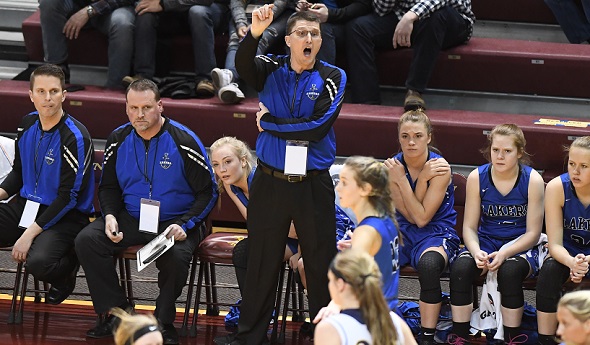
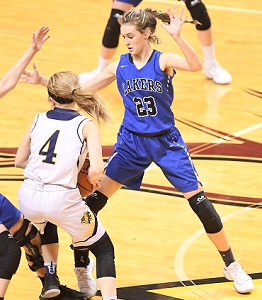
PHOTOS: (Top) Our Lady coach Steve Robak (standing) directs his team during last season’s Class D Semifinal against Chassell at Van Noord Arena. (Middle) Isabelle Kline (23) blocks a path as the Panthers look to push the ball up the floor.
Maska/Shiels/Zajac Family Celebrating, Sharing In Each Other's Hoops Successes
By
Doug Donnelly
Special for MHSAA.com
March 6, 2024
Call them Lenawee County’s First Family of Basketball.
 The Maska-Shiels-Zajac clan have dominated the Lenawee County basketball scene this season with family members breaking records and winning championships in multiple communities.
- Brad Maska has coached Onsted to its third straight Lenawee County Athletic Association championship. His Wildcats are 20-5, won a District and will play for a Division 2 boys basketball regional title Thursday.
- Kristy Zajac, Brad’s sister, is the head coach of Tecumseh’s girls basketball team, which shared the Southeastern Conference White title this season – the program’s first league title in 20 years – and surpassed 100 career wins last month.
- The season came to an end Tuesday for Britton Deerfield and head coach Darren Shiels, who is married to Brad and Kristy’s sister Kelly. But it was the best in BD history and included the program’s first District championship.
“As happy as I was for myself, I think I was happier for Darren,” Maska said, reacting to Britton Deerfield and Shiels upsetting second-ranked Adrian Lenawee Christian in the District Final last week. “I was so ecstatic for them. To lose to that team by 50 points a month ago, to get those kids to believe and come back … I couldn’t believe it.”
The family is tight. They spend summers together at the family cottage in northern Michigan, vacation together every spring break in Florida, and during basketball season it’s not uncommon to find any one of them at each other’s practices.
Over Christmas break, Shiels stopped by Zajac’s Tecumseh practice to help with a specific defense she wanted to implement, and Shiels and Maska shared some strategy at a practice in January.
“We talk basketball all of the time,” Zajac said. “It’s constantly basketball.”
All three played at Britton High School before Britton and Deerfield merged. They all played under the tutelage of Bart Bartels, who coached both the girls and boys varsity teams at Britton for years. He is an assistant coach with Zajac at Tecumseh now.
“It’s really fun to bounce ideas back and forth,” Maska said. “We talk often, probably every other day. It really spurs a lot of conversations. It’s neat to have that family base where we can bounce ideas off each other.”
Zajac has been on the phone this week talking to her brother about their matchups.
"Why reinvent the wheel when you have two great coaches in your family that you can go to for help," she said. "At Christmas this year, all three of us were drawing out plays on napkins. It's always a great resource to have."
Shiels hit the game-winning shot for Britton in its 1995 District championship game, which was the last time Britton or Deerfield won a District basketball title until last week.
He began coaching almost as soon as high school ended and took over the Britton varsity in 2005. He coached his alma mater for four seasons, then Britton and Deerfield became a cooperative program for a couple of seasons, and then the communities voted to join the districts together. He’s been head coach through it all. This season’s 18-7 Patriots were led by Darren and Kelly’s son Logan Shiels, who finished as the school’s all-time leading scorer.
 BD has six seniors, including Shiels and Brayden Shiels, a nephew of the head coach, and Ryan Good, a cousin.
“I’ve coached them since they were little because they were all on my son’s team,” Shiels said after Tuesday’s Regional loss to Allen Park Inter-City Baptist. “This is tough. The finality of it all hasn’t hit me yet, but I just think I’m most proud about how the kids all care about each other so much.
“They tell each other they love each other all the time. They’ve played together so long.”
After the District title was won at Adrian College, the Britton Deerfield team held an impromptu celebration at BD. The team gathered in front of family and friends to cut down the nets and talk about the season.
“I was surprised so many people showed up,” Shiels said. “It just shows how big it was to win the District. It’s hard to win a District.”
Maska was a 1,000-point scorer at Britton who played college football at Adrian College. He is in his 17th season as head coach at Onsted. His teams have averaged 15 wins a year and have had two Mr. Basketball Award candidates despite being one of the smallest schools in Division 2.
Ayden Davis is a Mr. Basketball finalist this year and will finish his career with more than 1,800 points, 1,200 rebounds and as the No. 2 shot-blocker in state history.
“Mr. Basketball candidates don’t come around very often, and we’ve had two,” Maska said. “It’s a big deal. We’ve had a lot of success and built a pretty solid program.”
Zajac was the all-time leading scorer during her playing days at Britton and played four years at Eastern Michigan University. She has two daughters on the Tecumseh team, including junior Alli, who recently became Tecumseh’s career scoring leader.
“I told her now that she has the school record, she has to catch me,” Zajac said.
One of the biggest fans in the gym at Onsted, Britton Deerfield or Tecumseh is 92-year-old Urvin Reau.
Reau grew up on a farm a few miles from Britton. He raised six children, including Brad and Kristy’s mom Denise. He is at a game almost every night of the week supporting his grandkids – who coach – and great grandkids who play.
“I always get to the games,” said Reau, 92. “I love to watch the kids play. High school sports are great. They are playing against their rivals. That makes it fun.”
The families got together the Sunday before the boys started District week for a family dinner, and they already have spring break carved out of their schedules.
“Spring break has always been our time,” Maska said. “It’s literally when we all have time to decompress and relax. It’s when we all can get together and discuss a lot of things – good and bad – that we had during the season.”
Basketball season rolls on. Zajac’s team is in the District Semifinals tonight as it tries to repeat as District champ.
Maska said Tecumseh better.
“I already told Kristy,” he said, “that if she’s the one that doesn’t have a District championship when we head down to spring break, she is going to hear about it.”
 Doug Donnelly has served as a sports and news reporter and city editor over 25 years, writing for the Daily Chief-Union in Upper Sandusky, Ohio from 1992-1995, the Monroe Evening News from 1995-2012 and the Adrian Daily Telegram since 2013. He's also written a book on high school basketball in Monroe County and compiles record books for various schools in southeast Michigan. E-mail him at [email protected] with story ideas for Jackson, Washtenaw, Hillsdale, Lenawee and Monroe counties.
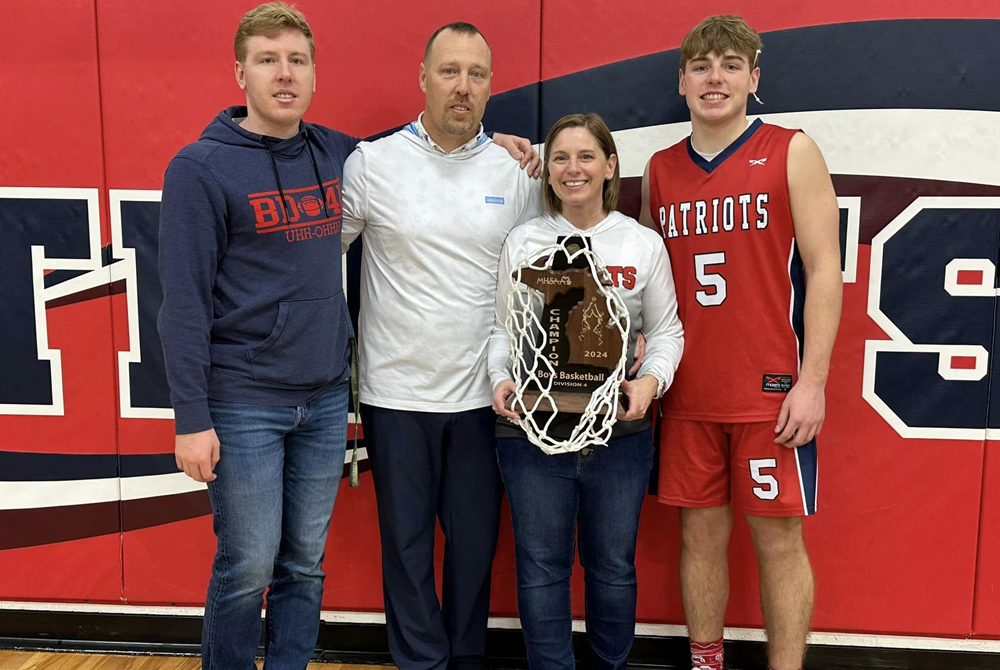
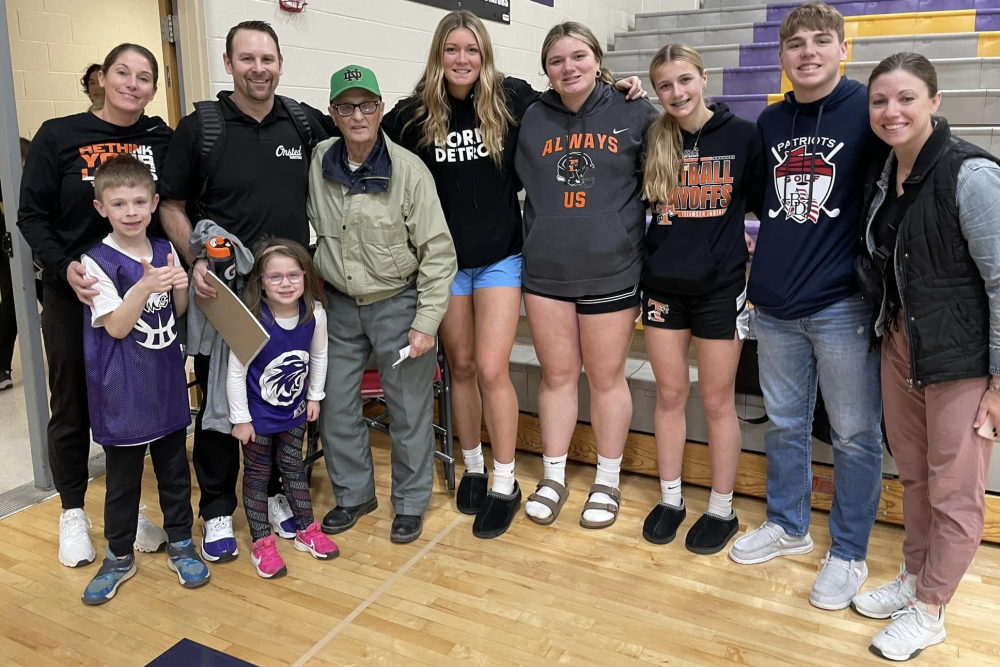
PHOTOS (Top) From left: Cole Shiels, Darren Shiels, Kelly Shiels and Logan Shiels. Darren is the varsity boys basketball coach at Britton Deerfield, Kelly is the longtime scorekeeper and Logan and Cole have both played for their father. (Middle) The Maska family, including from left: Kristy Zajac, Brad Maska, Urvin Reau, Alli Zajac, Addi Zajac, Avery Zajac, Logan Shiels and Gretchen Maska, Brad’s wife. (Photos courtesy of the Shiels/Maska/Zajac family.)