

Lakes 'Family' Ready to Run Again
By
Tom Markowski
Special for Second Half
December 13, 2018
WATERFORD – Waterford Our Lady of the Lakes has taken a big step forward and become a perennial state power in girls basketball since Steve Robak became the coach before the 2007-08 season.
 Robak guided the Lakers to a Regional Final that first winter and a Quarterfinal appearance in 2009 before Our Lady went on to play in its first MHSAA Final in the sport – and tie the Class D girls basketball record with three straight titles. The Lakers followed that run by losing in the 2013 championship game.
Although Our Lady hasn’t reached a Final since, the Lakers have been to the Semifinals three times (including last winter) and as far as the Quarterfinals on another occasion. The only season the Lakers haven’t won at least a District title under Robak was 2013-14.
Any coach who has experienced similar success will tell you it takes a certain amount of talent to reach this level. Robak is no different. But at this Detroit Catholic League school, you’ll find achieving such success goes far beyond talent.
Our Lady of the Lakes offers a community aspect to the high school experience that only a few small public and non-public schools provide. The students and faculty are like family, no more so than for Robak and his extended family.
Robak, 51, is a graduate of Our Lady and attended school there for 12 years, from 1st-12th grade. The school offers students a K-12 education and is one of four within the Catholic League to do so, along with Allen Park Cabrini, Dearborn Divine Child, Royal Oak Shrine and Clarkston Everest Collegiate. Thirty or 40 years ago this was quite common within the Detroit Catholic League. It isn’t so now and makes places like Our Lady rare, a fact not lost on those who attend or work within a parish school.
Vic Michaels is the director of athletics for the Detroit Catholic League, and in the 1980s was the boys basketball coach at Center Line St. Clement when it was a parish school.
“Years ago there were a lot of schools like that,” he said. “It’s a comfortable environment. You have the support of the parish. The kids continue through high school and, yes, you will get some new students. But (your) classmates, for the most part, remain the same.”
Robak is the oldest of seven children, all of whom went to Our Lady of the Lakes.
“There’s a real comfort there,” Robak said. “You’ve been friends for seven or eight years before you get to high school. We’ve had some come in the ninth grade, but it’s a small number. We’ve had two transfers in our program in my tenure.
“When you’re at a parochial school, (and people say), ‘Oh, you recruit.’ That doesn’t happen here. Our players come up through the system. That’s not to say we haven’t had some go on to play in college. I’m not a travel-AAU guy at all. A good athlete will be found no matter where you play.”
 Another word that’s often associated with a winning program is stability. When Robak took over the program, his brother Paul came on as an assistant before switching to take over the boys program six years later. Replacing him was Tim Ross, the Robaks’ brother-in-law. Last season Paul returned to the girls program as an assistant.
We’re just starting with this family thing.
Steve had two daughters play for him: Lauren, a 2011 graduate, and Lexie, who graduated two years later. Both were all-staters. Ross had two daughters come through the system, Lindsay and Megan. And not to be left out, Paul’s oldest daughter, Brooklyn, is a sophomore on the team this season and one of the top players. Paul has another daughter, Elli, but she’s still in grade school. Another niece, Maria Oliver, is a freshman on the team.
Want more? Steve has two more daughters, currently in grade school, who are expected to be a part of the program in the future.
And therein lies a big reason for the program’s success. The students are in the same building from the elementary level through high school. The younger ones look up to those on varsity, and the coaches at all levels are on the same page teaching the same system.
“We get to the younger coaches, showing them how to teach our younger kids through clinics and stuff,” Steve said. “A lot of times volunteers are needed. When you have coaches who have the same philosophy, it helps. Also, winning helps. Winning has helped get kids out who might not have played.”
This season the Lakers are in a bit of a transition. Three starters graduated and there are just two seniors, two juniors and no junior varsity. Our Lady is 0-3 having lost to Flint Hamady, Romeo and Harper Woods Chandler Park, all from higher enrollment divisions, with a combined record of 9-1.
Isabelle Kline started playing basketball at Our Lady when she was in 6th grade. Kline rarely missed a varsity home game while in grade school and noticed the high level of determination those players displayed – which she said played a major role in her work ethic and development.
Now a junior, Kline, a three-year varsity player, is one of two starters returning. She said even though there isn’t a lot of experience, the team is progressing despite a slow start.
“We have a young team but the transition has been very good,” she said. “We’ve been bonding as a team.
“We came into (the game against Romeo) with our heads low, and that wasn’t the right thing to do. But we played incredible. We were talking on defense. It was a team effort. We played great team defense.
“We knew those (first three) teams we’re really good. When we saw who we were playing it was like, ‘Steve, what are you doing?’ But we played a tough (nonconference) schedule last year with Detroit Country Day and (Ypsilanti) Arbor Prep and we made it to the semis. We know we have to play good teams to get better.”
 Tom Markowski is a correspondent for the State Champs! Sports Network and previously directed its web coverage. He also covered primarily high school sports for the The Detroit News from 1984-2014, focusing on the Detroit area and contributing to statewide coverage of football and basketball. Contact him at [email protected] with story ideas for Oakland, Macomb and Wayne counties.
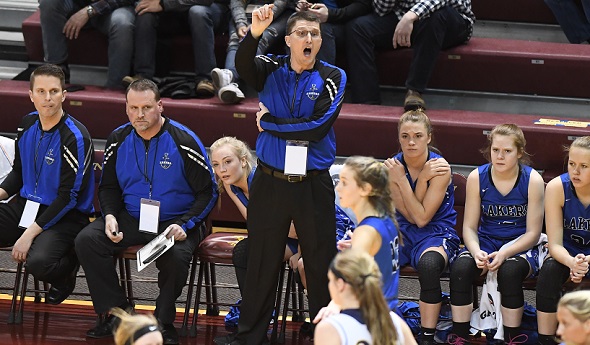
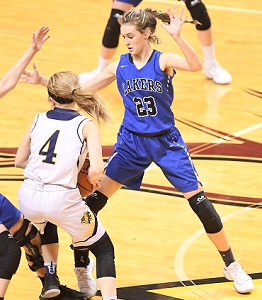
PHOTOS: (Top) Our Lady coach Steve Robak (standing) directs his team during last season’s Class D Semifinal against Chassell at Van Noord Arena. (Middle) Isabelle Kline (23) blocks a path as the Panthers look to push the ball up the floor.
March Hoops Magic Continues to Connect Bradford Family
By
Tom Spencer
Special for MHSAA.com
March 26, 2021
Bear Lake – Check. Onekama? You bet. Traverse City West? Yup.

Glen Lake? Absolutely!
Chances are if you played basketball at one of these schools over the last decade or so, you were coached by a very special educator named Bradford. Perhaps not the same Bradford, but it definitely was a member of the Onekama-raised family with a long line of special education teachers.
While growing up on the farm of parents Arden and Lynn in Onekama, the future educators picked up the love of the game of basketball. Some went on to play college ball, and all reportedly did some coaching.
March Madness has always been a lot of fun in the Bradford family.
“Our family has had a lot of success in March Madness, and it is fun to be able to talk about it with each other and with our kids,” said Nathan Bradford, currently the boys basketball coach, athletic director and special ed teacher at Onekama. “As a player, I also played at the Breslin Center and in the state Semifinals.
“It was an experience that I will never forget,” he continued. “My sisters have also made it to the state Semifinals.”
Nick Bradford joined Nathan’s staff as the junior varsity boys coach. The Portagers ended their season Thursday night with a hard-fought loss to Brethren after leading most of the way.
One of the sisters, April, had a long run as the Bear Lake girls coach. She still teaches special ed there.
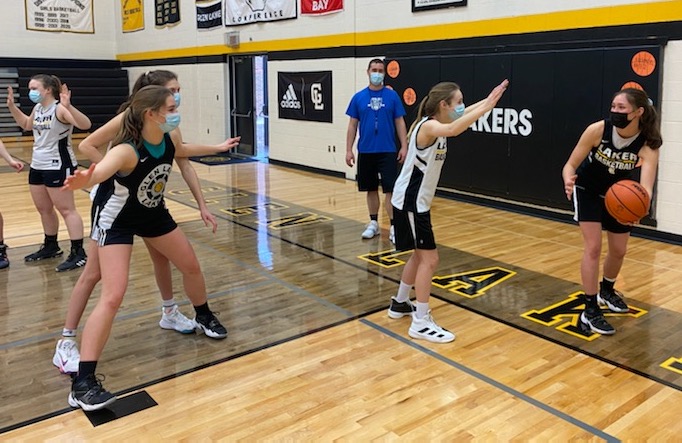 Jason Bradford, whose undefeated Glen Lake girls squad plays for the District championship tonight against Elk Rapids, has fond memories of March Madness on the Bradford farm.
“The one that got into it the most was probably Nate,” Jason said. “We’d go back and forth picking different teams.”
“We were on the living room floor cheering – it was a friendly competitive thing,” he continued. “We were Michigan State fans. Whenever they were in the mix, we were always cheering for them.”
While the father of five doesn’t have the Spartans to root on any longer this year, he does have the Lakers. All the Bradfords will likely be cheering on the Lakers as they try to move on from last season’s abrupt end.
Jason’s oldest son, J.J., is now a freshman in college. He saw his senior season at Glen Lake come to an end with the pandemic outbreak halting tournament play last March as he was preparing for a District Final game.
His daughters, Grace, now a junior, and Maddie, a sophomore, advanced to the Regional Final against Manton last year and were pretty much boarding the bus when things stopped.
Season-ending losses have always caused sleep deprivation for Jason. They have a bigger impact when his own kids are on the team.
“It might be tougher on them,” Jason acknowledged. “Maybe I put more pressure on them. (The season ending) still hurts, but you learn to deal with it.
“You want the success for them,” he continued. “Maybe I am a little more anxious for games ... it’s the pressure.”
But it is a great and fun time of year, Nathan noted.
“I always look at throwing records aside and showing up, giving it your all because you always have a chance to win during tournaments,” he said. “I have experienced both ends of the spectrum with teams with high expectations and getting upset and teams with nothing to lose and making a run.
 “You always hope your team is peaking at the right time and you can advance in the tournaments.”
Jason and Nathan have never coached against each other. They both have young boys so that could change. The sibling rivalry has presented some competitiveness.
 They started coaching girls varsity basketball the same year and their teams were in different conferences at the time. Nathan moved to boys before Onekama and Glen Lake competed against each other in the Northwest Conference.
“We always set up a few (girls) scrimmages and I have to admit that Jason usually got the better of me at that time,” Nathan said. “I would say we really help each other out and talk coaching strategies quite a bit.
“Usually after games we call each other and get the run down on each other's games,” Nathan added. “It helps having another sibling in the family that coaches a varsity sport to talk to and bounce things off of.”
The summer breaks helped lure the Bradfords into teaching so they could help out on the farm. Their upbringing paved their way. Coaching is a bonus.
“While playing I always thought that it would be great to give back to the sport that gave me so many opportunities, and this led to me wanting to become a teacher and a coach,” Jason said. “Our dad taught us great work ethic and discipline growing up on a farm. Our mom is the most patient and caring individual you can meet and would do anything to help another individual.”
Tonight Glen Lake will take the floor without three seniors from last year’s team but with a lot more experience Jason hopes that bodes well for the Lakers.
“I feel we have a little more depth,” he pointed out. “We’re another year older, and it helps with confidence too.”
 Tom Spencer is a longtime MHSAA-registered basketball and soccer official, and former softball and baseball official, and he also has coached in the northern Lower Peninsula area. He previously has written for the Saginaw News, Bay County Sports Page and Midland Daily News. He can be reached at [email protected] with story ideas for Manistee, Wexford, Missaukee, Roscommon, Ogemaw, Iosco, Alcona, Oscoda, Crawford, Kalkaska, Grand Traverse, Benzie, Leelanau, Antrim, Otsego, Montmorency, Alpena, Presque Isle, Cheboygan, Charlevoix and Emmet counties.
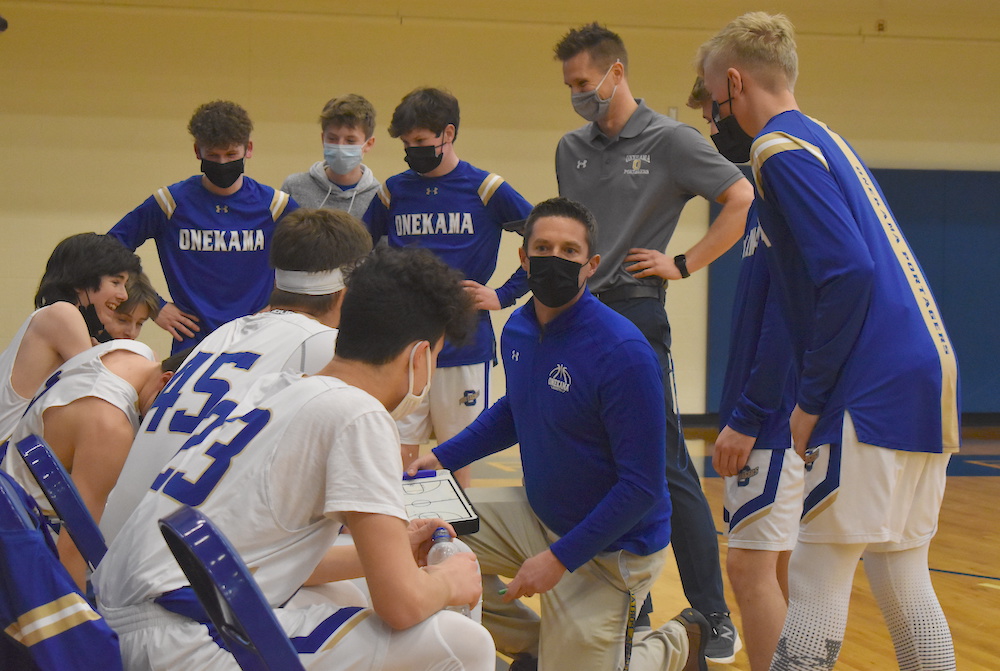
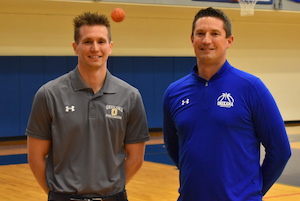
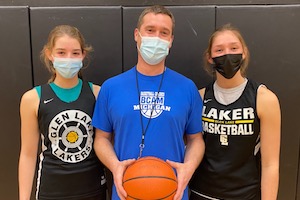
PHOTOS: (Top) Nathan Bradford (kneeling) and assistant and brother Nick Bradford huddle with their Onekama boys basketball team this season. (Middle) Jason Bradford guides his Maple City Glen Lake girls basketball team through an inbounds scenario, with daughters Grace inbounding and Maddie setting up to receive the pass. (Below) Clockwise from top left, Nick Bradford, Nathan Bradford, Grace Bradford, Jason Bradford and Maddie Bradford. (Onekama photos by Paul Cunningham. Glen Lake photos by Liz Moeggenberg.)