

Lakes 'Family' Ready to Run Again
By
Tom Markowski
Special for Second Half
December 13, 2018
WATERFORD – Waterford Our Lady of the Lakes has taken a big step forward and become a perennial state power in girls basketball since Steve Robak became the coach before the 2007-08 season.
 Robak guided the Lakers to a Regional Final that first winter and a Quarterfinal appearance in 2009 before Our Lady went on to play in its first MHSAA Final in the sport – and tie the Class D girls basketball record with three straight titles. The Lakers followed that run by losing in the 2013 championship game.
Although Our Lady hasn’t reached a Final since, the Lakers have been to the Semifinals three times (including last winter) and as far as the Quarterfinals on another occasion. The only season the Lakers haven’t won at least a District title under Robak was 2013-14.
Any coach who has experienced similar success will tell you it takes a certain amount of talent to reach this level. Robak is no different. But at this Detroit Catholic League school, you’ll find achieving such success goes far beyond talent.
Our Lady of the Lakes offers a community aspect to the high school experience that only a few small public and non-public schools provide. The students and faculty are like family, no more so than for Robak and his extended family.
Robak, 51, is a graduate of Our Lady and attended school there for 12 years, from 1st-12th grade. The school offers students a K-12 education and is one of four within the Catholic League to do so, along with Allen Park Cabrini, Dearborn Divine Child, Royal Oak Shrine and Clarkston Everest Collegiate. Thirty or 40 years ago this was quite common within the Detroit Catholic League. It isn’t so now and makes places like Our Lady rare, a fact not lost on those who attend or work within a parish school.
Vic Michaels is the director of athletics for the Detroit Catholic League, and in the 1980s was the boys basketball coach at Center Line St. Clement when it was a parish school.
“Years ago there were a lot of schools like that,” he said. “It’s a comfortable environment. You have the support of the parish. The kids continue through high school and, yes, you will get some new students. But (your) classmates, for the most part, remain the same.”
Robak is the oldest of seven children, all of whom went to Our Lady of the Lakes.
“There’s a real comfort there,” Robak said. “You’ve been friends for seven or eight years before you get to high school. We’ve had some come in the ninth grade, but it’s a small number. We’ve had two transfers in our program in my tenure.
“When you’re at a parochial school, (and people say), ‘Oh, you recruit.’ That doesn’t happen here. Our players come up through the system. That’s not to say we haven’t had some go on to play in college. I’m not a travel-AAU guy at all. A good athlete will be found no matter where you play.”
 Another word that’s often associated with a winning program is stability. When Robak took over the program, his brother Paul came on as an assistant before switching to take over the boys program six years later. Replacing him was Tim Ross, the Robaks’ brother-in-law. Last season Paul returned to the girls program as an assistant.
We’re just starting with this family thing.
Steve had two daughters play for him: Lauren, a 2011 graduate, and Lexie, who graduated two years later. Both were all-staters. Ross had two daughters come through the system, Lindsay and Megan. And not to be left out, Paul’s oldest daughter, Brooklyn, is a sophomore on the team this season and one of the top players. Paul has another daughter, Elli, but she’s still in grade school. Another niece, Maria Oliver, is a freshman on the team.
Want more? Steve has two more daughters, currently in grade school, who are expected to be a part of the program in the future.
And therein lies a big reason for the program’s success. The students are in the same building from the elementary level through high school. The younger ones look up to those on varsity, and the coaches at all levels are on the same page teaching the same system.
“We get to the younger coaches, showing them how to teach our younger kids through clinics and stuff,” Steve said. “A lot of times volunteers are needed. When you have coaches who have the same philosophy, it helps. Also, winning helps. Winning has helped get kids out who might not have played.”
This season the Lakers are in a bit of a transition. Three starters graduated and there are just two seniors, two juniors and no junior varsity. Our Lady is 0-3 having lost to Flint Hamady, Romeo and Harper Woods Chandler Park, all from higher enrollment divisions, with a combined record of 9-1.
Isabelle Kline started playing basketball at Our Lady when she was in 6th grade. Kline rarely missed a varsity home game while in grade school and noticed the high level of determination those players displayed – which she said played a major role in her work ethic and development.
Now a junior, Kline, a three-year varsity player, is one of two starters returning. She said even though there isn’t a lot of experience, the team is progressing despite a slow start.
“We have a young team but the transition has been very good,” she said. “We’ve been bonding as a team.
“We came into (the game against Romeo) with our heads low, and that wasn’t the right thing to do. But we played incredible. We were talking on defense. It was a team effort. We played great team defense.
“We knew those (first three) teams we’re really good. When we saw who we were playing it was like, ‘Steve, what are you doing?’ But we played a tough (nonconference) schedule last year with Detroit Country Day and (Ypsilanti) Arbor Prep and we made it to the semis. We know we have to play good teams to get better.”
 Tom Markowski is a correspondent for the State Champs! Sports Network and previously directed its web coverage. He also covered primarily high school sports for the The Detroit News from 1984-2014, focusing on the Detroit area and contributing to statewide coverage of football and basketball. Contact him at [email protected] with story ideas for Oakland, Macomb and Wayne counties.
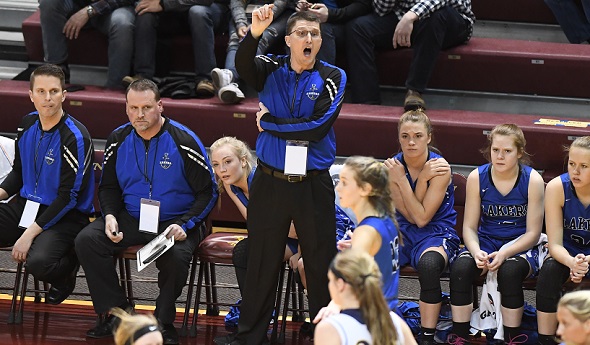
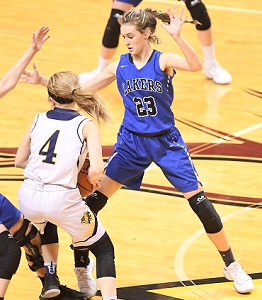
PHOTOS: (Top) Our Lady coach Steve Robak (standing) directs his team during last season’s Class D Semifinal against Chassell at Van Noord Arena. (Middle) Isabelle Kline (23) blocks a path as the Panthers look to push the ball up the floor.
Performance: Renaissance's Kailee Davis
February 20, 2020
 Kailee Davis
Detroit Renaissance junior – Basketball
The Phoenix’s guard scored a team-high 34 points with seven 3-pointers to lead Renaissance past Detroit Cass Tech 81-55 in Friday’s Detroit Public School League Tournament championship game, earning the MHSAA “Performance of the Week.” The PSL overall championship was Renaissance’s first since 2011, and Davis has set the pace as the team has since improved to 17-2 with one more game next week before the postseason begins.
Phoenix coach Shane Lawal called Davis the best junior in the state after the Cass Tech win, and he has plenty to back that up. The 5-foot-4 Davis was averaging a team-leading 16.8 points per game on 50-percent shooting from the floor heading into Wednesday night’s win over Flint Carman-Ainsworth. She had made 35 3-pointers and also was averaging 3.7 assists and 3.4 rebounds per game. Her numbers have come against a schedule loaded with MHSAA title contenders – Renaissance’s opponents have a combined .643 winning percentage – and she often defers to a talented group of teammates, which include four other starters already holding college basketball scholarship offers. The Phoenix’ only loss came to reigning Division 2 champion Detroit Edison, 54-52 on Feb. 1, and Davis scored a game-high 22 points against the Pioneers’ star-studded lineup. She should get a chance to show her skills on the playoff stage over the next month; Renaissance currently is ranked No. 3 in Division 1 in the MHSAA's Michigan Power Ratings.
Davis also played baseball growing up and is considering playing softball at Renaissance as a senior. She’s been on the basketball varsity since freshman year and continues to be all hoops right now, and has made a variety of campus visits and picked up eight Division I scholarship offers with interest from a number of other programs. She is interested in studying criminal justice after high school with aspirations of becoming a detective.
Coach Shane Lawal said: “Basketball is a game of height. So height is always measured into talent, unfortunately. (But) as far as shooting off the dribble, shooting off the catch, finishing with her left or right hand, finishing in traffic, ball-handling – not just bringing the ball up but under pressure, her shiftiness, her passing ability. ... There's a lot of great juniors in the state, but a lot of them have that height that's added to their attributes. I think if she was four inches taller, everybody would be saying the same things I'm saying. She can score on all three levels. That's something that a lot of high school kids can't do – rim, mid-range and 3-point. Defensively, she’s really underrated; she leads us in steals, covers lots of ground. Her IQ offensive and defensively is extremely high. She just sees the game, and she knows how to make reads and just make the right play. ... I have five great starters. I think if she's playing for a lot of teams she's averaging 25 points a game. She averages 17 because she only needs to average 17. She has so much talent around her that she doesn't have to be superwoman.”
Performance Point: “Coming into the game, I didn't really think I'd have to score a lot of points and take over in the game,” Davis said of the PSL final. “But the way the game was coming to me at the beginning, I just had a feeling that I was going to have a good game. Then my coach just told me to keep shooting, so in the third quarter and fourth quarter I was just shooting the rock when I was open, and just taking good shots. ... (Early) I was getting my points off of playing defense. My shots were just falling. I was going to the rim and to the free throw line, getting my teammates the ball. ... We just work hard every practice. We practice to get to the bigger picture, because our goal is to win a state championship. And we know we've got what it takes to beat any team that's in front of us, so we just came in wanting to play hard.”
 Energized: “I feel like our energy is different, like energy from the coach and the coaching staff. And we just all want it more this year because we know we could've had it the last two years, and we know we were good. We just didn't have the drive. … A lot of (the energy) came from our coach. When he first came in, he came in telling us that our goal from the beginning of the season was to win a state championship. Every practice we just set our goal, and we just practice hard all the time and play hard all the time.”
Big game: “I feel like me being shorter, or smaller, gives me an advantage because I'm quicker than most people. I just try to show people that even though I'm small, I can still do all of the things that anybody bigger than me can do. (Bigger players) think they either can shoot over me or block all of my shots. So I like the challenge when I play against them.”
Finding her groove: “Right now the best part (of my game), I’m letting the game come to me. Playing hard, so I don't have to force my shots. I get my teammates involved first, and then I'll get my groove going. (And) each year my shooting has gotten better. I shoot a lot at practice, and the advantage is me shooting with more confidence.”
All shark: “We learned that we have to play hard every game. We can't just turn it on when we want to. We have to go out playing hard every game, no matter who we're playing against. (That idea) kicked in in the beginning of this year. On the back of our shooting shirts we have this slogan that says "#ClownsAndSharks" And it's like, which one are you? So we treat all of the teams the same way. We don't underestimate any team.”
– Geoff Kimmerly, Second Half editor
Past honorees
Feb. 13: Jamison Ward, Carson City-Crystal wrestling - Report
Feb. 6: Elena Vargo, Farmington United gymnastics - Report
Jan. 31: Michael Wolsek, Trenton swimming - Report
Jan. 24: Kensington Holland, Utica Ford bowling - Report
Jan. 17: Claycee West, White Pigeon basketball - Report
Jan. 10: Seth Lause, Livonia Stevenson hockey - Report
Dec. 5: Mareyohn Hrabowski, River Rouge football - Report
Nov. 28: Kathryn Ackerman, Grand Haven swimming - Report
Nov. 21: Emily Van Dyke, Southfield Christian volleyball - Report
Nov. 14: Taylor Wegener, Ida volleyball - Report
Nov. 7: Carter Solomon, Plymouth cross country - Report
Oct. 31: Jameson Goorman, Muskegon Western Michigan Christian soccer - Report
Oct. 24: Austin Plotkin, Brimley cross country - Report
Oct. 17: Jack Spamer, Brighton cross country - Report
Oct. 10: Kaylee Maat, Hudsonville volleyball - Report
Oct. 3: Emily Paupore, Negaunee cross country - Report
Sept. 26: Josh Mason, South Lyon soccer - Report
Sept. 19: Ariel Chang, Utica Eisenhower golf - Report
Sept. 12: Jordyn Shipps, DeWitt swimming - Report
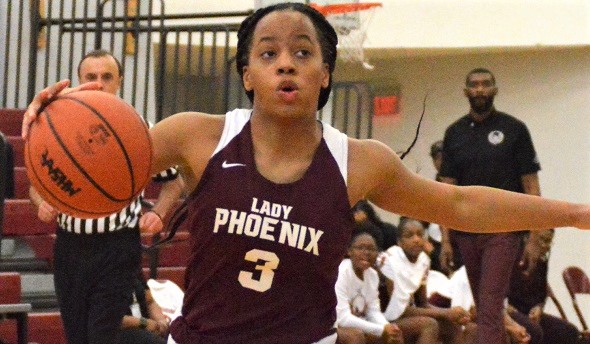
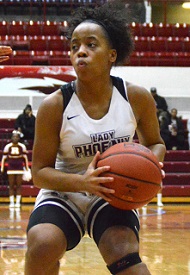
PHOTOS: (Top) Detroit Renaissance's Kailee Davis makes a move toward the basket against Detroit Cody this season. (Middle) Davis prepares to pull up for a jumper during last week's PSL final against Cass Tech. (Photos courtesy of State Champs Sports Network.)