

Lakes 'Family' Ready to Run Again
By
Tom Markowski
Special for Second Half
December 13, 2018
WATERFORD – Waterford Our Lady of the Lakes has taken a big step forward and become a perennial state power in girls basketball since Steve Robak became the coach before the 2007-08 season.
 Robak guided the Lakers to a Regional Final that first winter and a Quarterfinal appearance in 2009 before Our Lady went on to play in its first MHSAA Final in the sport – and tie the Class D girls basketball record with three straight titles. The Lakers followed that run by losing in the 2013 championship game.
Although Our Lady hasn’t reached a Final since, the Lakers have been to the Semifinals three times (including last winter) and as far as the Quarterfinals on another occasion. The only season the Lakers haven’t won at least a District title under Robak was 2013-14.
Any coach who has experienced similar success will tell you it takes a certain amount of talent to reach this level. Robak is no different. But at this Detroit Catholic League school, you’ll find achieving such success goes far beyond talent.
Our Lady of the Lakes offers a community aspect to the high school experience that only a few small public and non-public schools provide. The students and faculty are like family, no more so than for Robak and his extended family.
Robak, 51, is a graduate of Our Lady and attended school there for 12 years, from 1st-12th grade. The school offers students a K-12 education and is one of four within the Catholic League to do so, along with Allen Park Cabrini, Dearborn Divine Child, Royal Oak Shrine and Clarkston Everest Collegiate. Thirty or 40 years ago this was quite common within the Detroit Catholic League. It isn’t so now and makes places like Our Lady rare, a fact not lost on those who attend or work within a parish school.
Vic Michaels is the director of athletics for the Detroit Catholic League, and in the 1980s was the boys basketball coach at Center Line St. Clement when it was a parish school.
“Years ago there were a lot of schools like that,” he said. “It’s a comfortable environment. You have the support of the parish. The kids continue through high school and, yes, you will get some new students. But (your) classmates, for the most part, remain the same.”
Robak is the oldest of seven children, all of whom went to Our Lady of the Lakes.
“There’s a real comfort there,” Robak said. “You’ve been friends for seven or eight years before you get to high school. We’ve had some come in the ninth grade, but it’s a small number. We’ve had two transfers in our program in my tenure.
“When you’re at a parochial school, (and people say), ‘Oh, you recruit.’ That doesn’t happen here. Our players come up through the system. That’s not to say we haven’t had some go on to play in college. I’m not a travel-AAU guy at all. A good athlete will be found no matter where you play.”
 Another word that’s often associated with a winning program is stability. When Robak took over the program, his brother Paul came on as an assistant before switching to take over the boys program six years later. Replacing him was Tim Ross, the Robaks’ brother-in-law. Last season Paul returned to the girls program as an assistant.
We’re just starting with this family thing.
Steve had two daughters play for him: Lauren, a 2011 graduate, and Lexie, who graduated two years later. Both were all-staters. Ross had two daughters come through the system, Lindsay and Megan. And not to be left out, Paul’s oldest daughter, Brooklyn, is a sophomore on the team this season and one of the top players. Paul has another daughter, Elli, but she’s still in grade school. Another niece, Maria Oliver, is a freshman on the team.
Want more? Steve has two more daughters, currently in grade school, who are expected to be a part of the program in the future.
And therein lies a big reason for the program’s success. The students are in the same building from the elementary level through high school. The younger ones look up to those on varsity, and the coaches at all levels are on the same page teaching the same system.
“We get to the younger coaches, showing them how to teach our younger kids through clinics and stuff,” Steve said. “A lot of times volunteers are needed. When you have coaches who have the same philosophy, it helps. Also, winning helps. Winning has helped get kids out who might not have played.”
This season the Lakers are in a bit of a transition. Three starters graduated and there are just two seniors, two juniors and no junior varsity. Our Lady is 0-3 having lost to Flint Hamady, Romeo and Harper Woods Chandler Park, all from higher enrollment divisions, with a combined record of 9-1.
Isabelle Kline started playing basketball at Our Lady when she was in 6th grade. Kline rarely missed a varsity home game while in grade school and noticed the high level of determination those players displayed – which she said played a major role in her work ethic and development.
Now a junior, Kline, a three-year varsity player, is one of two starters returning. She said even though there isn’t a lot of experience, the team is progressing despite a slow start.
“We have a young team but the transition has been very good,” she said. “We’ve been bonding as a team.
“We came into (the game against Romeo) with our heads low, and that wasn’t the right thing to do. But we played incredible. We were talking on defense. It was a team effort. We played great team defense.
“We knew those (first three) teams we’re really good. When we saw who we were playing it was like, ‘Steve, what are you doing?’ But we played a tough (nonconference) schedule last year with Detroit Country Day and (Ypsilanti) Arbor Prep and we made it to the semis. We know we have to play good teams to get better.”
 Tom Markowski is a correspondent for the State Champs! Sports Network and previously directed its web coverage. He also covered primarily high school sports for the The Detroit News from 1984-2014, focusing on the Detroit area and contributing to statewide coverage of football and basketball. Contact him at [email protected] with story ideas for Oakland, Macomb and Wayne counties.
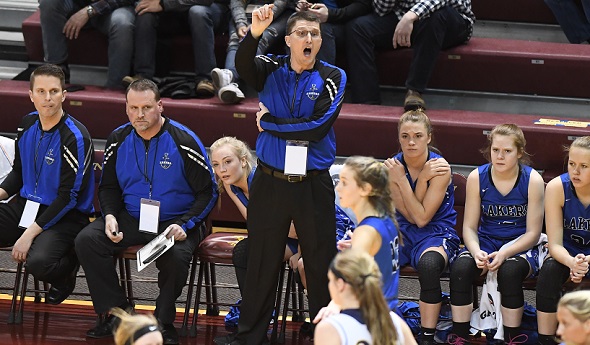
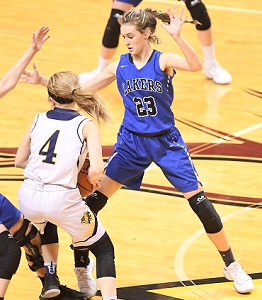
PHOTOS: (Top) Our Lady coach Steve Robak (standing) directs his team during last season’s Class D Semifinal against Chassell at Van Noord Arena. (Middle) Isabelle Kline (23) blocks a path as the Panthers look to push the ball up the floor.
Countdown to Calvin: Regional Preview
March 5, 2018
By Geoff Kimmerly
Second Half editor
We're just days removed from one of the most highlight-filled and upset-loaded Girls Basketball District weeks in recent memory. We could spend this entire "Countdown to Calvin" report noting every single game that sent a wave through the brackets.
 But the tournament is about advancing and looking ahead, and we've got plenty to preview as Regional Semifinals tip off tonight.
Below we mention five of the District results that especially made an impression, plus look at three Regionals of particular note in each class – all powered by MI Student Aid. Host sites are bolded, and matchups shown are for Regional Semifinals. (Click for brackets for every Regional in all four classes.)
Week in Review
The countdown of last week’s five most intriguing results:
1. Caledonia 46, East Kentwood 45 – A last-second basket pushed Caledonia past the reigning Class A runner-up and undefeated Falcons after East Kentwood has won the first two meetings between the teams.
2. Manchester 46, Pittsford 45 – In Class C, Manchester ended Pittsford’s winning streak at 76, two wins short of the MHSAA record.
3. Big Rapids 49, Stanton Central Montcalm 34 – In Class B, Big Rapids handed Central Montcalm its only loss after falling twice to the Hornets during the regular season.
4. Dexter 41, Ann Arbor Huron 36 – The Dreadnaughts knocked out a Class A contender in the District opener, ending the River Rats’ 18-game winning streak.
5. Ishpeming Westwood 59, Negaunee 44 – Westwood ended the Class C contender Miners’ perfect season after also falling twice to Negaunee earlier this winter.
Regionals at a Glance
These could be among our most competitive brackets. Host sites are in bold:
CLASS A
Mount Pleasant
Marquette (16-6) vs. Saginaw Heritage (22-1), Flint Carman-Ainsworth (21-2) vs. Davison (11-12)
All three of Heritage’s District opponents last week had winning records, and things of course aren’t going to get easier. Marquette was the Great Northern Conference champion, and Carman-Ainsworth finished second to Heritage in the Saginaw Valley League. The Cavaliers’ losses came to the Hawks 60-44 on Jan. 5 and reigning Class B champion Detroit Country Day the next day 65-59. Davison had lost seven of nine to close the regular season, but bounced back at the right time to win three and the title last week.
West Bloomfield
Utica Eisenhower (19-3) vs. Waterford Kettering (16-6), Clarkston (18-4) vs. Bloomfield Hills Marian (18-4)
Eisenhower won the Macomb Area Conference White, Clarkston shared the Oakland Activities Association Red title and Marian shared the Detroit Catholic League Central championship. Kettering only finished second in the Lakes Valley Conference but then won its fifth straight District title. Marian has a 52-38 win over Kettering from Nov. 30 and some tournament experience as well having won the Catholic League A-B title and its seventh straight District championship.
Zeeland East
Caledonia (18-5) vs. Muskegon (21-2), Hudsonville (16-7) vs. East Grand Rapids (20-3)
Caledonia should be riding high after shocking previously undefeated and reigning Class A runner-up East Kentwood last week, and the Fighting Scots ran their winning streak to six in clinching the District title one game later. Next up is Muskegon, which hasn’t lost since Dec. 22 and survived a three-point scare against Grand Haven in their District Final. Ottawa-Kent Conference Gold runner-up East Grand Rapids has won 11 straight, and Hudsonville was one of six teams from the seven-team O-K Red that finished the regular season with a winning record.
CLASS B
Goodrich
Corunna (16-6) vs. Birch Run (20-3), Goodrich (18-4) vs. Freeland (21-2)
Half of the six-team Genesee Area Conference Red won District titles, including champion Goodrich and third-place Corunna. Next up they face two of the best from the Tri-Valley Conference – East champion Birch Run and Central title winner Freeland. The Falcons downed the Panthers 70-55 in a crossover Jan. 30, and also have a 61-43 win over the Martians from Jan. 16.
Grant
Comstock Park (19-4) vs. Muskegon Oakridge (20-3), Grand Rapids South Christian (18-4) vs. Howard City Tri-County (15-8)
Oakridge has won six straight West Michigan Conference titles and four Districts during that time, but is seeking its first Regional championship during this string of successes. It won’t come easy if this is the year. Comstock Park won the O-K Blue and has improved 11 wins this season from 2016-17. On the other side of the bracket, South Christian won the O-K Gold and is only two seasons removed from finishing Class B runner-up. And Tri-County is dangerous too; the Vikings claimed a trophy last week after finishing third in the Central State Activities Association Gold behind Stanton Central Montcalm (20-1) and Big Rapids (21-2).
Milan
Ida (19-3) vs. New Boston Huron (20-2), Michigan Center (20-2) vs. Dearborn Henry Ford Academy (16-6)
Ida won the Lenawee County Athletic Association, Huron shared the Huron League title, Michigan Center won the Cascades Conference outright and Henry Ford Academy finished second in the Charter School Conference. Ida finished the regular season with a 19-point win over Huron co-champ Monroe St. Mary Catholic Central, and that could be telling. Henry Ford Academy has the most losses for a reason – all but one came against teams that went on to win District titles as well. Michigan Center and New Boston Huron both found success after playing in different classes last year, Michigan Center Class C and Huron in Class A.
CLASS C
Bridgman
Schoolcraft (23-0) vs. Kalamazoo Hackett (15-8), Niles Brandywine (21-2) vs. Bronson (17-6)
Schoolcraft has followed up its Quarterfinal run of a year ago with perfection, including wins of 13 and 18 over Hackett as they finished first and second, respectively, in the Southwestern Athletic Conference Valley. All but one of the Eagles’ win have been by double digits; that lone single-digit win came 62-61 over Bronson on Dec. 12. The Vikings tied for third in the strong Big 8 Conference and face Berrien-Cass-St. Joseph Conference Red runner-up Brandywine, which has won Regional titles five of the last six seasons. The Bobcats’ only losses this season were to Class B Comstock (19-2).
Escanaba
Iron River West Iron County (18-4) vs. Ishpeming (19-3), St. Ignace (21-1) vs. Houghton (15-7)
Ishpeming – which finished runner-up to Negaunee in the Mid-Peninsula Athletic Conference – emerged from their District last week after rival Westwood ended the undefeated Miners’ season. Now the Hematites could get their chance to topple another undefeated power; first up is Western Peninsula Athletic Conference runner-up West Iron, but St. Ignace looms on the other side of the bracket. The Saints open with West PAC champ Houghton, annually one of the Upper Peninsula’s best as well. But St. Ignace’s only loss was to reigning Class C champ Detroit Edison, and it put up an impressive 87-56 win on Class B Goodrich (also noted above) on Feb. 10.
Grand Rapids NorthPointe Christian
Pewamo-Westphalia (22-0) vs. Laingsburg (20-2), Grandville Calvin Christian (11-11) vs. Hemlock (20-3)
Reigning Class C runner-up Pewamo-Westphalia has been all but unstoppable, winning by an average margin of 41 points per game. Springport, falling only 34-27 in the District Final, gave the Pirates by far their toughest test; two teams, including Class A District champ Detroit Renaissance, got within 23 during the regular season. Laingsburg got within 24 on Feb. 15, and both of its losses this season were to P-W – this matchup could be even closer. On the other side, Calvin Christian finished second in the O-K Silver despite playing a number of larger schools. Hemlock won the TVC West, with its losses to Class B Freeland and Birch Run (see above) and league runner-up Saginaw Valley Lutheran. The Huskies made the Quarterfinals last season.
CLASS D
Big Rapids Crossroads Academy
Mount Pleasant Sacred Heart (22-0) vs. Onekama (12-10), Fruitport Calvary Christian (19-3) vs. Bear Lake (17-5)
Sacred Heart is arguably the favorite to win the entire Class D tournament after falling to reigning champion Pittsford in either the Semifinals or Final the last two seasons. Onekama has been on a roll, though, with five wins in its last six games and seven over its last 10 – with the three losses during that run to Class B Kingsley (23-0) and Benzie Central (17-5) and Class C Maple City Glen Lake (20-2). Bear Lake shared the West Michigan D League title and has rattled off nine wins over its last 10 games. The Lakers open against Alliance League champion Calvary Christian, which has won 15 straight and avenged one of those three losses by beating Muskegon Heights Academy in the District Final.
Kingsford
Bark River-Harris (17-5) vs. Crystal Falls Forest Park (13-9), Munising (22-1) vs. Chassell (22-1)
The second game of the night pits the Skyline Central Conference large-school division champion Mustangs against the Copper Mountain Conference Copper Country title winner Chassell. The Panthers haven’t lost since falling to L’Anse by four in their opener. Munising’s lone defeat came Jan. 4 to Gwinn. Tonight’s first game is a rematch of SCC-Large rivals – the teams split 12-point wins, with Forest Park’s coming in the regular-season finale Feb. 22 as part of a six-game winning streak. Bark River-Harris has won nine of its last 11, however.
St. Ignace
Harbor Spring Harbor Light Christian (19-2) vs. Cedarville (19-3), Gaylord St. Mary (21-1) vs. Rudyard (9-13)
Cedarville has taken a big jump this season after going 13-9 a year ago. Not only did the Trojans win the Eastern UP Athletic Conference, but their lone losses were twice to Class C contender St. Ignace and once to Sault Ste. Marie, a Class B District champ. But Northern Lakes Conference champ Harbor Light Christian will provide an immediate challenge this week. Rudyard, which plays in two leagues including the EUP, upset Engadine to win its District and has won five of its last six games. Gaylord St. Mary has won 21 straight, with a perfect run through the Ski Valley Conference, as it looks to get back to the final week of the season after falling in its Regional Final by three points a year ago.
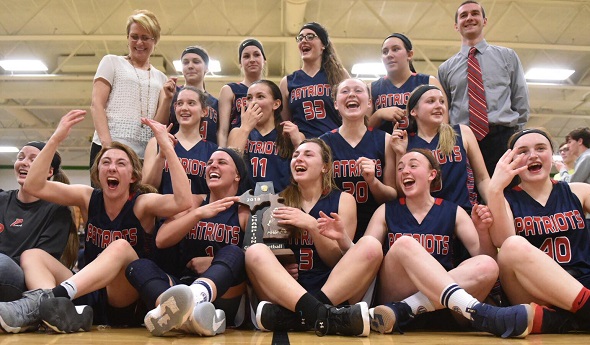
PHOTO: Unionville-Sebewaing celebrates its Class C District title after defeating Cass City in overtime last week. (Click to see more from Varsity Monthly.)