

Lakes 'Family' Ready to Run Again
By
Tom Markowski
Special for Second Half
December 13, 2018
WATERFORD – Waterford Our Lady of the Lakes has taken a big step forward and become a perennial state power in girls basketball since Steve Robak became the coach before the 2007-08 season.
 Robak guided the Lakers to a Regional Final that first winter and a Quarterfinal appearance in 2009 before Our Lady went on to play in its first MHSAA Final in the sport – and tie the Class D girls basketball record with three straight titles. The Lakers followed that run by losing in the 2013 championship game.
Although Our Lady hasn’t reached a Final since, the Lakers have been to the Semifinals three times (including last winter) and as far as the Quarterfinals on another occasion. The only season the Lakers haven’t won at least a District title under Robak was 2013-14.
Any coach who has experienced similar success will tell you it takes a certain amount of talent to reach this level. Robak is no different. But at this Detroit Catholic League school, you’ll find achieving such success goes far beyond talent.
Our Lady of the Lakes offers a community aspect to the high school experience that only a few small public and non-public schools provide. The students and faculty are like family, no more so than for Robak and his extended family.
Robak, 51, is a graduate of Our Lady and attended school there for 12 years, from 1st-12th grade. The school offers students a K-12 education and is one of four within the Catholic League to do so, along with Allen Park Cabrini, Dearborn Divine Child, Royal Oak Shrine and Clarkston Everest Collegiate. Thirty or 40 years ago this was quite common within the Detroit Catholic League. It isn’t so now and makes places like Our Lady rare, a fact not lost on those who attend or work within a parish school.
Vic Michaels is the director of athletics for the Detroit Catholic League, and in the 1980s was the boys basketball coach at Center Line St. Clement when it was a parish school.
“Years ago there were a lot of schools like that,” he said. “It’s a comfortable environment. You have the support of the parish. The kids continue through high school and, yes, you will get some new students. But (your) classmates, for the most part, remain the same.”
Robak is the oldest of seven children, all of whom went to Our Lady of the Lakes.
“There’s a real comfort there,” Robak said. “You’ve been friends for seven or eight years before you get to high school. We’ve had some come in the ninth grade, but it’s a small number. We’ve had two transfers in our program in my tenure.
“When you’re at a parochial school, (and people say), ‘Oh, you recruit.’ That doesn’t happen here. Our players come up through the system. That’s not to say we haven’t had some go on to play in college. I’m not a travel-AAU guy at all. A good athlete will be found no matter where you play.”
 Another word that’s often associated with a winning program is stability. When Robak took over the program, his brother Paul came on as an assistant before switching to take over the boys program six years later. Replacing him was Tim Ross, the Robaks’ brother-in-law. Last season Paul returned to the girls program as an assistant.
We’re just starting with this family thing.
Steve had two daughters play for him: Lauren, a 2011 graduate, and Lexie, who graduated two years later. Both were all-staters. Ross had two daughters come through the system, Lindsay and Megan. And not to be left out, Paul’s oldest daughter, Brooklyn, is a sophomore on the team this season and one of the top players. Paul has another daughter, Elli, but she’s still in grade school. Another niece, Maria Oliver, is a freshman on the team.
Want more? Steve has two more daughters, currently in grade school, who are expected to be a part of the program in the future.
And therein lies a big reason for the program’s success. The students are in the same building from the elementary level through high school. The younger ones look up to those on varsity, and the coaches at all levels are on the same page teaching the same system.
“We get to the younger coaches, showing them how to teach our younger kids through clinics and stuff,” Steve said. “A lot of times volunteers are needed. When you have coaches who have the same philosophy, it helps. Also, winning helps. Winning has helped get kids out who might not have played.”
This season the Lakers are in a bit of a transition. Three starters graduated and there are just two seniors, two juniors and no junior varsity. Our Lady is 0-3 having lost to Flint Hamady, Romeo and Harper Woods Chandler Park, all from higher enrollment divisions, with a combined record of 9-1.
Isabelle Kline started playing basketball at Our Lady when she was in 6th grade. Kline rarely missed a varsity home game while in grade school and noticed the high level of determination those players displayed – which she said played a major role in her work ethic and development.
Now a junior, Kline, a three-year varsity player, is one of two starters returning. She said even though there isn’t a lot of experience, the team is progressing despite a slow start.
“We have a young team but the transition has been very good,” she said. “We’ve been bonding as a team.
“We came into (the game against Romeo) with our heads low, and that wasn’t the right thing to do. But we played incredible. We were talking on defense. It was a team effort. We played great team defense.
“We knew those (first three) teams we’re really good. When we saw who we were playing it was like, ‘Steve, what are you doing?’ But we played a tough (nonconference) schedule last year with Detroit Country Day and (Ypsilanti) Arbor Prep and we made it to the semis. We know we have to play good teams to get better.”
 Tom Markowski is a correspondent for the State Champs! Sports Network and previously directed its web coverage. He also covered primarily high school sports for the The Detroit News from 1984-2014, focusing on the Detroit area and contributing to statewide coverage of football and basketball. Contact him at [email protected] with story ideas for Oakland, Macomb and Wayne counties.
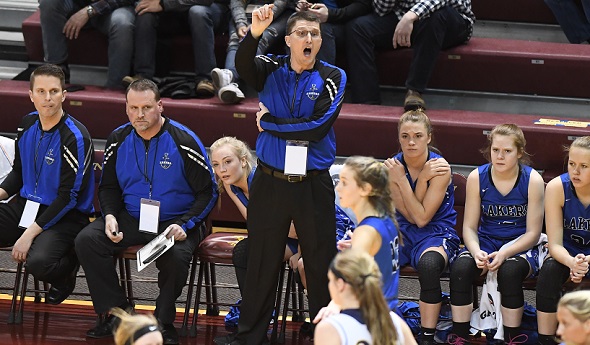
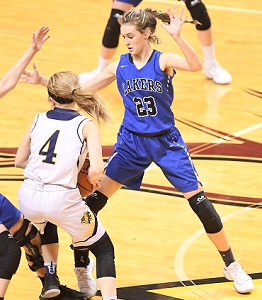
PHOTOS: (Top) Our Lady coach Steve Robak (standing) directs his team during last season’s Class D Semifinal against Chassell at Van Noord Arena. (Middle) Isabelle Kline (23) blocks a path as the Panthers look to push the ball up the floor.
Saints Survive to Earn Repeat Try
March 13, 2014
By Geoff Kimmerly
Second Half editor
EAST LANSING – St. Ignace senior Kelley Wright set an MHSAA record by being part of her 102nd high school basketball victory Thursday at the Breslin Center.
This had to be one of the ugliest – but could end up one of the most meaningful as well.
Wright and the Saints earned an opportunity to play for a second-straight MHSAA championship and third in her four season with a 34-30 Semifinal win over Grosse Pointe Woods University Liggett.
St. Ignace improved to 24-2 this winter after finishing 27-0, 25-1 and 26-1, the last three seasons, respectively. Redford Bishop Borgess’ Aiysha Smith formerly held the record with 101 wins from 1994-97.
“All I know is I’ve lost four times. I never really thought about all the times I’ve won,” Wright said. “I play for a really good team, and I can’t take credit for that just because I moved up freshman year. All of us deserve it, and fortunately we’re all getting the benefits from it.”
Wright said after she expects to “feel sick and little nervous” before her team takes on Saginaw Nouvel in Saturday’s 4 p.m. Final.
Saints coach Dorene Ingalls joked about firing husband Doug as the team’s shooting coach after a performance that left both teams at least in some disbelief, if not feeling a little ill as well.
St. Ignace made a meager 19 percent of its shots from the floor. Liggett connected on 25 percent. Still, the Saints led by seven heading into the fourth quarter – but Liggett tied the score at 30-30 with 2:36 to play.
The Knights (20-4) had an opportunity to go ahead before St. Ignace senior Emily Hinsman gave the Saints back the lead with a put back with 1:37 to play. The teams then traded misses and turnovers as Hinsman stepped in to intercept a pass into the paint with 39 seconds. Junior guard Margo Brown made two free throws seconds later to push the lead to its final margin of four.
“It was frustrating at first. They’d just trap you as soon as you got the ball in your hands,” said Liggett junior Lauren Ristovski, who led the team with nine points. “They’d just jump out and trap you, making you throw the ball away.”
It’s not the kind of game Wright has been part of winning too often during the last four seasons and especially during this current 18-win streak. But the Saints made it go in part with 59-36 rebounding advantage, which included grabbing 28 on the offensive side. The Saints also had only 12 turnovers to Liggett’s 18.
Wright led the Saints with eight points and nine rebounds, while Hinsman grabbed 13 rebounds and sophomore center Abbey Ostman had seven points and 12 rebounds.
“Once we got back in January, our practices when we came back were intense. Just a different level,” Dorene Ingalls said. “Our team took over a different identity at that moment. Kelley and I were on the side, and (I told her) this is going to be really good.
“I’m glad we got an opportunity to show on Saturday that we’re better than we showed tonight. But you’ve got to give Liggett a lot of credit for that.”
St. Ignace also got a helpful and inspiring bucket late from junior Autumn Orm; she had four points total, despite being restricted to only 30-second spurts of playing time because of a neurological disorder that won’t allow her to be active for longer, Ingalls said. “She was getting deflections, getting rebounds. That was our inspiration. That’s why we won,” Ingalls added.
The Knights nearly pulled off the comeback despite all five starters playing all 32 minutes. The team’s rotation got down to that minimum in part because Liggett lost junior forward Haley Neuenfeldt to a knee injury in the final regular-season game.
But three of this season’s starters also started on the 2012 team that finished Class C runner-up. And they helped the Knights improve on last season’s run, which ended during the Regional.
“I expected for us to play hard enough to get through the District and do better than last year. That’s what we preached,” Liggett coach Omar Ahart said. “Once we got to the Regional Final, and got through that one, (I thought) someone has to win state. Why not us?”
Click for a complete box score and video from the press conference.
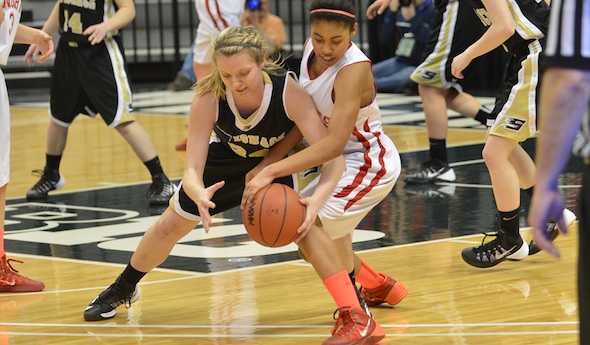
PHOTOS: (Top) St. Ignace’s Emily Hinsman (34) and Liggett’s Kendall McConico battle for a loose ball Thursday. (Middle) Saints junior Autumn Orm (10) drives against Knights senior Angelia Evangelista.
HIGHLIGHTS: (1) Autumn Orm takes a pass from Emily Hinsman and hits a jumper with 3:37 to play to give St. Ignace a 30-26 lead against Grosse Pointe Woods University Liggett. (2) Nia Ahart of Liggett ties the game at 30-30 with 2:36 to go on a nifty runner. St. Ignace won the game, 34-30.