

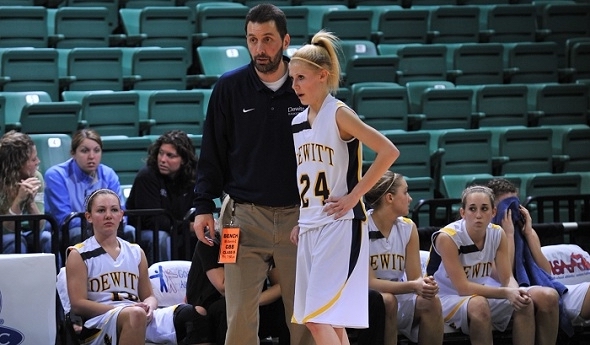
McCullen Reaches Milestone: 300 wins
March 7, 2012
Bill McCullen truly earned his 300th coaching victory — the program’s first-ever tournament win as a Class A school — in the first round of MHSAA District action by defeating No. 4-ranked St. Johns on Feb. 27.
After the Redwings hit two free throws, McCullen called a timeout with 9.9 seconds left, down one, and the length of the floor to go. He drew up a play that was introduced to his team only the day before — senior Kalya Hanses to inbound the ball to senior Erica Goodenough, who was to get the ball to sophomore Lexi Banaszak at the division line. Banaszak was instructed to get the ball to left-handed freshmen Claudia Reid on the left wing, giving her a 2-on-1 break with junior Kaylee Schmit.
McCullen finished drawing up the play in the team huddle by saying, “We are going to score, and this place is going to go crazy!”
The play worked as it was drawn up. Reid received the ball and saw an opening to the basket, hitting the layup with 3.3 seconds left. McCullen was exactly right; the score went in, DeWitt won 36-35, and the home crowd did go crazy.
McCullen just completed his 16th season coaching the Panthers, taking the helm of a girls basketball program in 1996 that had struggled with a 28-37 record (14-22 in league play) over its three previous seasons.
The 300-win milestone is an achievement in itself — but more amazing with a closer look.
Under McCullen’s leadership, the program has posted a 150-20 league record (.882 winning percentage) while winning 13 league championships (including seven straight through this season), seven District championships, three Regional championships, and three MHSAA Semifinals appearances.
In a sport with a 20-game regular season, he has averaged 18.75 wins per (to just 4.25 losses). McCullen reached his 100th win in just five seasons, averaging an incredible 20 wins over that span. DeWitt has posted six 20-win seasons in the program’s history; McCullen is responsible for five of them.
In the history of MHSAA girls basketball, McCullen is the 44th coach to reach the 300-win plateau and only the sixth from the Lansing area. His win total and .815 winning percentage places him eighth and second, respectively, among active coaches.
Expectations are just as high in the classroom. McCullen’s squads have averaged a team grade-point average of 3.59 (with a 3.84 team GPA this season), earning top honors in Class B twice during the 2000 and 2010-2011 seasons. Nine players have earned academic all-state honors.
Above all the wins, McCullen is an exemplary role model for coaches, players, and parents. His behavior on the sidelines and how he talks to officials and players exemplifies what is expected of coaches. He has taken teaching and coaching beyond the classroom and hardwood and has created a “basketball family” within his program, building an uncanny rapport with what he calls “my girls.”
McCullen would likely recognize his wife (Denise) and two sons (Carter and Jerod) for their support and countless sacrifices, and he would also quickly shift credit for his success to the many assistant coaches throughout his tenure. His mentor, Jim Lutzke (who coached at DeWitt for six seasons before succumbing to cancer in 1999), had a lasting and profound impact on McCullen; Luztke undoubtedly would be proud.
Click to see the MHSAA record book listing for girls basketball coaches, and e-mail updates to [email protected].
McCullen, by the numbers
(League record in parentheses)
1996: 14-7 (7-5)
1997: 22-3 (10-2)
1998: 17-4 (11-1)
1999: 25-1 (12-0)
2000: 22-5 (11-1)
2001: 20-3 (10-0)
2002: 19-5 (10-0)
2003: 17-7 (7-3)
2004: 13-8 (7-3)
2005: 18-3 (9-1)
2006: 19-3 (10-0)
2007-08: 16-5 (8-2)
2008-09: 25-2 (10-0)
2009-10: 17-4 (9-1)
2010-11: 19-3 (10-0)
2011-12: 17-5 (9-1)
Totals 300-68 (150-20)
Breslin Bound: Girls Report Week 8
January 27, 2014
By Geoff Kimmerly
Second Half editor
The number of undefeated girls basketball teams left this late in the season is dwindling. But there are plenty of strong squads who have stumbled only once or a few times along the way.
These are some that impressed last week in adding to impressive runs so far this season.
1. Flat Rock (10-2, Class B) – Save for losses to outstanding Detroit County Day and Flint Powers Catholic at the Motor City Roundball Classic, Flat Rock is perfect and leads the Huron League.
2. Brighton (9-3, Class A) – The Bulldogs have a two-win lead in the Kensington Lakes Activities Association West with seven victories in their last eight games (and the only loss of that string by five to strong Waterford Mott).
3. Hamilton (9-3, Class B) – The Hawkeyes are looking good to repeat as O-K Green champions and make a run at equaling last season’s 20 wins.
4. Napoleon (8-2, Class B) – The Pirates finished second in the Cascades Conference in 2012-13 to eventual Class C champion Manchester, but beat Manchester and Michigan Center last week to move into the top spot.
5. Brooklyn Columbia Central (7-2, Class B) – The Golden Eagles are one of two teams undefeated in Lenawee County Athletic Association play; the first game against co-leader Blissfield was postponed, but another is scheduled for Feb. 6.
6. Breckenridge (9-3, Class C) – The Huskies have raised their play another level after winning 13 games a year ago; they are tied for second to St. Louis in the Tri-Valley Conference West.
7. Muskegon Oakridge (9-2, Class B) – A 12-point win over second-place Mason County Central has Oakridge atop the West Michigan Conference standings after the first round of league games.
8. Sault Ste. Marie (8-3, Class A) – The Blue Devils are nearly to last season’s 12 wins and have won four straight, all by six points or fewer.
9. Reading (10-3, Class C) – The Big 8 Conference is one of the most competitive among small-school leagues in the state, and Reading is tied for first with a win over co-leader Concord.
10. Ishpeming Westwood (7-5, Class C) – A nine-point win over rival Ishpeming on Thursday was no doubt an enjoyable way for the Patriots to equal last season’s win total.
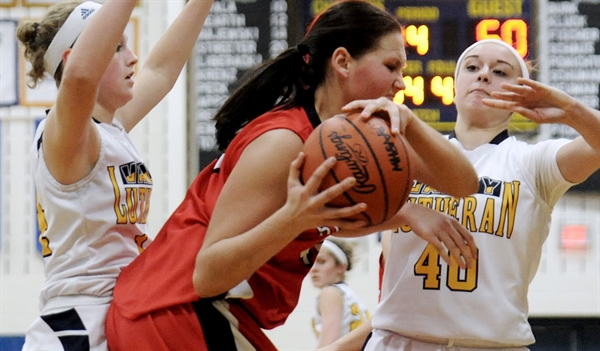
PHOTO: St. Louis (in red uniforms), here in a win over Saginaw Valley Lutheran, is in first place in the Tri-Valley Conference West. (Click to see more at HighSchoolSportsScene.com.)