

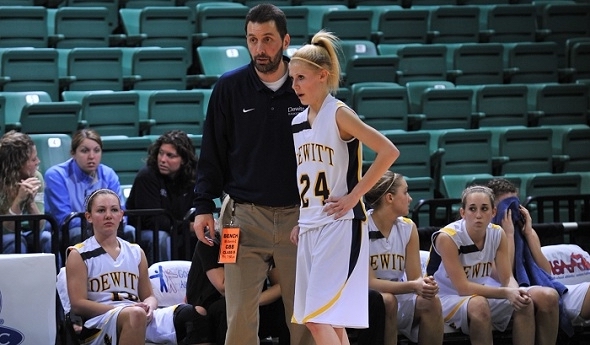
McCullen Reaches Milestone: 300 wins
March 7, 2012
Bill McCullen truly earned his 300th coaching victory — the program’s first-ever tournament win as a Class A school — in the first round of MHSAA District action by defeating No. 4-ranked St. Johns on Feb. 27.
After the Redwings hit two free throws, McCullen called a timeout with 9.9 seconds left, down one, and the length of the floor to go. He drew up a play that was introduced to his team only the day before — senior Kalya Hanses to inbound the ball to senior Erica Goodenough, who was to get the ball to sophomore Lexi Banaszak at the division line. Banaszak was instructed to get the ball to left-handed freshmen Claudia Reid on the left wing, giving her a 2-on-1 break with junior Kaylee Schmit.
McCullen finished drawing up the play in the team huddle by saying, “We are going to score, and this place is going to go crazy!”
The play worked as it was drawn up. Reid received the ball and saw an opening to the basket, hitting the layup with 3.3 seconds left. McCullen was exactly right; the score went in, DeWitt won 36-35, and the home crowd did go crazy.
McCullen just completed his 16th season coaching the Panthers, taking the helm of a girls basketball program in 1996 that had struggled with a 28-37 record (14-22 in league play) over its three previous seasons.
The 300-win milestone is an achievement in itself — but more amazing with a closer look.
Under McCullen’s leadership, the program has posted a 150-20 league record (.882 winning percentage) while winning 13 league championships (including seven straight through this season), seven District championships, three Regional championships, and three MHSAA Semifinals appearances.
In a sport with a 20-game regular season, he has averaged 18.75 wins per (to just 4.25 losses). McCullen reached his 100th win in just five seasons, averaging an incredible 20 wins over that span. DeWitt has posted six 20-win seasons in the program’s history; McCullen is responsible for five of them.
In the history of MHSAA girls basketball, McCullen is the 44th coach to reach the 300-win plateau and only the sixth from the Lansing area. His win total and .815 winning percentage places him eighth and second, respectively, among active coaches.
Expectations are just as high in the classroom. McCullen’s squads have averaged a team grade-point average of 3.59 (with a 3.84 team GPA this season), earning top honors in Class B twice during the 2000 and 2010-2011 seasons. Nine players have earned academic all-state honors.
Above all the wins, McCullen is an exemplary role model for coaches, players, and parents. His behavior on the sidelines and how he talks to officials and players exemplifies what is expected of coaches. He has taken teaching and coaching beyond the classroom and hardwood and has created a “basketball family” within his program, building an uncanny rapport with what he calls “my girls.”
McCullen would likely recognize his wife (Denise) and two sons (Carter and Jerod) for their support and countless sacrifices, and he would also quickly shift credit for his success to the many assistant coaches throughout his tenure. His mentor, Jim Lutzke (who coached at DeWitt for six seasons before succumbing to cancer in 1999), had a lasting and profound impact on McCullen; Luztke undoubtedly would be proud.
Click to see the MHSAA record book listing for girls basketball coaches, and e-mail updates to [email protected].
McCullen, by the numbers
(League record in parentheses)
1996: 14-7 (7-5)
1997: 22-3 (10-2)
1998: 17-4 (11-1)
1999: 25-1 (12-0)
2000: 22-5 (11-1)
2001: 20-3 (10-0)
2002: 19-5 (10-0)
2003: 17-7 (7-3)
2004: 13-8 (7-3)
2005: 18-3 (9-1)
2006: 19-3 (10-0)
2007-08: 16-5 (8-2)
2008-09: 25-2 (10-0)
2009-10: 17-4 (9-1)
2010-11: 19-3 (10-0)
2011-12: 17-5 (9-1)
Totals 300-68 (150-20)
The More Things Change ...
December 20, 2013
By Rob Kaminski
MHSAA benchmarks editor
As we begin another calendar year, let's take a brief look at how the mission of school sports has (or hasn’t) changed since 1955, when former MHSAA Executive Director Charles E. Forsythe presented this practicum to the University of Michigan.
The following is an excerpt:
Presented by Charles E. Forsythe
Practicum in Physical Education
University of Michigan, Ann Arbor
Tuesday, June 21, 1955
WHY DO WE HAVE INTERSCHOLASTIC ATHLETICS IN OUR SCHOOLS?
 To meet the urge for competition which is a basic American tradition – let’s keep it.
- To provide a “whole school” interest and activity, bring in students other than athletes, enlist many student organizations.
- To teach students habits of health, sanitation, and safety.
- Athletics teach new skills and opportunities to improve those we have; this is basic educationally.
- To provide opportunities for lasting friendships both with teammates and opponents.
- To provide opportunity to exemplify and observe good sportsmanship which is good citizenship.
- Athletics give students a chance to enjoy one of America’s greatest heritages, the right to play and compete.
- One of the best ways to teach that a penalty follows the violation of a rule is through athletics.
- There must be an early understanding by students that participation in athletics is a privilege which carries responsibilities with it. Awarding school letter to a student is the second-highest recognition his school can give him – his diploma at graduation is the highest.
- To consider interscholastic athletic squad as “advanced” classes for the teaching of special skills – similar to bands, orchestras, school play casts, members of debating teams, etc. There is no reason why a reasonable amount of attention should not be given to such groups – as well as to those in the middle and lower quartiles in our schools. Both leaders and followers must be taught.
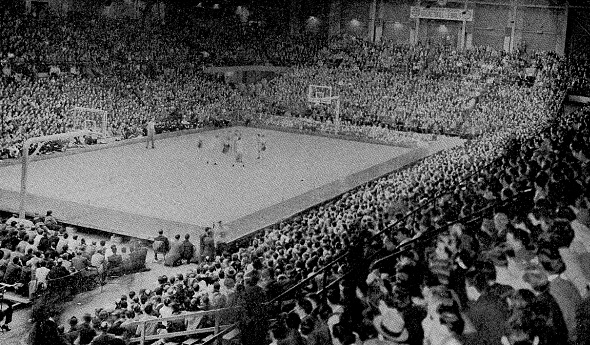
PHOTOS: (Top) Fans filled the arena for this MHSAA boys basketball tournament game. (Middle) Charles Forsythe served as the first executive director of the MHSAA.