

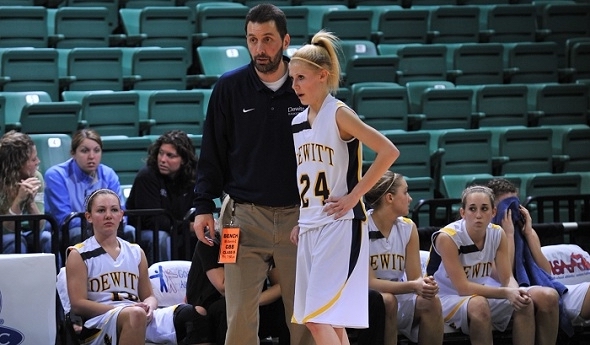
McCullen Reaches Milestone: 300 wins
March 7, 2012
Bill McCullen truly earned his 300th coaching victory — the program’s first-ever tournament win as a Class A school — in the first round of MHSAA District action by defeating No. 4-ranked St. Johns on Feb. 27.
After the Redwings hit two free throws, McCullen called a timeout with 9.9 seconds left, down one, and the length of the floor to go. He drew up a play that was introduced to his team only the day before — senior Kalya Hanses to inbound the ball to senior Erica Goodenough, who was to get the ball to sophomore Lexi Banaszak at the division line. Banaszak was instructed to get the ball to left-handed freshmen Claudia Reid on the left wing, giving her a 2-on-1 break with junior Kaylee Schmit.
McCullen finished drawing up the play in the team huddle by saying, “We are going to score, and this place is going to go crazy!”
The play worked as it was drawn up. Reid received the ball and saw an opening to the basket, hitting the layup with 3.3 seconds left. McCullen was exactly right; the score went in, DeWitt won 36-35, and the home crowd did go crazy.
McCullen just completed his 16th season coaching the Panthers, taking the helm of a girls basketball program in 1996 that had struggled with a 28-37 record (14-22 in league play) over its three previous seasons.
The 300-win milestone is an achievement in itself — but more amazing with a closer look.
Under McCullen’s leadership, the program has posted a 150-20 league record (.882 winning percentage) while winning 13 league championships (including seven straight through this season), seven District championships, three Regional championships, and three MHSAA Semifinals appearances.
In a sport with a 20-game regular season, he has averaged 18.75 wins per (to just 4.25 losses). McCullen reached his 100th win in just five seasons, averaging an incredible 20 wins over that span. DeWitt has posted six 20-win seasons in the program’s history; McCullen is responsible for five of them.
In the history of MHSAA girls basketball, McCullen is the 44th coach to reach the 300-win plateau and only the sixth from the Lansing area. His win total and .815 winning percentage places him eighth and second, respectively, among active coaches.
Expectations are just as high in the classroom. McCullen’s squads have averaged a team grade-point average of 3.59 (with a 3.84 team GPA this season), earning top honors in Class B twice during the 2000 and 2010-2011 seasons. Nine players have earned academic all-state honors.
Above all the wins, McCullen is an exemplary role model for coaches, players, and parents. His behavior on the sidelines and how he talks to officials and players exemplifies what is expected of coaches. He has taken teaching and coaching beyond the classroom and hardwood and has created a “basketball family” within his program, building an uncanny rapport with what he calls “my girls.”
McCullen would likely recognize his wife (Denise) and two sons (Carter and Jerod) for their support and countless sacrifices, and he would also quickly shift credit for his success to the many assistant coaches throughout his tenure. His mentor, Jim Lutzke (who coached at DeWitt for six seasons before succumbing to cancer in 1999), had a lasting and profound impact on McCullen; Luztke undoubtedly would be proud.
Click to see the MHSAA record book listing for girls basketball coaches, and e-mail updates to [email protected].
McCullen, by the numbers
(League record in parentheses)
1996: 14-7 (7-5)
1997: 22-3 (10-2)
1998: 17-4 (11-1)
1999: 25-1 (12-0)
2000: 22-5 (11-1)
2001: 20-3 (10-0)
2002: 19-5 (10-0)
2003: 17-7 (7-3)
2004: 13-8 (7-3)
2005: 18-3 (9-1)
2006: 19-3 (10-0)
2007-08: 16-5 (8-2)
2008-09: 25-2 (10-0)
2009-10: 17-4 (9-1)
2010-11: 19-3 (10-0)
2011-12: 17-5 (9-1)
Totals 300-68 (150-20)

Class C: Mohawks get their title shot
March 15, 2012
EAST LANSING – Morley-Stanwood coach Bob Raven said his team has been knocking on the Breslin Center door for a long time.
Clichés aside, the top-ranked Mohawks finally have busted right through.
After four Quarterfinal tries over the last seven seasons, Morley-Stanwood broke through on their fifth attempt earlier this week. And by knocking off reigning Class C champion St. Ignace 60-50 in Thursday’s Semifinal, the Mohawks have earned their first opportunity to play for an MHSAA championship.
"I think we have the experience this year for sure. All of our tournament games have been tough, and we weren't as nervous as we've been in past games," Huntey said. "It's definitely exciting to be here. But then again, you have to make sure you stay calm, do what you've always done and be prepared for the next game."
Morley-Stanwood (27-0) will face No. 9 Grosse Pointe Woods University Liggett (23-4) in the Class C Final at 4 p.m. Saturday.
The Mohawks won their 11th straight league and seventh-straight District championships earlier this year. But Breslin was a foreign building, while St. Ignace was quite familiar with it after also finishing Class C runner-up in 2010.
“I think St. Ignace had the advantage having played down here,” Raven said. “But I wouldn’t trade this group of girls for anybody.”
All-state seniors Bailey Cairnduff and Alexis Huntey also led the Morley-Stanwood volleyball team to the Class C championship in the fall. They and senior guard Elyse Starck took over Thursday when it was needed most.
Cairnduff broke a 38-38 tie with a basket and free throw with 7:20 to play. She scored 10 of her game-high 28 points during the fourth quarter, and Starck had 10 of her 19 points over the final eight minutes as well as the two combined to score 20 of the team’s 22 points in the final period. Huntey scored only a point in the fourth quarter, but had four rebounds and two assists. She finished with 11 points and five assists.
The Mohawks made 60 percent of their shots from the floor during the second half.
“We definitely got beat tonight by a team that was on fire,” St. Ignace co-coach Dorene Ingalls said. “We went through some things for Morley, but we would’ve liked one more day to prepare. They caught us on that back-door cut way too much. But I thought we battled back.”
Sophomore guards Kelley Wright and Emily Hinsman both scored 12 points to lead the Saints (25-1). Senior Lauren Goldthorpe – who began playing basketball seriously only three seasons ago and earned all-state special mention this season – had 11 points, six rebounds and four steals.
St. Ignace presented Morley-Stanwood with the toughest press defense the Mohawks had seen this season. Now they’ll take on Miss Basketball Madison Ristovski and the team that fell to St. Ignace in last season’s Final.
“We’ll definitely have a great game on our hands. We’ll have to play hard and take care of the ball and do what we do best, and I think we’ll be all right,” Starck said. “It’s always been our dream to even be here. And to make the state Finals is absolutely a blessing for our team and our community.”
Click for the box score. Watch the game and both teams' postgame press conferences at MHSAA.tv.
PHOTO: Morley-Stanwood senior guard Elyse Starck takes a shot Thursday. She scored 19 points. (Photo courtesy of Terry McNamara Photography.)