

Muskegon-Area Girls Hoops Builds Prestige
December 7, 2016
By Tom Kendra
Special for Second Half
Artrese Williams noticed something new at her basketball games last winter:
Big crowds.
 Williams, now a senior leader and defensive stopper for the Muskegon Reeths-Puffer girls basketball team, was blown away by the student sections, noise and just overall increased interest in girls basketball last season as the evenly-matched trio of Reeths-Puffer, Muskegon High and Muskegon Mona Shores battled for supremacy in the Ottawa-Kent Conference Green.
“I love it when there’s a big crowd and the students are getting crazy,” said Williams. “That’s all the motivation I need.”
The Meijer Muskegon Area Sports Hall of Fame Classic took notice of the growing buzz surrounding the girls games along the lakeshore – driven by a spike in talent, particularly at the area’s larger schools – and this year for the first time will feature a girls varsity opening game at its one-day, three-game event Dec. 28 at Reeths-Puffer High School.
Reeths-Puffer will tip off at 5:30 p.m. against perennial power Muskegon Oakridge in a showcase that has become a Muskegon-area tradition over Christmas break. The event is in its 15th year.
“Our committee has noticed much more interest in girls hoops, no question about it,” said Mack, a longtime boys and girls basketball coach at Mona Shores, who has served as the Hall of Fame Classic director since its inception in 2002. “They have earned the right to be part of this event.”
Mack expects an outstanding girls game leading into a clash of Top 10 boys teams in Grand Rapids Christian and Holland West Ottawa, followed by the traditional boys finale of Muskegon against East Kentwood.
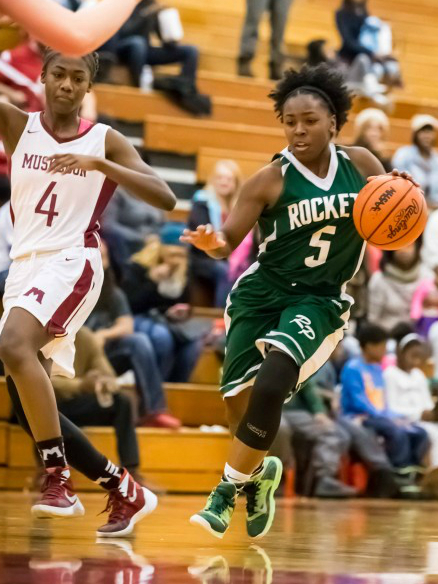
Williams can’t wait to get the crowd going as a senior on her home floor, where she leads a veteran team that includes fellow seniors Elysia Mattos (guard) and 6-foot twin towers Brooke Larabee and Delaney Bolles.
As juniors, those four helped the Rockets knock off Muskegon and Miss Basketball runner-up Mardrekia Cook (now at Michigan State) during the regular season but came up just short in three tough losses to OK Green champion Mona Shores, including a season-ending 47-38 defeat in the Class A District title game. Reeths-Puffer finished the season 15-6.
 “It doesn’t seem like anyone is really talking about us this year, but we have experience and I think our conditioning has been a lot better, plus we have the motivation,” said Williams, a speedy, 5-4 guard whose older sister Camaryia Williams and cousin Kalisa Williams also were standout players for the Rockets and now play at Muskegon Community College.
Mona Shores is the league favorite again with the return of Miss Basketball candidate Jordan Walker and junior Alyza Winston, while Muskegon also boasts a deep, experienced team. The sleeper along the lakeshore could be the O-K Red’s Grand Haven, which is only four years removed from back-to-back Class A championships.
“There’s just a really special group of girls players in the Muskegon area right now,” said ninth-year Reeths-Puffer coach Brandon Barry. “I think it’s great that was recognized.”
Reeths-Puffer’s matchup with Oakridge, which boasts a stellar backcourt in senior sharpshooter Hannah Reinhold and sophomore point guard Sophia Wiard, has special meaning for the veteran coach. Barry has taught at Oakridge since 1989 and in July was inducted into the Michigan High School Baseball Coaches Association Hall of Fame after his 25th year as the Oakridge baseball coach.
“I’ll cheer for them every other night,” Barry said of the Eagles, who have won 50 consecutive games in the West Michigan Conference under coach Terry DeJonge. “We have had some great games with them the past few years, and this should be another one.”
 Tom Kendra worked 23 years at The Muskegon Chronicle, including five as assistant sports editor and the final six as sports editor through 2011. E-mail him at [email protected] with story ideas for Muskegon, Oceana, Mason, Lake, Oceola, Mecosta and Newaygo counties.
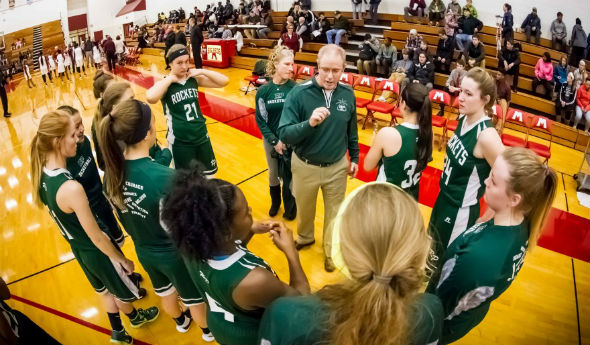
PHOTOS: (Top) Coach Brandon Barry and his Muskegon Reeths-Puffer girls basketball team get ready for introductions before an O-K Black conference game last year at Muskegon High School. (Middle) Artrese Williams (5) is one of four senior starters for the Muskegon Reeths-Puffer girls basketball team, which will play Muskegon Oakridge on Dec. 28 in the opening game of the 15th annual Muskegon Area Sports Hall of Fame Classic at Reeths-Puffer. (Photos by Tim Reilly.)
Breslin Bound: Girls Report Week 3
December 17, 2012
By Geoff Kimmerly
Second Half editor
As a general rule, basketball teams evolve plenty between the first games of December through the final regular-season contests in February.
But these pre-break matchups matter just as much in the win-loss columns. And a number of games are being played right now that will surely make a difference as this season draws to a close.
This week's report includes some of the teams that have came out on the winning ends of key December battles. (Results and records based on those reported to Score Center at MHSAA.com)
1. Inkster (4-0) – The Vikings are a regular at Breslin Center and made the Class A Semifinals last season, so another great start is hardly surprising. But it's proof why Inkster remains a force – last week’s wins were 51-45 over improved Detroit Mumford and 57-51 over always-powerful Detroit Pershing.
2. Waterford Our Lady (3-1) – The reigning Class D champion has bounced back quickly from an opening-night loss to West Bloomfield. Last week, Our Lady beat Livonia Ladywood 50-38 and Mount Pleasant Sacred Heart by the same score.
3. Detroit Martin Luther King (3-0) – This is another team always in the Class A mix, and it got a big win Saturday – 56-48 over returning Class A Semifinalist Ann Arbor Huron, which earlier in the week had defeated Detroit Country Day 65-58. King also beat Detroit East English 61-7.
4. Johannesburg-Lewiston (5-0) – The Cardinals lost only two regular-season games last season, both times to Ski Valley Conference rival Gaylord St. Mary. But they got a little bit of revenge last week with a 50-48 win over St. Mary after also beating East Jordan 57-43.
5. Holt (5-0) – The Rams are again setting up nicely to contend in the strong Capital Area Activities Conference Blue. They beat nonleague foe St. Johns 52-48 and then Lansing Everett 48-39 to keep early pace with other frontrunners Grand Ledge and East Lansing.
6. Napoleon (5-1) – Napoleon’s 15-7 finish in 2011-12 included splits against Michigan Center and Grass Lake. The Pirates got an early upper hand on both last week, beating Michigan Center 49-45 and Grass Lake 47-42.
7. Traverse City St. Francis (4-1) – The Gladiators opened last season 14-1, with that lone loss to Cadillac – which they beat last week 55-50. St. Francis also defeated Kalkaska 44-36 on Friday.
8. Pewamo-Westphalia (3-2) – The Pirates got off to a rough start with opening-week losses to Class B Williamston and Lakewood. But back in familiar territory in the Central Michigan Athletic Conference, they've won three straight – including 51-42 last week over returning Class D Semifinalist Portland St. Patrick.
9. North Farmington (3-1) – The Raiders are coming off a 10-12 season that included a pair of losses to Pontiac. But North Farmington earned the early edge this time with a 59-58 win over Pontiac, followed by a 58-48 win over West Bloomfield.
10. Powers North Central (5-1) – After opening with a 13-point loss to returning Class D Semifinalist Crystal Falls Forest Park, North Central hasn't fallen again. The Jets beat Stephenson 62-51 and Munising 50-22 to get nearly halfway to last season’s win total of 11.
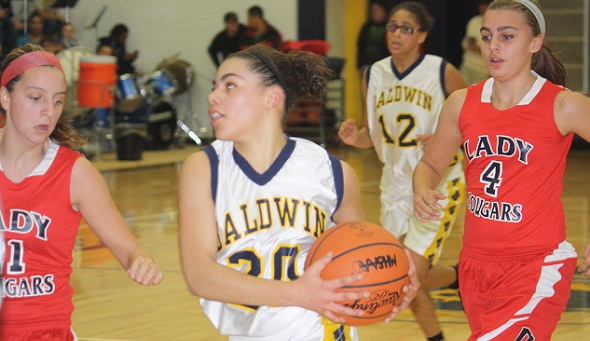
PHOTO: Big Rapids Crossroads (in red) defeated Baldwin on Thursday to move to 4-0 this season. (Click to see more at HighSchoolSportsScene.com.)