

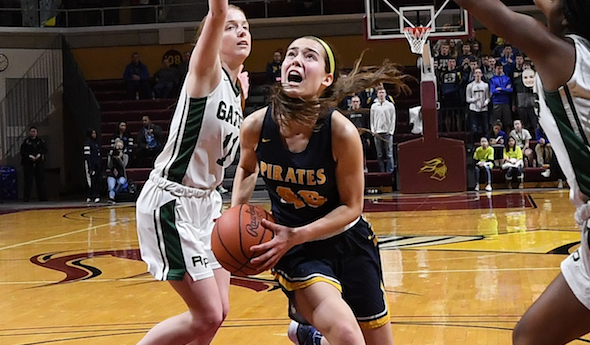
P-W Wins OT to Earn Historic Opportunity
March 21, 2019
By Geoff Kimmerly
Second Half editor
GRAND RAPIDS – Pewamo-Westphalia has played in three MHSAA Girls Basketball Finals. Three more teams have ended seasons in the Semifinals. Four more teams on top of those reached Quarterfinals and were done.
Total, that’s 10 teams that had made the final week of the season before this one. And now the Pirates have earned another opportunity to celebrate for all of them.
P-W will play for its first championship thanks to a 37-33 overtime win over Ypsilanti Arbor Prep on Thursday that also set the record for the lowest-scoring Semifinal in MHSAA girls basketball history.
Despite scoring six or fewer points during the second, third and fourth quarters, the Pirates outscored Arbor Prep 7-3 in the extra period to reach their second Final in three seasons.
“We’ve been here so many times before, and it’s frustrating when you just miss it by such a short amount,” P-W junior guard Ellie Droste said. “So this year being able to make it to the Finals again, and hopefully we can come out with the win … at practice every single day we work for these moments. We work on defense, we work on offense, we work on pressure situations. And that’s what got us here.”
The Pirates (26-1) will take on Flint Hamady in Saturday’s 4 p.m. Division 3 championship game at Calvin College.
Droste and Hannah Spitzley were freshmen on the P-W team that fell 46-44 to Detroit Edison in the 2017 Class C Final. Rachel Huhn was a sophomore sub on that team and then played 20 minutes as a junior in last season’s Semifinal loss to the Pioneers.
But the program’s drive for this opportunity goes back much farther than the last few years. The 1983 and 1984 teams both lost in Class C Finals – the 1983 Pirates to Hamady.
Arbor Prep (19-7) was last season’s Class C runner-up and playing in its fifth straight Semifinal.
“I was a 10-year-old boy back in 1984, 85, watching Carol Bogard Rademacher take teams to Western Michigan back at that time and fall short with great teams and great kids that were extremely well-coached,” Pirates coach Steve Eklund said. “It’s that hurdle we just haven’t been able to get over. So I’m excited for these kids, I’m excited for our community, I’m excited for all of these girls basketball teams we’ve had over the last 30 years that have been there and just not gotten over the hurdle. It just burns inside of me to go get that win Saturday, and we’re going to do everything in our power to go get that win for all of the teams from the past.”
 To earn the opportunity, P-W had to hop a few hurdles Thursday. Arbor Prep featured one of the top freshmen in the state in guard Mya Petticord and 2018 all-state honorable mention Mahri Petree. And both teams struggled to get the ball through the hoop – P-W made 33 percent of its shot from the floor and Arbor Prep checked in at 29 percent, and combined they connected on just 7-of-33 3-point shots.
The Pirates ended the first quarter up 14-7. Arbor Prep stormed back to make it 18-18 at the break. For the game, the score was tied five times and the lead changed seven.
Droste scored to give P-W the first lead of overtime 28 seconds in, and she made two free throws to make the advantage 34-30 with 1:28 to play. Senior Karli Waddell came up with a huge 3-pointer for Arbor Prep to cut the lead to one with 33 seconds left on the clock. But Spitzley made 3-of-4 free-throw tries over the final 12 seconds, and Arbor Prep got off only one shot after Waddell’s 3-pointer.
“I think we lost to the state champion,” Arbor Prep coach Scott Stine said. “(I’m) disappointed we couldn’t score a few more points, questioning whether we should’ve been more aggressive defensively. That’s a coaching call … we’ll look at after today and decide if we should’ve been more aggressive, should’ve pushed the tempo.
“If you’d told me the score would be 34-30, I would’ve said it was 50/50 who would win the game. If you’d told me someone got to 50 points, I’d have said Arbor Prep would’ve won.”
Petticord led Arbor Prep with 14 points, and senior Kashyra Jackson had 10 and eight rebounds. Spitzley scored 16 to lead P-W, while Droste had 15 points and four assists. Junior Addison Bauer didn’t score a point and attempted just one shot, but grabbed a game-high 10 rebounds.
“My players made adjustments. Defensively after the first quarter, I thought they were extremely solid,” Stine said. “I thought we made things tough on them, just the same way they made things tough on us.”
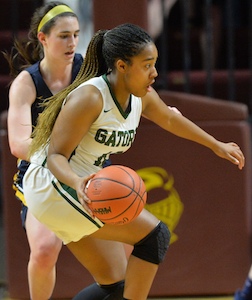
PHOTOS: (Top) Pewamo-Westphalia’s Ellie Droste makes a move toward the basket during Thursday’s second Division 3 Semifinal. (Middle) Arbor Prep’s Alaya Mack seeks an opening.
Breslin Bound: Girls Report Week 1
December 3, 2012
By Geoff Kimmerly
Second Half editor
More than 700 girls basketball teams hope to be playing at Michigan State University's Breslin Center when this season ends.
That may be fourth months away. But those quests began last week.
Each Monday, Second Half will tell you about 10 teams and individuals who jumped out the week before. What's below isn't any sort of statewide ranking – merely a top-10 list of notables for fans no matter where they live and who they will cheer on this winter.
I fully admit I won't be able to catch every team that does something special. That's where you come in. Post below and let us know which teams did what, or who we should watch coming up.
1. Brownstown-Woodhaven (1-0) – Much is expected this season out of the Warriors, who finished 22-2 last season. And Detroit Country Day is replacing an all-state backcourt that graduated a year ago. But a win over Country Day is still a win over Country Day, and Brownstown-Woodhaven got one Saturday, 54-52.
2. Goodrich (1-0) – The reigning Class B champion beat the reigning Class C runner-up, Grosse Pointe Woods University Liggett, 51-42. Goodrich still has a number of key pieces from last season’s run, while University Liggett has a few too, but is replacing Miss Basketball Madison Ristovski.
3. AuGres-Sims (2-0) – Welcome to high school basketball, Cassidy Boensch. AuGres’ 6-foot-2 freshman had 29 points, 17 rebounds, 16 blocks and 13 steals in her team’s 55-16 win over Whittemore-Prescott, and then 28 points, 12 rebounds and 10 blocks in a 51-42 win over Fairview. Click to read more from the Bay City Times.
4. East Lansing (1-0) – The Trojans and Lansing Waverly regularly have been the Lansing area’s best over the last decade and regularly face each other on the first Friday. This time the Trojans won big, 72-44.
5. West Bloomfield (1-0) – West Bloomfield got off to a good start with a 52-44 win over a team that has finished the last three seasons with victories. Waterford Our Lady has won the last three Class D championships.
6. Hartland (2-0) – The Eagles returned to the court after their 21-win season and second straight District title with a pair of close victories. Hartland beat Holly 36-31 and then Fenton 49-48.
7. Saginaw Michigan Lutheran Seminary (2-0) – The Cardinals showed perhaps some of the poise they learned during last season’s run to the Class D Quarterfinals. They won two close ones over Class B teams, 49-47 over Standish Sterling and 33-31 over Hemlock.
8. Oxford (2-0) – The Wildcats won 10 games last season, and are 20 percent of the way to equaling that total thanks to a pair of close wins. Oxford edged Rochester 35-34 on opening night, then Farmington Hills Harrison 30-27.
9. Leroy Pine River (1-1) – The Bucks rebounded from an opening-night loss to Reed City to double up the reigning Class C champion, Morley-Stanwood, 57-25.
10. Shepherd (2-0) – The Bluejays opened with wins against both teams that call Mount Pleasant home. They beat Class D Sacred Heart 46-37 and Class A Mount Pleasant High 36-23.
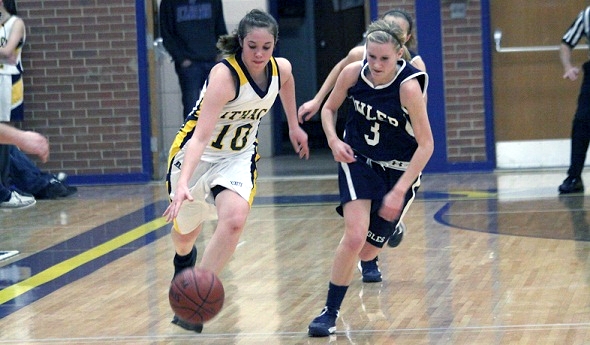
PHOTO: Fowler defeated Ithaca 51-37 on Tuesday. The Eagles are among teams that have begun 2-0 this season. (Click to see more at HighSchoolSportsScene.com.)