

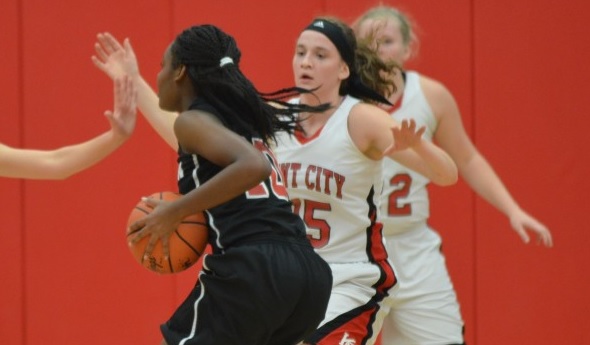
Performance: Kent City's Kaitlyn Geers
December 8, 2015

Kaitlyn Geers
Kent City junior - Basketball
Geers, a 5-foot-11 forward in her third season on the Kent City varsity, scored the game-winning basket on a near baseline-to-baseline lay-up (see video below) during the closing seconds of her team’s 59-58 win over Muskegon on Dec 4 – earning her the inaugural Michigan National Guard "Performance of the Week."
The Class C Eagles have beaten the Class A Big Reds during the opening week three seasons in a row, but were in jeopardy of seeing that streak end when Musekgon senior Mardrekia Cook – arguably the top player in the state and a Michigan State University recruit – stole an inbounds pass intended for Geers and scored with 17 seconds to play to put the Big Reds ahead by one. On the ensuing inbounds, Geers instead passed it in, got the ball back and drove the length of the court for the winning score. She finished with a team-high 23 points.
 Geers averaged 18.5 points and seven rebounds over two games last week, and 11.5 points, 7.8 rebounds and 2.4 steals per game in helping the team to a 19-4 record in 2014-15. Kent City is a combined 38-9 with her on the roster over the last three seasons. Only a junior, Geers has committed to sign next year with Saginaw Valley State University, where she plans to study athletic training and eventually physical therapy. She also plays volleyball and sprints for the track and field team, carries a 4.0 grade point average and is a member of her school’s student council and National Honor Society chapter.
Coach Scott Carlson said: “Kaitlyn has worked constantly on her game to be the player she is today. It is exciting to see the growth and confidence as she matures. She has the ability to get to the rim that many players do not have, and on top of that she is unselfish. She makes the extra pass to the open player to get her team a better shot. She is fundamentally sound and has an all-around game in that she can post up, bring the ball up the court, pass, rebound and defend. Kaitlyn creates match-up problems for many teams.”
Performance Point: “When I got the ball, I knew I had about 10 seconds to get down the court. I knew I had to get there, get somebody the ball or get to the rim. I knew I didn’t have much time; I tried to keep myself calm and keep my team calm.”
Sign of things to come: “We put a lot of work toward that game. We always talk about preparing for Muskegon in the beginning of the season, getting in shape for running the court and getting ready to run the court and play defense because (Cook) is a great driver. The little things, we really, really work only. (Winning Friday) shows we’re going to get better. We pushed for that big win, and we’re going to push for (every) win at that time, and hopefully we’ll go far.”
On the rise: Geers grew eight inches as an eighth grader, changing her basketball game dramatically. “When I was younger, I wasn’t nearly as fast as I am right now. I was a lot shorter. I was really uncoordinated. I grew into my body a little bit. When I was younger, I was the ninth man, 10th man. I was not into my body yet.”
Train to train: “I love biology and science, and I’m going to major in athletic training and pursue physical therapy. I had some encounters with physical therapy (during the above-mentioned growth spurt) and I wanted to go into the health field – and not deal with blood.”
All-Around Achiever: Geers made first-team all-league in the Central State Activities Association Silver as a sophomore in helping her team to league and District titles, but she also played a big role in the volleyball team’s first league title since 2001. She earned all-league second-team honors for track in helping that team to a league title this spring as well. “It keeps me in shape. Bouncing from one to another, I don’t have to get in shape multiple times. … I always say I don’t like to sit down. Sometimes in class I have to stand up and walk around. It keeps me focused. I like to be busy, I guess. I play basketball, I play volleyball and run track, and I go to school. I wouldn’t trade it for anything. My whole family is like that. We run on sports, friends, family and school.”
– Geoff Kimmerly, Second Half editor
Beginning this week and continuing throughout the 2015-16 school year, Second Half and the Michigan National Guard will recognize a “Performance of the Week" from among the MHSAA's 750 member high schools.
The Michigan Army National Guard provides trained and ready forces in support of the National Military Strategy, respond as needed to state, local, and regional emergencies to ensure peace, order, and public safety. The Guard adds value to our communities through continuous interaction. National Guard soldiers are part of the local community. Guardsmen typically train one weekend per month and two weeks in the summer. This training maintains readiness when needed, be it either to defend our Nation's freedom, or protecting lives and property of Michigan citizens during a local natural disaster.
PHOTO: Kaitlyn Geers defends at the top of the key during last week's win against Grand Rapids Union. (Photo courtesy of Kent City athletic department.)
“Reaching Higher” Marks 5th Year
July 11, 2013
By Geoff Kimmerly
Second Half editor
The annual Reaching Higher showcases of Michigan’s top high school basketball players will return to South Lyon High School beginning with the boys event Wednesday, July 17, followed by the state’s top girls prospects taking the floor July 25.
More than 220 athletes with aspirations to play at the college level will train and scrimmage under the tutelage of high school coaches from across the state and in front of college coaches expected to represent all three NCAA divisions, the NAIA and junior college levels. Coaches from 42 college basketball programs attended during the 2012 Reaching Higher events, including 12 from Division I schools.
This will be the fifth year of Reaching Higher. An educational effort by the Michigan High School Athletic Association and the Basketball Coaches Association of Michigan, the Reaching Higher experience includes classroom sessions for student-athletes and their parents as well as on-court drills and scrimmaging. The events aim to give athletes a vision of what it takes to become a college basketball player and also succeed in college life.
Participants in the program were selected by a committee of BCAM members. The process began in December when local high school coaches submitted nominations to the selection committee. Participants were chosen in February.
A complete schedule of activities and invitees can be found on the “Reaching Higher” page of the MHSAA Website.
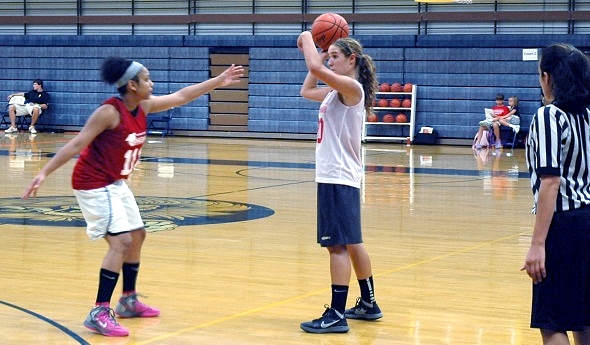
PHOTOS: Players face off during a scrimmage at the 2012 Reaching Higher girls basketball showcase at South Lyon High School.