

Performance: Oakridge's Sophia Wiard
February 9, 2018
 Sophia Wiard
Muskegon Oakridge junior – Basketball
Wiard, a 5-foot-9 guard and three-year varsity player, went over 1,000 points scored for her career with 27 against rival Shelby on Feb. 1, earning the Michigan Army National Guard “Performance of the Week” as he team extended what is now a 76-game winning streak in West Michigan Conference play. Oakridge has clinched a share of the league title – its ninth over the last decade – with two league games to play.
Wiard also has been part of two of the team’s six District titles over the last eight seasons, and she has a career record of 54-9 entering tonight’s game against Ravenna. This winter, she’s averaging 22.3 points, eight rebounds, five assists and five steals per game – and by going over 1,000 career points, joined her sister Keyara in achieving that milestone. Keyara Wiard graduated from Oakridge in 2013 with the program record of 1,353 points and last winter finished her career at Grand Valley State University. That record has since been broken, and Sophia Wiard is chasing 2017 graduate Hannah Reinbold's milestone of more than 1,500 points, which she hopes to eclipse next season.
 Oakridge fell to Hamilton in a Regional Semifinal last season and to Grand Rapids Catholic Central in the Regional Final in 2015-16. If Wiard can lead her team to a Regional title, it would be the program’s first since her mom Renee (Burns) Wiard was a senior on the team in 1991. Sophia also will join her sister as a college athlete, already having committed to sign with University of Toledo this fall. A strong student, she is interested in studying chemical engineering or pharmacy. Wiard also joined Oakridge's softball varsity as a freshman and helped the team make last season's Division 2 Regional Finals.
Coach Terry DeJonge said: "Sophie is the epitome of being a student-athlete. Her 3.965 grade-point average and her Division I basketball skills make her a role model for all young females to follow. She has been not only our floor leader, but also the locker room and classroom leader. Pursuing and landing Sophie makes Toledo one of the smartest colleges in the country, as far as I am concerned."
Performance Point: “(The 1,000th point) is one step, one part of the process. It’s one goal that’s been met. It’s one of the first that I’ve been focusing on. Now it’s time to look even farther past that. … What’s next hopefully this season is to win the District, Regional and state championship.”
Born scorers: “I think (my sister and I) both put in the time, and I think in girls basketball if you put in the time, you will find success. We were raised playing basketball, so it was natural instinct to play basketball – and that’s what we did. I think that really just helped lead to scoring and stuff like that, when we’ve both just always been surrounded by good players to help us do that.”
 Thanks Mom, thanks Sis: “My mom’s always been a kind-hearted person, which (taught me) be kind to everyone. And on the basketball court, it’s work hard, but make sure you’re having fun – stuff like that. It’s not just the game of basketball, it’s life. Just the simple things. She’s never been one to force me to do anything. She’s just been riding the roller coaster with me. … (From Keyara, I learned) work hard. Do the dirty things, like she was very scrappy. She did all the little things. (She was the) most athletic player to come through Oakridge, for sure. She just was the go-to player to make the shot but you could trust her to make the stop her team needed. She was always capable of doing the things others wouldn’t do.”
This can be the team: “Over the years we’ve always been really close. I’ve always been really close with my teammates. This year, the group of girls, everybody clicks really well. We all mesh really well. We’re all very close. We count on each other in school, out of school, on the basketball court, anywhere really. Our bench helps support us. Just little things like that. We’re all in it together. … Since I was watching my sister, when I was the manager, and they were always so close to winning Regionals, I was just getting hungry for that. I wanted to live that. I wanted to get that trophy at the end of the game. … I’m really hungry, and I really want to win.”
Finding the formula: “Science and mathematics, those are my two favorite subjects, and if I follow the path of chemical engineering I can do both. … I just think finding new ways to do things, (like) if it’s more environmentally-friendly, just being able to solve the little things to make it better – to improve things is what interests me the most.”
- Geoff Kimmerly, Second Half editor
Every week during the 2017-18 school year, Second Half and the Michigan Army National Guard will recognize a “Performance of the Week" from among the MHSAA's 750 member high schools.
The Michigan Army National Guard provides trained and ready forces in support of the National Military Strategy, and responds as needed to state, local, and regional emergencies to ensure peace, order, and public safety. The Guard adds value to our communities through continuous interaction. National Guard soldiers are part of the local community. Guardsmen typically train one weekend per month and two weeks in the summer. This training maintains readiness when needed, be it either to defend our nation's freedom or protect lives and property of Michigan citizens during a local natural disaster.
Previous 2017-18 honorees:
February 2: Brenden Tulpa, Hartland hockey - Read
January 25: Brandon Whitman, Dundee wrestling - Read
January 18: Derek Maas, Holland West Ottawa swimming - Read
January 11: Lexi Niepoth, Bellaire basketball - Read
November 30: La'Darius Jefferson, Muskegon football - Read
November 23: Ashley Turak, Farmington Hills Harrison swimming - Read
November 16: Bryce Veasley, West Bloomfield football - Read
November 9: Jose Penaloza, Holland soccer - Read
November 2: Karenna Duffey, Macomb L'Anse Creuse North cross country - Read
October 26: Anika Dy, Traverse City Central golf - Read
October 19: Andrew Zhang, Bloomfield Hills tennis - Read
October 12: Nolan Fugate, Grand Rapids Catholic Central football - Read
October 5: Marissa Ackerman, Munising tennis - Read
September 28: Minh Le, Portage Central soccer - Read
September 21: Olivia Theis, Lansing Catholic cross country - Read
September 14: Maddy Chinn, Pontiac Notre Dame Prep volleyball - Read
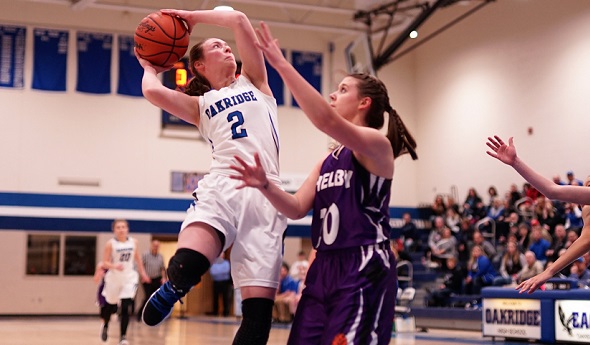
PHOTOS: (Top) Oakridge's Sophia Wiard works to get up a shot against Shelby last week. (Middle) Wiard breaks between two Muskegon defenders earlier this season. (Photos by Sherry Wahr.)
Breslin Bound: Girls Report Week 2
December 11, 2012
By Geoff Kimmerly
Second Half editor
We're only two weeks into this girls basketball season. But there are plenty of teams that already can take pride in strong starts that either are continuing on last season's success or showing a nice turnaround after a rough run.
Some of those are highlighted in this week's report. Remember, what's below isn't any sort of statewide ranking – merely a top-10 list of notables from last week.
Records and results are through Sunday and based on those found at MHSAA.com. Click on Score Center to follow scores throughout the week and enter those of the games you attend.
1. Concord (3-0) – Most of the key pieces to last season’s Class C Semifinalist team are back, and they earned a pair of close wins. Concord edged Michigan Center 36-32 – after also beating Michigan Center in overtime in the District opener last season – and then got past Homer 37-35.
2. L’Anse (4-0) – The Purple Hornets are again off to a nice start – with a bonus. According to the Houghton Daily Mining Gazette, L’Anse’s 60-56 win over Houghton gave Houghton its first loss to a team from the state’s four northernmost counties since Nov. 2, 1999. Click to read more from the Daily Mining Gazette.
3. Westland John Glenn (2-0) – The Rockets got off to a strong start with a 66-34 win over Grosse Pointe North and then a 63-56 victory over Dearborn Divine Child. Divine Child is coming off a trip to the Class B Semifinals.
4. Grand Rapids South Christian (3-0) – Two of the Sailors four losses last season came to Grand Rapids Catholic Central. They haven’t played GRCC yet, but did edge Grand Rapids Christian 50-46 just three days after the Eagles beat GRCC by six.
5. Marshall (3-1) – This returning Class B Quarterfinalist added a strong week to a solid start. First, Marshall topped Richland Gull Lake 48-44 – Gull Lake won its Class A District last year – and then the Redhawks finished the week with a 46-33 win over Battle Creek Central.
6. Pontiac (2-0) – The Phoenix were a .500 team last season, but are off to a quick start thanks to two close wins. Pontiac beat Waterford Mott 49-45 and then Harper Woods Chandler Park 57-55.
7. Manchester (4-0) – The Flying Dutchmen have beaten every opponent by at least 10 points this season, including Onsted 59-40 and Napoleon 64-34 last week. Napoleon entered 3-0.
8. Bloomfield Hills Marian (2-0) – Marian is off to a solid start after beating annual Class A power Canton 44-30. Marian opened by beating Grosse Pointe North two weeks ago.
9. Athens (3-0) – The reigning Class D runner-up is off to a fast start again. Athens opened last week by beating Climax-Scotts 55-44, then survived a close one against Reading, 37-31.
10. Saginaw Heritage (2-2) – The Hawks bounced back from two losses during the first week to even their record by beating Arthur Hill 54-35 and Bay City Western 51-14. Heritage lost to Arthur Hill by 17 in their game last season.
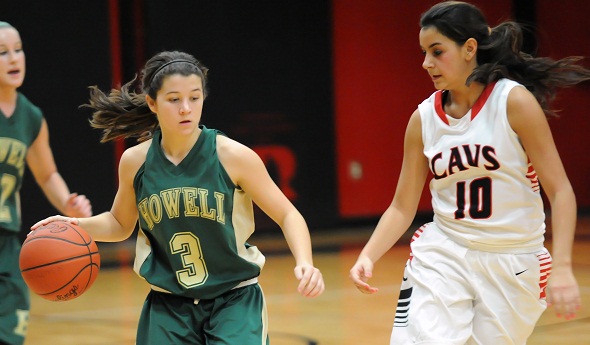
PHOTO: Howell junior Meredith Wood works to get around a defender as the Highlanders pushed toward their first win of the season, 60-48 over Carrollton on Thursday. (Click to see more at HighSchoolSportsScene.com.)