

PH Northern Measures Up Among State's Best
By
Paul Costanzo
Special for MHSAA.com
January 4, 2017
It wasn’t long ago that Port Huron Northern’s girls basketball team started scheduling measuring stick games.
 The Huskies put teams like Detroit Country Day, Flint Powers and Detroit Martin Luther King on the schedule to see what it was like to play against the best in the state.
Now, in coach Mark Dickinson’s ninth season, the Huskies still have those games on the schedule. They’re just looking more like the “measuring stick” team for their opponents, instead.
“It’s a great feeling,” Northern senior Kendyl Keyes said. “A couple years ago, it’s hard to believe that we would have been at this point, because you’re coming in, you’re so young, and it’s like, ‘Wow, we really did make it.’
“All this work that we put in, that the coaches put in, it’s paid off.”
Northern is 7-0 to start the season, with big early-season wins against Farmington Hills Mercy and Williamston. The Huskies are ranked No. 2 in Class A and No. 4 in the Super 10 by Tom Markowski of State Champs! Sports Network.
The biggest early-season game, however, comes tonight when Northern plays host to reigning Class A champion Warren Cousino, a team it defeated twice a year ago to prove it belongs in the conversation of the state’s best teams.
“I think the kids are more and more confident that we can play with anybody as a team,” Dickinson said. “We pride ourselves on having a team. We don’t have Miss Michigan, but we have a lot of good players from top to bottom.”
It’s a long way from where the Huskies were less than 10 year ago.
Point Guard University
Dickinson’s tenure as varsity coach had humble beginnings. In his first season (2008-09), the Huskies went 1-20, and he and his coaching staff decided to focus on basic fundamentals.
“The first year, we were limited because three kids moved away,” Dickinson said. “We were playing with people who were out of position, so we said, ‘Hey, we’re going to play good D, we’re going to start with that. It’s like building a house, and laying the foundation.’ The first two or three years, that’s what we talked about, that we were going to lay one layer of bricks, lay another layer of bricks.
“The first two years, I had a segment of practice called Point Guard University, where we had them all do tons of ball-handling. We were having some struggles with ball-handling, so we made everybody improve their ball-handling, and it started growing from there.”
It worked. Over the next six seasons, Northern managed to win more games than it had the year before: 9-12 in 2009-10, then 11-10, 17-4 (with a conference title), 18-5 (conference title), 19-7 and 21-4 in 2014-15. Last season also saw 21 wins (21-5), and a co-Macomb Area Conference Red title shared with that eventual Class A champion Cousino.
While it was an entirely different set of girls doing the winning, Dickinson gives a lot of credit for the recent success to the girls who came before them.
“Even the groups before that that didn’t win Districts, they really started to compete and put themselves in position to win games. We just didn’t have quite enough depth at that time, or enough shooters,” Dickinson said. “They were the building blocks of the program. I look back at those early teams, those kids were the ones that kind of set the tone that we’re working in March and April; instead of sitting home and watching TV on Sunday, we’re going to be up here working. Those kids started it, and then it just kind of snowballed.”
Breaking through
While the program started taking off in 2012, its postseason breakthrough didn’t come until 2014 when it won a Regional title, its first under Dickinson. It was also the first District title under Dickinson, and the first of three straight.
Last season, Northern repeated the feat, winning another Class A Regional title before falling in the Quarterfinal against St. Johns. All of that in a season many saw as a rebuilding year, as Northern had graduated a strong senior class the year before.
 Thanks to the foundation the Huskies have built, however, rebuilding has turned into reloading.
“I think, partly, we’ve got a really good coaching staff from top to bottom,” Dickinson said. “That’s huge for skill development during the season. During the offseason, we put a lot of time in, and the kids have bought into that. We’ve had kids that have made a commitment to come in year-round and work on their shot, work on their ball-handling. When we do our team stuff in the summer, I know a lot of teams have trouble getting their whole teams there, but I usually have everybody there.”
While the talent and depth continues to grow for the Huskies, the work ethic instilled on those early teams has remained the same.
“We’ve just been in the gym a lot together as a whole,” senior Jenna Koppinger said. “Whenever you want to come in, the coaches are here. If you want to go at 6 a.m., they’re here. If you want to go at 6 at night the same day, they’re back again. That’s really what’s founded it.”
The early-season tests against top-level competition have helped take the Huskies to their current level, but so has playing in the Macomb Area Conference Red, which Dickinson considers one of the best conferences in the state. The Huskies also have traveled throughout the summer to play against the best and in big venues, including at the legendary St. Cecelia’s in Detroit.
All of that combined has created a team that isn’t afraid to play on the biggest stages or wildest environments.
“It’s so exciting – it’s fun,” senior Bree Bauer said. “It gives you a lot of adrenaline, and I think it makes me play better.”
This year’s team features six seniors – Keyes, Koppinger, Bauer, Cassidy Koschnitzke, Brooke Austin and Kathleen O’Connor – as well as an experienced, play-making junior in Sami Klink. But beyond the experience, there’s a large group of girls waiting for their turn.
Dickinson said several members of his junior varsity team would be varsity players most years, but with his current depth he simply can’t bring them up. His JV squad was a perfect 20-0 a year ago, and spent the summer holding its own against varsity teams, so don’t expect the Huskies to fade away any time soon.
Of course, there’s still plenty to accomplish in the present. With its foundation solidly built, Northern can now look to break through its ceiling, something recent results show it’s more than capable of doing.
“A lot of people think you can’t win a state championship in Port Huron,” Dickinson said. “I’m not going to go that far. We have to keep getting better, and it would nice to make a run at it – we’ve been close. If you get to Breslin Center, you never know what’s going to happen, so we’re knocking on the door. I don’t know if we’re ever going to get there, but we’re working towards it. If you don’t have a goal like that, you’re never going to achieve it.”
 Paul Costanzo served as a sportswriter at The Port Huron Times Herald from 2006-15, including three years as lead sportswriter, and prior to that as sports editor at the Hillsdale Daily News from 2005-06. He can be reached at [email protected] with story ideas for Genesee, Lapeer, St. Clair, Sanilac, Huron, Tuscola, Saginaw, Bay, Arenac, Midland and Gladwin counties.
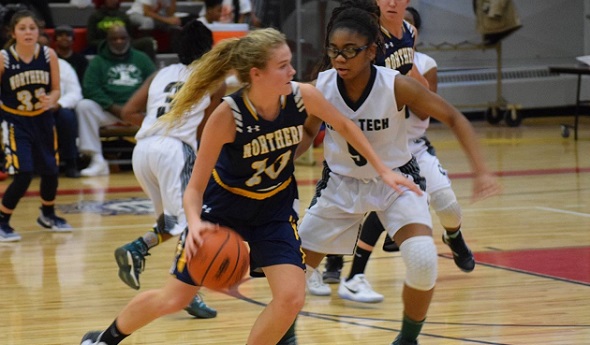
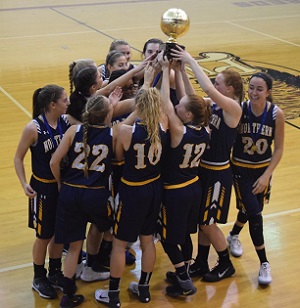
PHOTOS: (Top) Northern's Sami Klink moves the ball around the perimeter against Detroit Cass Tech on Dec. 28 at the Motor City Roundball Classic. (Middle) The Huskies hoist the championship trophy after defeating Croswell-Lexington on Dec. 22 to win the Port Huron Holiday Tournament. (Photos by Jill O'Connor.)
Plan Plays Out Well for Cousino Standout
By
Tom Markowski
Special for Second Half
December 1, 2016
WARREN – As a teacher at Carter Middle School, Mike Lee, the varsity girls basketball coach at Warren Cousino, was approached by one of his students who made a rather boisterous statement.
 “There was this girl,” Lee said. “She was in the sixth grade and she came up to me and said, ‘I’m going to play for you as a freshman.’ No, I didn’t believe her. She was long, but she was a bean pole.”
Intrigued, Lee went to watch this skinny 10-year-old play and was impressed but not yet sold.
This girl is now one of the state’s best basketball players. Her name is Kierra Fletcher, and she won the hearts of everyone in the Warren Consolidated School system – which includes high schools Cousino, Mott and Sterling Heights – by leading the Patriots, and the Warren district as a whole, to their first girls MHSAA Finals basketball title.
By the time Fletcher was in the eighth grade, Lee knew Fletcher’s bold statement would come to fruition. She was that good.
“She was still skinny,” Lee said. “It wasn’t until her junior year that she bulked up.
“Obviously, she’s talented. I am pretty lucky to have someone like Fletch. But it’s what she does for the other players that makes her special. She makes them better. She puts them in spots to succeed. They want to play faster. There’s a higher energy. On the defensive side, you know she’s out there, getting steals and such. The others feed off of her.”
Fletcher, 16, is 5-foot-9 and a bundle of energy. And that energy was there from the start.
“I was out in (first grade) early,” Fletcher said. “My mom said I was talking all of the time. The teachers (in preschool) told her I was way ahead of the other kids.”
Born and raised in Detroit, Fletcher attended Dove Academy until the third grade, when her family moved to Warren. She attended Siersma Elementary within the Warren Consolidated district and then went to Carter.
Fletcher was also ahead of the curve when it came to basketball. She started playing competitively in the Warren recreation leagues, but before that she got the itch playing in her grandmother’s driveway.
“She had a basket in her backyard,” Fletcher said. “I would play by myself, and sometimes I’d play with an older cousin and my dad (Anthony Fletcher). My dad used to be really good. He played in college and he could have gone pro, but he had a bad heart and had to stop playing.”
Fletcher began playing AAU basketball in the fifth grade. It took less than a week for the coaches to move Fletcher up to play with the sixth grade team. That was nothing new for her. And she said it’s one reason why she continued to improve.
“I had been playing up for a while,” she said. “I always played with older kids. They had more experience, and I learned from it. What I learned was it doesn’t matter how old or how big you are. I’d play well and they wouldn’t know I was younger, and they’d tell me to keep playing and that made me feel good.”
 Fletcher was on the bench for her first varsity game as a freshman, but she didn’t stay there long. Lee put her in the game in the first quarter, much to Fletcher’s surprise.
“I’ll never forget it,” she said. “It was against Romeo, and it was our home opener. I was nervous. I didn’t want to mess up.”
That nervousness and her coming off the bench didn’t last long. Soon she was in the starting lineup gaining more confidence as the season progressed.
As a sophomore she was one of the top players in the Detroit area, as she averaged 25 points and 12 rebounds per game. That fine season placed her in at least one publication’s 2015-16 preseason top 25 (State Champs! ranked her No. 14), and soon everyone who followed the sport knew about her.
Fletcher averaged 23 points, 10 rebounds, 9.4 assists and 5.5 steals as Cousino (23-4) made its run on the way to eventually defeating Detroit Martin Luther King, 67-65, in the Class A Final to complete a remarkable season for the Patriots and Fletcher.
Fletcher saved her best for last, as she had 37 points, nine rebounds and five assists in the Semifinal (a 60-45 win over Hudsonville), and had 27 points, eight rebounds and five assists against King.
“I love to compete,” she said. “I love the friendships. I’ve met a lot of people playing basketball. Sports teaches you discipline, in the way you live life. Sports has a way of bringing people together.”
Fletcher turned down a number of other college scholarship offers, including one from University of Michigan, to sign with Georgia Tech. She has a 3.7 grade-point average and plans on majoring in public policy and working for the U.S. Government.
“I also have aspirations of playing professionally,” she said. “Overseas or in the WNBA.”
 Tom Markowski is a columnist and directs website coverage for the State Champs! Sports Network. He previously covered primarily high school sports for the The Detroit News from 1984-2014, focusing on the Detroit area and contributing to statewide coverage of football and basketball. Contact him at [email protected] with story ideas for Oakland, Macomb and Wayne counties.
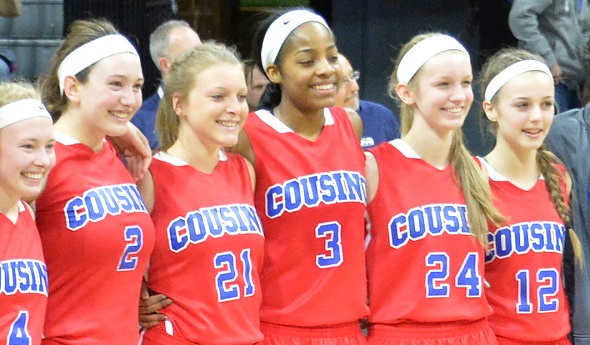
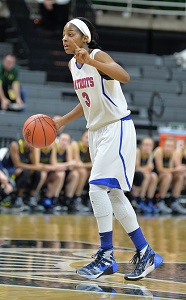
PHOTOS: (Top) Kierra Fletcher (3) poses for a photo with her teammates after Warren Cousino won last season’s Class A championship. (Middle) Fletcher brings the ball up the court during her team’s Semifinal win over Hudsonville.