

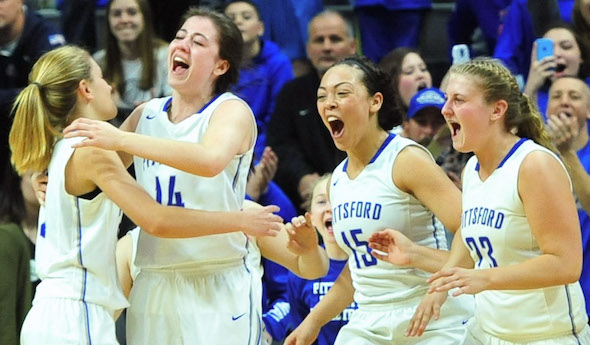
Pittsford Caps Finals Return as Champ
March 19, 2016
By Geoff Kimmerly
Second Half editor
EAST LANSING – Laura Smith's emotions whirled like a tornado Saturday afternoon.
After her team came so close a year ago to winning its first MHSAA championship, the Pittsford senior was ecstatic.
 But realizing immediately that her four-year varsity career was done after an incredible 91-8 run, she was sad as well.
What a way to finish. The Wildcats, who ended their first MHSAA Finals trip with an overtime loss a year ago, all but wrapped up their first championship during the third quarter of a 48-30 Class D victory over Mount Pleasant Sacred Heart at the Breslin Center.
“Just coming here last year, I was so nervous. Then we lost, and it was devastating,” Smith said. “This year, when we won, I didn’t know how to feel. I was so happy, and then I started crying because it was my last game. I don’t want to leave these girls; they’re my best friends, and we play so well together on the court. But I’ll come back next year and watch them win again.”
Pittsford closed this winter 27-0, to go with finishes of 16-6, 22-1 and 26-1, respectively, over the last three seasons.
And “tornado” was the operative word of the day, the result of the Wildcats’ most meaningful lesson learned during last season’s championship game loss to St. Ignace.
Pittsford led that game 34-21 at halftime and by eight with a quarter to play before the Saints came back to tie it by the end of regulation and win 64-60 with the extra period.
Hence “tornado,” Pittsford’s appropriately named halfcourt pressure defense that led to many of Sacred Heart’s 29 turnovers – off which the Wildcats scored 37 of their 48 points.
“We kept our intensity up the entire game, pressuring the entire game,” Pittsford junior guard Jaycie Burger said. “Last year … we came out and our defense just fell apart. The whole game (today), at halftime, we told each other we have to play defense, we’re still playing defense, and that’s what helped us out.
“We really wanted to win this game a lot, and every time we scored a basket, got a turnover, we were just that much closer to winning the game.”
That began to become apparent during Pittsford’s 9-0 run to end the first half that included six Sacred Heart turnovers and put the Wildcats up 22-13.
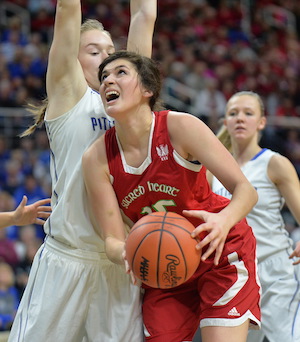 The run continued with the first seven points of the third quarter, coming off three more turnovers.
“Their pressure really caused us to move a little faster than we wanted to,” Sacred Heart coach Damon Brown said. “They made it difficult for us to get into our offense, and when you can’t get into your offense it’s difficult to be effective. I thought we did a good job in the first half of managing that, but then they had that run right there at halftime. I think that got us on our heels, and we were scrambling a bit to try to adjust from there.”
The Irish (24-2) had been held to 30 or fewer points three more times this season, but had won all three of those games.
“We can still work on it,” Pittsford coach Chris Hodos joked. “No, our defense is outstanding. You saw it in our Semifinal game. Our Quarterfinal game, I think we had 24 steals. I asked them to work harder (earlier this winter). We went to some different drills halfway through the season. They did what I asked them – a pretty easy team to coach.”
Like Waterford Our Lady on Thursday, Sacred Heart also couldn’t contain Pittsford junior forward Maddie Clark. She made 10 of 15 shots for 23 points and grabbed 10 rebounds to go with her 24 points and 16 rebounds in the Semifinal.
She and senior Madison Ayers also combined to stifle Irish senior center Averi Gamble, who got off only five shots and finished with eight points – half her average. Freshman guard Scout Nelson was the team’s leading scorer with nine.
Gamble and senior guard Megan English also started on the team that won the Class D championship in 2014. This season they were joined in the starting lineup by three underclassmen and mentored a team that should return the other five players who saw the floor Saturday.
“It doesn’t always have to be about winning. Just being with these girls is a blessing in itself,” Gamble said.
“The way these girls competed all 32 minutes, that was just amazing,” English added. “I wouldn’t want to play with any other team and finish with any other team.”
Ayers, who like Smith played on the varsity as a freshman and sophomore, took off last season but returned this winter after being persuaded by her past and now current teammates and also by how much desire they showed during last season’s run. Ayers finished with eight points and Burger had 11, three assists and four steals.
All but Smith and Ayers should be back next season, when the Wildcats will attempt to add to the current juniors’ career record of 75-2.
“From (when we were) little, we’ve always wanted to win,” Clark said. “Seventy-five and two, that’s pretty amazing. We want to keep it going; (we've) got one more year.
“When we were little we played junior pro together, and our junior pro record growing up was like 100-10, so we don’t really know how to lose,” Burger added. “I mean, we don’t like to lose. … It’s been a great, great opportunity that we’ve had. To go through three years with only two losses is a really special thing, and I’m just thankful we get to do it together.”
The Girls Basketball Finals are presented by Sparrow Health System.
PHOTOS: (Top) Pittsford players including Laura Smith (14) and Madison Ayers (15) celebrate their first MHSAA girls basketball championship. (Middle) Sacred Heart’s Sophie Ruggles works to get to the basket as Pittsford’s Maddie Clark defends.
A-B Preview: Return of the Champs
March 15, 2017
By Geoff Kimmerly
Second Half editor
Three 2016 MHSAA champions will take the floor for Friday’s Semifinals in Classes A and B.
Warren Cousino is back attempting to repeat in Class A, and Marshall is seeking to do the same in Class B. The third guarantees there will be a new Class C champion this weekend; Ypsilanti Arbor Prep won that title last year but is in Class B and earned the top ranking during the regular season.
All four Class A and B Semifinals will be played Friday, with all four championship games Saturday.
Semifinals - Friday
Class A
Warren Cousino (24-2) vs. Flushing (22-3), 1 p.m.
East Kentwood (25-1) vs. Southfield Arts & Technology (22-4), 2:50 p.m.
Class B
Detroit Country Day (24-1) vs. Marshall (23-2), 6 p.m.
Ypsilanti Arbor Prep (26-0) vs. Freeland (26-0), 7:50 p.m.
Finals - Saturday
Class A - Noon
Class B - 6 p.m.
Class C - 4 p.m.
Class D - 10 a.m.
Tickets cost $8 per pair of Semifinals and $10 per two-game Finals session. All Semifinals will be streamed live on MHSAA.tv on a pay-per-view basis. All four Finals will be broadcast live on Fox Sports Detroit, the Class D, A and C Finals on the network’s PLUS channel and Class B on the primary channel. Free radio broadcasts of all weekend games will be available on MHSAANetwork.com.
And now, a look at the semifinalists in Class A and Class B. Click on the name of the school to see that team’s full schedule and results from this season. (Statistics are through teams' Regional Finals, except Freeland’s are through the end of the regular season.) The Girls Basketball Finals are presented by Sparrow Health System.
Class A
EAST KENTWOOD
Record/rank: 25-1, No. 9
League finish: First in Ottawa-Kent Conference Red
Coach: Jimmy Carter, sixth season (79-57)
Championship history: Has never played in an MHSAA Final.
Best wins: 57-43 over No. 7 Muskegon Mona Shores in the Regional Semifinal, 59-45 and 63-46 over Grand Haven, 51-49 (District Final) and 52-43 over Grand Rapids Christian.
Players to watch: Lazurea Saunders, 6-0 jr. C (14 ppg, 7.0 rpg, 4.0 spg); Alona Blackwell, 5-10 soph. F (10 ppg, 3.0 apg);
Outlook: East Kentwood has its second 20-win season under Carter, but also has increased its win total each of the last four winters. The Falcons are 11 victories better than a year ago and won their first Regional title last week. The only loss was to Class B No. 4 Grand Rapids Catholic Central in East Kentwood’s second game. Eight players average at least five points per game; sophomore guard Mauriya Barnes (11.5 ppg) and junior center Corinne Jemison (10) add plenty of scoring off the bench.
FLUSHING
Record/rank: 22-3, unranked
League finish: First in Flint Metro League.
Coach: Larry Ford, 13th season (228-67)
Championship history: Has never played in an MHSAA Final.
Best wins: 45-39 over No. 4 Midland Dow in the Regional Final, 47-25 over Flint Hamady, 65-37 and 50-39 (District Final) over Flint Carman-Ainsworth.
Players to watch: Lauren Newman, 5-8 sr. G (11.3 ppg, 4.6 rpg); Shelby Morrow, 5-7 jr. G (10.9 ppg, 2.5 spg).
Outlook: Flushing has advanced to its first Semifinal since 1976 and won 21 of its last 22 games after opening 1-2 this winter. The Dow win in the Regional Final avenged one of those early losses, and the others were to No. 3 Saginaw Heritage and Class B top-ranked Arbor Prep. Only league rival Fenton (41) has scored more than 40 points against the Raiders since Dec. 6. Senior 6-foot center Bre Perry adds to a balanced attack with 8.6 points and 6.7 rebounds per game.
SOUTHFIELD ARTS & TECHNOLOGY
Record/rank: 22-4, No. 6
League finish: First in Oakland Activities Association Red
Coach: Michele Marshall, 22nd season (276-92)
Championship history: First season as a program.
Best wins: 55-51 over No. 1 Detroit Martin Luther King in the Regional Final, 68-52 over Detroit Renaissance in the District Final, 52-38 over Ann Arbor Huron in the Quarterfinal.
Players to watch: Deja Church, 5-10 sr. G (20.1 ppg, 8.5 rpg); Alexis Johnson, 5-10 soph. F (14.8 ppg, 7.0 rpg).
Outlook: Although Southfield A&T technically is a new program, Marshall formerly built Southfield Lathrup into a top program before that school and the former Southfield High merged last fall. Lathrup won the Class A title in 2005. Church was a Miss Basketball finalist and will continue at University of Michigan. Freshman guard Cheyenne McEvans adds another 10.3 points and six rebounds per game and with Church is among three who had at least 22 3-pointers this season entering the week.
WARREN COUSINO
Record/rank: 24-2, No. 2
League finish: First in Macomb Area Conference Red
Coach: Mike Lee, eighth season (150-43)
Championship history: Class A champion 2016.
Best wins: 47-41 over Farmington Hills Mercy in the Quarterfinal, 41-39 over Bloomfield Hills Marian in the Regional Final, 53-51, 52-34 and 66-45 over No. 7 Port Huron Northern.
Players to watch: Kierra Fletcher, 5-9 sr. G (22.7 ppg, 13 rpg, 6.2 apg, 5.2 spg, 2.1 bpg); Erin McArthur, 5-6 sr. G (13.7 ppg, 5.0 rpg, 5.4 apg, 4.1 spg, 65 3-pointers).
Outlook: Cousino was as big a surprise last season as a 23-win team could be – but definitely won’t be this weekend. Fletcher was a Miss Basketball finalist after starring in last season’s Finals, and she’ll continue her career at Georgia Tech. In addition to Fletcher and McArthur, senior Rachel Hayes and sophomore Mackenzie Cook also started in last season’s championship game and current starter senior Aubrey Fetzer played 21 minutes off the bench. Cousino also picked up two wins over league foe Macomb Dakota, which also made the Quarterfinals.
Class B
DETROIT COUNTRY DAY
Record/rank: 24-1, No. 2
League finish: Does not play in a league.
Coach: Frank Orlando, 36th season (757-113)
Championship history: Eleven MHSAA titles (most recent 2015), four runner-up finishes.
Best wins: 55-46 over Class A No. 1 Detroit Martin Luther King, 56-46 over Class A No. 4 Midland Dow, 60-51 over Class A No. 6 Southfield A&T, 53-35 over Ann Arbor Huron.
Players to watch: Destiny Pitts, 6-0 sr. G (22.7 ppg, 5.9 rpg, 3.3 apg, 71 3-pointers); Kaela Webb, 5-7 jr. G (14.8 ppg, 3.0 apg, 36 3-pointers).
Outlook: Country Day returned to the Semifinals last season and will try to send off Pitts with a second title in three seasons. She also was a Miss Basketball finalist and will continue at University of Minnesota. She was named Class B Player of the Year by The Associated Press, and Webb also made the all-state first team. In addition to an impressive Class A lineup and its Class B run, the Yellowjackets beat Class C semifinalists Detroit Edison PSA and Flint Hamady during the regular season.
FREELAND
Record/rank: 26-0, No. 5
League finish: First in Tri-Valley Conference Central.
Coach: Tom Zolinski, 10th season (198-45)
Championship history: Class C champion 1998.
Best wins: 68-45 over No. 9 Bay City John Glenn in the District Semifinal, 57-35 and 39-38 over Saginaw Swan Valley, 53-38 over Cadillac in the Quarterfinal.
Players to watch: Jenna Gregory, 5-10 sr. F (10 ppg, 5.3 rpg, 2.5 spg); Alyssa Argyle, 5-9 soph. F (9.7 ppg, 2.7 spg);
Outlook: The Falcons are back in the Semifinals for the first time since 2012 and with only two wins decided by fewer than 10 points. Freeland is 47-3 over the last two seasons and has dominated this one with a balanced lineup; five players average at least seven points per game, and five entered the postseason with at least 20 3-pointers. Bullock Creek was the other opponent to get within 10 points, and the Falcons beat the Lancers in the District Final by 40.
MARSHALL
Record/rank: 23-2, No. 6
League finish: First in Interstate Eight Athletic Conference.
Coach: Sal Konkle, 17th season (305-95)
Championship history: Class B champion 2016, runner-up 1981.
Best wins: 49-27 over No. 4 Grand Rapids Catholic Central in the Quarterfinal, 55-29 over Comstock in the District Semifinal, 41-40 and 50-29 over Jackson Northwest.
Players to watch: Nikki Tucker, 5-10 sr. F (15.1 ppg, 7.1 rpg); Jill Konkle, 5-6 sr. G (11.3 ppg, 43 3-pointers).
Outlook: The reigning Class B champion is surging again, avenging its second loss by beating GRCC in the Quarterfinal; the other defeat came to No. 3 Williamston on opening night. Four senior starters are back from last season’s Final. Balance and defense are again the names of Marshall’s game: six players score at least 4.8 ppg, and of the 23 wins, only that first over the league rival Mounties came by fewer than 10 points.
YPSILANTI ARBOR PREP
Record/rank: 26-0, No. 1
League finish: Does not play in a league.
Coach: Rod Wells, sixth season (129-17)
Championship history: Class C champion 2016.
Best wins: 41-39 over No. 3 Williamston in the Quarterfinal, 53-38 over No. 8 Ida in the Regional Semifinal, 38-28 over Flushing, 53-33 over Ann Arbor Huron, 72-31 over Detroit Mumford, 57-39 over Class A No. 7 Muskegon Mona Shores.
Players to watch: Adrienne Anderson, 5-7 sr. G (13.7 ppg, 4.2 spg); Ro’zhane Wells, 5-5 sr. G (10.6 ppg, 3.6 apg, 2.9 spg).
Outlook: Arbor Prep’s encore to last season’s Class C title has been to move to Class B and go undefeated. Senior forwards Cydney Williams (9.1 ppg) and Kayla Knight (4.8) joined Anderson and Wells starting in last season’s championship game, and 6-0 junior forward Lasha Petree adds another 10.4 ppg this winter. Only Williamston and Dearborn Heights Robichaud in the District Final have gotten closer than 10 points as the team has given up more than 40 only five times. Arbor Prep also downed Class C quarterfinalist Detroit PSA.
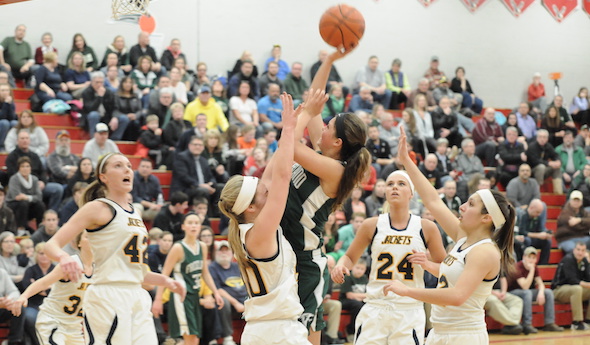
PHOTO: Freeland downed Ithaca last week to claim a Class B Regional title. Click to see more at HighSchoolSportsScene.com.)