

Riley Sisters, Fowler Shine on Statewide Stage
By
Jason Schmitt
Special for MHSAA.com
April 9, 2021
EAST LANSING — Fowler certainly is a small town.
Located just 30 miles northwest of Lansing, everyone in town knows everyone. And if they didn’t already know the Riley sisters’ prowess on the basketball court, they sure do now.
Sisters Mia and Emma Riley combined to score 34 points in leading Fowler to a 54-20 victory over Bellaire on Friday in the Division 4 title game at the Breslin Center. It was Fowler’s first MHSAA Finals championship since 1991.
“I’ll constantly have relatives who drive by their house and they’ll say, all the time, that they’re in their driveway playing one-on-one,” Fowler head coach Nathan George said of the sisters. “So it’s no coincidence that they’re in this spot, that they’re this good. All their hard work is paying off.”
Emma Riley, a sophomore, scored the first four points of the game and her older sister, Riley, scored her team’s first nine points of the second quarter as Fowler overwhelmed Bellaire early on. Fowler led 29-7 at halftime. It shot 48 percent from the field while limiting Bellaire to just three field goals and 12 percent shooting.
“We have confidence that teams will struggle against our speed and aggressiveness,” George said. “It hasn’t worked every game, but for the most part I think teams have a hard time adjusting to it because we have so many guards we can rotate in. It worked pretty well tonight.
“When we get those fast starts and the girls get their confidence, it’s a pretty special thing to see.”
Bellaire struggled throughout the first half, connecting on just 3 of 25 shots. It was just 1 for 11 in the first quarter and at one point missed 13 straight shots while falling behind 17-3.
“It definitely is upsetting because normally we can bounce back when shots aren’t falling in,” Bellaire senior Katie Decker said. “We have confidence in each other and hold each other up. Normally they’re going in, but I don’t know what was happening today. I guess nerves and we never settled in, but we did the best we could.”
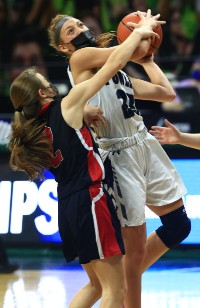
Fowler’s defense played a big part in Bellaire’s shooting woes. George’s team collected 12 steals and forced 18 turnovers in the game. The Riley sisters accounted for eight of those steals.
“They can shoot and they can defend,” Bellaire head coach Brad Fisher said. “They shot the ball so well and they just play a different level of defense. We knew it was coming, but to simulate it, you can’t. I don’t know that we could have done too much differently when a team shoots like that and can defend like that.”
Mia Riley, a junior, was 6 for 8 shooting in the first half, while Emma was 3 for 5.
“I try to go into the game with a lot of confidence and I know my sister does too,” said Mia, a junior. “Coach always tells us, ‘Be confident and if you get a shot, it’s going up.’ So that’s kind of our mentality. We just didn’t want to hold back this game.”
Emma Riley said she didn’t let the arena atmosphere get to her.
“(Coach) always says if you get an open look, shoot it. So nothing changed on this court,” Emma said. “We kept saying that it was an important game, but it’s just like it was back at Fowler. We just tried not to overthink it and shoot with confidence like always.”
Mia Riley finished with a game-high 18 points to go along with five rebounds and three steals. Emma Riley had 16 points, seven rebounds and five steals for Fowler (16-4). Junior Emma Halfmann and sophomore Grace Epkey each added six points.
George said he’s known how good the Riley sisters are on the basketball court. But after Friday’s performance, other people will, too.
“Being from a small town, I don’t think people get to appreciate them,” George said. “We don’t get a lot of media coverage. There aren’t a lot of people in our gyms. Their skill level is incredible. I appreciate that we get to this type of stage, where others can appreciate how good they are.”
Bellaire finished its season with an 18-4 record. Decker and junior Jacey Somers led the team with six points apiece.
“Our girls had a pretty darn good season, too,” Fisher said. “We’ve talked about what this team has done and what this team is capable of. We have so many people to thank, the community, the MHSAA has been awesome.
“I’m just so proud of my girls. This was a fun ride. Eventually the season has to come to an end. And we had a couple special victories along the way. It’s obviously not the outcome we wanted, but we still made history.”
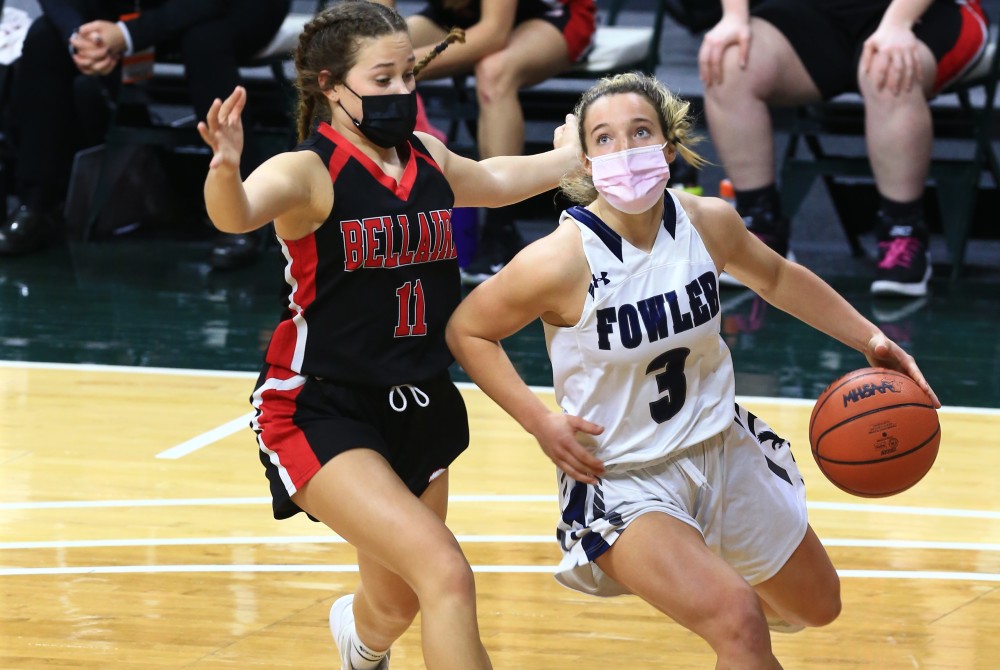
PHOTOS: (Top) Fowler's Avery Koenigsknecht (3) works to get past Bellaire's Emersyn Koekpe during Friday's Division 4 Final. (Middle) Fowler's Leah Wieber (22) works to get to the basket. (Click for more from Hockey Weekly Action Photos.)
'Fire & Ice' Sail Mona Shores into Regional
By
Tom Kendra
Special for MHSAA.com
March 6, 2017
Guard play is crucial in girls basketball.
Especially in March, and definitely in the second half of a District championship game against a crosstown rival.
 Jordan Walker, a 5-foot-7 Miss Basketball finalist for Muskegon Mona Shores, took control the way a senior guard is supposed to – scoring the first eight points of the second half Friday, including hitting two big 3-pointers, and finishing with a game-high 21 points as the Sailors blew open a relatively close game and held on for a 50-43 victory over host Muskegon Reeths-Puffer for their third consecutive Class A District title.
“You can’t stop her,” Mona Shores coach Brad Kurth said amidst the postgame celebration. “You can slow her down, but she’s going to keep coming.”
Mona Shores, 19-3 and champion of the Ottawa-Kent Conference Black, advanced to face O-K Red champion East Kentwood (22-1) in Tuesday’s 6 p.m. Class A Regional opener at Zeeland East.
Walker, who has signed with Western Michigan University where she will play with her older sister, Jasmyn, has been driving hard toward a big finish all season long. She now has more than 1,500 career points after breaking the Mona Shores girls basketball scoring record in January, held for 22 years by another Miss Basketball finalist, Jamie Ahlgren, who went on to star at Oakland University. Walker scored 39 points in a win over Muskegon and notched a quadruple-double with 22 points, 14 rebounds, 14 steals and 10 assists in a win over Grand Rapid Union.
But as impressive as Walker has been, the reason the Sailors have been able to knock off teams with superior front lines like Reeths-Puffer is because Walker is not alone in the backcourt.
Joining Walker is 5-6 sophomore dynamo Alyza Winston, a duo Kurth has dubbed “Fire and Ice,” and opposing coaches have pulled their hair out trying to contain.
Walker is the “ice” – the refined, composed senior who never gets rattled despite constant double teams, box-and-ones and other gimmicks designed to throw her off her game.
Winston is the “fire” – the energetic, speedy sophomore who breaks down defenses off the dribble (and with an ankle-breaking crossover dribble) and steps up anytime the Sailors’ offense gets stagnant.
The way that dynamic duo interacts and conspires to frustrate opponents was on display in Friday’s District championship game.
Walker caught fire to open the second half, turning a 10-point halftime lead into a seemingly comfortable 31-13 advantage early in the third quarter. That’s when Reeths-Puffer coach Brandon Barry called a timeout and adjusted even more of the Rockets’ defense toward the task of slowing down Walker.
Enter Winston.
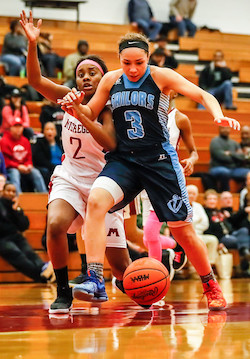 For much of the remainder of the game, Shores started its attack with the ball in the hands of Winston, whose dynamic ball-handling skills have brought her plenty of offers from Division I college programs, even though she still has two years of high school remaining. Winston, who finished with 13 points, repeatedly broke through fullcourt pressure and then either pulled it out to run off clock or dished it off inside to fellow underclassmen Nia Miskel, Ryleigh Wehler and Veronica Kastelic.
“Our guards were the difference,” said Walker, whose mother, Danielle Smith-Walker, is a counselor at Mona Shores and a varsity assistant coach. “People say that a basketball team will go only as far as the guards will take them, so we’ll see how far we can go.”
While the District title game was a classic matchup of Reeths-Puffer’s inside strength vs. Mona Shores’ guards, Tuesday’s Regional showdown with East Kentwood will feature two of the top backcourts in West Michigan.
Kentwood went undefeated in the O-K Red behind the guard trio of senior Anaya Powell, defensive stopper Amari Brown and Mauriya Barnes. How that threesome matches up with Walker and Winston could determine the outcome of the Regional showdown, but on Friday night, Kurth was just relieved to finally be playing an opponent outside of the Muskegon area.
Over the past two seasons, the lakeshore “big three” of Mona Shores, Reeths-Puffer and Muskegon High have battled during O-K Black and District action. Shores discovered how hard it is to beat a good team three times in one season Wednesday night, when it needed two clutch free throws from Kastelic in the waning seconds to edge Muskegon, 50-49. Then the Sailors had to turn around two nights later and fend off Reeths-Puffer, which had beaten them by nine points the last time they played at Puffer’s gym.
“I know it breaks their heart to lose this game,” Kurth said, speaking after Friday’s Reeths-Puffer game, though the same emotions applied to Wednesday’s win over Muskegon. “These rivalries have made us all better, and it has made Muskegon-area basketball better.”
Walker is the lone senior starter for Mona Shores, whose season ended last year in a Regional championship game loss to Hudsonville, 45-44.
Hudsonville faces Grand Rapids Forest Hills Northern in Tuesday’s second Regional game at Zeeland East.
 Tom Kendra worked 23 years at The Muskegon Chronicle, including five as assistant sports editor and the final six as sports editor through 2011. E-mail him at [email protected] with story ideas for Muskegon, Oceana, Mason, Lake, Oceola, Mecosta and Newaygo counties.
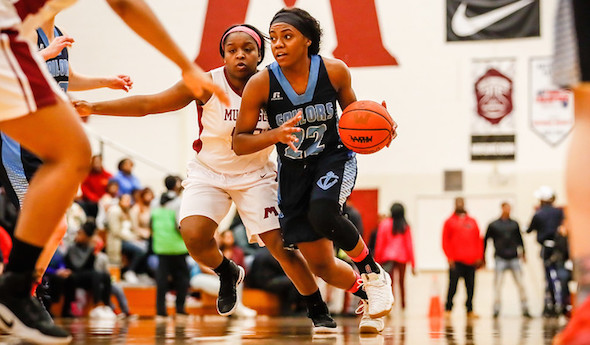
PHOTOS: (Top) Mona Shores' Jordan Walker (22) works to get past a Muskegon defender during a game earlier this season. (Middle) The Sailors' Alyza Winston (3) races for a loose ball. (Photos by Tim Reilly.)