

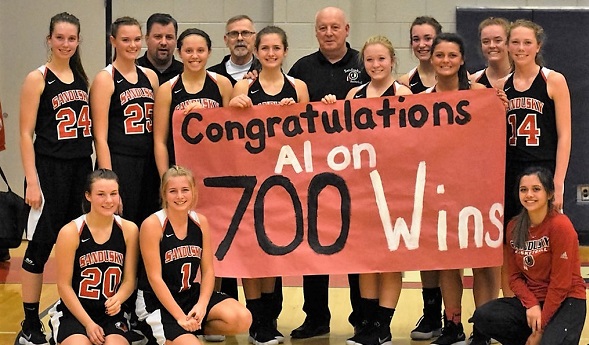
Sandusky's DeMott: 700 and Counting
By
Paul Costanzo
Special for MHSAA.com
January 3, 2018
When Al DeMott took the Sandusky girls basketball coaching job in 1979, he wasn’t planning on it being a long-term gig.
 A few losing seasons motivated him to turn the program around, however – and nearly 40 years later he’s not only succeeded in doing so, he’s become one of the most successful coaches in state history.
DeMott hit the 700-win mark on Dec. 5, joining Detroit Country Day’s Frank Orlando as the only girls basketball coaches in Michigan to reach the milestone.
“I’ve been coaching for a long time, and I know I’ve been blessed,” DeMott said. “I’ve had a lot of good kids and parents and assistant coaches who have been part of it. I’ve been blessed with great kids that work hard, and want to work hard.”
DeMott is 703-187 in his time at Sandusky, with 19 league titles, 25 District titles, seven Regional titles and one MHSAA Finals runner-up finish (1999). He’s also had the joy of coaching his three daughters, Marissa, Allison and Desiree.
“They have all actually helped me in my program,” he said of his daughters. “It’s been a lot of fun. I planned on getting out a few years ago, but I’m still having a lot of fun. I’ve got kids that are so fun to work with, and it’s hard to walk away from that. Thank God my wife has always been supporting me, too.”
It did take about five years for him to get things moving in that positive direction, though.
“We got a piece of the league title for the first time in 1984, then in 1985 we upset Flint Academy in the Regional,” he said. “That really sparked these younger kids, and we had pretty good success ever since.”
Starting a youth program in the early 1980s was a key cog in the turnaround, but also a sign of Sandusky and DeMott adjusting to the changing climate of girls basketball at the time.
“When I started, the level of play compared to what it is now is night and day,” he said. “Girls basketball has come a long way. Nobody did anything in the summer, but now they’re as active as the boys, or more active.”
As the game has changed, DeMott has, too. He’s won games with teams that lit it up from outside, he’s won games with teams that pounded the ball down low, and most recently, he’s won games with suffocating defense.
“Year by year it can change,” he said. “Depending on the personnel.”
What doesn’t change is DeMott’s commitment to the game and his team.
“There are so many secrets to his success,” Sandusky senior Haley Nelson said. “But he prepares us so well. He does his research. We know the other team’s plays just as well as they know them sometimes. He’s always scouting and he watches so much tape.”
Nelson is a four-year player for DeMott, and recently committed to continue her career at Saginaw Valley State University. She said playing for DeMott is something players in Sandusky look forward to from a young age.
“Coach DeMott is known by everyone in Sandusky,” she said. “If you say, ‘Al DeMott,’ everyone knows who he is. If you go other places, everyone knows who Al DeMott is. He’s very well respected.”
It’s partly because DeMott has coached so many members of the community, including those who eventually watched their daughters play for their former coach.
“I personally think it’s pretty awesome,” said Nelson – whose mother didn’t play for DeMott, but her older sister Keegan did. “If you could talk to your mom about your coach and it would be the exact same coach, that would be pretty awesome.”
Although, Nelson said, she’s heard he’s not exactly the same as he was back in the day.
“I hear back in the day he was a screamer,” Nelson said. “Clearly, he’s not like that anymore. He’s the calmest coach in America.”
This season’s Sandusky team is 7-1, and DeMott thinks it has potential to finish strong, despite a recent injury to a key player.
No matter how the rest of the winter goes, however, this year’s team will always be able to look back on the 53-26 win against Unionville-Sebewaing that put its coach into elite company.
“It’s pretty awesome,” Nelson said. “I felt like we just needed to do it for him, because he’s done so much for us.”
 Paul Costanzo served as a sportswriter at The Port Huron Times Herald from 2006-15, including three years as lead sportswriter, and prior to that as sports editor at the Hillsdale Daily News from 2005-06. He can be reached at [email protected] with story ideas for Genesee, Lapeer, St. Clair, Sanilac, Huron, Tuscola, Saginaw, Bay, Arenac, Midland and Gladwin counties.
PHOTO: Sandusky girls basketball coach Al DeMott stands with his team as they celebrate his 700th career win last month. (Photo courtesy of the Sandusky girls basketball program.)

P-W Earns Shot to Add to Title Collection
March 16, 2017
By Geoff Kimmerly
Second Half editor
EAST LANSING – Pewamo-Westphalia is enjoying a championship-caliber school year.
And now the Pirates girls basketball team wants its piece of MHSAA title success.
P-W can claim its third Finals title of 2016-17 on Saturday, thanks to the hoops team's 64-51 win over Maple City Glen Lake in Thursday’s second Class C Semifinal.
The Pirates girls can join the football and boys cross country teams as champions when they take on Detroit Edison Public School Academy in the 4 p.m. championship game. The Semifinal was P-W’s first since 2002, and the title game appearance will be the program’s first since finishing Class C runners-up in 1983 and 1984 – making it seem like all of this recent winning might be contagious.
“I think it’s just the community. Our community is so supportive, as you can see at any game and any championships – our community is there,” said P-W senior guard Brenna Wirth, herself a main cog on the school’s girls track & field Division 3 title winner in 2015. “I think we feed off that, and it keeps us going.
“I’ve been playing basketball for several years now, longer than I’ve been running, and basketball is really important to me and the community.”
How much it means to Wirth and her teammates came out especially over Thursday’s final 19 minutes.
Glen Lake (23-4) entered the regular season unranked but had already eliminated No. 2 Traverse City St. Francis and No. 7 St. Ignace before taking the floor against the No. 6 Pirates. The Lakers didn’t waste time going after another giant, taking as much as a nine-point lead into the final three minutes of the first half.
“Throughout the season, we tend to say the same thing over and over – you never win the game in the first four minutes,” P-W coach Steve Eklund said. “They were outhustling us; I’d say for the first 8 to 10 minutes they were outhustling us. Sometimes you have to adjust to your opponent. I think it took us a little time tonight to settle into the environment.”
“Obviously we had to fight back every little run they had,” junior forward Emily Spitzley added. “We just had in our minds to keep fighting. It’s just about confidence.”
 If the all-state second-teamer was lacking any, she found it as the comeback began.
Spitzley scored 20 of her game-high 24 points and grabbed eight of her 12 rebounds – and also blocked three shots – as the Pirates forced a 22-point swing.
P-W (24-2) closed the second quarter on an 8-0 run to get within 25-24 of Glen Lake by halftime. The Pirates then opened the third quarter on a 7-0 run to take a six-point lead.
Glen Lake got the advantage back twice with just under four minutes left in the third quarter, and after the Pirates rebuilt an eight-point lead got the deficit down to one again with 6:33 to play. But another P-W 8-0 run over the next three minutes finally put the game out of reach.
“We’ve had a lot of games where we had slow starts, but we’ve worked hard on coming out (strong) in the third quarter,” Glen Lake coach Jason Bradford said. “We just came out kinda slow on our heels and got away from what we usually do – pushing the ball, kicking it out. We were spinning our heels a little bit, and we got a little shell-shocked when the score started going the other way.”
Wirth added 13 points, and junior forward Kate Hengesbach added nine points, 12 rebounds and six steals off the bench in 20 minutes of play.
Junior guard Allie Bonzelet led three Lakers scoring in double figures with 14 points, and junior forward Jennifer LaCross had 13 and seven rebounds. Senior guard Kelly Bunek added 11 points and senior forward Sarah Carney finished her career grabbing nine rebounds.
P-W fans had about a 30-minute drive to fill their side of the Breslin stands Thursday, but Glen Lake had nearly as many fans – including three spectator bus loads – make a nearly four-hour trek.
“It’s just great to be able to put our name out there and show people all the hard work we’ve been putting in,” Carney said. “To just see the community come out and support us … it’s very rewarding to see the support we have.”
The Girls Basketball Finals are presented by Sparrow Health System.
PHOTOS: (Top) P-W’s Emily Spitzley drives to the basket during Thursday’s Class C Semifinal win. (Middle) Glen Lake’s Savannah Peplinski (24) works to get past the Pirates’ Ellie Droste.