

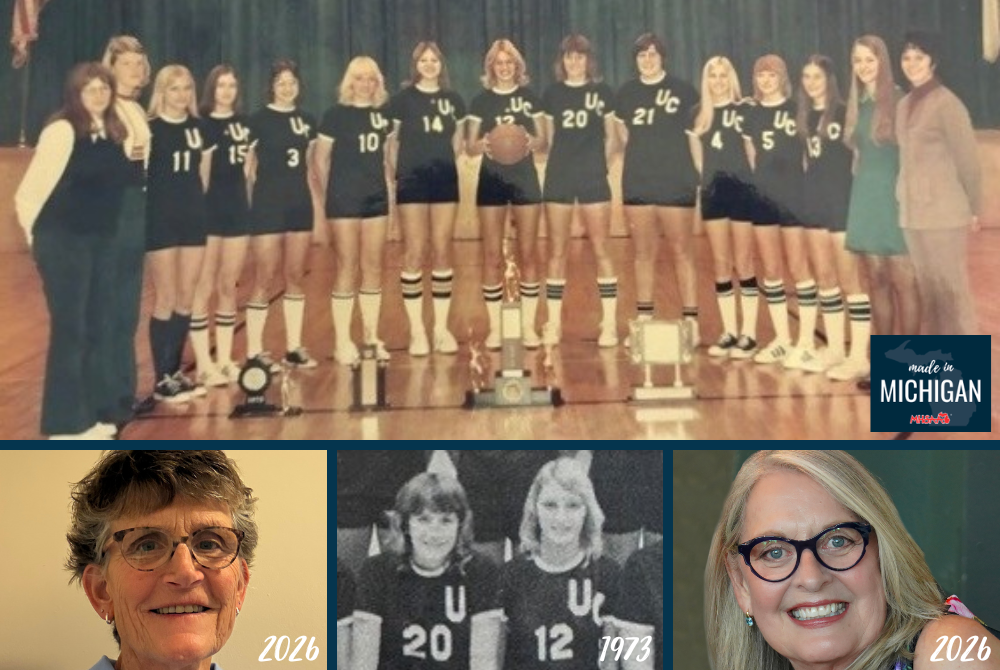
Significance of Historic Run, Relationships Formed Live On for 1973 Unity Champs
By
Dean Holzwarth
Special for MHSAA.com
August 7, 2026
It has been more than five decades, but Kim Hansen and Marcia (Visser) Beutel can still recall certain moments from a historic night in mid-December when their Hudsonville Unity Christian girls basketball team accomplished a tremendous feat.
 On Dec. 15, 1973, at East Kentwood High School, the teammates helped the Crusaders win the first MHSAA Girls Basketball Finals championship in Class B.
Unity Christian defeated Saginaw MacArthur 49-45 before a crowd of 1,000.
“i just remember the team, the bus ride out there, and I remember just how excited we were to be together and what we had accomplished as a group,” Hansen said. “Our parents and friends were such big supporters through the whole process, and when I think back I see faces of pure joy.”
A total of 629 schools participated in that first tournament, which like now lasted three weeks and was divided into four classifications.
Cindy Masselink scored 17 points and Deb Aukeman added 16 points to lead the Crusaders to the championship win.
“For us, it was an excitingly significant day because we had been working hard throughout the season, and we, as women, could be the first winners of a state championship for our school and the state,” Beutel said. “A lot of us had been playing together since the sixth grade, and that camaraderie, that friendship, that teamwork and the work we had put in was going to end with a state championship.
“We were very blessed to be there, and we also knew that we were pioneers and trailblazers in the game.”
The Crusaders consisted of 11 girls, three managers and head coach Susan Contant.
An interesting sidenote from the Class B title game: As the home team, Unity Christian was to wear white uniforms. But the Crusaders didn’t own those.
“There were limited resources for women's sports back then so we had to wear the boys uniforms for the state championship,” Beutel said. “They didn't fit well so we had to wear T-shirts underneath them.”
One thing the 1973 squad possessed was size, which proved to be a benefit as the 3-point shot didn’t yet exist.
“We took each tournament game as it came to us and just kind of did our thing,” Hansen said. “I look back at our pictures, and we were huge. We had a starting five of 6-foot plus, and we were a big team. That definitely worked in our favor, and I really don't think that we were going to be denied.”
Beutel and Hansen, both 69, are organizing a night to recognize this special group of women.
 It will take place Dec. 11 during a Unity Christian girls and boys varsity game night.
“We are all much older and lives have happened and we are in different places, but I’m hoping that many of the teammates will come back for that,” Hasen said. “I know our head coach and her husband are going to come back for that, and I think that is just amazing. I haven't seen Sue since 1973.
“I got to see some of my teammates when we were recognized at Central Michigan for the 30-year anniversary, and I’m looking forward to seeing who is going to be able to make it and hoping that many do.”
Beutel lives in Toronto with her husband, Robert. She recently visited her old high school.
“They had a list of all the state championships on the wall, and the first one was us,” she said. “That was very emotional for me to see that, to see that recognition.”
Beutel met her husband at the University of Michigan, and they had three kids. One of their daughters, Sophie, played Division I basketball at Brown.
Beutel moved to Toronto in 1987 and coached basketball in a recreational league while helping grow the game. She was president of the Toronto Basketball Association, which has surged to 1,000 athletes.
The country needed to push for basketball representation and now has the NBA’s Toronto Raptors and the Toronto Tempo, currently playing its inaugural season in the WNBA.
“Back then it was a hockey country, so I had to search for basketball in Toronto,” Beutel said. “I got involved in it and expanded it on the girls side and always coached my kids.”
Now retired after a career as a health care executive, Beutel and her husband love adventures and have traveled to several countries. “There is so much more to experience in life,” she said.
While she stays active by playing tennis, cycling and kayaking, Beutel also plays clarinet in a band and volunteers at a cancer support group as a peer counselor after enduring two bouts of breast cancer.
After high school, Hansen played four years of basketball at Grand Valley State University before being drafted by the San Francisco Pioneers of the Women’s Professional Basketball League.
She played there one season before being traded to the Chicago Hustle. She also spent time with the Minnesota Fillies before the league went bankrupt and disbanded in 1981.
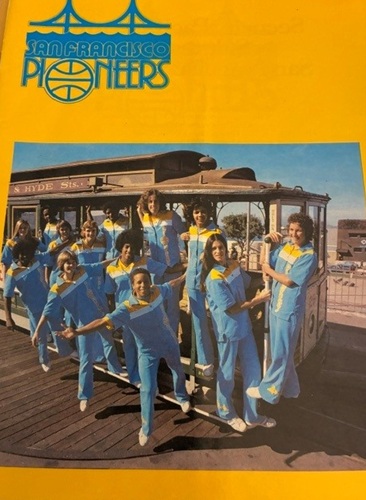 “I think I made $7,000 for my salary and the season was very short, but it was such an amazing experience and San Francisco was a very good franchise,” Hansen said. “They had good ownership and we flew all over the place and stayed in really nice hotels. They had a good practice facility, and we were treated really well.”
Prior to a game scheduled in Chicago on March 21, 1981, Hansen and her Fillies teammates walked off the court before the starting lineups were announced in a protest over unpaid salaries.
“We planned to do our warm-up, go back to the locker room and then get back in vans and drive back to Minnesota because we weren’t getting paid,” Hansen said. “That was our way of showing that we were not happy with ownership and the only way that we could make a stand.”
Despite the disbanding of the league, Hansen said lifelong relationships were formed.
“The beauty of playing sports is relationships, and even relationships that we developed at Unity are still so strong, and relationships I developed while playing pro ball are still very active and to me that is the beauty of playing sports,” she said.
After the WPBL, Hansen went to graduate school at Lamar University in Texas and eventually became an educator and coach at several colleges and high schools, including Wichita State and North Central College (Ill.).
Her final stop was Cleveland Heights High School, where she coached and taught physical education and health. She lives in Kirtland, Ohio, and retired from teaching and coaching in 2024 although she still works part-time in the transportation department.
“I love coaching and I always loved practice,” Hansen said. “I just finished working with four seventh-grade boys and helping them with fundamentals and skills. I just enjoy that part of it so much.”
2026 Made In Michigan
Aug. 4: Work Ethic Continues to Drive Van Dyk's Endeavors as Co-Owner of Family Farm - Report
July 24: Hackett Mentor's Care Sparked Lifetime in Hoops for BCAM President White - Report
July 24: Mackey Leaving Court with 500+ College Hoops Wins, Many More Lessons Shared - Report
July 16: Country Day Two-Time Champ Moore Building Perennial Winner at Harvard - Report
July 9: Multi-Sport Career at TC West Helps Gillis Thrive as Pro in Game She Once Left Behind - Report
July 2: Inspired by Home, Eager to Give Back, Spencer Hosts Hoop City Alumni Games - Report
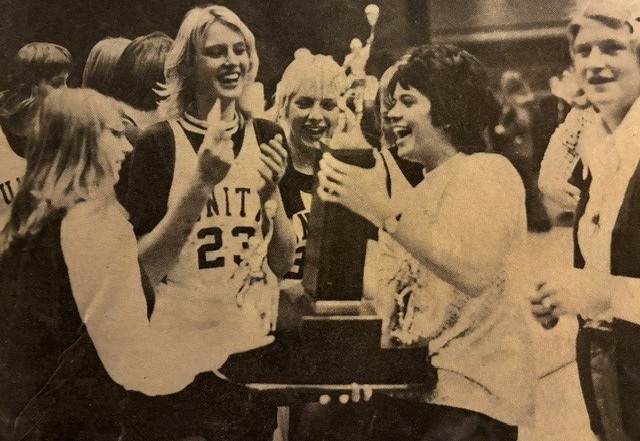
PHOTOS (Top) The 1973 Unity Christian girls basketball team poses for a team photo with its championship trophy; Kim Hansen (20) and Marcia Beutel (12) then and now. (Middle) Unity coach Susan Contant holds the championship trophy surrounded by her players after the clinching victory. (Below) Hansen stands for a photo with her San Francisco Pioneers teammates during the 1979-80 season. (Photos provided by Kim Hansen and Marcia Beutel.)
Gooding & King Work to Fill SW Michigan's Officiating Ranks, Schedules
By
Pam Shebest
Special for MHSAA.com
December 12, 2023
KALAMAZOO – Cheer them or boo them, without officials, there are no games. That’s just a fact in the sports world.
 Two area men are tasked with supplying those officials for Southwest Michigan schools, and it is not always as easy as it seems.
Portage’s Todd Gooding is in charge of assigning football referees for 70 schools across eight leagues, with 500 officials on his staff.
Vicksburg’s Rob King assigns officials for girls and boys basketball in five leagues and has 290 men and women on his roster to work 1,100 games throughout the hoops season.
“We have six females on staff,” King said. “We’re looking to add more. I think the girls who are playing enjoy having a female ref on the court with them, plus it shows them they can do this, too.”
Although totals were dropping a few percentage points every year, the MHSAA still registered an average of 10,317 officials annually during the decade ending in 2019-20. But the beginning of the COVID-19 pandemic that spring played a large part in a decrease in registered officials by 12 percent for 2020-21, down to 8,090.
The last two school years saw a bounce-back of four percent, and recruiting and retaining efforts continue. But Gooding and King – also veteran officials themselves, Gooding for 25 years and King for 24 – and their assigning colleagues across the state have the closest look at the effects of fewer officials as they work to schedule at the local level and make sure everything is covered.
Doing so gets even harder with unforeseen roadblocks.
One of those challenges for Gooding came in August when extreme heat forced most schools to reschedule or delay their football games.
“Everyone was trying to get their games in,” he said. “We were moving start times back, then we were moving days. Football is a little different than basketball or baseball because you can only play within so many days, so we were really squeezed against the schedule.
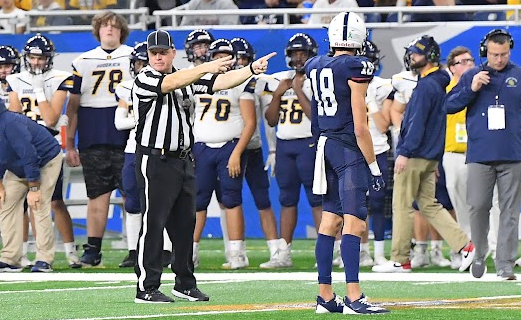 “I had a school or two reach out on Monday or Tuesday (before the Friday night game), so they looked ahead at the heat. Some of them waited, waited, waited, and then in some cases, it posed some big challenges because most of those crews had been spoken for.”
For a typical football Friday, Gooding staffs 30 or 35 games, “which is really difficult because everybody wants to play Friday night.”
Some referees in both football and basketball “double dip” by officiating games at freshman or junior varsity levels on nights other than Friday.
Gooding said at one time he hoped to go to seven officials for a football game, but with a shortage of officials, “Right now we’re just lucky to staff five in the games we have, and we’re still very short.
“Parents are a key component to a shortage of officials. A lot of it is more at the youth level, but everyone has to remember the sportsmanship aspect. Without officials there are no games, and sometimes we lose track of that, and that’s one reason there’s a shortage.”
Still, King noted that officiating provides more advantages than disadvantages.
“Everyone hears about the bad stuff, getting yelled at by fans and coaches, but those are so small,” he said.
“After a season of doing this, you learn to block out that stuff and realize it’s just part of the game. Fifty percent of people are mad at you every time you blow the whistle, so you get used to that.”
Pay raises in some leagues enticed many of those who “retired” to return, King said, but both he and Gooding agree the camaraderie developed while officiating is what makes it most special.
“It’s more about the time you spend on the floor with guys, in the locker room, driving to games, grabbing something to eat after the games, just talking about life, just building friendships,” King said. “That’s the part you remember.”
Gooding added some games stick in his memory more than others.
“My first varsity game (refereeing) was Lawton playing Saugatuck,” he said. “I show up and Channel 3 was there. I wondered what’s going on.
“Both schools were 0-8, both senior classes were 0-35. Somebody had to win, and it was my first varsity game. I think Saugatuck won, and it was close to 25 years ago.”
Another memory came as he officiated a basketball game.
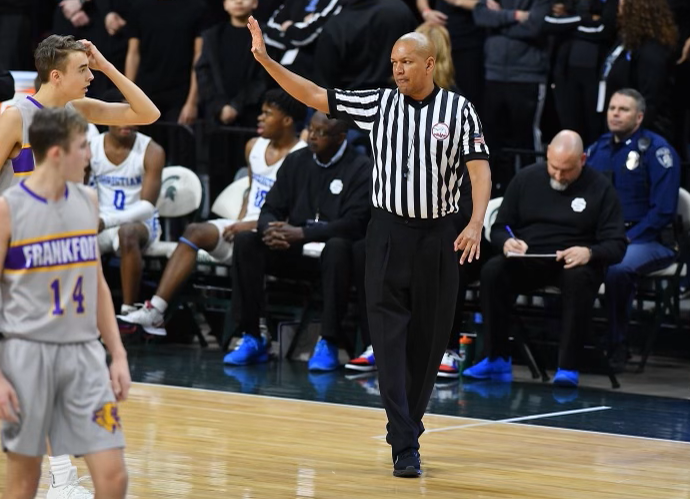 “A girl from Benton Harbor (Kysre Gondrezick in 2016) had 72 points,” he said. “It’s in the record books. and you’re just one small part of that and you remember them.”
Officiating is not only for adults. Even teenagers still in high school can become referees as part of the MHSAA Legacy Program.
King recently hosted an officiating summit at Paw Paw for high school athletes.
“There are nine schools in the Wolverine Conference and six of them brought 10 to 15 kids,” he said. “Myself and another official presented on basketball. They also did something on other sports.
“We got the kids up blowing the whistles and doing some of the signals. Three reached out wanting to get involved.”
King said officiating is a great way to earn money, especially while in college.
“You’ll work maybe two or three hours at the most and make $150 to $300 depending on the level,” he said. “Your friends will have to work six-, seven-, eight-hour days to make that much money.
“You can also block your schedule. We have a software with a calendar on it. If there are days you know you can’t work because you have classes or other things, you just block those days out, so you control your own schedule.”
With training, freshmen and sophomores can work junior high/middle school games, and juniors and seniors are able to officiate at the freshman and junior varsity levels.
“Usually what we do is get you a mentor,” King said, “and you work with that mentor and make some money.”
Those Legacy officials hopefully continue in the avocation, eventually becoming the next mentors.
Officiating, like school sports in general, is a cycle that’s constantly in motion – both when it comes to filling the ranks and filling the schedule to cover games ahead.
For example, although football season is over, “I don’t know if there really is an offseason,” Gooding said. “Leagues are going to start giving me their schedules. We’ll get those into an Arbiter system. Everything’s assigned by Arbiter, a computer system where officials get their assignments.
“I’ll start evaluating the crews, reach out to the crew chiefs. They’ll let me know any changes in their crew dynamics. I’ll evaluate the year gone by, how they performed and then start getting ready to work on getting those games staffed. That will start after the new year.”
For more information on officiating, including the Legacy Program, go to the Officials page of MHSAA.com.
 Pam Shebest served as a sportswriter at the Kalamazoo Gazette from 1985-2009 after 11 years part-time with the Gazette while teaching French and English at White Pigeon High School. She can be reached at [email protected] with story ideas for Calhoun, Kalamazoo and Van Buren counties.
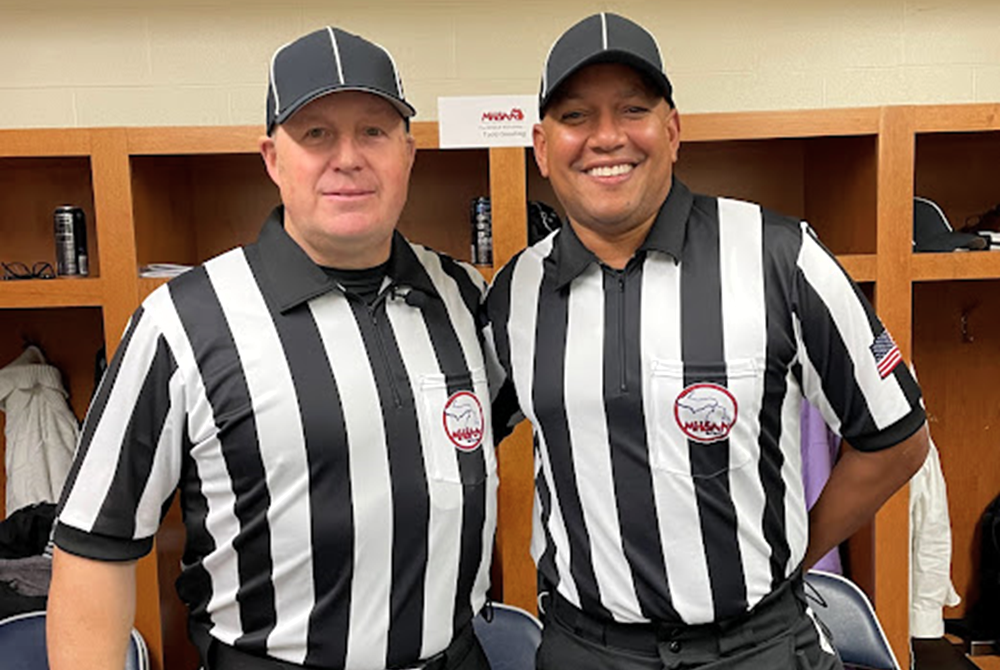
PHOTOS (Top) Todd Gooding, left and Rob King take a photo together while officiating the Division 4 Final at Ford Field in 2022. (Middle) Gooding signals during that contest between Goodrich and Grand Rapids South Christian. (Below) King officiates the 2019 Division 4 Boys Basketball Final at Breslin Center. (Photos courtesy of Gooding and King.)