

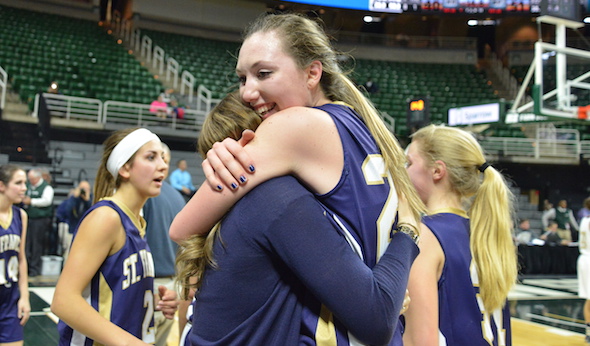
St Francis Stands Tall in Run to 1st Final
March 17, 2016
By Geoff Kimmerly
Second Half editor
EAST LANSING – Regardless of the winner, a team from Thursday’s first Class C Semifinal was going to finish this weekend playing in an MHSAA championship game for the first time.
 And Traverse City St. Francis – especially 6-foot-4 junior Juliana Phillips – was able to reach a little higher for that opportunity during the opener at the Breslin Center.
The Gladiators will play on the season’s final day for the first time thanks to a 53-40 win over Niles Brandywine, which was making its first Semifinal appearance since 2010 and also was seeking its first title game berth.
Phillips stood six inches taller than anyone on Brandywine’s roster, and it showed in her 17 points, 12 rebounds and three blocked shots – as did her athleticism, which helped her to four steals and allowed her to alter a number of other shots she didn’t reach.
“Both of our teams were struggling a little bit from the outside, so we just played into our strengths,” Phillips said. “They didn’t have a lot of height on their team, so we tried to play a little high-low and in-and-out, and it just started going for us.”
A lot has gone well this season for the No. 3 Gladiators (26-1), who have won 24 straight and will next face top-ranked Ypsilanti Arbor Prep at 4 p.m. Saturday.
Phillips has been St. Francis’ second-leading scorer at 12 points per game, but took on more of the offense Thursday as leading scorer Annie Lyman played through an illness and only a week after spraining both ankles, one each in successive games.
Despite struggles shooting from outside, Lyman still finished with seven points and six rebounds. Phillips scored her first points two minutes into the game and put up nine during the first half as the Gladiators took a 22-18 lead into the break. She made 7 of 12 attempts for the game.
Phillips’ impact was equally significant on the defensive end. Brandywine made only 32 percent of its shots during the first half and 26 percent for the game – partly because the Bobcats didn’t convert as usual on 3-point shots, but also because Phillips made for an obstacle if they tried to get to the basket.
“She’s obviously a tremendous shot-blocker, and after you get a couple (blocks) that does get into your mind,” St. Francis coach Keith Haske said. “I’m guessing they haven’t seen a 6-4 girl that’s athletic like she is, all year, so it’s tough. And she does such a great job of blocking without fouling; that’s just a great gift that she has.
Brandywine this season made 212 3-pointers – third-most in one season in MHSAA history. But they connected on only 3 of 21 tries in the Semifinal, and even three or four more makes could’ve shifted the game dramatically.
Senior forward Makenna Hartline did make eight of her 17 shots from the floor to lead Brandywine (24-3) with 17 points, and she also grabbed eight rebounds. Senior guard Emily Erwin added 11 points.
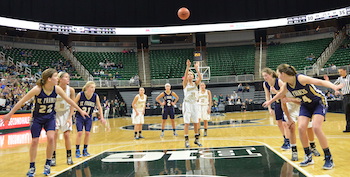 “We knew we’d have to shoot the 3 today. When (they) have a 6-4 and 6-1 post player with that kind of size, and with our size, you have to be able to knock them down from the perimeter,” Brandywine coach Josh Hood said. “I think the effort was there. We had more offensive rebounds, more shot attempts; we did a lot of little things we had to do to win the game. (But) we need to shoot the basketball better. We were right there going into the fourth; it just didn’t work out.”
Sophomore Sarah Chouinard added 13 points and seven rebounds for St. Francis, and 6-1 senior center Lauren McDonnell had 10 points and 11 rebounds. The Gladiators led by six heading into the final period before breaking away on a final 16-9 run.
Haske has won 643 games and brought seven teams to Breslin over 32 seasons as a coach, and his Charlevoix girls finished Class C runner-up in 2004 and were one of five teams he’s taken to an MHSAA championship game.
Already the St. Francis boys coach, Haske added the girls varsity this winter and had a feeling early on he might be with them for a long run.
“This kinda fits our year. We won a state championship in cross country, the boys were semifinalists in football, and if you look at our sports right now we’ve got great athletes,” Haske said. “I told the kids at the first assembly this year that this was the year of St. Francis, just because of the collection of people we have. And I think this just goes to that. For whatever reason, this seems to be our year.
“We put a banner up in the gym if you make it to a state final game, so they were excited about that. They’ll live up on our ceiling of our gym forever, which is pretty cool.”
Brandywine will graduate a memorable seven-player senior class that has been part of a 91-7 run over the last four seasons.
“That says enough, 91 wins. Pretty special,” Hood said. “We’ve been (here) seven years, and I think we’re at 162 wins. So we have a lot of girls coming, but yeah, we lose a lot.
“When you look at our program, we’ve got a lot of kids that take pride in what we do. And we’ll be back.”
The Girls Basketball Finals are presented by Sparrow Health System.
PHOTOS: (Top) St. Francis’ Juliana Phillips celebrates Thursday’s Class C Semifinal win. (Middle) Brandywine's Emily Erwin shoots a free throw; she finished with 11 points.
“Reaching Higher” Marks 5th Year
July 11, 2013
By Geoff Kimmerly
Second Half editor
The annual Reaching Higher showcases of Michigan’s top high school basketball players will return to South Lyon High School beginning with the boys event Wednesday, July 17, followed by the state’s top girls prospects taking the floor July 25.
More than 220 athletes with aspirations to play at the college level will train and scrimmage under the tutelage of high school coaches from across the state and in front of college coaches expected to represent all three NCAA divisions, the NAIA and junior college levels. Coaches from 42 college basketball programs attended during the 2012 Reaching Higher events, including 12 from Division I schools.
This will be the fifth year of Reaching Higher. An educational effort by the Michigan High School Athletic Association and the Basketball Coaches Association of Michigan, the Reaching Higher experience includes classroom sessions for student-athletes and their parents as well as on-court drills and scrimmaging. The events aim to give athletes a vision of what it takes to become a college basketball player and also succeed in college life.
Participants in the program were selected by a committee of BCAM members. The process began in December when local high school coaches submitted nominations to the selection committee. Participants were chosen in February.
A complete schedule of activities and invitees can be found on the “Reaching Higher” page of the MHSAA Website.
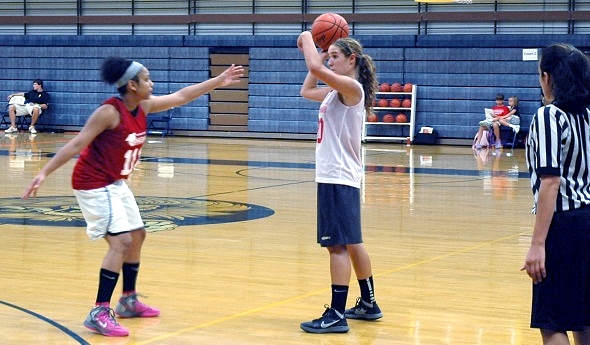
PHOTOS: Players face off during a scrimmage at the 2012 Reaching Higher girls basketball showcase at South Lyon High School.