

Step by Step, EGR's Brown Climbs to Miss Basketball Award, College Future
By
Steve Vedder
Special for MHSAA.com
March 16, 2023
EAST GRAND RAPIDS – Macy Brown remembers spending her Saturday mornings with her older sisters scrambling around gymnasiums when she was no older than a first grader.
The long and winding journey from those early days to a sterling career at East Grand Rapids is one chronicled by overcoming the gangly body of a middle schooler, surrendering interest in two other sports in favor of basketball, countless hours of AAU, critical advice from two older sisters, a misfortunate accident to a teammate as a junior that necessitated a position switch and eventually to sorting through scholarship offers from a handful of elite college programs.
It's a path that concluded this week with the Pioneers’ point guard not only becoming one of just 1.3 percent of high school players to accept a Division I scholarship, but also being named winner of the prestigious Miss Basketball Award as the state's top senior player.
It's a long way from those weekend mornings to becoming the school's all-time leading scorer, a four-year starter, all-stater and Miss Basketball winner – and a story that Brown says exceeds anything she could have imagined.
"It's been amazing, magical at times," Brown said. "You don't realize how you've spent your time until it's over. There were a lot of sacrifices, but you also gain so much with the relationships you've had through basketball."
The journey started at the East Hills center in Grand Rapids with older sisters Oliva and Jillian, both of whom are currently playing Division I college basketball, and their mother Noelle, who ran an AAU program. It was the first time Macy Brown recalls taking an interest in the sport and began taking stock of what it would take to play basketball at the high school or possibly even college level.
By the time Brown entered middle school, she was all of 5-foot-9 with skills that while encouraging, were far from a guarantee that a long basketball bloodline would be extended by one more daughter. In fact, it was the first time Brown was spotted by EGR coach Troy Hammond, who recalls her as anything but the player who would become the program’s all-time leading scorer with 1,537 points while starting all 86 of the team's games over four varsity seasons.
"She was a tall, lanky kid who was just figuring her body out," Hammond said, "She was a tag-along with her sisters. She was always smiling, a happy-go-lucky kid who loved being in the gym. But I would be lying if I said she would be as good or better than the experiences I had with her sisters. That was no foregone conclusion."
Still, Brown stuck it out and slowly made progress, both mentally and physically. Boosted by advice from her sisters, Brown's on-court talent began to take shape. She also grew about three inches and began hitting the weight room to gain strength. As she entered middle school, she elected to give up lacrosse and soccer to spend more time playing basketball. Armed by having additional time for basketball, she threw herself into even more AAU ball. College coaches who constantly mine the AAU circuit for emerging talent began to notice Brown, who received her first scholarship offer from Loyola of Chicago following her eighth-grade season.
 Despite the interest, however, Brown knew she had to become a better player.
"I was pretty good, but you don't realize how big of a leap it is from middle school to high school," said Brown, who had no second thoughts about becoming a single-sport athlete. "I grew up around basketball, it was always my first sport. I couldn't see playing lacrosse or soccer past high school."
Brown was good enough to make EGR's varsity as a freshman, She averaged 11.7 points per game in her inaugural season and gained additional attention from playing on a 22-1 team that would have been in contention for a Division 1 title if the season hadn't been cancelled because of COVID-19.
Brown continued to hone her game, averaging 13.5 points as a sophomore. She made all-conference for a second time and also made her college choice: she would become a Michigan Wolverine.
"When you know, you know," she said. "I knew I would wind up at Michigan because when I went other places, I would always compare them to Michigan. It just felt like home."
Brown said she relied on her sisters to know what required her utmost attention during the recruitment period. Olivia started at St. Bonaventure and now plays at Valparaiso, while Jillian is at Northwestern. Both offered crucial advice on how to pick a school.
"It definitely helped playing against them. I would get beat on, but it helped me," Macy said. "It was all for the best because it helped me become a better player."
It was after picking her college that Brown's career took another significant step forward. The Pioneers' senior point guard, Ally Carlson, who now plays at Western Michigan, suffered a season-ending ACL injury before senior-year practice began. The injury meant Brown, who had been a shooting guard her first two seasons, would have to move to point. She had to transition from becoming the team's second or even third offensive option to someone counted on to score points. She responded by averaging 22.4 as a junior and tossing in 25 points per game this season.
"I watched her develop into a leader, both as a person and on the court," Hammond said. "To see that development as a coach, it was wonderful."
Brown's improvement as a player included serious self-reflection. She admits to being the kind of athlete who maps out goals and then isn't satisfied until she reaches them.
"Every year was a checkpoint for me," she said. "I worked hard every offseason, and I would always notice what it took to play the game."
While the book on her high school career closes with the Miss Basketball Award, another door is opened in Ann Arbor. Brown said if she were to speak to a room full of young basketball wannabes, her advice would be simple. Brown was once in their position, and better than anyone else knows what it takes to conquer the next step in moving up the basketball ladder.
"It's definitely step by step, and you have to learn from your experiences," she said. "You make sacrifices, but you can gain so much."
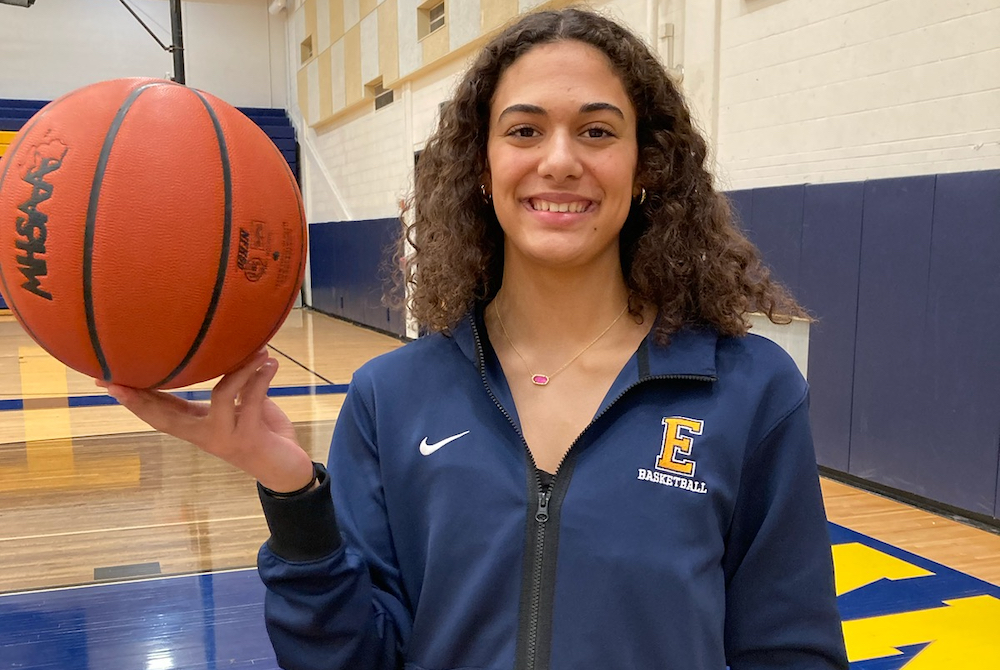
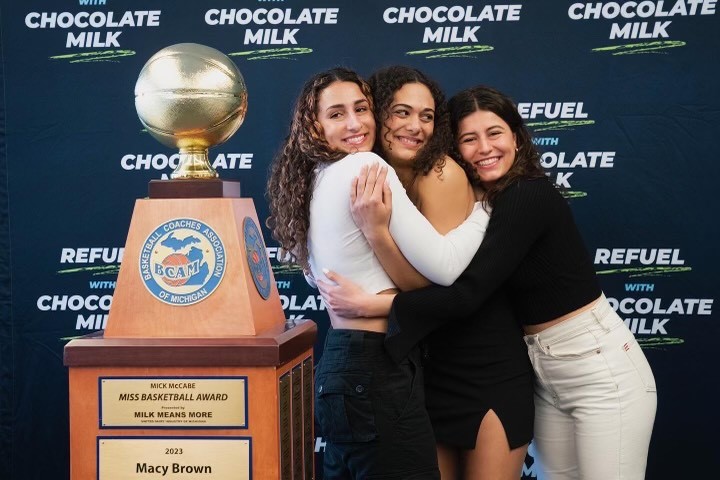
PHOTOS (Top) Macy Brown is this season's Miss Basketball Award winner. (Middle) Brown and her sisters celebrate her award this week. (Top photo by Steve Vedder. Middle photo courtesy of the East Grand Rapids athletic department.)
Breslin Bound: Girls Report Week 2
December 17, 2013
By Geoff Kimmerly
Second Half editor
Those who regularly contend for MHSAA titles or monitor high school sports statewide always are on the lookout for surprise teams making an impression at the beginning of a season or showing signs of contending at the end.
A number of teams making this week’s report would qualify. Read on for why.
1. Pittsford (4-0, Class C) – The Wildcats have won their last three games by at least 18 points apiece, including by 18 over last season Class D Semifinalist Climax-Scotts.
2. Ann Arbor Huron (4-1, Class A) – Huron has rebounded from an opening loss against powerful Goodrich to put up some solid wins including a 26-pointer over Temperance Bedford.
3. Jackson (4-1, Class A) – The Vikings also started last season 4-1, but look a lot better this time with a big win over perennial power East Lansing.
4. Flat Rock (4-0, Class B) – The Rams are on another run after going 22-2 last season, already posting an impressive win over Flint Southwestern.
5. Mount Pleasant Sacred Heart (5-0, Class D) – The Irish have cruised after an opening two-point win, and beat reigning Class D runner-up Waterford Our Lady by 30 last week.
6. Mackinaw City (5-0, Class D) – The school has only 61 students but five girls hoops wins including three by 40 or more points.
7. Flint Southwestern (3-2, Class B) – Southwestern won only five games last season; its victories so far include an impressive one over Muskegon, while the losses were to Flat Rock (mentioned above) and last season Class B runner-up Flint Powers.
8. Plymouth (3-0, Class A) – The Wildcats have beaten three teams with winning records to reverse paths after opening last season 1-3.
9. Hemlock (4-0, Class C) – The Huskies have won their first four games by 50, 19, 40 and 43 points, respectively, after opening last season 2-4.
10. Twining Arenac Eastern (4-0, Class D) – The Eagles have beaten soundly some bigger opponents already, with three victories by 25 or more points.
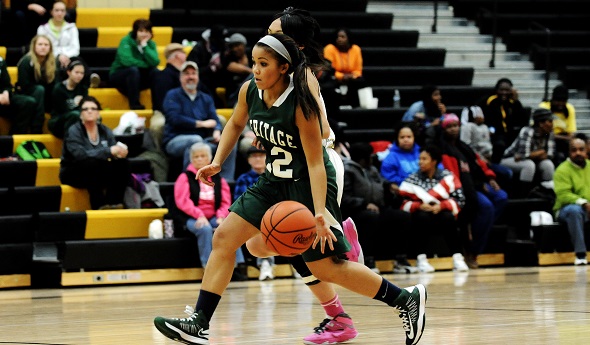
PHOTO: Saginaw Heritage, in green, got past Saginaw 61-48 last week and stood at 2-1 entering this week. (Click to see more at HighSchoolSportsScene.com.)