


Team of the Month: Midland Dow Girls Basketball
By
Geoff Kimmerly
MHSAA.com senior editor
January 13, 2022
Coming off an undefeated regular season and trip to the Division 1 Semifinals, it might seem strange to consider Midland Dow’s fast start this girls basketball season . The Chargers never stopped the steam-rolling that carried them to the Breslin Center last April.
But the start of this winter certainly has been different for Dow – the MHSAA/Applebee’s “Team of the Month” for December – and in a way that could pay off big again this March.
Because of COVID-19 precautions, teams weren’t allowed to play their first games last season until Feb. 8, and Dow ended up with 13 of their 17 games against Saginaw Valley League opponents as teams emphasized their league schedules during the abbreviated season.
A return to a full schedule for 2021-22 has allowed the Chargers to make a trip west to face reigning Division 1 champion Hudsonville, bookended by appearances in the Ice Breaker Classic at Ypsilanti Arbor Prep (against Goodrich) and Best of Michigan Holiday Classic at Belleville (against Grass Lake) – events that annually feature many of the state’s elite teams.
They made the most of those renewed opportunities, having handed Hudsonville and Goodrich their only losses and also defeating Grass Lake – the reigning Division 3 champ. Dow is 8-0, and that’s even more impressive considering the Chargers’ first five opponents this season all have winning records and are a combined 27-13.
“We talked about it before the season started, that we had scheduled a pretty hard December on purpose,” Dow coach Kyle Theisen said. “Pretty much every game was on the road – we’ve only had three home games so far – and all of our tough games are road games.
“That was kinda our focus, getting battle-tested early and figuring out where our weaknesses might be. We definitely found the weaknesses, but we were able to do it with wins.”
Those against Hudsonville and Grass Lake, predictably, were close – Dow defeated the Eagles 56-51 and the Warriors 44-40. No other opponent has gotten within single digits of catching the Chargers.
Dow’s 2020-21 season ended with a 22-1 record and its only loss in the Division 1 Semifinals to Hudsonville, 49-37. So doing the math, the Chargers are a combined 30-1 over the last two seasons, and 51-4 over the last three. Total, Theisen has led the team to a 151-22 records now into his eighth season as varsity coach, with this winter’s success following a similar pattern that has made his team one of the state’s best over his tenure.
Long-range shooting is Dow’s name of the game. Ellie Taylor drained 242 3-pointers – ranking eighth in Michigan history – during her four-year varsity career ending in 2017. Molly Davis also is on that record book list having made 174 from 2016-19. Maizie Taylor – Ellie’s younger sister – is on the single-season 3-pointers list after connecting on 65 as a senior in 2018-19. Jada Garner was among the team’s sharpest shooters and its leading scorer last season, and like those three has moved on to play in college. Leading the way this season are seniors Abby Rey and Alexa Kolnitys, who both are averaging 19.8 points per game with plenty of sting from the arc – Rey has made 23 3-pointers at a 39-percent success rate, and Kolnitys has 21 connecting on 35 percent of her attempts.
As a team, Dow averages 8.5 3-pointers per game on 30-percent shooting success. The Chargers’ 66 points scored per game are among the best outputs of the Theisen era, and the team’s 17 3-pointers in Tuesday’s win over Lapeer were a school record and tied for sixth-most in state history made by one team in a single game.
The team doesn’t work much in practices on set plays, but spends an hour or more daily on shooting. Future Chargers learn early. Theisen and his former assistant (and former college coach) Bob Taylor (also Ellie and Maizie’s father) created TRUE Shooting camps about five years ago, and their sessions draw students as young as kindergarteners who “get to high school having a pretty good foundation of shooting.”
“It’s definitely a feedback loop of girls see the success of it, and girls come in and want to improve (on the team’s past records),” Theisen said. “It’s just that cycle of the young kids see it, and we preach at the youth camps that if you want to play college basketball, you’ve got to be able to shoot. And they definitely buy in. … It’s cool to see when you’ve been here long enough to have the next group, and the next group, and the next group, and everybody keeps coming in and doing well."
Past Teams of the Month, 2021-22
November: Reese girls volleyball - Read
October: Birmingham Groves boys tennis - Read
C-D Preview: Perfection & Possibilities
March 15, 2017
By Geoff Kimmerly
Second Half editor
One of the state’s most impressive winning streaks in any sport this decade will take the main stage again this weekend at Michigan State University’s Breslin Center.
Reigning Class D champion Pittsford will attempt to finish a second straight undefeated season and build on a run that has seen the Wildcats win 101 of their last 103 games over the last four winters.
Meanwhile, four of eight semifinalists in Class C and D are seeking their first championships ever, with a fifth playing for its first title in nearly four decades.
All four Class C and D Semifinals will be played Thursday, with all four championship games Saturday.
Semifinals - Thursday
Class C
Detroit Edison PSA (19-5) vs. Flint Hamady (19-5), 1 p.m.
Pewamo-Westphalia (23-2) vs. Maple City Glen Lake (23-3), 2:50 p.m.
Class D
Engadine (19-5) vs. Saginaw Michigan Lutheran Seminary (17-9), 6 p.m.
Pittsford (26-0) vs. Mount Pleasant Sacred Heart (25-1), 7:50 p.m.
Finals - Saturday
Class A - Noon
Class B - 6 p.m.
Class C - 4 p.m.
Class D - 10 a.m.
Tickets cost $8 per pair of Semifinals and $10 per two-game Finals session. All Semifinals will be streamed live on MHSAA.tv on a pay-per-view basis. All four Finals will be broadcast live on Fox Sports Detroit, the Class D, A and C Finals on the network’s PLUS channel and Class B on the primary channel. Free radio broadcasts of all weekend games will be available on MHSAANetwork.com.
And now, a look at the semifinalists in Class C and D. Click on the name of the school to see that team’s full schedule and results from this season. (Statistics are through teams' Regional Finals.) The Girls Basketball Finals are presented by Sparrow Health System.
Class C
DETROIT EDISON PUBLIC SCHOOL ACADEMY
Record/rank: 19-5, No. 5
League finish: Does not play in a league.
Coach: Monique Brown, sixth season (80-35)
Championship history: Has not appeared in an MHSAA Final.
Best wins: 58-42 over No. 10 Blissfield in the Quarterfinal, 43-39 over Flint Hamady 58-55 over Detroit Mumford, 57-56 over Class A No. 6 Southfield Arts & Technology, 57-45 over Chicago Whitney Young.
Players to watch: Gabrielle Elliott, 5-10 fr. G (17.5 ppg, 3.6 rpg, 3.2 spg); Rickea Jackson, 6-3 soph. G (17.3 ppg, 9.2 rpg, 3.1 apg, 3.4 spg, 2.3 bpg).
Outlook: It’s difficult to not point out immediately that Edison has no seniors, two juniors, one sophomore and nine freshmen – and that they’ve been tested this season against top teams from Classes A and B as well as C. All five losses came to larger schools, including two still alive this weekend. Elliott – one of three freshman starters – made the all-state first team and Jackson was named to the second, while Brown was named Coach of the Year by The Associated Press.
FLINT HAMADY
Record/rank: 19-5, unranked
League finish: First in Genesee Area Conference Blue.
Coach: Keith Smart, 15th season (332-44)
Championship history: Three MHSAA titles (most recent 2010), two runner-up finishes.
Best wins: 38-36 over No. 1 Sandusky in the Regional Final, 75-67 over Dearborn Heights Robichaud, 51-46 over Goodrich, 81-27 over Lake Fenton, 55-50 over Flint Beecher in the District Final.
Players to watch: Deajah Cofield, 5-7 sr. G (15 ppg, 5.0 rpg, 5.0 apg); Sasha Penn, 5-7 jr. G (statistics not available for Penn).
Outlook: Hamady was unranked after taking losses to one Class A and three Class B teams, plus Detroit Edison. But Cofield was named Class C co-Player of the Year by The Associated Press and Penn and senior Krystal Rice earned all-state honorable mentions (although Rice is out for the season with a knee injury). This is Hamady’s third Semifinal this decade; the Hawks were Class C runners-up in 2015.
MAPLE CITY GLEN LAKE
Record/rank: 23-3, unranked
League finish: First in Northwest Conference.
Coach: Jason Bradford, ninth season (146-58)
Championship history: Class D champion 1978, runner-up 1979.
Best wins: 63-52 over No. 7 St. Ignace in the Quarterfinal, 50-44 over No. 2 Traverse City St. Francis in the District Semifinal, 55-40 and 42-38 over Kingsley.
Players to watch: Kelly Bunke, 5-6 sr. G (10.3 ppg, 4,4 rpg, 2.9 apg); Jennifer LaCross, 5-8 jr. F (10.8 ppg, 6.1 rpg, 3.0 apg).
Outlook: Glen Lake has won 20 games two seasons in a row for Bradford, with two league titles, and has shown it belongs among the elite in the postseason with two wins over ranked opponents, including avenging its opening-night defeat to St. Francis. The only other losses were to eventual Class B quarterfinalist Cadillac and in overtime to McBain. This will be Glen Lake’s first Semifinal since 1995. Bunek earned an all-state honorable mention.
PEWAMO-WESTPHALIA
Record/rank: 23-2, No. 6
League finish: Second in Central Michigan Athletic Conference.
Coach: Steve Eklund, eighth season (154-33)
Championship history: Class C runner-up 1983 and 1984.
Best wins: 40-31 and 38-31 over honorable mention Laingsburg, 50-27 over Ithaca, 55-34 over Springport in the Regional Final, 44-28 over Bath in the District Semifinal.
Players to watch: Emily Spitzley, 5-10 jr. F (13.2 ppg, 3.4 rpg, 2.2 spg); Hannah Spitzley, 5-10 fr. F (8.7 ppg, 4.0 rpg, 2.5 spg).
Outlook: P-W is returning to the Semifinal for the first time since 2002, avenging its two losses by beating CMAC champ Bath to open the postseason. The Pirates start two seniors but also two freshmen – guard Ellie Droste adds 8.6 points and 2.5 steals per game. Defense is this team’s strong point; Schoolcraft (19) in the Quarterfinal marked the 15th time this season P-W held a team under 30 points, and the Pirates have given up more than 31 only twice (in those losses to Bath). Emily Spitzley made the all-state second team.
Class D
ENGADINE
Record/rank: 19-5, honorable mention
League finish: Second in Eastern Upper Peninsula Athletic Conference.
Coach: Roger French, seventh season (79-64)
Championship history: Has never played in an MHSAA Final.
Best wins: 44-41 over No. 8 Crystal Falls Forest Park in the Quarterfinal, 50-48 (Regional Final) and 40-39 over honorable mention Pickford in the Regional Final, 60-55 and 63-57 over No. 10 Cedarville
Players to watch: Olivia Vaughn, 5-9 sr. F (18.3 ppg, 6.0 rpg, 3.2 spg); Aubrey Simmons, 5-10 jr. C (12 ppg, 12.7 rpg).
Outlook: Engadine is playing in its second Semifinals after also making the final weekend in 2005. The Eagles were one of three Class D teams from their EUP conference to receive state poll votes and emerged with eight wins over their last nine games. Vaughn and starting forward Keely Fuller are the only seniors, while freshman guard Sophie Vaughn – Olivia’s sister – adds 8.7 points and 6.4 rebounds per game. Engadine won only four games four seasons ago, but has upped its win total every season since.
MOUNT PLEASANT SACRED HEART
Record/rank: 25-1, No. 2
League finish: First in Mid-State Activities Conference.
Coach: Damon Brown (ninth season (178-41)
Championship history: Class D champion 2014, runner-up 2016 and 2008.
Best wins: 48-37 over Frankfort in the Quarterfinal, 52-25 over Fruitport Calvary Christian in the Regional Final, 23-17 over Carson City-Crystal.
Players to watch: Scout Nelson, 5-9 soph. G (13.5 ppg, 4.1 rpg, 4.1 apg, 4.0 spg); Sophie Ruggles, 6-0 jr. F (14 ppg, 5.9 rpg, 3.4 spg).
Outlook: Few Class D teams would have this kind of success the year after graduating an all-state center and three-year starting guard. But the Irish rose again in a league featuring 19-win Class C Carson City-Crystal, and Frankfort was the only playoff opponent to score more than 30 points. Nelson and Ruggles made the all-state first team and with junior Hadyn Terwilliger (8.3 ppg) started in last season’s Class D Final.
SAGINAW MICHIGAN LUTHERAN SEMINARY
Record/rank: 17-9, unranked
League finish: Fifth in Tri-Valley Conference West
Coach: Brian Blaine, first season (17-9)
Championship history: Has never played in an MHSAA Final.
Best wins: 56-48 over Waterford Our Lady in the Quarterfinal, 44-39 over Portland St. Patrick in the Regional Semifinal, 56-34 over Bay City All Saints in the District Final, 45-39 over Hemlock.
Players to watch: Meghan Blaine, 5-10 soph. F (12.1 ppg, 7.8 rpg, 2.7 apg); Rylee Pankow, 5-10 sr. C (10.ppg, 9.1 rpg, 3.0 spg).
Outlook: MLS may not have been the pick to advance farthest from the mostly Class B-C TVC West that had four teams total win at least 16 games. But the Cardinals have won 10 straight games and did make the Quarterfinals as recently as 2012, although this will be the program’s first Semifinal. Meghan Blaine can also score from the outside, with 46 3-pointers entering the week, and total six players have scored at least 12 points in a game this season.
PITTSFORD
Record/rank: 26-0, No. 1
League finish: First in Southern Central Athletic Association East
Coach: Chris Hodos, fifth season (117-8)
Championship history: Class D champion 2016, runner-up 2015.
Best wins: 62-19 over No. 6 St. Joseph Michigan Lutheran in the Quarterfinal, 59-47 over Manchester, 59-33 over Bellevue, 57-39 over Grass Lake.
Players to watch: Maddie Clark, 5-9 sr. F (16.4 ppg, 11.8 rpg, 3.4 spg); Jaycie Burger, 5-9 sr. G (19.2 ppg, 5.3 apg, 3.2 spg, 62 3-pointers).
Outlook: Pittsford’s 53-game winning streak is just short of making the MHSAA record book list, and it’s four-season run of 101-2 can’t have many rivals although that statistic hasn’t been kept. Clark was named Class D Player of the Year by The Associated Press and Burger also a first-team all-stater as both continued to star in leading their team to Breslin for the third straight season. Junior guard Marissa Shaw adds another 8.6 points and 6.2 steals per game, and she’d made 56 3-pointers entering this week.
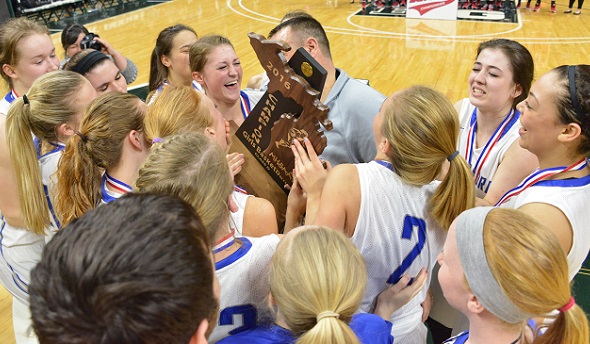
PHOTO: Pittsford celebrates last season's Class D championship at the Breslin Center.