

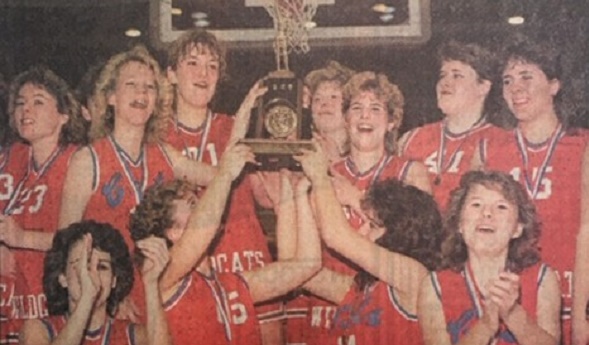
Walkerville Earns Back-to-Back Title Trips
January 2, 2019
By Ron Pesch
Special for Second Half
Holton’s trip to the 2018 MHSAA Division 8 Football Semifinals was another return to the past of sorts for Angela Slowik.
Her youngest son, Nathan, was the kicker on the Red Devils football team. The little city celebrated the school’s deep run with public “welcome back” celebrations that were heartwarming and inspirational. Cars and people lined the streets, sirens and horns blasted, and people smiled, cheered and waved as the team returned home.
“I’ve been very fortunate,” said the mother of three. “My daughter’s softball team made it to the state semifinals, my oldest son’s teams went to state in track, and both sons went in cross country. It never gets old.”
The celebrations were strikingly similar to the ones Slowik, formerly Angela Frick, and her high school teammates had experienced in her hometown just more than 30 years ago.
Walkerville is located in Oceana County, 25 miles north of Holton and about 35 miles southeast of Ludington. In the days when girls basketball was played in the fall, the town was gifted two straight MHSAA Class D basketball championships in 1987 and 1988 by its daughters. Christmas had come early.
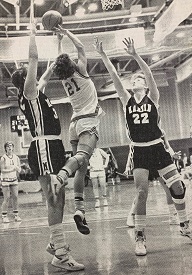 Three players, each graduating a year apart, stood out in the media reports from the time. Angela Frick (now Slowik) was a senior in 1987, a track star and perhaps an even better basketball player. A stellar free-throw shooter, 5-foot-10 Debbie Bettys (now Claeys) was in her junior year in 1987, while Angie Bond (now Patton), a long-range bomber, was a sophomore. They represented an impressive array of talent, but in the eyes of each, Walkerville’s success came from an unselfish, team-first mindset, with starters and non-starters all contributing when needed most.
“That’s what made Walkerville special,” said Patton. “We were a team.”
“It was bigger than you,” added Slowik, describing the feeling. “You were playing for the community.”
“There was just overwhelming support from our area and the surrounding towns,” recalled Claeys.
The area is best known as the “Asparagus Capital of the World.” Little has changed in this farming community, at least population-wise. According to census numbers, Walkerville still totals around 300 residents – but like many school districts, graduating classes are down due to a variety of factors. The area’s migrant worker population has influenced enrollment numbers over the years. Graduating classes were never huge, averaging around 24 students during the championship run.
“That included at least two foreign exchange students in my class,” noted Slowik, laughing.
Girls basketball at Walkerville dates back at least into the early 1930s. You wear many hats at a small school. Home Economics and English instructor Leona Kitchen coached the team from the early 1950s into the late 1960s during the days of the 6-player game.
During the second half of that era, the hoops news out of Walkerville related to a long losing streak by the boys basketball team.
“If there was a “bottom 10” high school basketball poll,” wrote Larry Paladino for The Associated Press in 1975, “Walkerville probably would have led the list at least three years running in the mid-1960s.”
The boys basketball team had landed in the AP’s weekly poll with a 10-0 record and Paladino was discussing the sudden rise in Wildcat stock. According to Woody Millspaugh, head coach of the boys since 1971, the success was due to the creation of an elementary school athletic program that had altered the sports climate at the high school. It was started around the low-point of the streak.
“Kids started developing skills early when they should be developed,” Millspaugh said, referring to teams established for fifth and sixth graders. “The juniors I have now are the first ones who came all the way through the program.”
Girls basketball coach Tom Kicas had been a 1,000-point scorer while in high school at Pentwater. Following graduation from Central Michigan University, he began his teaching career at Walkerville, and led a talented bunch of Wildcats girls to the state quarterfinals in volleyball in the spring of 1977, then to a 20-3 record on the basketball court in the fall of the following school year – a run that included the first District crown in school history. Millspaugh followed Kicas as girls coach in the early 1980s, leading both basketball programs for a short span.
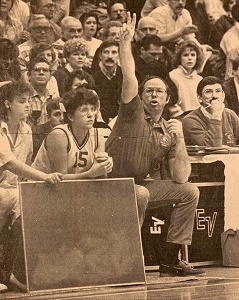 Following his record-setting days playing basketball at Pentwater, Greg Gregwer headed to St. Thomas Aquinas College in Grand Rapids, and then spent two summers in Ecuador with the Peace Corp. When he returned, he took over the boys basketball team at Walkerville for a single season during the 1968-69 school year. The consecutive game losing streak had recently been ended. Gregwer’s team quickly put an end to a conference losing streak that was still active.
“The past records are records, but not ones we want to cling to or even think about,” said Gregwer to the Ludington Daily News in 1968 after that win. “We’re starting it right now.”
In the mid-1980s, Gregwer then took over the girls team from Millspaugh.
“Mr. Gregwer was our sixth grade teacher. He knew us pretty well,” recalled Claeys. “I remember watching my older sisters play basketball. We started playing in fourth grade and rode the bus to games. Not many schools did that, I guess. When I was a sophomore (in 1986), we were pretty good. We won our league for the first time in over a decade, and that was a big deal. But we lost early in the Districts to North Muskegon that year.”
Walkerville trailed the Norsemen by double digits early that day, and the loss may have been inevitable. But it became certain when the Wildcats lost Slowik to a knee injury late in the second quarter. She had torn her meniscus and would require surgery.
“It wasn’t even a question that I was coming back for my senior year,” said Slowik, remembering the time. “I did every one of those exercises they give you to make sure.”
After the team had been eliminated from the postseason, Gregwer suggested to his team that they travel down and watch the girls state championship contests. At the time, the games were held in Allendale at Grand Valley State, about an hour away.
“Of course, it’s not unusual for a team to go watch the games,” said Claeys. “Lots of coaches do that. It was a neat experience to watch. It opened your eyes. You could see how good we could be.”
“We’re watching the games and Debbie suddenly says, ‘We could play here next year,’” said Slowik, laughing about the visit. “I was thinking, ‘Umm. Okay Debbie, we’ll see about that.’ That next year, each win was another stepping stone and I started to believe she was right.”
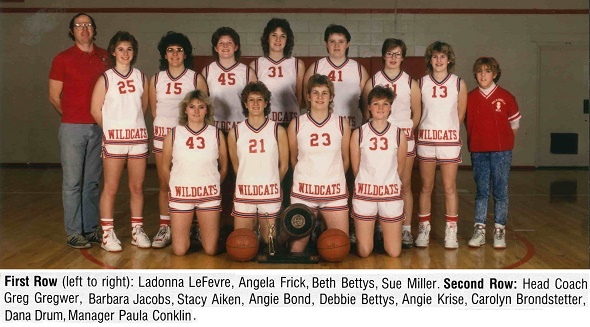 Indeed, the Wildcats, it seemed, could do no wrong in the fall of 1987 and ended the regular season undefeated. They cruised through the early rounds of the tournament, survived a scare in the Regionals against McBain, and then pulled into the Quarterfinals at Wexford Arena in Cadillac (on Slowik’s birthday) with a 25-0 record for their game against Johannesburg-Lewiston.
For the most part, it was business as usual. Walkerville trailed by a point after the first quarter, but outscored the Cardinals 21-9 in the second to take a 39-28 lead into the locker room at the half. The team was up 49-34 late in the third, when the Cards began their comeback. With 50 seconds to play in the quarter, Johannesburg-Lewiston had cut the lead to eight, 55-47. Rattled by the press and man-to-man pressure, the Wildcats turned the ball over repeatedly. With 1:03 left in the game, the teams were tied, 70-70.
Claeys put Walkerville up by a point, 71-70, with a free throw on a one-and-one, but missed the second. Slowik grabbed the rebound and was fouled. With 54 seconds to play, she missed the front end of the opportunity. Cardinals all-stater Vickie Ellison snagged the carom, ran the length of the floor and nailed a jumper with 43 seconds remaining, giving Johannesburg-Lewiston its first lead since the first quarter, 72-71.
Slowik was again fouled with 19 seconds to play, but again missed the first shot of another one-and-one opportunity. Ellison grabbed the board, but this time was immediately fouled by Claeys.
“We had two fouls to give,” said Gregwer following the game. “Debbie did a great job in fouling right away.”
The Cardinals were forced to inbound the ball. On the play, Patton stole the pass, and immediately fed Slowik underneath for an easy lay-up and a 73-72 lead with 12 seconds to go. On another inbounds play, this time at the Cardinals’ end with five seconds remaining, the sophomore guard again stole the ball, and dribbled down court as the horn sounded, sealing the nerve-rattling win.
“I told Angie after the game, ‘Thank you so much. I love you!’” said Slowik, who ended with 38 points on the night. “This is the best birthday I’ve ever had.”
“A friend of mine’s dad was so mad at us for giving up that lead that he went out to the car early and sat there,” Claeys remembered. “Then the crowd came pouring out after the game, celebrating. Then he was mad that he missed it!”
“That was too close,” said Slowik three decades later. “I had missed those free throws. It changed my mindset. After the game, I was in the gym with my track coach and shot free throws over and over. I was not going to let that happen again.”
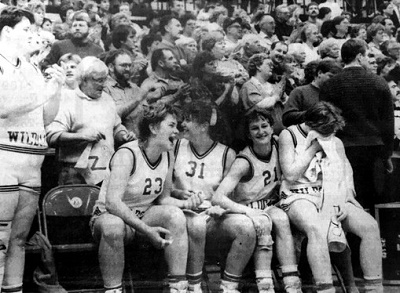 Slowik scored 28 in their 67-52 Semifinal win over DeTour, as the Wildcats advanced to the championship.
“It was just strange that the next year we would be one of the teams playing,” added Claeys. “It was a lot of fun, but it didn’t seem real. Everyone fell into roles, and everything just clicked.”
“Starters and non-starters, all the supporting cast contributed,” said Patton. “No one cared who scored.”
Slowik caught much of the media spotlight as her 99 points over the final three rounds of the tourney set a state mark that still stands today. The total topped the previous mark of 88 points scored by Detroit Northeastern’s Helen Williams in 1975. Slowik’s total was matched by Detroit Country Day’s Peggy Evans in 1989.
Slowik scored 33 points in the Final – a point shy of the then-tournament record for scoring in a championship game – while leading the Wildcats to a 65-59 win over Martin before a packed house of nearly 3,000. The 5-foot-8 forward grabbed 13 offensive rebounds and 16 total, tops in the game.
“We beat No. 1. We were No. 2 in the final poll, so it was considered an upset. But we didn’t necessarily think it was an upset,” exclaimed Claeys laughing and enjoying the memory.
Martin had jumped out to a 19-11 advantage with under a minute to play in the first quarter, led by 5-foot-11 all-stater Julie Davis, who scored 11 of her team’s points. Davis would finish the day with 31.
The 1987 season was the first with the 3-point shot, and Patton was the one girl for Walkerville who had the green light to shoot them anytime she was open. The lightning-quick guard knocked down three of four 3-point shots early and helped to close that gap. The Wildcats were down by only two, 33-31, at the intermission.
“Coach was happy,” said Claeys. “He felt since it was close, we had a chance. We were very fast. If we got into a shootout, we had good outside shooters.”
“I was so pleased at the half that all I did was hug all the girls,” said Gregwer at the time. “We looked to be five points down at the half. If we had been down by more, it wouldn’t have been in our game plan.”
Martin pushed the lead to six, 41-35, on a baseline jumper by Davis with 3:43 to go in the third quarter. But the Wildcats rallied back and the teams were deadlocked, 43-43, entering the fourth. A pair of unexpected buckets late in the game by 5-foot-3 junior Carolyn Brondstetter, the first player off the bench for the Wildcats, put Walkerville up 58-55. It was a lead they wouldn’t relinquish.
The team finished the season with a flawless 28-0 record.
Genealogy roots run deep in small villages like Walkerville, and the championship was celebrated by many with ties to past girls and boys teams. Perhaps the title and the undefeated mark meant the most to the fathers of Slowik, Patton and starting guard Stacy Aiken. Each of the men had been part of the boys program during the long losing streak.
The ride home along the backroads was long, and included tons of well-wishers, pulled off to the side, blasting their horns as the team bus rolled by. Slowik earned first team all-state honors from The Associated Press and the Detroit Free Press at season’s end. In the spring she won two MHSAA track titles and then was off to college.
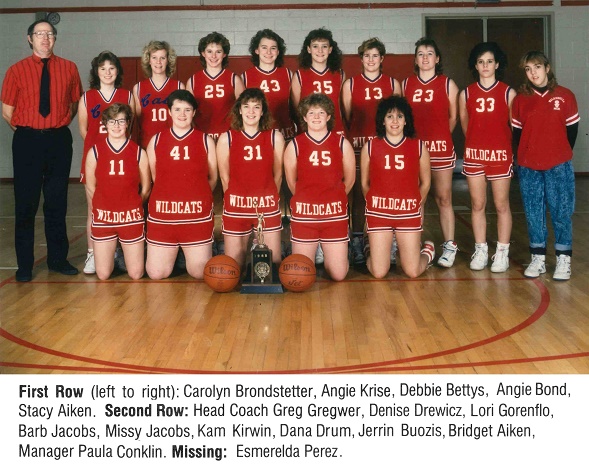
Come the 1988 season, the team’s win streak ended quickly. Early in September, the reigning champs lost their season opener to Kent City, 66-43. Combined with the loss of Slowik to graduation after the 1987 run, statewide expectations fell surprisingly fast.
“After that (first) game I thought, ‘This is going to be a long season. I felt so bad,’” said Claeys, recalling the moment for a Detroit Free Press reporter a few months later.
The team dropped a game to West Michigan D League rival Mason County Eastern in late September, falling to 1-1 in conference play and 6-2 for the season.
“That was tough,” said Patton. “Debbie picked it up a lot. Everyone stepped it up.”
“It just took a while to find our own identity,” said Claeys recalling the challenge. “Then we were good to go.”
The Wildcats didn’t drop another regular-season game that fall, but throughout the span remained unranked in the weekly Detroit Free Press prep rankings and the regular poll conducted by the Basketball Coaches Association of Michigan. Gregwer played up the fact that the team wasn’t getting any respect.
“That inspired me,” said Patton. “Scoring didn’t motivate me. I worked hard and wanted to show other teams that we were real; that we weren’t just some little hick town.”
“Walkerville’s good. I have no idea why they’re not ranked,” said Mason County Eastern coach Kristy Stark following her team’s defeat at the hands of the Wildcats in the Class D Regional Finals. Eastern was ranked 17th in the final coaches poll. Freesoil, another conference foe who was twice beaten by the Wildcats, finished as an honorable mention in that poll.
“They should be in the Top 10 – especially with their reputation from last year,” Stark added. “If they play like they did tonight, they should go quite far. They’re peaking right now, and they look good.”
Claeys, now a senior, finished with 24 points and 16 rebounds in the game, while Patton added 13 points. Brondstetter, now a starter, scored 10 as did backup Missy Jacobs, a freshman who was 6-for-7 at the free throw line.
Once again, the Quarterfinal contest, also played at Wexford, nearly upset the path to glory.
 With 2:33 remaining, Walkerville had lost Patton to fouls. Claeys had played like an All-American, scoring 31 points on the night including 12 of the Wildcats’ 17 points in the fourth quarter, but the outcome of the game with Maple City Glen Lake hinged on the shoulders of Jacobs. The freshman was sent to the foul line with the game knotted 57-57 with 34 seconds to play, and hit the first free throw of a one-and-one opportunity.
“After Jacobs’ second free throw missed the mark and bounced off the rim, Glen Lake rebounded the ball and had two more shots to win the game,” wrote Don Vanderveen for the Muskegon Chronicle, “but missed them both.”
“They had a player that hasn’t played much step up to the foul line, and I felt good about that. But then she canned it,” said Maple City coach Ted Swierad about the 58-57 defeat. “Let’s hand it to those girls from Walkerville. I can’t understand why they’re not rated.”
Patton posted the first triple-double in MHSAA title game history, scoring 14 points, dishing out 11 assists and grabbing 10 rebounds, as Walkerville cruised to a 70-52 win over Portland St. Patrick. Claeys poured in 30 points to become the eighth player in Finals history to reach the 30-point plateau. (Two other players would join that exclusive club by the end of the day.) Stacy Aiken added 20 points.
Claeys earned first team all-state from the AP and second team honors from the Free Press, while Patton was named to the fourth team by the Free Press and was an honorable mention by AP. (A year later as a senior, Patton would earn first-team AP all-state and second team honors from the Free Press.)
“The whole gym was packed; look at the photos. It took so long to get back home. Car after car. Sirens and car horns. All the way from GVSU,” remembered Patton. “I loved to ride the bus together, the team atmosphere, listening to music together.”
The school celebrated the 30-year anniversary of the championships this past January, inviting team members back for a dinner, a meeting with the current team and an introduction at the game.
“I still have my MHSAA sweatshirt, so I wore that,” Claeys said, reminiscing about the time.
“(Both years) we had escorts all the way back,” she continued. “We went the long way. We were tired and hungry, and I remember that first year, my sister Beth (the team’s starting center) joked, ‘We’re never getting off this bus.’”
“We just wanted to get home.”
 Ron Pesch has taken an active role in researching the history of MHSAA events since 1985 and began writing for MHSAA Finals programs in 1986, adding additional features and "flashbacks" in 1992. He inherited the title of MHSAA historian from the late Dick Kishpaugh following the 1993-94 school year, and resides in Muskegon. Contact him at [email protected] with ideas for historical articles.
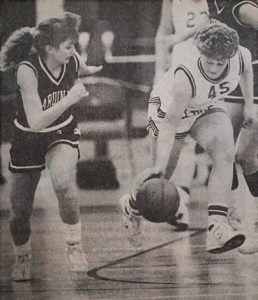
PHOTOS: (Top) Walkerville's 1988 girls basketball team celebrates its second straight Class D title. (2) Angela Frick (21) and her team take on Martin and star Julie Davis (22) in 1987. (3) Coach Greg Gregwer calls the shots from Walkerville's bench. (4) The 1987 Walkerville team. (5) The Wildcats celebrate their 1987 championship game win. (6) The 1988 Walkerville team. (7) Angie Bond (45) pushes the ball upcourt against Johannesburg-Lewiston during the teams' 1987 tournament matchup. (Photos collected by Ron Pesch.)
Glen Lake 'Slams the Door' on 1st Finals Championship Since 1978
By
Paul Costanzo
Special for MHSAA.com
March 18, 2023
EAST LANSING – The motto this postseason for the Maple City Glen Lake girls basketball team was “Slam the door.”
But at halftime of Saturday’s MHSAA Division 4 Final against Baraga, the Lakers still had to find their own way through it.
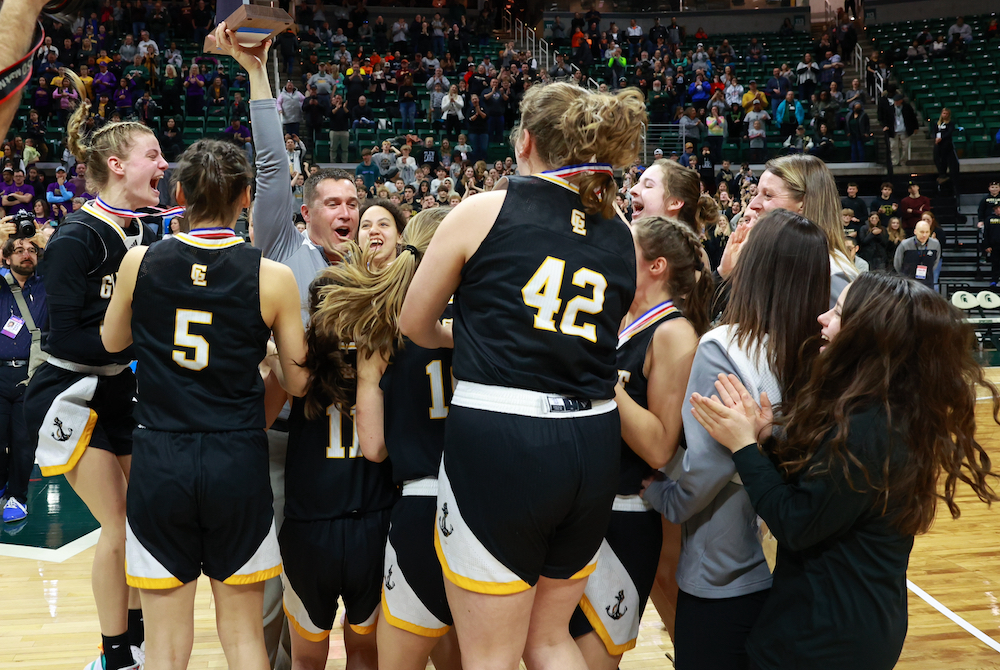
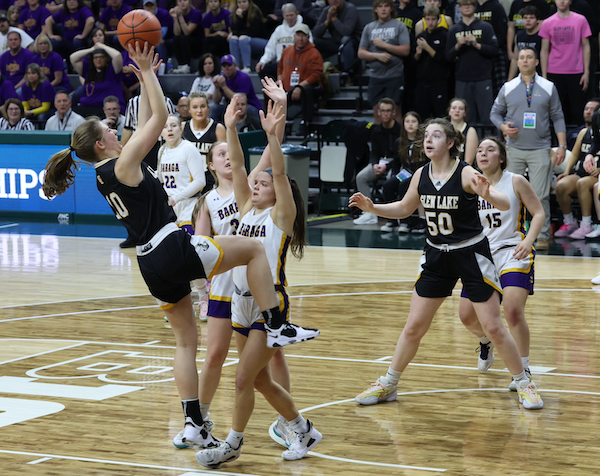
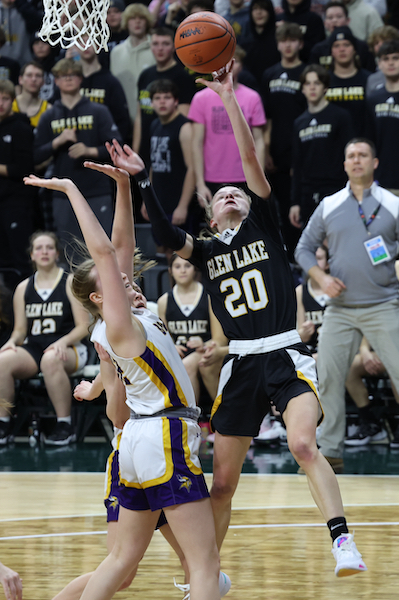
Thanks to suffocating second-half defense and the inside-outside combination of seniors Ruby Hogan and Maddie Bradford, Glen Lake ran through and slammed the door on a 60-43 win, claiming its first Finals title since 1978.
“We knew we had to come out in the second half like we had in the past few games and just take it to them and be focused,” Hogan said. “Work on our offense, work on our defense and don’t foul them. Then things would come our way. Our motto for the postseason has been ‘Slam the door’ and we definitely have been a second-half team this postseason. Today we proved that again.”
Hogan had 19 points, seven rebounds and five assists for the Lakers, who were making their first Finals appearance since 1979.
“It’s amazing,” said Glen Lake senior guard Gemma Lerchen, who had six assists. “It’s unbelievable to finally be able to get it done. It’s been forever that we’ve worked for this. Through the summer, through the whole year. It just feels so good to get it done.”
 Glen Lake coach Jason Bradford, who is in his 15th season at the helm, was well aware of the program’s history and the Finals drought.
His teams have had plenty of success, winning more than 280 games and stepping up their postseason success in recent years, winning Regional titles in five of the past seven seasons.
And when he woke up to hear those traveling from Glen Lake would have to brave a snowstorm to get to the Breslin Center, he became even more confident this could be the year.
“Like I said on Thursday, it seems like the stars were all lining up,” he said. “It’s been 45 years, and 45 years ago, there was a snowstorm (on the day of the Final). My wife called just after 6 (a.m.) and said they were a bit behind with the snowstorm. I looked out the window and I was like, ‘That’s a good sign.’ But it’s unbelievable. We knew we were capable of doing it.”
Maddie Bradford, Jason’s daughter, led all scorers with 28 points. She also had eight rebounds. Eleanor Valkner added 11 rebounds.
Sixteen of those points, and 17 of Hogan’s, came in the second half as the Lakers turned the tide in a game during which they trailed by five at halftime.
“I just focused on, if I’m not open and not able to hit those shots, I trust my team,” Hogan said. “That’s what I need to do and that’s what all of us need to do, is trust each other. If I’m not open and I’m not hitting my shots, then Maddie can and Jessie (Pugh) can and Olivia (Mikowski) can. I know that I’ll have my time when I’m needing to make shots. But in the first half, it just wasn’t my time. It was my time to play defense and my time to pass the ball.”
The first half was the time for Baraga star guard Corina Jahfetson to hit shots, as she scored 14 of her 20 points in the opening 16 minutes, including four 3-pointers. Glen Lake held her to six points and 2 of 15 shooting, including 1 of 12 from 3, in the second half.
 “It was not really the attention factor, I was just not feeling it in that second half,” Jahfetson said. “I kept trying to push it through and do what I had to do.”
As a team, Baraga struggled from the field in the second half as Glen Lake’s defense improved. The Vikings (23-6) were 4 of 22 from the field in the second half, and went scoreless for more than 5 minutes at one point in the third quarter.
“We came out better than we usually do in the first half,” Baraga coach Tyler Larson said. “We’re used to playing from behind in a lot of games. I thought we had a great start, things were falling in our favor. We came out in the second half, they made some good adjustments, credit to them. Some of the size factor played in there. I think we needed to do a better job boxing out, and transition points that we didn’t want to let up. That’s a good ballclub right there that we just played, and our girls fought to the end. Just really proud of what they’ve done this game and all season long.”
Makenna Hendrickson had 14 points for Baraga, while Jahfetson added seven rebounds to her 20 points in Baraga’s first Finals appearance.
“It means so much to be here sitting with these girls and coach Ty,” Jahfetson said. “I’m happy that we’re state runner-up. It would have been amazing to be No. 1, but not everything works out that way.”
PHOTOS (Top) Maple City Glen Lake celebrates its Division 4 championship Saturday as coach Jason Bradford presents the trophy to his team. (Middle) The Lakers’ Maddie Bradford (10) works to get up a shot while defended by Jaycee Larson. (Below) Ruby Hogan (20) gets to the basket.