

Westwood Sets Sights on Past Heights
December 20, 2018
By Dennis Grall
Special for Second Half
ISHPEMING – The Westwood Patriots do not have a senior on their girls basketball roster and only two players stand as tall as 5-foot-9.
 But don’t overlook this team.
Five juniors who played extensively a year ago provide the leadership and experience, while two sophomores and a promising freshman show excellent potential in the challenging Mid-Peninsula Conference. And they play for a team that is steeped in tradition and success, including a 2003 Class C championship.
Kurt Corcoran, a former Westwood cager, is in his seventh season as head coach. His assistant coach is Irv Dieterle, who is second in the Upper Peninsula among boys basketball coaches with 555 wins. Corcoran played for Dieterle in the 1990s.
“Irv is one of my very best friends in life now,” said Corcoran. “At times I was so angry and frustrated with him as a teenage boy. Now we can sit over a cup of coffee and laugh and laugh and laugh.
“I have the best assistant coach possibly in the nation. I feel very privileged to have him as a friend, assistant and mentor.”
Dieterle provides suggestions at halftime or when asked on the bench. “I would be crazy not to heed his advice,” said Corcoran, who is in charge of this team.
With the lack of size, the Patriots use solid defense and rely heavily on the shooting skills of junior Madi Koski, a three-year starter who was all-conference and All-U.P. as a freshman. In their most recent game, Dec. 18, Koski scored 21 points and hit two 3-point baskets to help subdue Gladstone 50-32.
“Madi is a stone-cold killer when it comes to scoring,” said Corcoran. “I’ll put her shot up against anybody (in high school).”
Her sister Jillian is a freshman with outstanding promise playing like most freshmen riding the roller coaster of success and mis-adventures. She did not score against Gladstone but had 17 points against archrival Ishpeming on Dec. 10.
“They are not the same player. Jillian will sacrifice her body, but Madi is a little more reserved diving into those (piles of) bodies,” said Corcoran. “(Jillian) is a real good ball handler, probably one of the best I’ve seen, but she needs to get stronger and catch up to the speed of the game.”
Jillian Koski has been a point guard since forever but is now at shooting guard, with her sister at the point. “(Jillian) is not on anybody’s radar yet (but) she is catching up with the speed of the game. That takes at least 10 games,” said Corcoran. “She lets the game come to her. Madi has to score. Madi facilitates the game. She wears many hats (scoring, passing, defending).”
 He said the young sisters “really have just one goal in common, and that is to win.”
Corcoran is trying to restore Westwood to the level of long-ago years when the Patriots were always among the Upper Peninsula’s elite teams under veteran coach Tom Hammar (nearly 400 career wins) and with such standouts as Sarah Stream and Megan Manninen, who both played in the Great Lakes Intercollegiate Athletic Conference for Michigan Tech and Lake Superior State, respectively. Jessica Racine also played at Tech, and Chelsea Wealton was another standout.
Two years ago, the Patriots beat unbeaten Norway and all-stater Jordan Kraemer, and last year they beat unbeaten neighbor Negaunee in the District opener. Negaunee and Westwood, two of the best teams in the peninsula this season, will collide in the tourney opener in March after two regular-season league matchups.
“With the guard play we have now and in the future, our goals are set high,” said Corcoran. “But we have to get past that first game to even get out of Districts. I’d be lying if I didn’t say we have our sights set on making a run downstate. They have paid their dues; they want a state championship. That is not a secret, but that is also Negaunee’s goal and West Iron’s goal. That is everyone’s goal.”
Reaching that height would be a big change from where the Patriots were a couple of years ago. The Pats were 5-15 when Madi Koski and fellow junior standout Tessa Leece were in eighth grade.
“As freshmen, they came to a struggling program that had been down in the dumps. They were given the keys to the Cadillac as young teenagers and they really were not ready,” said Corcoran.
But the two frosh made an immediate impact and Corcoran said “from that moment forward the program took a turn for the better. They got to 12 wins and beat 18-0 Norway. (Madi Koski and Leece) are the lead dogs and are really comfortable in their lead roles. They really stepped into a big hole in the program.”
He said his junior aces spend 365 days a year in the gym, and that hard work is catching on with their teammates, such as junior Karlie Patron and sophomore Ellie Miller.
Leece’s sister Mallory is a freshman on the school’s junior varsity. With low numbers (eight varsity players, nine jayvees), the younger Leece stayed with the jayvees but could join the varsity for the postseason.
Corcoran said he is seeing many long-time Westwood fans returning to the gym as they hear about the program’s revival. “We’re turning heads a little bit and people are starting to notice,” he said, admitting that also generates pressure from parents, fans and administrators.
He pointed out the Westwood school district was born in 1974 through a consolidation that brought in students from Champion, National Mine and Michigamme. “Westwood is not a town,” he said of the area west of Ishpeming that covers about 700 square miles of woodlands and water and consists of multiple generational Westwood school families.
With just 17 girls in the basketball program, Corcoran was asked about the future of girls basketball, which in the U.P. has just seven freshmen teams.
He said youth travel programs have made a big impact in recent years – and goals can become misplaced on winning tournaments instead of how many players enjoy the sport enough to continue on into high school.
“They play little (weekend) tournaments and everybody has fun, they have pizza parties at their hotel. Then they get to the high school level and coaches hold you accountable," Corcoran said. "We practice seven days a week, there are no pizza parties, no trophies. They’re in ninth grade and they already have a seven-year career and they’re not having fun anymore.”
“Basketball is a way of life up here and we take it seriously. With that comes a lot of hard work, too.”
 Denny Grall retired in 2012 after 39 years at the Escanaba Daily Press and four at the Green Bay Press-Gazette, plus 15 months for WLST radio in Escanaba; he served as the Daily Press sports editor from 1970-80 and again from 1984-2012 and currently is in a second stint as the interim in that position. Grall was inducted into the Upper Peninsula Sports Hall of Fame in 2002 and serves as its executive secretary. E-mail him at [email protected] with story ideas for the Upper Peninsula.
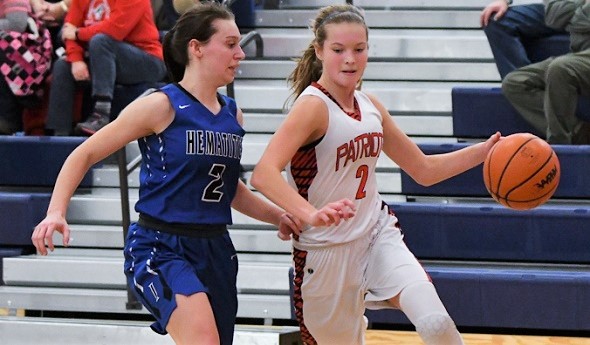
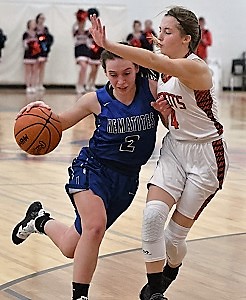
PHOTOS: (Top) Westwood's Tessa Leece (2) drives to the basket while Ishpeming's Emma Poirier defends last week. (Middle) Poirier (2) is pressured by Westwood's Jillian Koski as she heads to the basket. (Photos by Cara Kamps.)
Breslin Bound: Girls Report Week 2
December 11, 2012
By Geoff Kimmerly
Second Half editor
We're only two weeks into this girls basketball season. But there are plenty of teams that already can take pride in strong starts that either are continuing on last season's success or showing a nice turnaround after a rough run.
Some of those are highlighted in this week's report. Remember, what's below isn't any sort of statewide ranking – merely a top-10 list of notables from last week.
Records and results are through Sunday and based on those found at MHSAA.com. Click on Score Center to follow scores throughout the week and enter those of the games you attend.
1. Concord (3-0) – Most of the key pieces to last season’s Class C Semifinalist team are back, and they earned a pair of close wins. Concord edged Michigan Center 36-32 – after also beating Michigan Center in overtime in the District opener last season – and then got past Homer 37-35.
2. L’Anse (4-0) – The Purple Hornets are again off to a nice start – with a bonus. According to the Houghton Daily Mining Gazette, L’Anse’s 60-56 win over Houghton gave Houghton its first loss to a team from the state’s four northernmost counties since Nov. 2, 1999. Click to read more from the Daily Mining Gazette.
3. Westland John Glenn (2-0) – The Rockets got off to a strong start with a 66-34 win over Grosse Pointe North and then a 63-56 victory over Dearborn Divine Child. Divine Child is coming off a trip to the Class B Semifinals.
4. Grand Rapids South Christian (3-0) – Two of the Sailors four losses last season came to Grand Rapids Catholic Central. They haven’t played GRCC yet, but did edge Grand Rapids Christian 50-46 just three days after the Eagles beat GRCC by six.
5. Marshall (3-1) – This returning Class B Quarterfinalist added a strong week to a solid start. First, Marshall topped Richland Gull Lake 48-44 – Gull Lake won its Class A District last year – and then the Redhawks finished the week with a 46-33 win over Battle Creek Central.
6. Pontiac (2-0) – The Phoenix were a .500 team last season, but are off to a quick start thanks to two close wins. Pontiac beat Waterford Mott 49-45 and then Harper Woods Chandler Park 57-55.
7. Manchester (4-0) – The Flying Dutchmen have beaten every opponent by at least 10 points this season, including Onsted 59-40 and Napoleon 64-34 last week. Napoleon entered 3-0.
8. Bloomfield Hills Marian (2-0) – Marian is off to a solid start after beating annual Class A power Canton 44-30. Marian opened by beating Grosse Pointe North two weeks ago.
9. Athens (3-0) – The reigning Class D runner-up is off to a fast start again. Athens opened last week by beating Climax-Scotts 55-44, then survived a close one against Reading, 37-31.
10. Saginaw Heritage (2-2) – The Hawks bounced back from two losses during the first week to even their record by beating Arthur Hill 54-35 and Bay City Western 51-14. Heritage lost to Arthur Hill by 17 in their game last season.
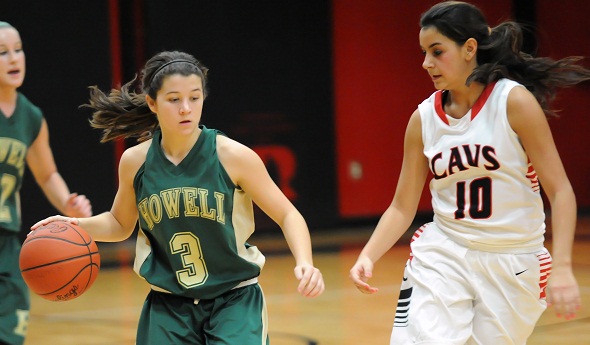
PHOTO: Howell junior Meredith Wood works to get around a defender as the Highlanders pushed toward their first win of the season, 60-48 over Carrollton on Thursday. (Click to see more at HighSchoolSportsScene.com.)