

Young Grass Lake Grows Into Contender
March 2, 2019
By Doug Donnelly
Special for Second Half
GRASS LAKE – Some coaches go a whole career without ever knocking off a No. 1-ranked team.
 The Grass Lake Warriors and head coach Andrea Cabana have done it twice in a month.
“And, we are just babies,” Cabana said of her youthful squad. “I think it really boosts our confidence. It gives us an idea of what we are capable of.”
The Warriors, who have been sneaking higher and higher into The Associated Press Division 3 rankings all season, are capable of just about anything with the MHSAA Tournament beginning this week. They have won 16 consecutive games since a December loss to Division 3 No. 1 Michigan Center. Included in that streak is two wins over a solid 14-5 Manchester squad, a rematch win over Michigan Center on Feb. 1 and a 64-53 win over Division 4’s No. 1 Adrian Lenawee Christian last week.
“It’s exciting,” said Cabana. “We are playing very well right now.”
On Thursday, the Warriors took care of business quickly, racing out to a 31-2 lead over Addison in a game that would clinch the Cascades Conference outright championship. Grass Lake won 64-36 to put the lid on a 19-1 regular season.
Success is certainly nothing new for Grass Lake. But this season’s rise to 19-1 can be considered somewhat of a surprise since the team, coming off an 18-5 season, had just one player returning with a lot of high school basketball experience – sophomore Abrie Cabana. She’s surrounded by two freshmen, a fellow sophomore and a junior.
“We’re not babies at this time of the year,” Coach Cabana said. “We’ve grown up.”
The Warriors have done it with a solid combination of lock-down defense and a high-powered offense. They average 56.4 points a game and allow just 29.6 a contest. The defense has allowed 20 or fewer points in a game seven times this season, and one opponent didn’t reach double figures. On the other end of the court, the Warriors have 11 games scoring above 60 points.
Lenawee Christian won the Class D championship a year ago and has been the No. 1-ranked team in Division 4 most of the season. The Cougars lost to Michigan Center to start the season and Grass Lake last week for their only two losses. Head coach Jamie Salenbien said Grass Lake has all of the pieces to make a long tournament run of its own this year.
“They have a high basketball I.Q.,” Salenbien said. “They are balanced with kids who can shoot it deep, and they get to the basket. They are well-coached and have a lot of weapons.”
Cabana called that win a total team effort.
“Lenawee Christian is a great team,” she said. “They have a handful of great players. We knew it was going to take a great effort. We went in real focused, and things went our way in the end.”
 Abrie Cabana, the 5-foot-10 daughter of Coach Cabana, leads the team in scoring and most statistical categories. Although just a sophomore, she verbally committed to play college basketball at Grand Valley State University last fall. She had other offers, including from the Division I level, but chose the Division II Lakers over them all.
“She’s probably our vocal leader,” Cabana said of her daughter. “She’s played a ton of travel ball. She’s the most experienced high school player on the team.”
Her backcourt running mate, Lexus Bargesser, is only a freshman but already plays at a high level.
“She’s almost identical to Abrie,” Cabana said. “She’s a little smaller, but she’s quick and gets to the hole quick. She’s a very sound player. We are very strong at the guard position. They are both strong outside the 3-point line and inside. They are hard to handle.”
Freshman Gabrielle Lutchka (6-0) is also an imposing figure at both ends of the court for Grass Lake.
“She’s been our game changer,” Cabana said. “She handles the other team’s big player. When she is playing well, we play well.”
In the win over Lenawee Christian, Lutchka scored 13 points and grabbed seven rebounds. She also drew the primary responsibility of guarding LCS’s Bree Salebien, the reigning AP Class D Player of the Year.
Other Warriors, such as Amber Boomer, Faith Patania and Lauren Pongracz, play big roles as well.
“They do a real nice job of playing to their roles, playing to their strengths,” Cabana said.
While young, Cabana said, the girls already have played a lot of basketball.
“A lot of our girls play travel ball,” Cabana said. “They are very experienced players. They’ve played a lot of basketball.”
Cabana is from the Jackson area but has lived in the Grass Lake district for about 20 years. She got her start coaching her oldest daughter – now a sophomore on the Spring Arbor University team – when she was in the third grade. The Warriors are 55-13 during her tenure, and the future keeps looking brighter.
“There was an opening in the middle school, and I coached that for three years,” Cabana said. “Then there was an opening as the JV head coach and I did that for two years, and this is my third year with the varsity.”
Grass Lake will open District play with Lenawee County Athletic Association champion Brooklyn Columbia Central. Looming on the other side of the Napoleon bracket is the likes of Michigan Center and Manchester.
“This time of the year,” Cabana said, “nothing is easy.”
 Doug Donnelly has served as a sports and news reporter and city editor over 25 years, writing for the Daily Chief-Union in Upper Sandusky, Ohio from 1992-1995, the Monroe Evening News from 1995-2012 and the Adrian Daily Telegram since 2013. He's also written a book on high school basketball in Monroe County and compiles record books for various schools in southeast Michigan. E-mail him at [email protected] with story ideas for Jackson, Washtenaw, Hillsdale, Lenawee and Monroe counties.
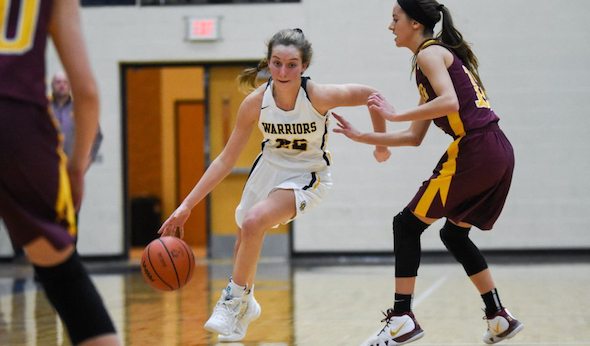
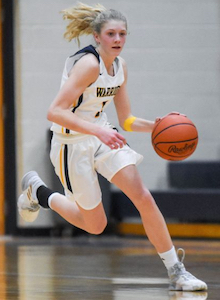
PHOTOS: (Top) Grass Lake’s Abrie Cabana pushes the ball upcourt against Manchester this season. (Middle) Teammate Lexus Bargesser looks for an opening. (Photos courtesy of the Grass Lake girls basketball program.)
Breslin Bound: Girls Report Week 3
December 17, 2012
By Geoff Kimmerly
Second Half editor
As a general rule, basketball teams evolve plenty between the first games of December through the final regular-season contests in February.
But these pre-break matchups matter just as much in the win-loss columns. And a number of games are being played right now that will surely make a difference as this season draws to a close.
This week's report includes some of the teams that have came out on the winning ends of key December battles. (Results and records based on those reported to Score Center at MHSAA.com)
1. Inkster (4-0) – The Vikings are a regular at Breslin Center and made the Class A Semifinals last season, so another great start is hardly surprising. But it's proof why Inkster remains a force – last week’s wins were 51-45 over improved Detroit Mumford and 57-51 over always-powerful Detroit Pershing.
2. Waterford Our Lady (3-1) – The reigning Class D champion has bounced back quickly from an opening-night loss to West Bloomfield. Last week, Our Lady beat Livonia Ladywood 50-38 and Mount Pleasant Sacred Heart by the same score.
3. Detroit Martin Luther King (3-0) – This is another team always in the Class A mix, and it got a big win Saturday – 56-48 over returning Class A Semifinalist Ann Arbor Huron, which earlier in the week had defeated Detroit Country Day 65-58. King also beat Detroit East English 61-7.
4. Johannesburg-Lewiston (5-0) – The Cardinals lost only two regular-season games last season, both times to Ski Valley Conference rival Gaylord St. Mary. But they got a little bit of revenge last week with a 50-48 win over St. Mary after also beating East Jordan 57-43.
5. Holt (5-0) – The Rams are again setting up nicely to contend in the strong Capital Area Activities Conference Blue. They beat nonleague foe St. Johns 52-48 and then Lansing Everett 48-39 to keep early pace with other frontrunners Grand Ledge and East Lansing.
6. Napoleon (5-1) – Napoleon’s 15-7 finish in 2011-12 included splits against Michigan Center and Grass Lake. The Pirates got an early upper hand on both last week, beating Michigan Center 49-45 and Grass Lake 47-42.
7. Traverse City St. Francis (4-1) – The Gladiators opened last season 14-1, with that lone loss to Cadillac – which they beat last week 55-50. St. Francis also defeated Kalkaska 44-36 on Friday.
8. Pewamo-Westphalia (3-2) – The Pirates got off to a rough start with opening-week losses to Class B Williamston and Lakewood. But back in familiar territory in the Central Michigan Athletic Conference, they've won three straight – including 51-42 last week over returning Class D Semifinalist Portland St. Patrick.
9. North Farmington (3-1) – The Raiders are coming off a 10-12 season that included a pair of losses to Pontiac. But North Farmington earned the early edge this time with a 59-58 win over Pontiac, followed by a 58-48 win over West Bloomfield.
10. Powers North Central (5-1) – After opening with a 13-point loss to returning Class D Semifinalist Crystal Falls Forest Park, North Central hasn't fallen again. The Jets beat Stephenson 62-51 and Munising 50-22 to get nearly halfway to last season’s win total of 11.
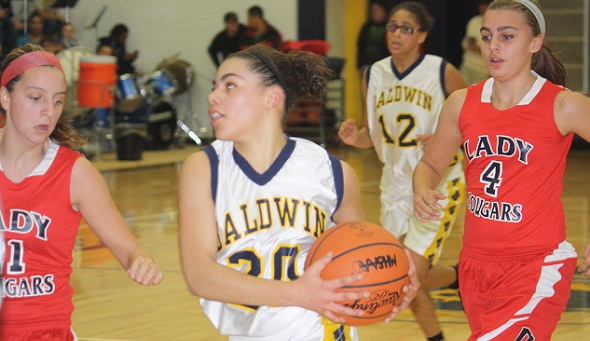
PHOTO: Big Rapids Crossroads (in red) defeated Baldwin on Thursday to move to 4-0 this season. (Click to see more at HighSchoolSportsScene.com.)