

Be the Referee: Cross Country Uniforms
By
Paige Winne
MHSAA Director of Brand Management
September 10, 2024
Be The Referee is a series of short messages designed to help educate people on the rules of different sports, to help them better understand the art of officiating, and to recruit officials.
Below is this week's segment – Cross Country Uniforms - Listen
Today we’re talking roster sizes and uniforms in cross country.
In the regular season, a school can enter a maximum of 12 competitors, and the top seven contribute to the school’s score. In the postseason, schools can enter a max of seven runners, with the top five contributing to the team score.
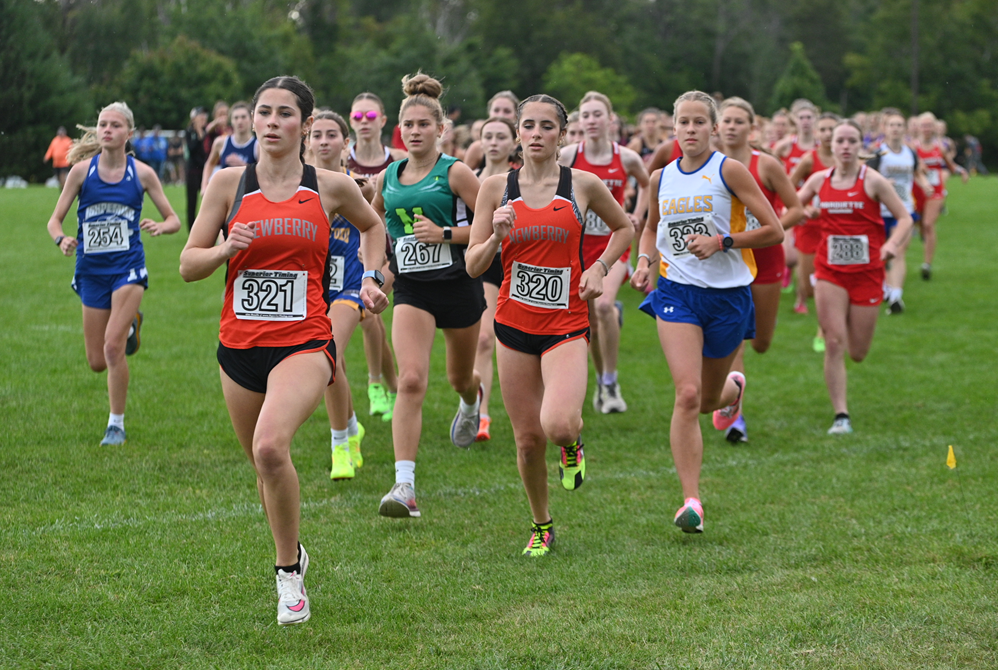
In the past, all members of a team had to wear identical uniforms. But that’s no longer the case. Now, each runner must wear a uniform that clearly indicates their team through the use of their predominant school colors, school logo, or nickname. They don’t have to be identical – but the school they are representing must be obvious, and it must be clear who your teammates are.
Something to think about the next time you are getting ready to run 3.1 miles.
Previous 2024-25 Editions
Sept. 3: Soccer Handling - Listen
Aug. 24: Football Holding - Listen
PHOTO Newberry's Samantha Taylor (321) and Abby Taylor (320) lead the beginning of the Wildcat Invite last month at Northern Michigan University, with Samantha eventually finishing first and Abby third. (Photo by Cara Kamps.)
Soccer Hall of Famer Seitz, NFL Analyst Pereira Headline Officiate Michigan Day 2026
By
Geoff Kimmerly
MHSAA.com senior editor
July 14, 2026
Officiate Michigan Day 2026 will welcome more than 1,000 Michigan High School Athletic Association-registered game officials July 25 to DeVos Place in Grand Rapids, where they will receive knowledge and instruction from several high-profile voices headlined by recent National Soccer Hall of Fame inductee Kari Seitz – a Brighton High School graduate – and one of television’s most recognizable rules analysts, Mike Pereira.
Officiate Michigan Day is designed to benefit officials with any level of experience, veteran to beginner. High-profile clinicians representing several sports and all levels including the NFL, NBA, MLB, NCAA, FIFA and the National Women’s Soccer League (NWSL) will provide face-to-face training during four sport-specific breakout sessions throughout the conference.
Pereira, a past collegiate and NFL football official who also has served as the NFL’s vice president of officiating, will present the opening address at 9 a.m. He has provided his knowledge during FOX Sports football broadcasts since 2010, explaining rules scenarios on-air as situations unfold in-game.
Seitz, also a graduate of Michigan State University, refereed Women’s World Cups in 1999, 2003, 2007 and 2011 and Olympics tournaments in 2004, 2008 and 2012, and will deliver the conference’s closing message. She’s currently the vice president of refereeing for U.S. Soccer and formerly served as FIFA’s heading of refereeing.
This will be the third Officiate Michigan Day, joining events in 2013 and 2018. OMD 2026 will accompany the annual National Association of Sports Officials (NASO) Summit that will take place July 26-28, also at DeVos Place.
Officials may continue to register on the Officials page. Cost is $50. Additional details, including the full lineup of speakers and clinicians, also is available at that link.