

Cedar Springs' Weiler Takes Next Step
November 2, 2013
By Bill Khan
Special to Second Half
BROOKLYN — Kenzie Weiler was satisfied with being the MHSAA Lower Peninsula Division 2 cross country runner-up the last two years.
She knew as well as anyone that nobody was going to challenge two-time champion Julia Bos of Grand Rapids Christian.
With Bos now in college, that left a wide-open race for this season’s Division 2 individual title.
This time, Weiler wasn't going to be content with second place.
The Cedar Springs junior made one final surge with fewer than 100 yards to go, passing Detroit Country Day junior Jackie Bredenberg just before the finish line to win by 0.8 seconds with a time of 17:55.1 on Saturday at Michigan International Speedway.
Weiler finished 18.7 seconds behind Bos last year and 10.4 seconds behind her in 2011. Weiler's times were faster the last two years (17:35.1 in 2011, 17:49.1 in 2012), but a mud-slicked course limited runners' ability to produce personal records Saturday.
"I've gotten runner-up two years in a row," Weiler said. "I really wanted one more (place) this year. I was staying mentally strong. It was a really great day. I'm really happy."
Weiler could appreciate her championship even more after missing track and field season with an injury.
"I decided after missing out on a whole season, I'm just so thankful to run, so thankful to be in the state meet," she said. "I was staying mentally strong. I haven't had a physical change. It's been more mental to be a stronger person."
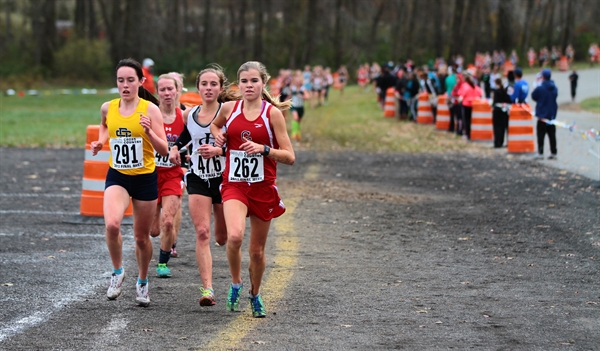
A pack of four runners reached the two-mile mark in 11:30 before Weiler and Bredenberg began to separate themselves. Bredenberg held a slight lead as the two sprinted down the long straightaway at MIS. Just when it appeared Bredenberg would hold on, Weiler found another gear and made the decisive pass.
"I was hoping I didn't start too late," Weiler said. "I trusted myself. It came over me, and I was like, 'I'm not done yet.' It was exciting."
Such a close loss might be difficult to take, but Bredenberg was in good spirits immediately following the race. She didn't come into it figuring to be in the mix for the title.
"I definitely did not expect this," she said. "I've been running since sixth grade. I never would've thought I would come this close. It's definitely motivating to do that extra pool workout every weekend. I could hear her and I was thinking, 'That girl has an amazing sprint.' It was really exciting."
The top six finishers were juniors, with St. Johns' Karrigan Smith in the hunt until late, finishing third in 18:04.0.
Grand Rapids Christian overcame the graduation of Bos to improve upon last year's third-place finish, winning its fifth MHSAA championship and fourth in the last nine years. The Eagles have been in the top five for 12 straight years.
Grand Rapids Christian scored 109 points to win by 96 over Spring Lake. The battle for the runner-up trophy was considerably closer, with 21 points separating second through sixth places.
The Eagles should be favored to repeat, with no seniors among their top six. Junior Rachel Warners led the team, placing sixth among team runners in 19:01.2. Junior Katie Verhulst (12th, 19:15.8), sophomore Claire Brouwer (19th, 19:38.3), junior Lindsey Fox (27th, 19:45.9) and sophomore Leah Bishop (45th, 20:00.8) rounded out the scoring.
PHOTO: Cedar Springs' Kenzie Weiler (262), Detroit Country Day's Jackie Bredenberg (291) and St. Johns' Karrigan Smith (476) lead at the 1.5-mile point during Saturday's LP Division 2 Final at MIS. (Click to see more from RunMichigan.com.)

Kilpela Farm Provides 'Perfect' Setting for 20 years of Jeffers Invitationals
By
John Vrancic
Special for MHSAA.com
September 9, 2022
ATLANTIC MINE — Imagine being able to host a cross country invitational on your own property.
 That’s what Painesdale Jeffers High School head coach Sam Kilpela does every year in late August.
The Jeffers Invitational has been held annually on the Kilpela farm property since 2003.
“My grandparents lived here,” he said. “This farm has been part of the Kilpela family for many years (since the 1890s) and many of their daughters were part of the program. We moved here in 2015, and now it’s up to us to keep the tradition going.
“People ask, ‘You mean you have a cross country course at your farm?’ We have a lot of property, about 40 acres. The starting line is in our front yard, and the finish line is in our back yard. It’s real convenient. We don’t have to drive anywhere to get what we need. We have everything we need right here.”
The course also has received many rave reviews, including a few after the most recent Jeffers Invite which drew 11 schools Aug. 31.
“It’s a beautiful course,” Hancock coach Jen Smith said after the Dale Phillips Invitational in Marquette the next day. “It has that old country feel to it, which makes you feel right at home. It makes you feel real comfortable. We decided to do races back-to-back days because the kids enjoy running on both courses. We didn’t want to miss either meet.”
Dollar Bay junior Amos Norlin, who won the 3.1-mile race at Atlantic Mine in 17 minutes, 50 seconds, had similar thoughts.
“This is one of my favorite courses,” he said. “This is better than running on a golf course. I find I need to look back when we race on a golf course. You’re more hidden here. Only, the downhills and sharp turns tend to bother my ankles.”
Watersmeet senior William Snow, who placed third (18:28), also enjoyed the course.
“I love the tall grass and the ground is nice and soft,” he added. “There’s not a cloud in the sky. It’s perfect for running. I wish I could train on this course. I’m going to miss it.”
The Jeffers boys put a little icing on the cake by winning their invitational for the first time in 13 years with 44 points. Ironwood was runner-up at 58.
“It has been many years,” said Kilpela, who has been coaching for seven. “The kids have been working hard. It’s really good to see their hard work pay off. I’m especially happy for our senior Tavin Larson because he finally got his first win on his home course. We have only five guys on varsity, but they’ve been strong.”
Calumet edged Hancock 55-61 for the girls championship.
 John Vrancic has covered high school sports in the Upper Peninsula since joining the Escanaba Daily Press staff in 1985. He is known most prominently across the peninsula for his extensive coverage of cross country and track & field that frequently appears in newspapers from the Wisconsin border to Lake Huron. He received the James Trethewey Award for Distinguished Service in 2015 from the Upper Peninsula Sportswriters and Sportscasters Association.
PHOTO The Painesdale Jeffers boys cross country team shows off its hardware after winning its invitational at the Kilpela farm Aug. 31. (Photo courtesy of Adams Township schools.)