

Jackson's Janke Recalled as 'Larger than Life,' Always Willing to Help
By
Doug Donnelly
Special for MHSAA.com
January 26, 2022
JACKSON – A few days before Christmas, Jackson boys track & field head coach Corey Pryor was called to meet with Charles Janke, the longtime former Jackson coach and teacher.
 Janke was very ill and in the final days of his life. Janke, it turns out, wasn’t leaving anything to chance.
“He asked me if the stadium was ready for our big track meet, the one named after him,” Pryor said. “Believe it or not, that’s what he asked. He was always so organized and meticulous. He wanted to make sure everything was always on schedule.
“I am grateful for getting the chance to spend a few more moments with him.”
Janke, 85, died Dec. 30 at Henry Ford Allegiance Hospice Home in Jackson.
Janke was a track and cross country coach for Jackson who was recognized statewide for his commitment to high school athletics, student athletes and the two sports he loved the most. Although he retired from coaching nearly two decades ago, he remained very involved in high school sports. He was a leader in both sports across the state, a giant in the high school running community.
A Detroit native who went to Central Michigan University to play football, Janke had short stints at Southfield and Milford schools before moving to Jackson where he taught history and physical education. Although he got his start as a football coach, at Jackson he took over the track and cross country programs in 1966. He pulled double duty for years before stepping down as track coach in 1990, but he continued with cross country through 2003 while helping coach the distance runners in track for several more years.
If it involved track & field or cross country in Michigan, Janke was probably involved. He was an early pioneer in the Michigan Interscholastic Track Coaches Association, the first statewide sports-specific association for coaches in the state. He founded several events, including the first countywide cross country meet in Jackson. He hosted, organized and gave presentations at coaching clinics for years and in the early 1970s helped organize indoor track & field meets through MITCA by contacting colleges across the state to see if they were interested in hosting events. He also was the first to publish a MITCA newsletter.
In cross country, he was among those who played a role in bringing all four classes together for a Lower Peninsula championship meet at Michigan International Speedway in Brooklyn. He helped with the event long after coaching. He also served as head field events judge at Big Ten Indoor Championships and became a high school official after retiring as head coach.
His passion for the sport was evident.
“He had a genuine love for the sport,” Pryor said. “He always had his way of doing things. He was a special kind of guy.”
When Pryor was a high school sprinter at Jackson, Janke was an assistant coach who mainly worked with long distance runners.
“He coached hard,” Pryor said, adding that he never fully appreciated Coach Janke until later in life and especially after he became track coach. Pryor found pages and pages of handwritten notes with dates, times and athletes’ names.
“He even wrote down the weather,” Pryor said.
He and Janke had a lot of discussions, often over breakfast, about track events.
“He would be at almost all of the meets,” Pryor said. “He learned every kid by name. He told them he wanted to see them at the state meet. I welcomed him with open arms. When I began to see just what he meant to our state, I realized this guy was a diamond.
“I was blessed to see him behind the curtain. I saw he was the type of guy who really cared about people and wanted to see them succeed. He was more than a coach.”
Vandercook Lake cross country coach Dan Roggenbaum is one of several from the Jackson area who would seek out Janke for advice and mentorship. He said Janke approached officiating with the same rigor and commitment he did coaching.
“Charlie was always willing to help me out with any questions I ever had,” he said. “He was larger than life to me and most other coaches in our county. He was always willing to help and give advice to any of us who were a lot newer to the cross country and track & field scene.”
Two things Janke was most proud of was Withington Stadium in Jackson and the cross country course at Ella Sharp Park named after him.
“I always admired his love and passion for cross country, track & field,” said Ben Pack, now a coach and administrator at Manchester, but once a shot and discus thrower for Janke. “On days of track meets he would have the track set up before the school day started, with the blocks at the starting line, the hurdles stacked along the track to be placed for the first hurdle race, and the throws event areas lined. Every detail for the practices and meets were paid attention to.
“He didn’t do this because he had to do it; he did it because he loved doing it. He always wanted everything to be first class.”
Janke was admittedly a tough coach.
In winning the Al Cotton Award for his dedication to Jackson athletics, the Jackson Citizen-Patriot wrote this about Janke in 2003: “One does not need to talk to many of Janke's athletes or listen very long to get a clear picture of the type of coach he was. He was intense. He was in charge. He demanded respect and he expected the best, and he received a huge measure of both from those who followed his regimen.”
Janke was inducted into both the Michigan High School Coaches Association Hall of Fame and the MITCA Hall of Fame.
Pack said, “During high school we had a sign that read, ‘The mind controls the body.’ In PE strength class we often did exercises that helped us understand how much more we could push ourselves if we fought off the pain of the exercise. Without question, this built mental toughness. He taught kids how to set goals, and the step-by-step process to get to the goal.”
All told, Janke spent more than 60 years involved in track and cross country. His impact will roll on in both sports. A number of former athletes have gone on to become teachers and coaches themselves, like Pack, who not only was an athlete for Janke but coached alongside him. Pack served as Jackson’s varsity football coach from 1987-2002 and again in 2012.
“As peers we often would guide kids to each other’s sports,” Pack said. “Kids that I felt would be better at running cross country, I sent to him. Kids that he felt would be good football players he sent to me. Working together was an honor.”
Jim Martin ran for Janke at Jackson in the 1970s. He’s now in his 36th year coaching track and cross country, the last 26 at Sault Ste. Marie High School. He said he’s a coach today because of the impact Janke had on him.
“At a time in my life that I needed structure and guidance, he was the rock,” Martin said. “He was always there. There's no way I'm in this (coaching) 35 years without him. He was my role model. He cannot be replaced.”
Last fall, Martin took his Sault Ste. Marie team to Jackson for the Charles Janke Invitational. His Blue Devils team won. Going into the meet, he didn’t think that was possible.
“For the life of me I couldn’t figure out how we won that,” Martin said. “We were good, but not Jackson good. … That was the last time Coach Janke saw my team. Now I know why.”
A Celebration of Life service will be held at 2 p.m. on June 12, 2022, at, appropriately, Withington Stadium.
 Doug Donnelly has served as a sports and news reporter and city editor over 25 years, writing for the Daily Chief-Union in Upper Sandusky, Ohio from 1992-1995, the Monroe Evening News from 1995-2012 and the Adrian Daily Telegram since 2013. He's also written a book on high school basketball in Monroe County and compiles record books for various schools in southeast Michigan. E-mail him at [email protected] with story ideas for Jackson, Washtenaw, Hillsdale, Lenawee and Monroe counties.
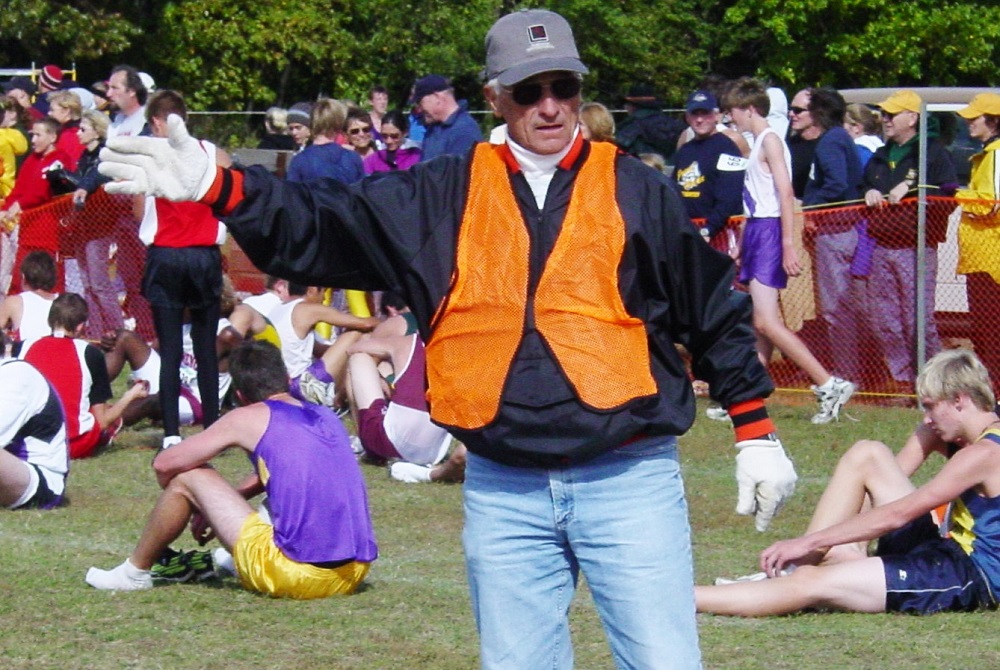
PHOTO: Charles Janke coaches his Jackson team during a cross country meet in 2003. (Photo by John Johnson.)
Performance of the Week: East Kentwood's De-Mani Roberts
May 28, 2026
 De-Mani Roberts ♦ East Kentwood
Sophomore ♦ Track
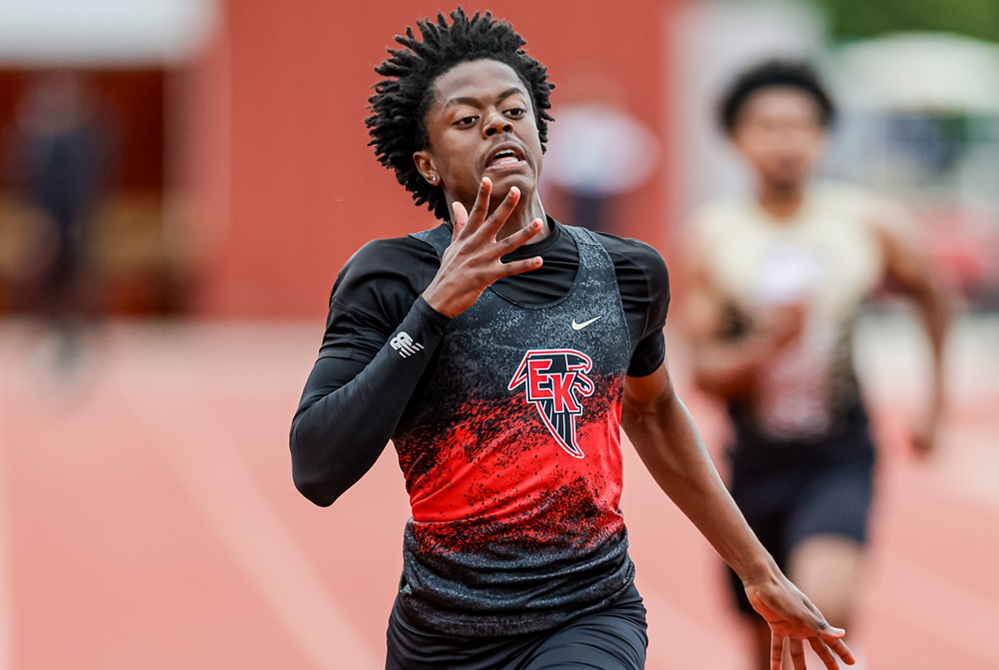
Roberts has made impressive strides in the second season of high school outdoor track, cutting nearly a half-second off his top 200-meter time from a year ago and more than a second off his freshman-year best in the 400 in helping East Kentwood become a favorite to win the team championship at Saturday's Lower Peninsula Division 1 Finals. Roberts won the 200 in a personal-best 21.26 seconds and ran on the winning 800 relay (1:26.83) as the Falcons won the Michigan Interscholastic Track Coaches Association (MITCA) Division 1 team championship last weekend.
That 200 time and his top 400 time of 47.55 seconds are both the fastest in the state in those respective races this spring, all divisions included. Roberts is undefeated in both races, a notable jump even as he finished 14th in the 200 and ran on three top-12 relays at last year's MHSAA Finals. That top 200 time also trails the current LPD1 Finals record by only 25 hundredths of a second, and he could make a run at Finals records in both individual races with half his high school career remaining. Roberts also has run cross country for East Kentwood the last two seasons.
@mhsaasports 🏃POW: De-Mani Roberts #eastkentwood #track #highschoolsports #performanceoftheweek #MHSAA ♬ Bright and fun upbeat pops, Kids, Animals, Pets, Fun, Cute, Happy, Playful, Upbeat(1465232) - SAKUMAMATATA
@mhsaasports 🏃POW: De-Mani Roberts #funfacts #tiktalk #performanceoftheweek #highschoolsports #MHSAA ♬ Girly and cute synth pop - SAKUMAMATATA
Follow the MHSAA on TikTok.
MHSAA.com's "Performance of the Week" features are powered by MI Student Aid, a division within the Department of Lifelong Education, Advancement, and Potential (MiLEAP). MI Student Aid encourages students to pursue postsecondary education by providing access to student financial resources and information. MI Student Aid administers the state’s 529 college savings programs (MET/MESP), as well as scholarship and grant programs that help make college Accessible, Affordable and Attainable for you. Connect with MI Student Aid at www.michigan.gov/mistudentaid and find more information on Facebook and X @mistudentaid.
Previous 2025-26 honorees
May 22: Taleon Guess, Temperance Bedford golf - Report
May 15: Zacchaeus Brocks, Detroit Catholic Central track - Report
May 7: Savanah Thompson, Howard City Tri County soccer - Report
April 30: Eliza Schwass, Ludington track - Report
April 23: Emily Postema, Ravenna softball - Report
April 16: Katie Berkshire, Gaylord track - Report
March 26: Kayla Hairston, Goodrich basketball - Report
March 19: Liam Smith, Otsego swimming - Report
March 12: Jack Sayen, Houghton hockey - Report
March 5: Devin Patrick, St. Clair Shores Lake Shore - Report
Feb. 26: Madison Nieuwenhuis, Plainwell wrestling - Report
Feb. 20: Sophie Ramey, Allen Park competitive cheer - Report
Feb. 13: Cam Ryans, Grand Rapids Northview basketball - Report
Feb. 6: Melanie Kolnitys, Midland Dow basketball - Report
Jan. 29: Stella Musialowski, Huron Valley United gymnastics - Report
Jan. 22: Baylor Perkins, Grand Blanc swimming - Report
Jan. 15: Delaney Vanier, Flint Kearsley bowling - Report
Jan. 8: Stevie Hall, Detroit Cass Tech basketball - Report
Dec. 18: Ethan Martha, Ishpeming Westwood basketball - Report
Dec. 11: Louis Smith, Three Rivers wrestling - Report
Dec. 4: Traverse Moore, DeWitt football - Report
Nov. 28: Elizabeth Eichbrecht, West Bloomfield swimming - Report
Nov. 20: Brady Kieff, Blanchard Montabella football - Report
Nov. 13: Ella Laupp, Battle Creek Harper Creek swimming - Report
Nov. 7: Hunter Eaton, Charlevoix cross country - Report
Oct. 31: Stephen Gollapalli, Lansing Christian tennis - Report
Oct. 23: Talya Schreiber, Pickford cross country - Report
Oct. 16: Avery Manning, Dexter golf - Report
Oct. 9: Brady Van Laecke, Hudsonville football - Report
Oct. 2: Sarah Giroux, Flat Rock volleyball - Report
Sept. 25: Sam Schumacher, Portage Central tennis - Report
Sept. 18: Kaylee Mitzel, Saline field hockey - Report
Sept. 11: Natasza Dudek, Ann Arbor Pioneer cross country - Report
Sept. 4: Kate Posey, Big Rapids golf - Report
PHOTO East Kentwood's De-Mani Roberts runs to a win in the 200 meters at the MITCA Division 1 championship meet. (Photo by Miles Postema.)