

Jackson's Janke Recalled as 'Larger than Life,' Always Willing to Help
By
Doug Donnelly
Special for MHSAA.com
January 26, 2022
JACKSON – A few days before Christmas, Jackson boys track & field head coach Corey Pryor was called to meet with Charles Janke, the longtime former Jackson coach and teacher.
 Janke was very ill and in the final days of his life. Janke, it turns out, wasn’t leaving anything to chance.
“He asked me if the stadium was ready for our big track meet, the one named after him,” Pryor said. “Believe it or not, that’s what he asked. He was always so organized and meticulous. He wanted to make sure everything was always on schedule.
“I am grateful for getting the chance to spend a few more moments with him.”
Janke, 85, died Dec. 30 at Henry Ford Allegiance Hospice Home in Jackson.
Janke was a track and cross country coach for Jackson who was recognized statewide for his commitment to high school athletics, student athletes and the two sports he loved the most. Although he retired from coaching nearly two decades ago, he remained very involved in high school sports. He was a leader in both sports across the state, a giant in the high school running community.
A Detroit native who went to Central Michigan University to play football, Janke had short stints at Southfield and Milford schools before moving to Jackson where he taught history and physical education. Although he got his start as a football coach, at Jackson he took over the track and cross country programs in 1966. He pulled double duty for years before stepping down as track coach in 1990, but he continued with cross country through 2003 while helping coach the distance runners in track for several more years.
If it involved track & field or cross country in Michigan, Janke was probably involved. He was an early pioneer in the Michigan Interscholastic Track Coaches Association, the first statewide sports-specific association for coaches in the state. He founded several events, including the first countywide cross country meet in Jackson. He hosted, organized and gave presentations at coaching clinics for years and in the early 1970s helped organize indoor track & field meets through MITCA by contacting colleges across the state to see if they were interested in hosting events. He also was the first to publish a MITCA newsletter.
In cross country, he was among those who played a role in bringing all four classes together for a Lower Peninsula championship meet at Michigan International Speedway in Brooklyn. He helped with the event long after coaching. He also served as head field events judge at Big Ten Indoor Championships and became a high school official after retiring as head coach.
His passion for the sport was evident.
“He had a genuine love for the sport,” Pryor said. “He always had his way of doing things. He was a special kind of guy.”
When Pryor was a high school sprinter at Jackson, Janke was an assistant coach who mainly worked with long distance runners.
“He coached hard,” Pryor said, adding that he never fully appreciated Coach Janke until later in life and especially after he became track coach. Pryor found pages and pages of handwritten notes with dates, times and athletes’ names.
“He even wrote down the weather,” Pryor said.
He and Janke had a lot of discussions, often over breakfast, about track events.
“He would be at almost all of the meets,” Pryor said. “He learned every kid by name. He told them he wanted to see them at the state meet. I welcomed him with open arms. When I began to see just what he meant to our state, I realized this guy was a diamond.
“I was blessed to see him behind the curtain. I saw he was the type of guy who really cared about people and wanted to see them succeed. He was more than a coach.”
Vandercook Lake cross country coach Dan Roggenbaum is one of several from the Jackson area who would seek out Janke for advice and mentorship. He said Janke approached officiating with the same rigor and commitment he did coaching.
“Charlie was always willing to help me out with any questions I ever had,” he said. “He was larger than life to me and most other coaches in our county. He was always willing to help and give advice to any of us who were a lot newer to the cross country and track & field scene.”
Two things Janke was most proud of was Withington Stadium in Jackson and the cross country course at Ella Sharp Park named after him.
“I always admired his love and passion for cross country, track & field,” said Ben Pack, now a coach and administrator at Manchester, but once a shot and discus thrower for Janke. “On days of track meets he would have the track set up before the school day started, with the blocks at the starting line, the hurdles stacked along the track to be placed for the first hurdle race, and the throws event areas lined. Every detail for the practices and meets were paid attention to.
“He didn’t do this because he had to do it; he did it because he loved doing it. He always wanted everything to be first class.”
Janke was admittedly a tough coach.
In winning the Al Cotton Award for his dedication to Jackson athletics, the Jackson Citizen-Patriot wrote this about Janke in 2003: “One does not need to talk to many of Janke's athletes or listen very long to get a clear picture of the type of coach he was. He was intense. He was in charge. He demanded respect and he expected the best, and he received a huge measure of both from those who followed his regimen.”
Janke was inducted into both the Michigan High School Coaches Association Hall of Fame and the MITCA Hall of Fame.
Pack said, “During high school we had a sign that read, ‘The mind controls the body.’ In PE strength class we often did exercises that helped us understand how much more we could push ourselves if we fought off the pain of the exercise. Without question, this built mental toughness. He taught kids how to set goals, and the step-by-step process to get to the goal.”
All told, Janke spent more than 60 years involved in track and cross country. His impact will roll on in both sports. A number of former athletes have gone on to become teachers and coaches themselves, like Pack, who not only was an athlete for Janke but coached alongside him. Pack served as Jackson’s varsity football coach from 1987-2002 and again in 2012.
“As peers we often would guide kids to each other’s sports,” Pack said. “Kids that I felt would be better at running cross country, I sent to him. Kids that he felt would be good football players he sent to me. Working together was an honor.”
Jim Martin ran for Janke at Jackson in the 1970s. He’s now in his 36th year coaching track and cross country, the last 26 at Sault Ste. Marie High School. He said he’s a coach today because of the impact Janke had on him.
“At a time in my life that I needed structure and guidance, he was the rock,” Martin said. “He was always there. There's no way I'm in this (coaching) 35 years without him. He was my role model. He cannot be replaced.”
Last fall, Martin took his Sault Ste. Marie team to Jackson for the Charles Janke Invitational. His Blue Devils team won. Going into the meet, he didn’t think that was possible.
“For the life of me I couldn’t figure out how we won that,” Martin said. “We were good, but not Jackson good. … That was the last time Coach Janke saw my team. Now I know why.”
A Celebration of Life service will be held at 2 p.m. on June 12, 2022, at, appropriately, Withington Stadium.
 Doug Donnelly has served as a sports and news reporter and city editor over 25 years, writing for the Daily Chief-Union in Upper Sandusky, Ohio from 1992-1995, the Monroe Evening News from 1995-2012 and the Adrian Daily Telegram since 2013. He's also written a book on high school basketball in Monroe County and compiles record books for various schools in southeast Michigan. E-mail him at [email protected] with story ideas for Jackson, Washtenaw, Hillsdale, Lenawee and Monroe counties.
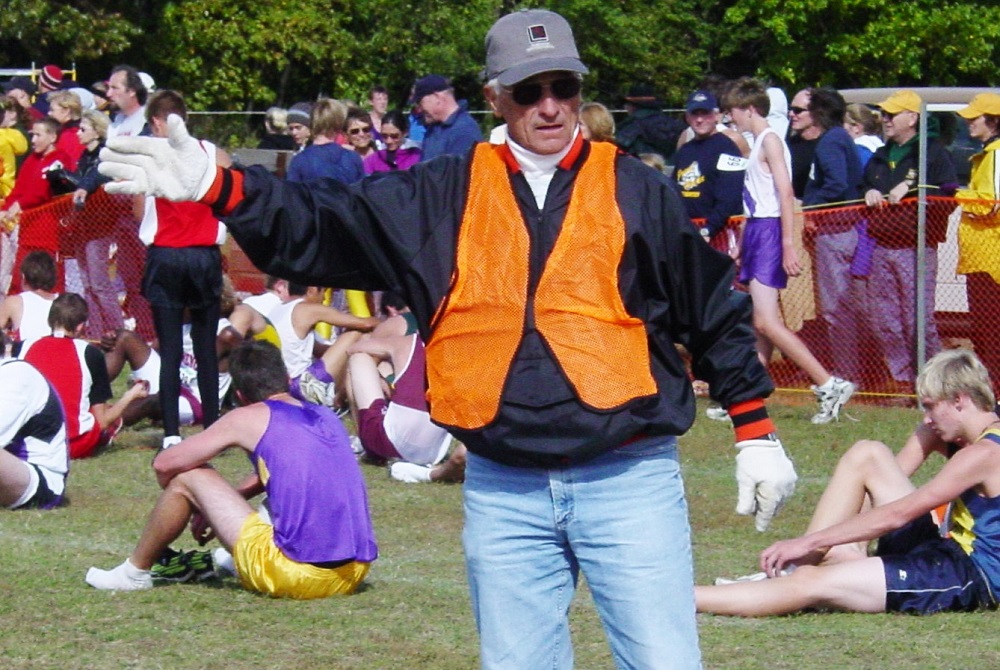
PHOTO: Charles Janke coaches his Jackson team during a cross country meet in 2003. (Photo by John Johnson.)
Preview: Senior Stars Enter Final Stretch
November 1, 2018
By Geoff Kimmerly
Second Half editor
Michigan International Speedway will showcase Saturday the last MHSAA Finals for a pair of the most successful champions all-time in this state.
Hart’s Adelyn Ackley will run for her third individual championship while attempting to lead her team to a repeat in Lower Peninsula Division 3. Rockford’s Ericka VanderLende won last season’s Division 1 individual title with one of the fastest 5K times in Finals history, and she enters this weekend with the state’s fastest time this fall.
A total of 958 runners will take to the course at MIS for the girls races, which begin with Division 4 at 10:50 a.m. – the boys start the day with their Division 4 at 9:30. Below are some of the teams to watch and a glance at each of the individual fields as well. Click for all Finals qualifiers, a map of the course and links to buy tickets and watch the Finish Line camera on MHSAA.tv, and come back to Second Half later Saturday for coverage of all four meets. (NOTE: “Rankings” of individual runners below are based on data at Athletic.net, which orders runners based on the single fastest times they’ve run this season.)
Division 1
Reigning champion: Troy
2017 runner-up: Northville
2018 top-ranked: 1. Northville, 2. Clarkston, 3. Ann Arbor Pioneer.
Troy held off Northville by five points to claim last season’s championship, but the Mustangs have six of their seven runners back including sophomore Yasmine Mansi (ninth in 2017) and senior Nicole Cybul (18th). Those two rank ninth and 11th, respectively, among runners regardless of division this fall. All five scorers are back from the Clarkston team that finished eighth a year ago, and Ann Arbor Pioneer brings back four of its top six from the team that finished fourth. Junior Zofia Dudek placed 20th individually for the Pioneers last fall, and freshman Sarah Forsyth ranks 16th regardless of division among this season’s best.
Individuals: Rockford’s VanderLende owns the state’s fastest time this fall by 14 seconds after winning her Regional in 16:43.3. But the returning crew accompanying her is also strong. Waterford Mott senior Rylee Robinson (third), West Bloomfield senior Kyla Christopher-Moody (fourth), Grand Haven senior Gabby Hentemann (eighth) and White Lake Lakeland senior Madeline Rehm (10th) joined VanderLende and Mansi in the top 10 in 2017. Farmington senior Abby Inch (11th), Highland Milford senior Victoria Heiligenthal (12th), Fenton junior Alexa Keiser (13th), Portage Northern senior Peyton Witt (16th), Midland Dow senior Anastasia Tucker (17th) and Romeo junior Madelyn Malczewski (19th) make it 14 of last year’s top 20 coming back to MIS.
Division 2
Reigning champion: Lansing Catholic
2017 runner-up: Grand Rapids Christian
2018 top-ranked: 1. East Grand Rapids, 2. Petoskey, 3. DeWitt.
East Grand Rapids has finished runner-up twice (2015 and 2016) since last winning the championship in 2011, and is back in Division 2 after placing 13th in Division 1 last fall. The top three finishers from that team return, and six runners rank among the top 29 in Division 2. Petoskey finished 19th last season but without a senior; five returnees are joined by two freshmen, and sophomore Emma Squires ranks seventh in the division. DeWitt has three runners ranked among the top 35 and returns four from the team that finished third last season, led by senior Ashley Shipps (13th individually in 2017).
Individuals: Division 2 graduated two of the state’s top runners this decade this spring, and the field still is loaded. Lansing Catholic’s Jaden Theis (sixth in 2017) and Lauren Cleary (third) have broken 18 minutes, Theis’ 17:07.3 on Sept. 29 ranking her fourth regardless of division as she looks to follow up her sister Olivia’s individual title last season. Mason also has two returning top-20 finishers – runner-up and now-senior Cecilia Stalzer and junior Lucy Petee (20th), while Plainwell junior Makenna Veen (fifth), Goodrich senior Jillian Lange (seventh) and Big Rapids senior Meghan Langworthy (10th) also are back from the top 10. St. Johns junior Taryn Chapko (11th), Wayland junior Rylee Cronkright (12th), Pontiac Notre Dame Prep junior Jennifer Ohlsson (14th) and Paw Paw senior Molly Thompson (18th), along with DeWitt’s Shipps, give the division 12 returning top-20 placers from a year ago.
Division 3
Reigning champion: Hart
2017 runner-up: Benzie Central
2018 top-ranked: 1. Hart, 2. Grandville Calvin Christian, 3. Clare.
Hart has ranked among the top teams in the state regardless of division the last two seasons, keyed in part by a number of members of the Ackley family. Adelyn Ackley will attempt to become the 26th three-time girls Finals champion, and her top time of 17:00.6 ranks her third in the state regardless of division. Total, five of Hart’s top six from last season are back including as well sophomores Savannah Ackley (sixth place individually) and cousin Lynae Ackley (20th). Calvin Christian is seeking its first championship in this sport after finishing third a year ago, and returns four of the top five runners from that team. Clare was fifth last season without a senior; senior Lainey Veenkant (12th individually) leads five returnees and two freshmen heading to MIS.
Individuals: Juniors took the top five places last season; the fifth-place runner is in Division 4 this fall, but Ackley will again be part of a chase with Shepherd senior Amber Gall (second), Kent City senior Lauren Freeland (third) and McBain senior Klaudia O’Malley (fourth). North Muskegon junior Isabella Lindsay (eighth) and Hanover-Horton senior Judy Rector (10th) also are back from the top 10. Rounding out returnees from the top 20 are Bad Axe junior Jelena Prescott (13th), Manton junior Paige Swiriduk (15th), Benzie Central junior Paige Johnston (17th) and Traverse City St. Francis senior Katelyn Duffing (19th) – making for 13 of the top 20 total.
Division 4
Reigning champion: Mount Pleasant Sacred Heart
2017 runner-up: Ubly
2018 top-ranked: 1. Mount Pleasant Sacred Heart, 2. Saugatuck, 3. Pittsford.
The Irish have won the last three Division 4 championships, last year by 99 points – but they’re in for perhaps the toughest race of this run against Saugatuck, which edged Sacred Heart to win the Division 4 race at the Oct. 6 Portage Invitational (although Sacred Heart was missing its fifth runner). The Irish have five of their seven runners back from last year’s championship team, with senior Scout Nelson coming in third individually in 2017, junior Desiree McConnell eighth and senior Lauren MacDonald 19th. Total, Sacred Heart has four of the top 19 ranked runners in Division 4. Saugatuck has three of the top 13, including senior Thea Johnson, who finished fifth in Division 3 in 2017. The Indians as a team last season finished fourth in Division 3 without a senior; the five scoring runners are back. Pittsford was 10th in Division 4 last season with just one senior, and five of the top six runners from that team will run this weekend led by senior Renee Osborne (16th individually in 2017).
Individuals: Four freshmen finished among the top 18 last season – led by Lansing Christian now-sophomore Madison Volz in fifth – and a freshman could be the story Saturday. Muskegon Western Michigan Christian’s Abby VanderKooi joins Rockford’s VanderLende as the only runners to clear 17 minutes this season, and VanderKooi’s best time of 16:57.3 is nearly 1:13 faster then Volz’s best as the second-ranked runner in Division 4. VanderKooi will work to outpace 12 top-20 returnees. In addition to those already mentioned, the following also are back: Hudsonsville Libertas Christian senior Anna Mason (sixth), Ubly senior Haili Gusa (seventh), Western Michigan Christian senior Josie Aardema (12th), Lansing Christian sophomore Lexi Kinnas (13th), Concord sophomore Skylar Thompson (14th), Royal Oak Shrine junior Ellie Kendell (15th) and Mayville sophomore Haley Rowbotham (18th).
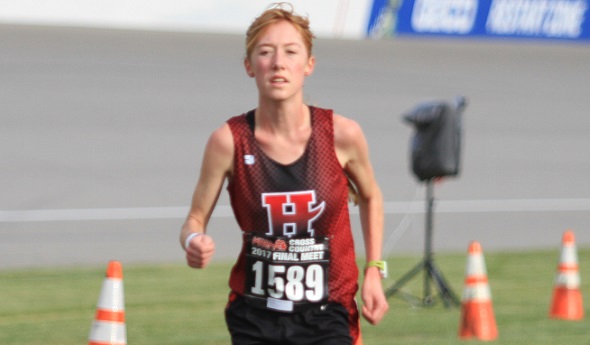
PHOTO: Hart’s Adelyn Ackley charges down the final stretch on the way to winning her second straight Division 3 championship last fall at MIS. (Click for more from RunMichigan.com.)