

MHSAA Vault: MIS Rose to Challenges to Host 2020 LP Finals
By
Rob Kaminski
MHSAA benchmarks editor
November 12, 2021
The “MHSAA Vault” features stories from past publications and other documents in the MHSAA Library. This issue takes a look at the MHSAA Cross Country Finals at Michigan International Speedway, which celebrated 25 years in 2020 – although it was an event that nearly didn’t happen last fall …
In 1996, the MHSAA and Michigan International Speedway began a partnership the changed the course of the Lower Peninsula Cross Country Finals – quite literally.
The land in and around the track at Brooklyn would host the Finals for all classes of runners in one place on one day, an annual festival of nearly 2,000 runners competing for the MHSAA’s top honors.
Even skeptics – and there were several among running purists who thought the course was too flat, for example – can’t deny the results.
Finals attendance nearly doubled in that first year, and crowds in excess of 10,000 have enjoyed a day of racing several times, including a record 12,153 in 2011.
Enthusiastic crowds were the norm in recent years, with 11,232 in 2017, and nearly 11,000 in 2018 (10,989) and 2019 (10,873).
In fact, attendance failed to reach at least 8,000 only twice since the move to MIS.
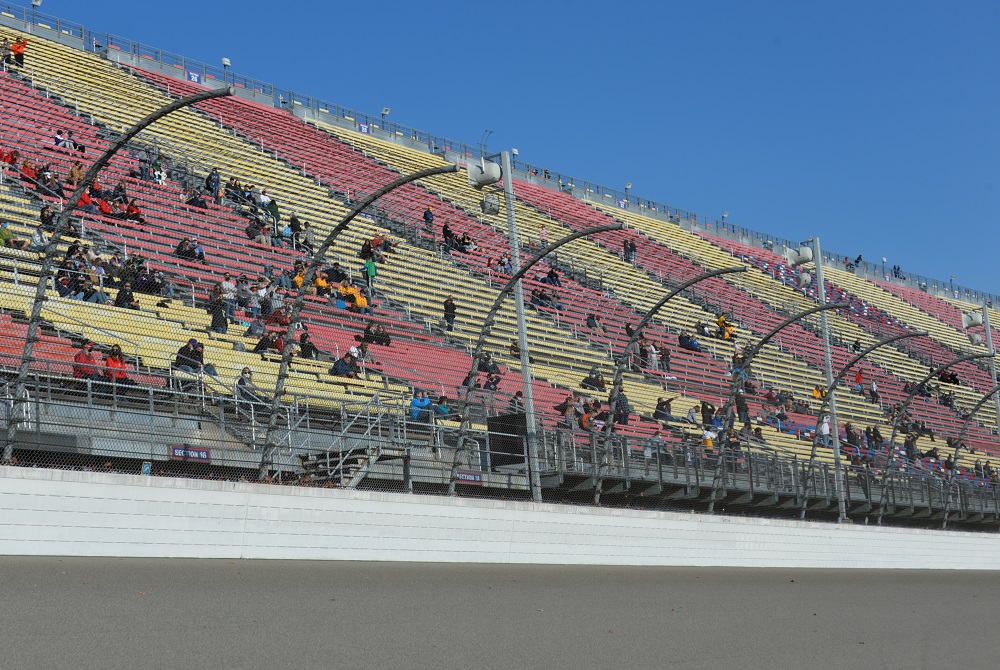
Of course, last year was an exception, when attendance was limited to 1,000 spectators per session due to the COVID-19 Pandemic. Fans also were restricted to the grandstands rather than following the action throughout locations on the course.
To reduce the number of runners in each race, the event was spread over two days, with each Division being run in two separate “sections” with times then combined at the end to determine team and individual champions.
While not ideal, the end result was another year of fantastic efforts at MIS – both from student-athletes and those behind the scenes.
“Even at the last hour, less than a week ahead of the Finals, we were closer to not having the Finals than we were to having them,” said MHSAA Assistant Director Cody Inglis, who coordinates the cross country postseason. “Rumors and challenges of mandated shutdowns, testing and other requirements were being discussed and caused a lot of unknowns. Even at the Regional level, we had schools, Regional courses and hosts shutting down their facilities; we had to relocate four Regionals 48 hours prior to race times. That scenario just could not happen at the Finals level where far more runners and much more travel would be involved.”
Among the many last-minute hurdles was the edict from NASCAR – which owns MIS – that all persons on site be temperature checked upon entry. That meant securing thermometers that were easy to operate in short order, along with personnel necessary to conduct the readings.
The attendance limitations certainly helped to implement the temperature screening, but brought their own issues.
“Limiting spectators was not a popular decision, but it really was the only way to have a race,” Inglis said. “We were taking direction and working with policies and protocols from the MDHHS, the Governor’s office, Lenawee County Health Department, MIS and NASCAR.”
Part of the solution was to utilize the grandstands as a “barrier” between participants and spectators. The reduced number of fans were dispersed over thousands of seats while still allowing them the chance to watch their student-athletes compete.
“It wasn’t the same, it wasn’t easy or perfect, but it was what we had to do to have a race,” Inglis said. “Separating the Finals into two days and different sections also allowed us to spread out the event and limit the number of people on site at any one time. This was a key part of the plan and worked well even though it separated races within a Division.”
The MHSAA, MIS and the cross country community never lost focus of the main goal: a culmination of the season for the student-athletes, who deserved something last year more than ever. And, more than ever, MIS once again displayed its advantage as a venue that could adapt to the fluid nature of the times to pull off the event.
“There were some thoughts of using four different sites, but as we learned during the Regionals, the climate of things was so tenuous from one area of the state to another that we couldn’t be 100-percent certain that there wouldn’t again be last-minute cancelations,” Inglis said. “MIS was wonderful to work and collaborate with, and was the best option to get it done. It was never mentioned once publicly about the possibility of not having the Finals – only how we could best do it under uncharted conditions.”
The moving parts and ever-changing scenarios created more complexity than ever in finalizing a season, but every decision was made with the complete desire to conduct the Finals as close to normal as possible.
“I firmly believe that a finish to the season, no matter the differences in race formatting and fan experience, was something everyone would have taken when the season began in August,” Inglis said.
Indeed, the finish line in Year 25 at MIS might have been the most gratifying of them all.
Litzner Completes Career Finals Sweep to Set Pace at UP Boys XC Finals
By
John Vrancic
Special for MHSAA.com
October 18, 2025
MUNISING — It’s not often a cross country runner gets to end his or her high school career as a four-time Upper Peninsula Finals champion.
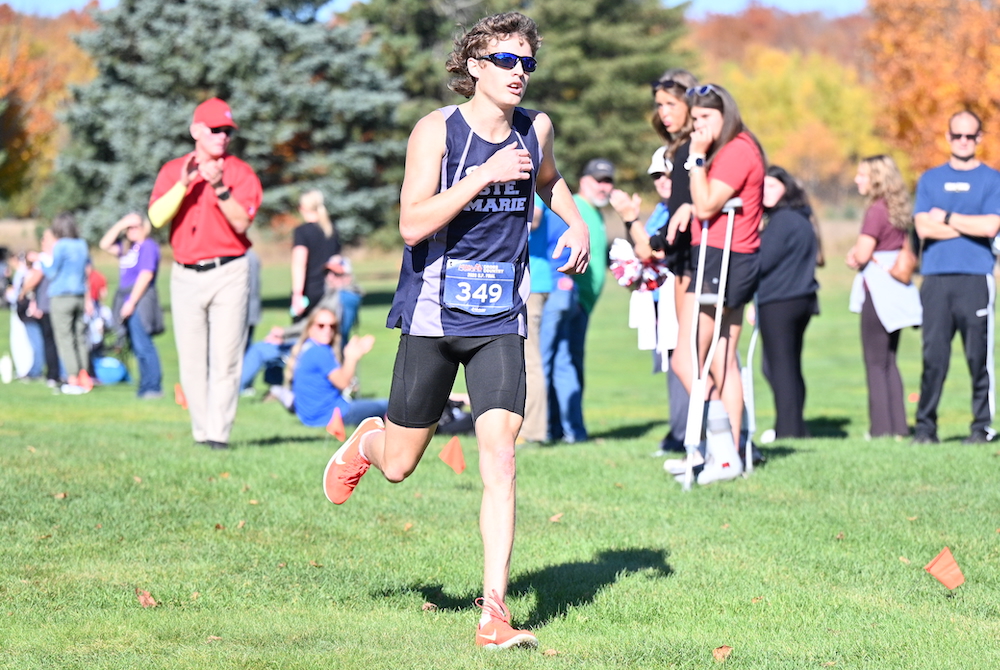
Sault Ste. Marie senior Gabe Litzner wasn’t going to be denied on this sunny and warm Saturday, however, completing the sweep by covering the Pictured Rocks Golf Course 3.1-mile course in 15:58.3.
He was followed by Marquette seniors Rorik Holmquist at 16:15.8 and Peter Argeropoulos (16:24.5) and junior Lucas Ballard (16:40), and Sault Ste. Marie senior Shea Armstrong (16:54.9).
“It’s awesome to look back at all the memories and friends I made,” Litzner said. “It feels like the conditions were a lot better last year. It warmed up quickly, and I think it caught everybody off guard. We’ve had quite a few colder races. The temperature had been in the 50s nearly every day.
“The Marquette guys were definitely pushing me throughout the race. I used a lot of the same strategy as last year. I followed a conservative approach in the first mile, then took off.”
Marquette captured its seventh-straight Division 1 title with 34 points. Sault was runner-up for the seventh consecutive time at 43, and Houghton placed third with 84.
Litzner became the first boys runner since 2019 to take a fourth U.P. championship, following Brimley’s Austin Plotkin, who earned top honors four times in a row in Division 3.
“Gabe and Shea did what they do,” Sault coach Jim Martin said. “We had some kids step up. One of our freshmen (Drew Burtt) really stepped up. We had five guys run good races. They found a way to get it done.”
Division 2
Painesdale Jeffers made it five team titles in a row, placing seven racers among the top 14 and scoring 23 points. The Jets were followed by Rudyard with 51 and Munising with 117.
“On the first day of practice we talked about it, and the biggest accomplishment is all seven boys and both girls medaled,” Jeffers coach Sam Kilpela said. “It ended up being a great day.
"This speaks volumes for our program. Overall, we stayed healthy, and on the last day we finished the job. This is the first time in our school history we won it five years in a row.”
Jeffers senior Cameron Anderson won an individual Finals championship for the first time, in 16:41.1, followed by classmate Landon Larson (17:33.4), Rudyard senior Steven Kirschner (17:51), Jeffers sophomore Branson Anderson (18:07) and Pickford junior Jacob Mitchell (18:11.6).
Division 3
Crystal Falls Forest Park clinched its first Division 3 championship with 58 points, followed by St. Ignace with 71 and 2024 champ Engadine at 91.
“This is a very special day,” Forest Park coach D.J. Rasner said. “I couldn’t be more proud of the boys. They worked so hard all year. Having a full team put us in a better situation. We got our fifth runner halfway through the season, and it gave us a lot of momentum. I think we’re also gaining some momentum in our school. More kids want to be a part of this.”
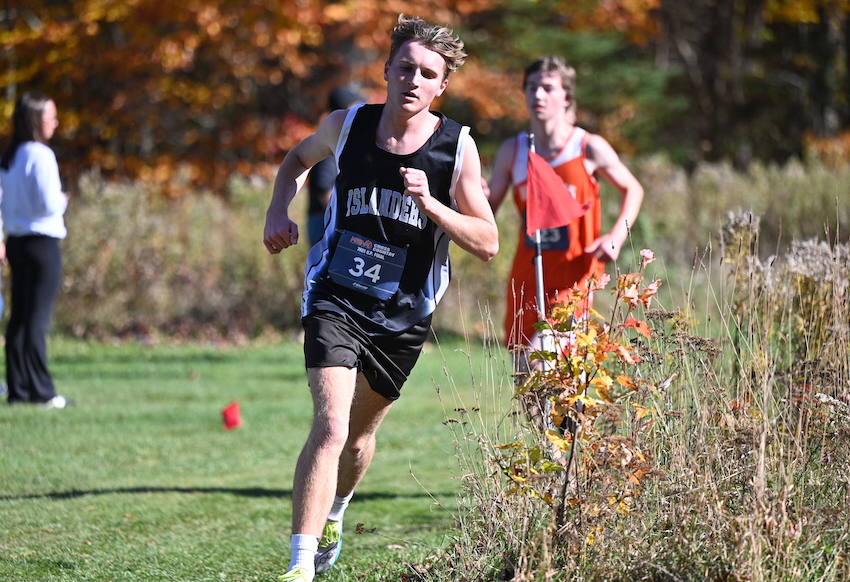
Cedarville/DeTour junior Ethan Snyder gained the top individual honor at 17:32, becoming the first from his school to take a U.P. title since 2004 when Cedarville’s Chad Schlosser was crowned champion.
Ishpeming junior Kemper Gearhart was runner-up at 17:51.7. He was followed by Rock Mid Peninsula freshman Ashdeyn Gerow in a personal-best 17:55, Engadine sophomore Nate Stielstra (18:13.4) and St. Ignace senior Dalton Champion (18:30.9).
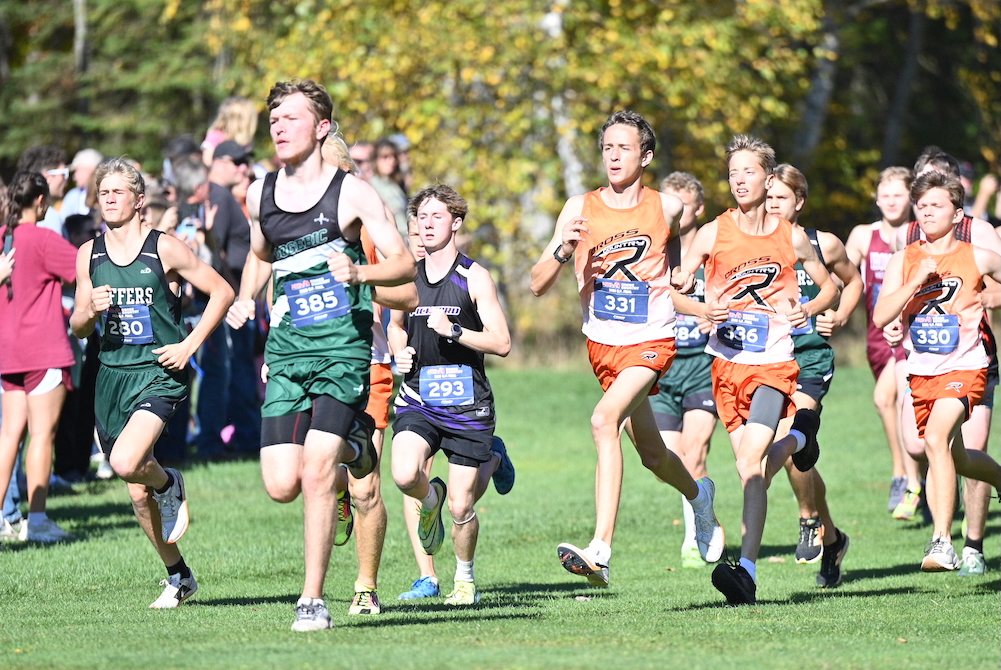
PHOTOS (top) Sault Ste. Marie's Gabe Litzner is the first to cross the finish line in the UP Division 1 Boys Final on Saturday in Munising. (Middle) At the beginning of the Division 2 Final, Painesdale-Jeffers' Cameron Anderson (280), Wakefield-Marenisco/Bessemer's Sean Lake, Pickford's Jacob Mitchell (293), and Rudyard's Eli Folkersma (331), Seth Templeton (336) and Oliver Dankert (330) lead the field. (Below) Cedarville/DeTour's Ethan Snyder takes over the lead in the Division 3 race. (Photos by Cara Kamps.)