

MHSAA Vault: MIS Rose to Challenges to Host 2020 LP Finals
By
Rob Kaminski
MHSAA benchmarks editor
November 12, 2021
The “MHSAA Vault” features stories from past publications and other documents in the MHSAA Library. This issue takes a look at the MHSAA Cross Country Finals at Michigan International Speedway, which celebrated 25 years in 2020 – although it was an event that nearly didn’t happen last fall …
In 1996, the MHSAA and Michigan International Speedway began a partnership the changed the course of the Lower Peninsula Cross Country Finals – quite literally.
The land in and around the track at Brooklyn would host the Finals for all classes of runners in one place on one day, an annual festival of nearly 2,000 runners competing for the MHSAA’s top honors.
Even skeptics – and there were several among running purists who thought the course was too flat, for example – can’t deny the results.
Finals attendance nearly doubled in that first year, and crowds in excess of 10,000 have enjoyed a day of racing several times, including a record 12,153 in 2011.
Enthusiastic crowds were the norm in recent years, with 11,232 in 2017, and nearly 11,000 in 2018 (10,989) and 2019 (10,873).
In fact, attendance failed to reach at least 8,000 only twice since the move to MIS.
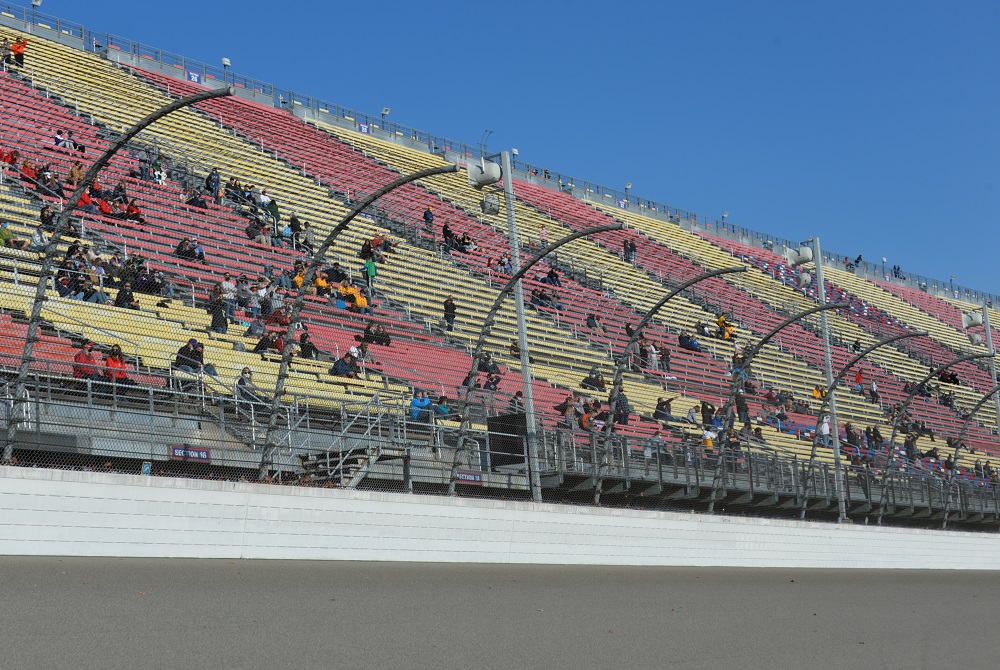
Of course, last year was an exception, when attendance was limited to 1,000 spectators per session due to the COVID-19 Pandemic. Fans also were restricted to the grandstands rather than following the action throughout locations on the course.
To reduce the number of runners in each race, the event was spread over two days, with each Division being run in two separate “sections” with times then combined at the end to determine team and individual champions.
While not ideal, the end result was another year of fantastic efforts at MIS – both from student-athletes and those behind the scenes.
“Even at the last hour, less than a week ahead of the Finals, we were closer to not having the Finals than we were to having them,” said MHSAA Assistant Director Cody Inglis, who coordinates the cross country postseason. “Rumors and challenges of mandated shutdowns, testing and other requirements were being discussed and caused a lot of unknowns. Even at the Regional level, we had schools, Regional courses and hosts shutting down their facilities; we had to relocate four Regionals 48 hours prior to race times. That scenario just could not happen at the Finals level where far more runners and much more travel would be involved.”
Among the many last-minute hurdles was the edict from NASCAR – which owns MIS – that all persons on site be temperature checked upon entry. That meant securing thermometers that were easy to operate in short order, along with personnel necessary to conduct the readings.
The attendance limitations certainly helped to implement the temperature screening, but brought their own issues.
“Limiting spectators was not a popular decision, but it really was the only way to have a race,” Inglis said. “We were taking direction and working with policies and protocols from the MDHHS, the Governor’s office, Lenawee County Health Department, MIS and NASCAR.”
Part of the solution was to utilize the grandstands as a “barrier” between participants and spectators. The reduced number of fans were dispersed over thousands of seats while still allowing them the chance to watch their student-athletes compete.
“It wasn’t the same, it wasn’t easy or perfect, but it was what we had to do to have a race,” Inglis said. “Separating the Finals into two days and different sections also allowed us to spread out the event and limit the number of people on site at any one time. This was a key part of the plan and worked well even though it separated races within a Division.”
The MHSAA, MIS and the cross country community never lost focus of the main goal: a culmination of the season for the student-athletes, who deserved something last year more than ever. And, more than ever, MIS once again displayed its advantage as a venue that could adapt to the fluid nature of the times to pull off the event.
“There were some thoughts of using four different sites, but as we learned during the Regionals, the climate of things was so tenuous from one area of the state to another that we couldn’t be 100-percent certain that there wouldn’t again be last-minute cancelations,” Inglis said. “MIS was wonderful to work and collaborate with, and was the best option to get it done. It was never mentioned once publicly about the possibility of not having the Finals – only how we could best do it under uncharted conditions.”
The moving parts and ever-changing scenarios created more complexity than ever in finalizing a season, but every decision was made with the complete desire to conduct the Finals as close to normal as possible.
“I firmly believe that a finish to the season, no matter the differences in race formatting and fan experience, was something everyone would have taken when the season began in August,” Inglis said.
Indeed, the finish line in Year 25 at MIS might have been the most gratifying of them all.
Together Since Middle School, Gobles' Record-Setting 4 Building On Historic Run
By
Pam Shebest
Special for MHSAA.com
September 24, 2025
GOBLES — When coach Marc Kline first met Libby Smith, he thought the sixth grader did not have much potential as a runner.
 Was he wrong.
Over the next few years, Kline noticed “there was a seriousness about her from seventh, eighth and beyond. You could just see even then, she’s going to be good, and she is good.”
“Good” is an understatement.
Last year as a sophomore, Smith finished third at the MHSAA Lower Peninsula Division 4 Cross Country Final. Her time of 18:26.4 helped lead Gobles to a sixth-place finish, the Tigers’ best in school history.
Since then, she has been chipping away, trying to get below the 18-minute mark.
She is getting closer, recording a personal record 18:07.0 to win Saturday’s Pewamo-Westphalia Invitational. Smith has now won six of the team’s last eight meets and finished second in the other two.
“I like the running part and the training,” said Smith, who lifts weights five days a week and runs on her own after school practices.
 On those solo runs, “My mom (Casey) follows me on an electric scooter,” she said. “My dad (Mitchell) does, too. They take turns riding with me, and I like that.”
In practice, Smith trains with three buddies, and the four have been running friends since middle school.
“We’re the only ones in our grades who run, so we are like a tight little group of runners since sixth grade,” Smith said.
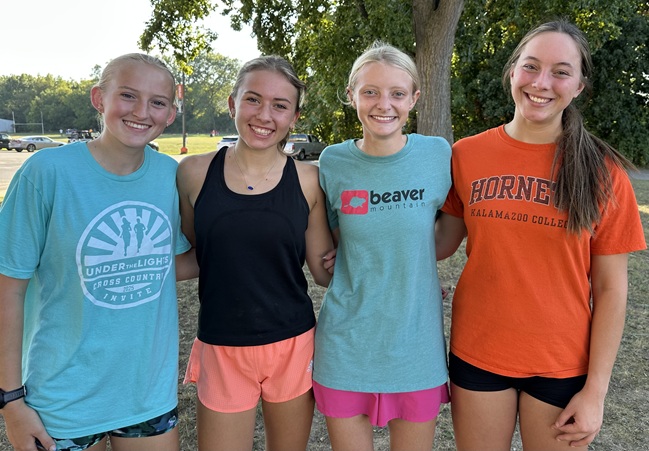
Her “little group” also consists of senior Madison Cooley and juniors Lauren Shaffer and Ava DeYoung.
“All four of them are our top four in Gobles history,” Kline said. “They all set the school record in (girls) cross. That’s like the perfect storm from my perspective. That’s amazing.”
Every time Smith runs another personal best, she breaks her own school record. Currently, Shaffer is second-best at 19:33.4, also a personal record recorded Saturday. DeYoung (19:48.2) is third in the record book and Cooley (20:33.7) fourth.
All four runners passed the former top mark of 20:41.5 set by Cheyenne Allyn-White in 2014.
“We all started so young, and that really helped and we all improved together,” DeYoung said. “When one person improved, you wanted to stick with them, you wanted to just keep pushing. We all worked together, and we all improved together.”
Sophomores Addison Tomsic and Alyssa Sparks plus freshman Taylor Cooley round out the team.
The only senior, Madison Cooley is also team captain.
 “It definitely makes a lot more responsibility,” she said. “I had to make shirts for the team, have to make sure they’re doing all the warmups and cool downs.
“Sometimes I have to keep myself in check and be positive all the time. Sometimes it’s pretty hard.”
Facing her last season on the team, Cooley said it’s important to stay in the moment.
“You have to cherish the moments,” she said. “Our captain last year (Zoie Wood) was a senior and was on my team since eighth grade.”
Kline said Cooley has been fun to watch in the leadership role this season.
“Her leadership skills have improved so much,” he said. “She’s very critical to the team.
“She’s planning to run track (in college). It’s really amazing to watch a sprinter take on a 5k role.”
While Smith led the team to the Finals last fall, Shaffer, who finished 33rd (20:45.5), was second on the team.
The junior started running at a very early age when her dad, Eric Shaffer, coached cross country at Gobles.
“I used to come to the practices after school,” she said. “I followed them around and have been running since then.
“A lot (of success) is being consistent, (training) over the winter and summer so you’re always running.”
Kline said Shaffer is gritty and shy.
“She loves her family a ton,” he said. “I can see a special relationship between her and her dad, which is really fun to see. She has a lot of talent as well.”
DeYoung, who started running in middle school, said the fab four instantly clicked.
“It was really fun and I just stuck with it,” she said. “We have such a unique bond together. We do easy runs together when we can just talk about our day.
 “There are other times when it’s a good pace and (Smith) goes off ahead. It’s so fun to see her do so good. It makes us all so proud of her. I would say it inspires us to do better because we all want to strive to be more like what she’s doing.”
DeYoung suffered four stress fractures of the tibia as a freshman and is still working her way back to peak form.
“I had a lot of support from my teammates,” she said. “Even when I was struggling and having hard times, they were always there for me.
“I really enjoy running and enjoy running with my teammates, and I wanted to get better. Even with the setbacks, I was working and striving to get better all the time.”
Kline said DeYoung is one of the hardest workers on the team.
“Her integrity level is so high,” he said. “I appreciate her. (Because of the injuries), she’s not been able to hit where she was early and is coming around really well this year.”
All four also run track during the spring, and while both sports involve running, Kline said track and cross country are like night and day.
“Cross country, everyone’s focused on one event, training, goals,” the coach said. “It’s all unified, and there’s a great sense of family that can develop from that team.
“In track, there’s 17 different events, people get so scattered. It’s really difficult in one sense to get that team feel in track, so that’s a big difference.”
Looking at this cross country season, “I am so excited about the opportunity we have this year,” Kline said. “Their buy-in, their interest and their love for each other.”
 Pam Shebest served as a sportswriter at the Kalamazoo Gazette from 1985-2009 after 11 years part-time with the Gazette while teaching French and English at White Pigeon High School. She can be reached at [email protected] with story ideas for Calhoun, Kalamazoo and Van Buren counties.
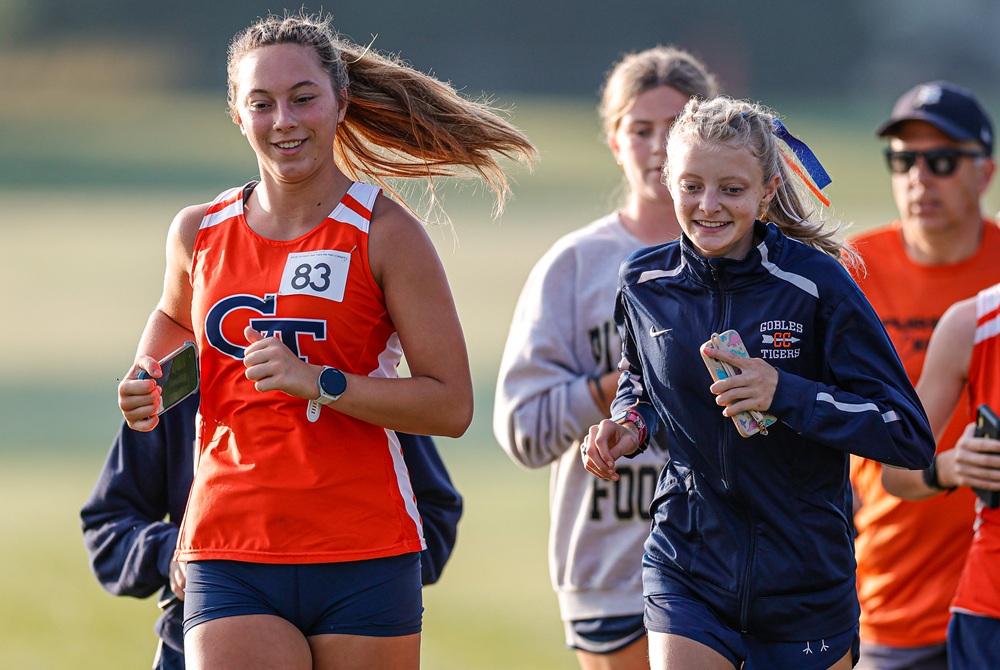
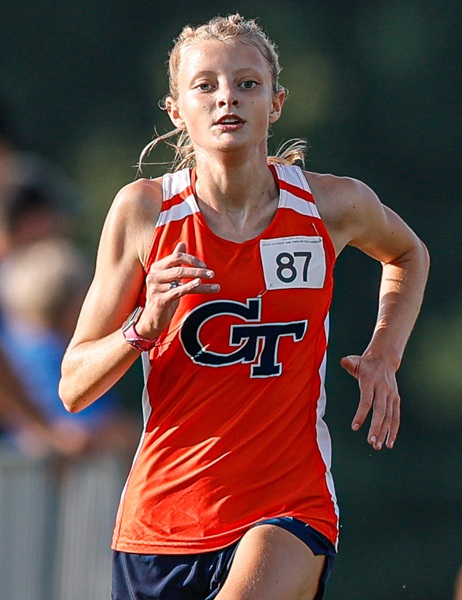
PHOTOS (Top) Gobles runners including Madison Cooley, front left, and Libby Smith warm up at the Portage Early Bird Invitational this season. (2) Gobles girls cross country coach Marc Kline. (3) Smith and Cooley are joined by, from far left, Ava DeYoung and Lauren Shaffer. (4) Smith runs at Portage. (Portage photos by Miles Postema. Coach and group photos by Pam Shebest.)