

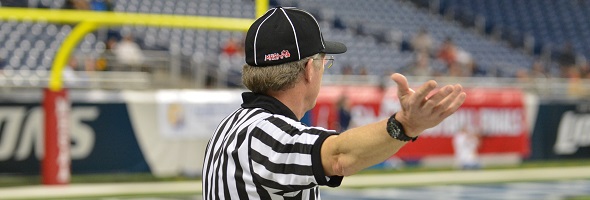
Be the Referee: Golf Rules Changes
October 10, 2019
This week, MHSAA officials coordinator Sam Davis explains new rules in golf for 2019-2020, including those pertaining to the use of cell phones during play.
Be The Referee is a series of short messages designed to help educate people on the rules of different sports, to help them better understand the art of officiating, and to recruit officials.
Below is this week's segment - Golf Rules Changes - Listen
Even though golf rules are mostly on the integrity of the players, there are several MHSAA-enacted changes that take effect this year.
One allows for the use of cell phones to call a coach or meet administrator for health and safety issues, the inputting of live scores, to contact a rules official with questions and to use as a distance-measuring device.
Dedicated distance finder devices will also be allowed for use in MHSAA Tournament play.
Another new local rule caps the maximum score per hole at 12 strokes in tournament activity.
Past editions
Oct. 3: No Tackle Box - Listen
Sept. 26: You Make the Overtime Call - Listen
Sept. 19: Swimming Finishing Touch - Listen
Sept. 12: Curbing Gamesmanship By Substitution - Listen
Sept. 5: Football Safety Rules Changes - Listen
Aug. 29: 40-Second Play Clock - Listen
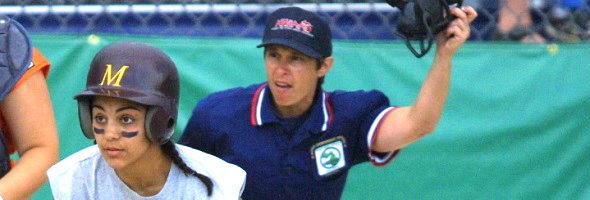
Be the Referee: Girls Lacrosse Self Start
May 23, 2019
This week, officials coordinator Sam Davis explains a rule change in girls lacrosse designed to smooth out starts and stops in game play.
Be The Referee is a series of short messages designed to help educate people on the rules of different sports, to help them better understand the art of officiating, and to recruit officials.
Below is this week's segment – Girls Lacrosse Self Start - Listen
There’s a new rule in girls lacrosse this year that’s designed to allow a great flow of the game, and it’s called the self-start.
Following a whistle blown for a foul, the player who was fouled previously had to wait for an official’s whistle from a stationary position before resuming play. The rule change this year allows for a player to self-start – or resume the game from a “settled stance” after being awarded a free position with all other players at least four meters away. Play resumes once the ball carrier takes a step or passes the ball.
Once play has commenced, the defenders may engage in play with the ball carrier. The self-start applies only to fouls called outside the critical scoring area.
Past editions
May 16: Lodged Ball - Listen
May 9: Bounced Pitch - Listen
May 2: Boys Lacrosse Safety - Listen
April 25: Softball Illegal Pitch - Listen
March 21: Instant Replay in Basketball - Listen
March 14: Basket Interference - Listen
March 7: Primary Areas - Listen
February 28: Under the Bus - Listen
February 21: You Make the Call - Listen
February 14: Because They Love It - Listen
February 7: Coach/Official Communication - Listen
January 31: Backcourt Violation? - Listen
January 24: Required Hockey Equipment - Listen
January 17: You Make the Call: 10-Second Clock - Listen
January 10: Tripping in Hockey - Listen
January 3: Sliding in Basketball - Listen
December 27: Stalling in Wrestling - Listen
December 20: Basketball: You Make the Call - Listen
December 13: Basketball Uniform Safety - Listen
December 6: Coaching Box Expansion - Listen
November 29: Video Review, Part 2 - Listen
November 22: Video Review, Part 1 - Listen
November 15: You Make the Call - Sleeper Play - Listen
November 8: 7-Person Football Crews - Listen
November 1: Overtime Differences - Listen
October 25: Trickery & Communication - Listen
October 18: Punts & Missed Field Goals - Listen
October 11: What Officials Don't Do - Listen
October 4: Always 1st-and-Goal - Listen
September 27: Unique Kickoff Option - Listen
September 20: Uncatchable Pass - Listen
September 13: Soccer Rules Change - Listen
September 6: You Make the Call: Face Guarding - Listen
August 30: 40-Second Play Clock - Listen
August 23: Football Rules Changes - Listen