

South Lyon United's Radcliffe Approaching Milestone Win, Another History-Making Moment
By
Keith Dunlap
Special for MHSAA.com
May 7, 2026
Originally, Deanna Radcliffe got into coaching lacrosse simply because it was a nice summer job.
 From that simple beginning, Radcliffe is now on the verge of making high school sports history within the state of Michigan.
No girls or boys lacrosse coach has reached 300 career victories since the sport became MHSAA-sponsored in 2005. But Radcliffe is oh-so-close. Following a win over Haslett on Wednesday, Radcliffe has 299 career victories.
The milestone 300th win likely will come Saturday when South Lyon United plays in a tournament at Saline.
In order to get their names etched in the record book, any high school coach in Michigan has had to reach at least 300 wins since the MHSAA brought the sport into its championship lineup. So Radcliffe is literally about to become the first and only coach in the MHSAA coaching records for lacrosse.
Radcliffe is in her 10th season coaching for South Lyon Unified and also coached at Hartland from 2013 to 2022. This is actually her second stint at South Lyon, where she spent seven years as head coach before taking the Hartland job.
“It just means I’ve been doing this for a long time,” Radcliffe said. “What it really represents to me is all the players, coaches and families I’ve had the opportunity to coach. I’ve been fortunate to coach in an area that was willing to embrace the sport. I have been able to catch some really great teams and athletes across all levels from youth to high school and even collegiately. That’s the part that means the most, those relationships and experiences. The wins are just a byproduct of that.”
Radcliffe got her start in lacrosse very young, saying she picked up the game at 3-4 years old while growing up in Pennsylvania. She was introduced to the game by her aunt.
 “It just became part of my life early on,” she said.
Radcliffe eventually became good enough as a player to earn a college opportunity, ultimately being named the Atlantic 10 Offensive Player of the Year in 2003 while playing for Temple.
Radcliffe eventually started a career as a special education teacher and was a high school coach in Pennsylvania before moving to Michigan in 2006, where she has coached club, high school and even college lacrosse as she spent time as an assistant at Cleary University.
“I just enjoyed being around the game and the competitive environment, so I kept doing it,” Radcliffe said of what has kept her coaching. “Over time, it stopped being something I was just doing in the summers and became something I really valued and stayed connected to. It’s grown naturally from there, and I’ve been fortunate to continue coaching while also working in education.”
The most noteworthy win of her career came last June, when South Lyon Unified earned a 6-3 Division 1-clinching victory over Hartland to give Radcliffe her first MHSAA Finals championship as head coach in a matchup between the two programs she built up.
South Lyon Unified is 18-0 this season and has won 39 straight games going back to last spring's opener.
“She has so much knowledge of the sport and really cares for each and every one of us,” said South Lyon United senior captain Teagan Wesner. “Deanna has been one of the best coaches I have ever had, and I am extremely grateful to have had the opportunity to play for her. I am very happy for Deanna, and I am excited to be a part of the team who helped her reach 300 wins.”
When Radcliffe first arrived in Michigan, lacrosse was in its first years as a sanctioned sport by the MHSAA. Now, she has seen it grow by leaps and bounds.
“One of the most rewarding parts has been seeing the long-term impact,” she said. “Many of the players I once coached are now youth, high school or college coaches themselves. Some are officials, and some I’m even coaching against or alongside now. That’s been incredibly meaningful and really speaks to the strength of the community the sport has built.”
 Keith Dunlap has served in Detroit-area sports media for more than two decades, including as a sportswriter at the Oakland Press from 2001-16 primarily covering high school sports but also college and professional teams. His bylines also have appeared in USA Today, the Washington Post, the Detroit Free Press, the Houston Chronicle and the Boston Globe. He served as the administrator for the Oakland Activities Association’s website from 2017-2020. Contact him at [email protected] with story ideas for Oakland, Macomb and Wayne counties.
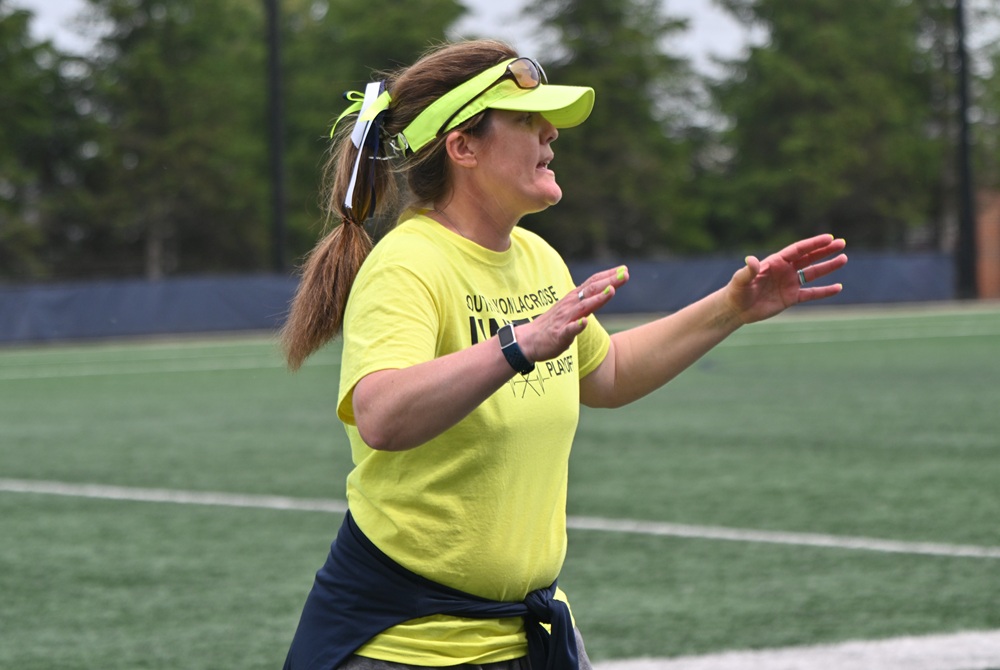
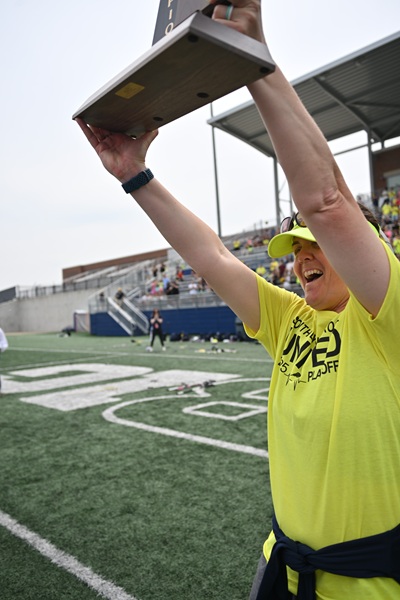
PHOTOS (Top) Deanna Radcliffe, here during the 2025 Division 1 Final, has reached 299 career coaching wins. (Middle) Radcliffe raises the championship trophy after last season’s clincher.
And the MHSAA Survey Says ...
April 2, 2015
By Rob Kaminski
MHSAA benchmarks editor
A survey of MHSAA member schools was conducted in the fall of 2014 aimed to determine opinions for and against a myriad of out-of-season coaching/contact period topics within the school year.
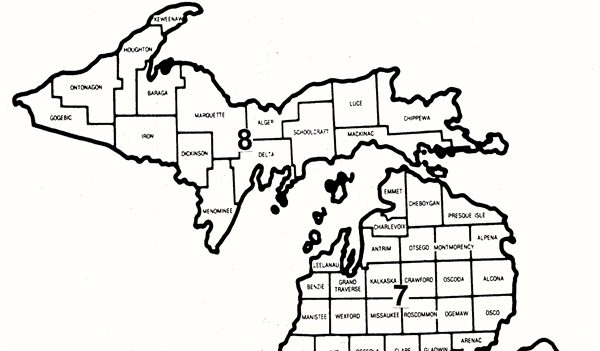
Below are some of the summaries drawn from that survey, plus a map of zones referred to in a number of points.
Survey Summary and Highlights
The larger the school, the higher the percentage of students who are involved in organized non-school sports.
The Detroit metro area (Zone 3) has the highest percentage of respondents in each of two groups in which the highest percentage of students are involved in organized non-school sports ... the 60 to 80% and 40 to 60% groups. The Grand Rapids area (Zone 6) ranks second.
The northern Lower Peninsula (Zone 7) and the Upper Peninsula (Zone 8) have the highest percentage of respondents in the group in which the lowest percentage of students are involved in organized non-school sports . . . the 0 to 20% group. This is also true of Zones 1, 2 and 5, although less dramatically.
In the majority of schools, coaches work with students out of season under the three- or four-player rule for a few weeks just before the season. This is generally true regardless of school classification or geographic zone.
In nearly 80% of schools, the frequency of coaches working with students out of season under the three- or four-player rule is one or two days a week.
100% of schools that sponsor basketball hold open gyms for basketball. Two-thirds of volleyball schools hold volleyball open gyms. Half of lacrosse schools hold lacrosse open gyms. Open gyms in baseball, softball and soccer occur in 40 to 45% of responding schools. Open gyms are less common for other sports.
More than half of all schools conduct open gyms for only a few weeks, just before the season begins.
In 85% of schools, the frequency of open gyms is one or two days a week.
The multi-sport athlete is common in schools of every classification, but more common in Class C and D schools than in Class A and B.
The multi-sport athlete is common in schools of every geographical zone, but more common in Zones 1, 2, 4, 7 and 8 than in Zones 3, 5 and 6.
Two-thirds of schools do not ban athletes from out-of-season workouts while in-season in a different school sport. Permitting weightlifting is most common (84%), then three- or four-player workouts (70%), then conditioning (66%) and open gyms (65%), and finally non-school competitions (57%).
Single-sport coaches are more common in smaller schools than larger (perhaps because fewer sports are sponsored in smaller schools).
For one question, schools were asked to rate ideas from 1 (I like the concept) to 6 (I do not like the concept). Average would be 3.5.
More than 60% of schools favor a no-contact period for all out-of-season sports at the start of every other sport’s season. (Support ranges from 55% for Class A schools to 65% for Class D schools and from 56% for Zones 1 and 3 to 71% for Zone 7.)
More than 72% of schools favor (in conjunction with a no-contact period) a defined contact period out of season. Support ranges from 69% for Class B schools to 76% for Class D schools and from 64% in Zone 6 to 88% in Zone 1.
Two-thirds of schools favor setting a limit on the number of contact days for out-of-season coaching. Support ranges from 63% for Class A schools to 72% for Class C schools and from 50% for Zone 2 to 73% for Zone 1.
More than 68% of schools favor setting a limit on the number of contact days in a week. There’s almost no difference based on school class. Support ranges from 58% in Zone 6 to 76% in Zone 5.
Counting days more than players – that is, allowing practice with any number of students for a defined number of days over a period of time – is favored by more than 72% of schools. Support ranges from 69% for Class D to 76% for Class A and from 59% for Zone 5 to 76.5% for Zone 3.
The least support of any idea surveyed was for allowing scrimmage competition (allowing the coach to coach any number of students from that coach’s school in competition against individuals not enrolled in that school).
More than 62% of schools favor a rule that would allow a school coach to coach a non-school team within a defined contact period; that is, a team with students from the coach’s school (and possibly other schools too), but not supported with school funds, administration, insurance, uniforms, etc. Support ranged from 58% for Class C schools to 68% for Class B schools. Support ranged from 54% for Zone 2 to 69% for Zone 6.
This is the most popular proposal (doesn’t preclude others being approved too): 84% of schools favor removing the phrase “under one roof” from Regulation II, Section 11(H) 2 a (see Tuesday's report). Support ranged from 80% for Class D schools to 86% for Class C schools and from 78% in Zone 2 to 89% for Zone 5.
Removing the portion of Interpretation 237 which prohibits setting up rotations that would allow a coach to work with dozens of players who rotate to his/her direct attention in groups of three or four is favored by 69% of schools, but with a distinct large school vs. small school difference of opinion: Class A (80.5% favorable), Class B (72.9%), Class C (61.3%) and Class D (61.7%).