

South Lyon United's Radcliffe Approaching Milestone Win, Another History-Making Moment
By
Keith Dunlap
Special for MHSAA.com
May 7, 2026
Originally, Deanna Radcliffe got into coaching lacrosse simply because it was a nice summer job.
 From that simple beginning, Radcliffe is now on the verge of making high school sports history within the state of Michigan.
No girls or boys lacrosse coach has reached 300 career victories since the sport became MHSAA-sponsored in 2005. But Radcliffe is oh-so-close. Following a win over Haslett on Wednesday, Radcliffe has 299 career victories.
The milestone 300th win likely will come Saturday when South Lyon United plays in a tournament at Saline.
In order to get their names etched in the record book, any high school coach in Michigan has had to reach at least 300 wins since the MHSAA brought the sport into its championship lineup. So Radcliffe is literally about to become the first and only coach in the MHSAA coaching records for lacrosse.
Radcliffe is in her 10th season coaching for South Lyon Unified and also coached at Hartland from 2013 to 2022. This is actually her second stint at South Lyon, where she spent seven years as head coach before taking the Hartland job.
“It just means I’ve been doing this for a long time,” Radcliffe said. “What it really represents to me is all the players, coaches and families I’ve had the opportunity to coach. I’ve been fortunate to coach in an area that was willing to embrace the sport. I have been able to catch some really great teams and athletes across all levels from youth to high school and even collegiately. That’s the part that means the most, those relationships and experiences. The wins are just a byproduct of that.”
Radcliffe got her start in lacrosse very young, saying she picked up the game at 3-4 years old while growing up in Pennsylvania. She was introduced to the game by her aunt.
 “It just became part of my life early on,” she said.
Radcliffe eventually became good enough as a player to earn a college opportunity, ultimately being named the Atlantic 10 Offensive Player of the Year in 2003 while playing for Temple.
Radcliffe eventually started a career as a special education teacher and was a high school coach in Pennsylvania before moving to Michigan in 2006, where she has coached club, high school and even college lacrosse as she spent time as an assistant at Cleary University.
“I just enjoyed being around the game and the competitive environment, so I kept doing it,” Radcliffe said of what has kept her coaching. “Over time, it stopped being something I was just doing in the summers and became something I really valued and stayed connected to. It’s grown naturally from there, and I’ve been fortunate to continue coaching while also working in education.”
The most noteworthy win of her career came last June, when South Lyon Unified earned a 6-3 Division 1-clinching victory over Hartland to give Radcliffe her first MHSAA Finals championship as head coach in a matchup between the two programs she built up.
South Lyon Unified is 18-0 this season and has won 39 straight games going back to last spring's opener.
“She has so much knowledge of the sport and really cares for each and every one of us,” said South Lyon United senior captain Teagan Wesner. “Deanna has been one of the best coaches I have ever had, and I am extremely grateful to have had the opportunity to play for her. I am very happy for Deanna, and I am excited to be a part of the team who helped her reach 300 wins.”
When Radcliffe first arrived in Michigan, lacrosse was in its first years as a sanctioned sport by the MHSAA. Now, she has seen it grow by leaps and bounds.
“One of the most rewarding parts has been seeing the long-term impact,” she said. “Many of the players I once coached are now youth, high school or college coaches themselves. Some are officials, and some I’m even coaching against or alongside now. That’s been incredibly meaningful and really speaks to the strength of the community the sport has built.”
 Keith Dunlap has served in Detroit-area sports media for more than two decades, including as a sportswriter at the Oakland Press from 2001-16 primarily covering high school sports but also college and professional teams. His bylines also have appeared in USA Today, the Washington Post, the Detroit Free Press, the Houston Chronicle and the Boston Globe. He served as the administrator for the Oakland Activities Association’s website from 2017-2020. Contact him at [email protected] with story ideas for Oakland, Macomb and Wayne counties.
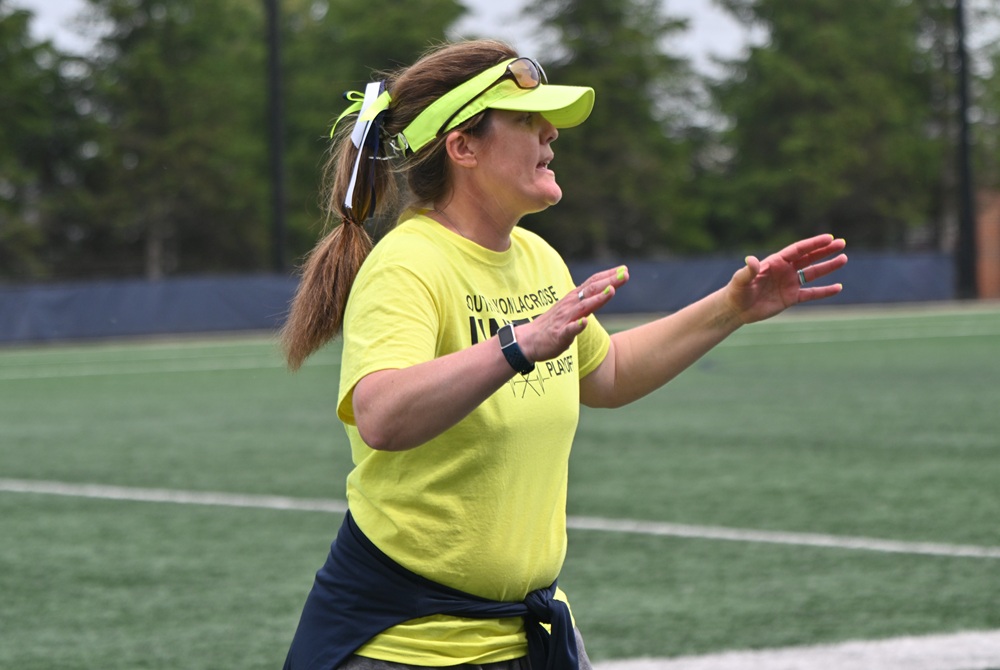
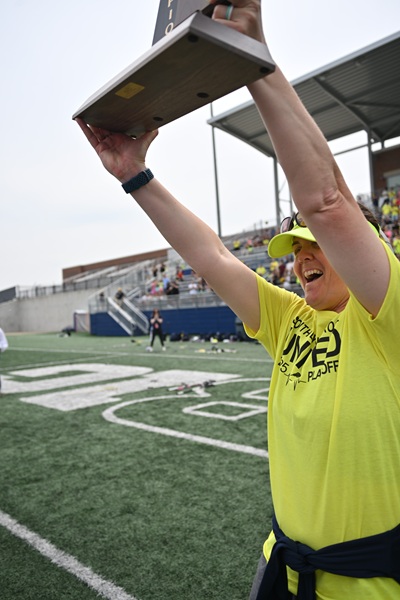
PHOTOS (Top) Deanna Radcliffe, here during the 2025 Division 1 Final, has reached 299 career coaching wins. (Middle) Radcliffe raises the championship trophy after last season’s clincher.
Pioneers Stake Claim as State's Best
June 8, 2013
By Geoff Kimmerly
Second Half editor
ROCKFORD – With three minutes to play in Saturday’s MHSAA Division 2 Girls Lacrosse Final, East Grand Rapids’ sideline emptied as subs and late-season call-ups all at once replaced the line-up on the field.
As the first-string group exited, Pioneers fans offered a standing ovation to a group that has become arguably the state’s elite over their four seasons.
East Grand Rapids, ranked No. 1 at the end of the regular season, finished its second-straight MHSAA championship run with a 16-6 win over Livonia Ladywood at Rockford High.
A group of 11 seniors – many who have played together since fifth grade – leave the program after helping accumulate a 78-14 record during their high school careers.
“We’ve learned a lot. Our coaches have been so committed to the program, and we have to thank them for everything and the parents as well,” EGR senior Claire Ludlow said. “The year before last year (2011) was when we really wanted it. We didn’t make it to the state finals, but that was our driving force especially for last year and this year as well.”
The Pioneers improved from 13-6 to 15-6 to 28-0 and now 22-2 over the last four seasons under coach Rich Axtell, and this season’s losses came to teams from Ohio and Illinois. EGR hasn’t lost to an in-state opponent since 2011 – when it fell in double overtime in a Regional Semifinal to eventual Finals champion Grand Rapids Catholic Central.
East Grand Rapids beat GRCC three times this season and finished a combined 8-0 against the next three teams ranked after the Pioneers in Division 2 at the end of the regular season. They also beat six of the top 10 in Division 1, including top-ranked Rockford.
 “We made ourselves a tougher schedule ... (and) really challenged the girls this year,” Axtell said. “This was one of those years where we came in with great expectations, and the girls met every single one of them.
“It’s a great way to send off 11 seniors. They’ve had one heck of a career here. They came in when this program was struggling and set a really great standard for the young ladies coming up.”
East Grand Rapids built a 6-0 lead over the first 7 minutes, 32 seconds and led 9-2 at halftime. But Axtell knew the Blazers had come back from an early deficit to beat Bloomfield Hills Cranbrook-Kingswood by a goal in the Semifinal, and he made a point of pointing that out.
“Recently we’ve gotten up and let the other team back in. ... We know (Ladywood) had it in them,” Axtell said. “The girls maintained their focus and basically just kept extending the lead. That sort of composure is something we’ve been preaching to the girls.”
East Grand Rapids indeed did keep a comfortable lead – although Ladywood trailed only 10-6 over the final 42 minutes.
“That’s the type of team I have. They won’t give up. They just want to keep going,” Ladywood coach Kris Sanders said. “If it’s a 10-goal differential, they’re still going to do it, which I like. I’m very proud of that.”
Eight Pioneers scored, led by Ludlow and senior Martha Bogo with three goals apiece. Bogo also had a pair of assists.
Junior Jessica Snyder scored four goals for Ladywood, which will graduate eight players but should return its top two scorers and three of its top five next spring. The Blazers also set a standard for teams to come – they finished 15-2, and Saturday’s was their first MHSAA Finals appearance in the sport.
Ladywood’s only other loss this season was to Division 1 power Birmingham Marian. The Blazers were ranked No. 8 in Division 2 entering the postseason.
“I couldn’t ask for anything else. If we’re 15-2 and get to the state final and lose the state final, that’s OK,” Sanders said. “We can’t lose sight of all the success we’ve had in the season.”
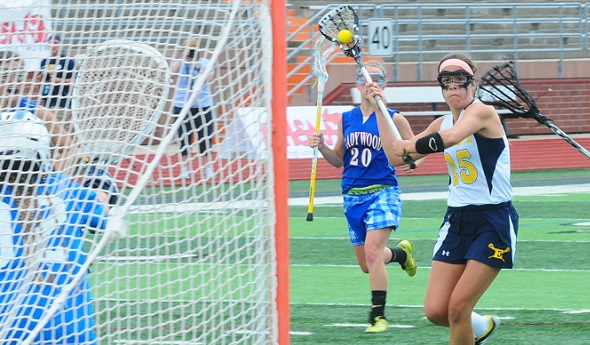
PHOTOS: (Top) East Grand Rapids sophomore Katherine Golladay winds up before scoring one of her two goals Saturday. (Middle) The Pioneers' Martha Bogo (16) works to keep the ball from Ladywood's Jaclyn Snyder.