


MHSA(Q&)A: Soccer Coaches President Zach Jonker
September 21, 2012
By Geoff Kimmerly
Second Half editor
Zach Jonker has had his hands – or, perhaps, feet – on just about every facet of soccer in this state over the last 20 years.
 He played on a Class B Semifinalist at Petoskey before graduating in 1995, then earned four letters and served as a captain at Hope College. He came back home to teach social studies and became coach of both boys and girls varsities that are regularly among the northern Lower Peninsula's elite, but also are highly-regarded statewide. And this fall, he began the first of a two-year term as president of the Michigan High School Soccer Coaches Association.
So he can speak first-hand on the benefits of playing high school soccer in Michigan, which is good news to get out perhaps now more than ever. Michigan high school soccer is facing a predicament unlike any it has tackled before – the creation by U.S. Soccer of its Development Academy, a set of travel teams all over the country that train nearly year-round and are meant to eventually fuel the men's national team. That opportunity has drawn a number of top Michigan players out of high school soccer.
Jonker and his coaching brethren are monitoring that situation closely, while continuing to lead their teams into the second half of this fall boys season. His Northmen are 6-7-1 overall this fall, but have faced three of the top-five ranked teams in Division 1 and another from Division 2.
Despite your location near the tip of the Lower Peninsula, you still manage to schedule strong competition. How do you make it work?
We’re in a really nice spot. Traverse City hosts a tournament during the regular season with Traverse City Central, Traverse City West and Petoskey, and then they invite three schools from downstate that have generally been (Warren) DeLaSalle, Clarkston and Ann Arbor Skyline. The following weekend, we host a similar format with Rochester Hills Stoney Creek and Bloomfield Hills Lahser. We get six really good games at the start of the season with two tournaments. It’s early in the season and teams love coming up, making a weekend out of it, hitting the beach and doing some bonding. And the fields at Traverse City and Petoskey are both beautiful, which helps teams commit, plus the three of us are very competitive.
We’re coming down next weekend to play East Lansing, and we always schedule a couple of those. Last year, Mason came up here. It’s definitely a commitment in terms of travel during the course of the year, but from a Petoskey standpoint, I don’t care about our nonleague record. We’re using those games to get better for our league and better for the (MHSAA) tournament. The only tough thing is putting that in perspective for the kids.
What is something happening in high school soccer that the coaches association is proudest about right now?
We’re always looking at it from the other side, what we want to make better. But one of our main goals as an association is to properly recognize players. And I think the process we have in place for giving all-district, all-regional and all-state recognition and ultimately the selection of the Dream Team, I think that’s a very good model that enables us as an association to truly recognize players who put the work in and had a successful season. We also redesigned our web site this past season, and we’ve done a lot of the all-state process online, which a lot of coaches really liked because it cut down travel time for meetings.
Is anything new on the horizon?
A lot of coaches are really interested in seeing what the long-term impact of the (U.S.) Academy ruling is. Everyone’s initial take is we’re seeing increased parity round the state as the result of 120 kids electing not to play high school soccer this year. Obviously, all of those players are good players playing at a high level, and people are interested in seeing at the end of the season if kids are going to have missed playing in front of their communities, and if kids are going to migrate back to high school soccer. There’s talk of U.S. Soccer adding a U-14 academy. They’re trying to expand.
What has been the reaction so far to the U.S. Academy?
For certain players, the academy makes sense. They’re in a professional training environment 10 months out of the year. But those guys not on the professional track would be equally served by playing high school soccer and playing club like we always have. (U.S. Soccer) is doing a lot of this to benefit the top one percent of players. It’s the main frustration from the coaches.
Everyone kind of understands why U.S. Soccer is headed down that path, and it impacted each (high school) team differently. Some programs lost upwards of 8-10 kids as a result. Some didn’t lose any.
In terms of geographic parity, we’re already seeing that. Two years ago, west side teams won all four championships. Last year, Detroit teams won all four. Now we’re going to see more parity within districts, within conferences. And I think we’ll see scores closer than in the past.
What role should high school soccer play compared to club, the academy, etc.?
I equate it as playing for your national team. When you put your school colors on, go out with your friends that you’ve played with since kindergarten, it’s really special. They can’t even begin to match the rivalries we have with high school soccer, the amount of passion that exists within our game and the number of fans that show up at these games. At an academy game, you might have a handful of parents on the sideline, that’s it, and a few college coaches watching. But you can’t match the high school experience and the passion that exists. Kids are going to miss that, and we’ll get kids back because of that.
Do your players see an MHSAA championship differently because so many elite players aren’t participating in high school?
It doesn’t even register with these guys. The (MHSAA) championships are going to be awarded in November, and for whoever wins this year, it will be just as meaningful for these guys as the guys who won last year.
Does soccer get a bump from U.S. national team success like swimming or gymnastics might during Olympic years?
Any time it’s a World Cup year, men’s or women’s, the players get really excited about the experience. It gets them enthused to get out and train. I don’t think kids watch enough soccer in this country, and that’s one of the big issues we have. Ultimately, what’s holding us back at the national team level is kids are not growing up in a culture of soccer on television like in other countries against which we compete. In a World Cup year, kids get excited, and they watch more soccer, and the play is better on the field.
How much has high school soccer changed since you played?
There are just so many more layers of sophistication, tactically. We had good athletes playing at that point, and we have good athletes playing now. But as a country, we’ve evolved from a coaching standpoint. The kids are getting better technical training at a younger age, and are much better tactically. There are many more teams now emphasizing more possession-based (play). What else has helped the evolution is getting off playing on football fields. During the (19)80s and 90s, a lot of games were played on them, and it made it hard to possess the ball when the turf was chewed up. Soccer-specific fields have helped the game evolve.
What will Michigan high school soccer look like five years from now?
I like the path we’re headed down. The number one thing going forward is seeing what happens with the evolution of the academy program – do kids come back, or does the academy program grow? Regardless, the kids playing high school soccer are going to have a great experience, and there are a lot of really good coaches in high school soccer, a lot of really great referees and administrators. That makes the game special. I see us continuing to have the best going forward.
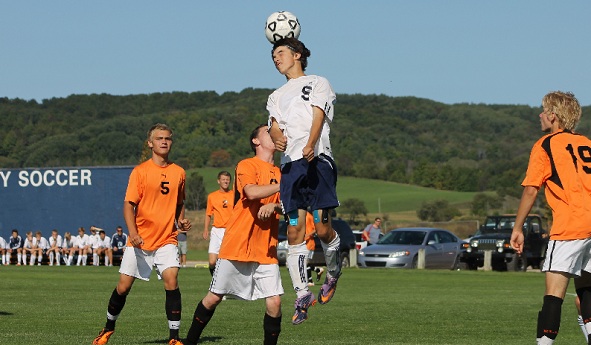
PHOTO: Petoskey senior Noah Honaker goes high while surrounded by defenders to head a ball during a game this season. (Photo courtesy of Dean Viles.)
Star Seniors Emerge Amid Tragic Losses to Lead Manistee on Historic Playoff Run
By
Tom Spencer
Special for MHSAA.com
November 7, 2025
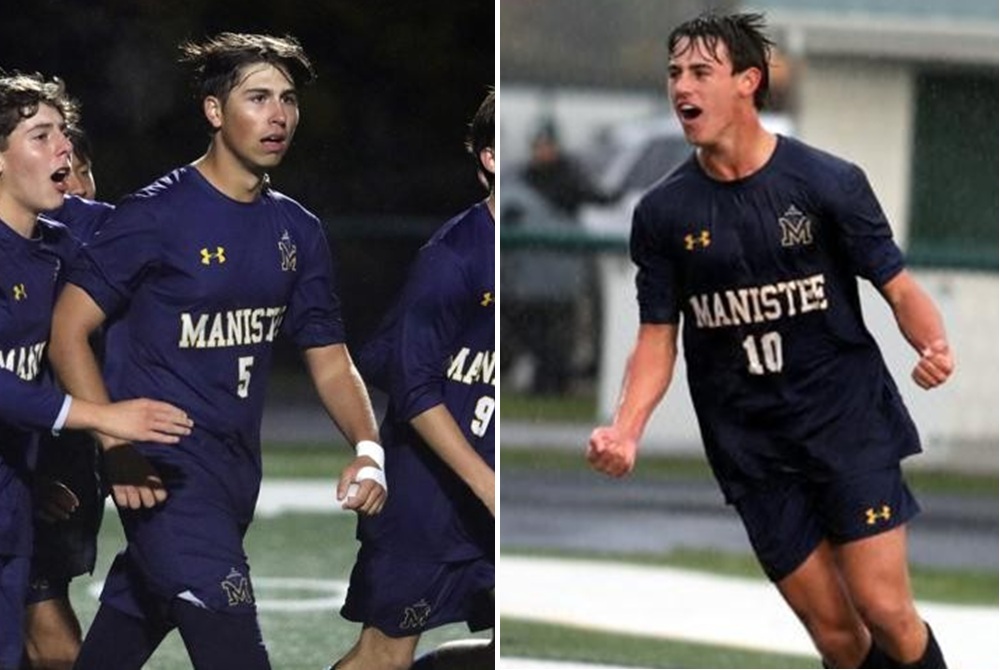
This fall’s high school boys soccer season is in the books, and Manistee advanced to the Division 3 Regional Finals for the first time since 2008 with Max Scharp and James Jados leading the way.
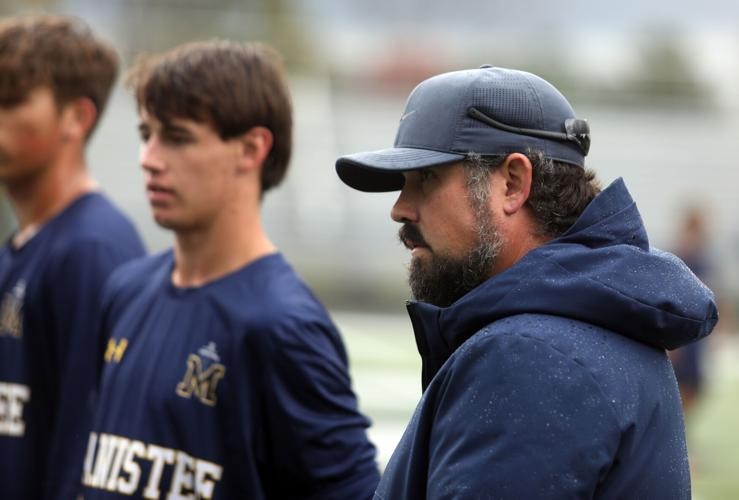
 Coach Brandon Prince is prepared to never have players like Scharp and Jados again. The senior duo was a once-in-a-lifetime combination.
But there was so much more to their stories.
“I think it says a lot about the characters of Max and James to keep doing what they did and also says a lot about the support groups they have behind them,” said Prince, who completed his 14th season at Manistee. “They never showed hardship from what they were experiencing outside. They just kept the focus on the team and what the team goals were.”
Scharp scored the District championship game’s only goal as the day marked the four-year anniversary of the death of his mother, Jessica. She lost a seven-year battle with breast cancer when Scharp was an eighth grader and older brother Jacob a freshman in the midst of helping Manistee make a run to the Regional Semifinals.
“I wanted to keep going in all kinds of ways — it was pretty emotional, and it kind of inspired me,” said Max Scharp, who suffered an ankle sprain in two spots as the Mariners earned a 4-3 shootout win over Standish-Sterling in the Regional Semifinal on Oct. 21. “She always liked to watch me play soccer.”
Scharp had 23 goals and 17 assists this season and was named to the all-West Michigan Conference first team and third-team all-state by the state coaches association.
He pointed to the sky after he scored the winning goal in the District Final win over Montague. Scharp then scored two goals in the Regional Semifinal as Jados, an all-conference center back, scored the deciding shootout goal advancing the Mariners to the Regional Final in Clare – where their season ended with a 4-1 loss to then-undefeated Fremont.
 Jados almost didn’t have a high school soccer career. He played as a youth but had no intention of joining the Mariners until he was encouraged to play by assistant coach Wendy Adamski.
This season, as the Mariners were about to host rival Ludington on Sept. 10, Jados lost his home, two dogs and cat in a fire. He vividly recalls watching the house burn with Prince alongside him.
“We were sitting up in front of the house and it was still burning, but Coach showed up for me and I knew I had to show up for the guys,” Jados said. “I told him I'd be there and got a ride over there. I told Coach I had to take care of business at home."
The Mariners took a 1-0 lead on Ludington but eventually fell 3-1. The team wasn’t told about the fire until after the game was over.
“I ran down to see him and his family before the game, and I was talking to James and his dad and I said, ‘Don't worry about us, we'll take it from here, but if you need something, you let us know,” Prince recalled of the conversation at the disaster site. “I remember, and here's the emotion in that moment, he kind of pulled my arm and he says, ‘I'll see you in a minute. We've got something to do.’”
Jados played all 80 minutes that day.
“James was dealing with the circumstances that you know, a 17-year-old young man probably shouldn't have to, but he did, and he did it with such maturity and composure,” Prince said. “I think that says a lot about James.”
Jados and Scharp were two of five seniors on the Mariners squad that finished 12-9-1 and featured a sophomore goalkeeper. Lane Piper, who finished the year with 155 saves. The senior leadership was key to the Mariners’ success as they also saw 15 freshmen, one sophomore and a couple of juniors come out for soccer in August.
Prince said he knew from the beginning of the season that Manistee would find success. He noted he’s had great players and great squads in the past, but this year’s team was unique. The team’s goal was to go as far as possible – together.
“We put the team first and the program first, and they never stopped believing that they could be doing something special,” Prince said. “And, you know, being in this sport as long as I have, I can honestly tell you these kids were special in a way that I don't think I've seen on other teams.”
 Tom Spencer is a longtime MHSAA-registered basketball and soccer official, and former softball and baseball official, and he also has coached in the northern Lower Peninsula area. He previously has written for the Saginaw News, Bay County Sports Page and Midland Daily News. He can be reached at [email protected] with story ideas for Manistee, Wexford, Missaukee, Roscommon, Ogemaw, Iosco, Alcona, Oscoda, Crawford, Kalkaska, Grand Traverse, Benzie, Leelanau, Antrim, Otsego, Montmorency, Alpena, Presque Isle, Cheboygan, Charlevoix and Emmet counties.
PHOTOS (Top) At left, Manistee’s James Jados (5) looks to his team’s bench after scoring the game-clinching goal in the Mariners’ Regional Semifinal win. At right, Max Scharp (10) celebrates his goal in the victory. (Middle) Manistee coach Brandon Prince, far right, talks to his team. Scharp is to his immediate right. (Photos courtesy of the Traverse City Record-Eagle.)