


Shrine Makes Best of 'Promising' Spring
June 15, 2019
By Jason Schmitt
Special for Second Half
EAST LANSING – Royal Oak Shrine Catholic girls soccer coach Mark Soma knew when he made a promise to Chloe Woodbeck, he’d have to do his best to keep it.
“Chloe and I were texting each other early in the year and I told her ‘If you come play for us, I promise you we will win a state title,’” the coach recalled.
On Saturday afternoon at DeMartin Stadium, the coach made good on his assurance to his Purdue-bound senior. His Knights scored a pair of goals in each half en route to a dominating 4-0 victory over Kalamazoo Christian in the Division 4 championship game, bringing home the school’s first team championship in any sport since 1974.
“He said it and I was like, ‘OK, we’ll see. We’ll see what happens. If we can do it, great. If not, it is what it is,’” Woodbeck said. “So I took the chance and I came out and played, and I’m so happy I did. It’s amazing to be out here with my classmates. It’s something I’ve never been able to do before. I’m so happy I can end my high school career doing this.”
It was Woodbeck, who has attended Shrine but played high-level club soccer with the Michigan Hawks up until this spring, who actually got things going for the Knights. She capitalized on a free kick with 24:11 to play in the first half. Drawing the penalty just moments earlier, Woodbeck sent a shot curling up and over Kalamazoo Christian goalkeeper Jenna Blackwell’s outstretched hands to break the ice for her team.
It proved to be the game-winning goal. But it was just the start for a potent Shrine team which defeated Saginaw Nouvel 6-0 in the Semifinal to earn a berth in its first-ever championship game.
Just under 11 minutes after Woodbeck’s score, junior Lily Hotts took a cross from junior Jess Reaume and redirected it for a 2-0 lead.
As good as the Knights’ offense was, it might have been an even more impressive showing by their defense with the play of junior goalkeeper Allison LaPoint. Trailing by a goal with just under 17 minutes to play in the first half, Kalamazoo Christian junior Lauryn Mohney broke in down the right side. She took a shot from 12 yards out but was thwarted by LaPoint, who made a diving save to her left. LaPoint did the same with 27:30 left in the second half and the Knights leading 2-0. Again it was Mohney on another breakaway. And again, it was LaPoint who made a diving save to preserve the two-goal cushion for her team.
“I rely a lot on my defense because they’re amazing and I trust them. But it is important to be able to make those key saves in tough situations like that,” said LaPoint, who finished the game with four saves.
Shrine (23-3-3) fed off of the defensive energy, scoring to make it 3-0 just five minutes later. Comets head coach Jay Allen felt that was a critical play for his team.
 “If Mohney scores that one in the second half, it’s 2-1. That changes the whole complexion of the game,” Allen said. “(LaPoint) makes that save, they come back and it’s 3-0; now we’re in a bigger hole. That keeper is just outstanding. When you have that kind of game, just like hockey, a keeper that can keep you in (the game), that’s half the battle.”
It was freshman Bridgette Drouillard who gave Shrine the three-goal lead, taking a crossing pass from Hotts and punching it home.
Shrine capped off the scoring with 10:24 remaining as junior Regan Robinson took a pass from Drouillard and drilled a shot from 30 yards out.
Despite falling in the Division 4 Final for the third straight season, Allen was proud of his team for achieving what so few get a chance to do.
“We worked hard, from Day 1. When they came in for preseason conditioning, our goal was to be playing here today,” the coach said. “We knew what we needed to do, but (Woodbeck) snuck that one in early on us and we just couldn’t recover from that. My seniors left it all out on the field today. We were just that one pass away, that one shot.”
Kalamazoo Christian finished the season 21-3-2.
Woodbeck has won high-level club championships over the years, but said Saturday’s title was sweet in its own way.
“The difference about playing for your school is the crowd, the amount of people that are here,” Woodbeck said. “I’ve played in a national championship (game) in San Diego, and there are just parents. It was great, but just having my entire community here and like people I don’t even know who are coming to me, cheering me on. The stands were packed, and I’ve never seen that in club.”
Woodbeck is one of just three seniors on the Shrine roster, along with Katie Norton and Mia Ciarlone. With all the talent returning next year, she’s confident her teammates can do it all over again in 2020.
“I think after this year, the confidence level is so high,” she said. “Even when we were standing in line receiving our medals, everyone was like, ‘Wow, we just did that.’ I think they can do it again. We’ve got like 11 juniors, and they’re all really strong and can carry our midfield. So I think they’re going to be just fine.”
PHOTOS: (Top) Royal Oak Shrine Catholic players prepare to accept their first Finals championship trophy in any sport since 1974. (Middle) Shrine’s Hanna Groth looks to score with Kalamazoo Christian’s Elise Van Sparrentak (15) and Jenna Blackwell defending.
Preview: Champs Seek to Extend Streaks
June 11, 2015
By Geoff Kimmerly
Second Half editor
The setting is new – at least somewhat – as the MHSAA Girls Soccer Finals return to Michigan State University this spring for the first time since 2012. The format is new, as two Finals will be played Friday and Saturday.
But most of the favorites are familiar as three teams compete to repeat as champions.
Grandville Calvin Christian is playing for its fourth straight title in Division 4, while Richland Gull Lake is looking to make it three straight in Division 2 and Hudsonville Unity Christian is playing for its second straight title but ninth total overall.
The narrative is the opposite in Division 1, where both teams are playing for the first title in program history.
Below is this weekend’s schedule, followed by glances at all eight finalists.
Friday
Hudsonville Unity Christian vs. Detroit Country Day, 1 p.m.
Richland Gull Lake vs. Fenton, 4 p.m.
Saturday
Grandville Calvin Christian vs. Lansing Christian, 1 p.m.
Saline vs. Grand Blanc, 4 p.m.
Tickets cost $8 per day and include admission to baseball and softball games that day also at MSU’s Old College Field. Radio broadcasts of all games can be heard online at MHSAAnetwork.com. All games will be streamed live online at MHSAA.TV and viewable on subscription basis.
All statistics below are through at least the regular season, with most through teams' Regionals. (Click for links to brackets and scores.)
DIVISION 1
GRAND BLANC
Record/rank: 18-5-5, unranked
Coach: Greg Kehler, 17th season (260-80-47)
League finish: Third in Kensington Lakes Activities Association West.
Championship history: Division 1 runner-up 2004.
Players to watch: Annie Walker, sr. F (29 goals, 10 assists), Lara Wheeler, fr. F (17 goals, 5 assists); Amy Puidokas, jr. GK (0.60 goals-against average, 8 shutouts).
Outlook: Grand Blanc is on its best tournament run since making the Semifinals in 2005 after eliminating No. 1 Rochester Hills Stoney Creek, No. 10 Northville and then No. 5 Troy Athens in its last three games. Walker made the all-state first team last season and is again the scorer to stop, with 2014 all-state honorable mention Lexi Trudeau, a junior, among those moving the ball into striking position.
SALINE
Record/rank: 21-0-3, No. 6
Coach: Dana Restrick, sixth season (record at school N/A)
League finish: First in Southeastern Conference Red.
Championship history: Has never played in an MHSAA Final.
Players to watch: Sofia Sweier, sr. GK (0.17 goals-against average, 20 shutouts); Taylor Mulder, sr. F (41 goals, 11 assists); Amanda Zylstra, sr. D (3 goals, 5 assists).
Outlook: Saline is 40-3-6 over the last two seasons and won its first Regional title last week. No. 3 East Kentwood in the Quarterfinal was the eighth straight opponent to be shut out by the Hornets, who have given up only four goals this season. Sweier and Zylstra made the all-state second team last season, and Mulder made the third.
DIVISION 2
FENTON
Record/rank: 15-4-3, honorable mention
Coach: Matt Sullivan, 11th season (record at school N/A)
League finish: Second in Flint Metro League.
Championship history: Has never played in an MHSAA Final.
Players to watch: Brennan Sullivan, sr. M (1 goal, 3 assists); Brianna Costigan, jr. M (9 goals, 11 assists); Abigail Quesnelle, soph. GK (0.60 goals-against average, 14 shutouts).
Outlook: Fenton has reached the Semifinals three of the last seven seasons, but after two one-goal heartbreak losses that ended those first two trips, broke through by beating No. 6 Trenton this week. The Tigers also eliminated No. 4 Warren Regina and No. 8 Linden during the tournament and have won 11 of their last 12 games. Fenton scored 26 goals during the regular season, but has put 17 in the net in six tournament games. Costigan made the all-state second team last season, and Sullivan earned an honorable mention.
RICHLAND GULL LAKE
Record/rank: 24-1-1, No. 2
Coach: Jeff Corstange, fourth season (82-8-4)
League finish: First in Southwest Michigan Athletic Conference East.
Championship history: Three MHSAA titles (most recent 2014), four runner-up finishes.
Players to watch: Hannah Phommavongsa, sr. F (16 goals, 8 assists); Amanda Pavletic, sr. M (14 goals, 8 assists); Olivia Sullivan, sr. D (1 goal, 4 assists); Kirsten Taylor, sr. F (24 goals, 11 assists).
Outlook: Gull Lake has won two straight MHSAA championships and is loaded with veterans as it goes for a third. Taylor made the all-state third team last season, and Phommavongsa, Sullivan and Pavletic earned honorable mentions. Gull Lake defeated No. 10 DeWitt and honorable mention Middleville Thornapple Kellogg during this run, with the lone loss by a goal midseason to Division 1 Grand Rapids Forest Hills Central. Junior keeper Regan Troff took over in net this spring and has saved 96 percent of the shots against her.
DIVISION 3
DETROIT COUNTRY DAY
Record/rank: 18-3-2, No. 3
Coach: Bob Bukari, 29th season (record at school N/A)
League finish: Does not play in a conference.
Championship history: Five MHSAA titles (most recent 2004), four runner-up finishes.
Players to watch: Isabel Nino, soph. D/GK; Jenna Staudt, sr. D/M; Dagny Hill, soph. M; Libby Ronchetto, sr. M/D (Statistics not submitted).
Outlook: Country Day has finished runner-up three times since its last title, but has plenty of key players who experienced last season’s run. Hill and Staudt made the all-state second team in 2014, Nino made the third and Ronchetto earned honorable mention. The Yellowjackets eliminated No. 6 Grosse Ile and then edged No. 2 Flint Powers Catholic in a shootout to advance to this weekend.
HUDSONVILLE UNITY CHRISTIAN
Record/rank: 23-1, No. 1
Coach: Randy Heethuis, 26th season (487-87-28)
League finish: First in Ottawa-Kent Conference Green.
Championship history: Eight MHSAA titles (most recent 2014), three runner-up finishes.
Players to watch: Bethany Balcer, sr. M (38 goals, 13 assists); Maddy VanDyke, jr. D (5 goals, 2 assists); Casandra Besteman, sr. M (3 goals, 3 assists); Elly Brummel, sr. D (4 goals, 5 assists).
Outlook: Unity Christian bounced back from a rare Finals miss by winning its eighth title last spring and second in three seasons. Unity Christian downed the reigning champion, Grand Rapids South Christian, in the Regional Final and also eliminated No. 4 Grand Rapids Catholic Central. Balcer – one of five players with at least 10 goals – and VanDyke are returning all-state first-teamers, while Brummel made the second team and Besteman earned honorable mention.
DIVISION 4
GRANDVILLE CALVIN CHRISTIAN
Record/rank: 21-3, No. 2
Coach: Tim TerHaar, 15th season (255-64-20)
League finish: First in O-K Silver.
Championship history: Division 4 champion 2014, 2013 and 2012.
Players to watch: Allison Keizer, sr. GK (0.88 goals-against average, 14 shutouts); Morgan Buursma, sr. D (20 goals, 4 assists); Hilary Curry, sr. M (24 goals, 16 assists); Emily VanVliet, sr. M (11 goals, 26 assists).
Outlook: Calvin Christian can become just the second team in MHSAA history to win four straight girls soccer championships, following the Unity Christian teams of 2005-10. Keizer and Buursma made the all-state first team last season, while Curry made the third team and VanVliet earned honorable mention. Four Calvin Christian players have scored at least 20 goals this season – junior forwards Whitney Koets (28) and Natalie Honeycutt (22) are the other two.
LANSING CHRISTIAN
Record/rank: 20-4, honorable mention
Coach: Joel Vande Kopple, ninth season (129-41-9)
League finish: Tied for first in Greater Lansing Activities Conference.
Championship history: Division 4 runner-up 2011.
Players to watch: Kasey Jamieson, fr. F (47 goals, 15 assists); Emily Voss, sr. F (27 goals, 16 assists); Rachelle Trafford, sr. GK (0.74 goals-against average, 15 shutouts).
Outlook: Lansing Christian has reached at least the Semifinals four of the last five seasons, giving the Pilgrims as much late-round experience as most left this weekend. Voss made the all-state third team in 2014 and provides an excellent one-two scoring punch with Jamieson, who also had both goals in the Semifinal win over Grosse Pointe Woods University Liggett to push her first-season total to 49.
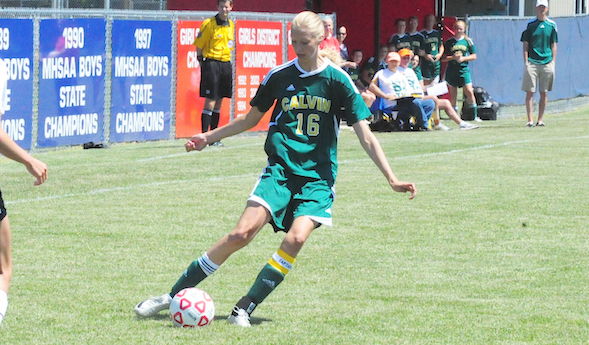
PHOTO: Grandville Calvin Christian's Emily VanVliet controls possession during last season's Division 4 Final win.