


Storch Returns to Retirement After Elevating Alpena Teams From Cellar to Contenders
By
Tom Spencer
Special for MHSAA.com
December 16, 2022
It wasn’t long ago that Alpena boys and girls soccer opponents took their long bus rides to play the Wildcats expecting an easy win, and most likely by securing the victory by the eight-goal differential rule, commonly known as the “mercy rule.”
 Worse yet, the Wildcats also had to take those trips across the northern part of the Lower Peninsula, as well as northern and southern journeys of two hours, dreading thoughts of experiencing yet another shortened game.
Those expectations started to change in 2011, when Tim Storch, arguably the most decorated coach in the history of Michigan high school soccer, took the reins of the Wildcats’ boys and girls programs.
Storch made the move after retiring from Troy Athens as a teacher and coach of the Redhawks’ boys and girls soccer teams.
Slowly but surely, Alpena’s mercy losses disappeared – and wins over their Big North Conference opponents became reality. Under Storch, the Wildcats went from the cellar to challenging for titles.
But now, Storch is showing some mercy on the Big North – perhaps an early Christmas present. The conference schools won’t see him on sidelines any longer. He’s retiring – again.
Storch is doing so after leading the Wildcats to wins over all conference opponents except Traverse City West. The Wildcats did get a tie this fall against the Titans, one of the BNC schools that regularly makes a deep postseason run, as Alpena stayed in the league title race most of the season.
“When I came to Alpena it was about trying to make the program relevant in the school, the community, the area, the BNC and northern Michigan,” Storch recalled. “We got to that point after some growing pains.
“Early on we took our lumps, and we were mercied by everybody,” he continued. “By the end we were competitive with everybody.”
Storch, who started the Athens soccer programs from scratch in 1981, won eight Class A or Division 1 Finals titles with the Redhawks. He’s near the top of the lists of the winningest boys and girls soccer coaches in the state. The last of his 1,109 wins was a 3-1 victory over Bay City Western during this fall’s postseason.
The Wildcats also beat conference opponent Cadillac in their District opener. They finished 14-6-3 on the season.
Storch will be dearly missed in Northern Michigan, veteran Petoskey boys and girls coach Zach Jonker pointed out. Jonker’s Northmen picked up a victory over Alpena in the Division 2 District Final – also Storch’s last game.
"Tim has had a legendary career as one of the most influential figures in Michigan high school soccer over the past 40 years while having an enormous impact on thousands of student-athletes,” Jonker said. “Over the past decade, Tim helped to dramatically raise the overall level of play in the Big North.
 “He is one of fiercest competitors I have ever coached against, but he is also one of the most genuine and empathetic coaches I have ever encountered,” Jonker continued. “I feel fortunate to have been able to build a competitive relationship with him and call him a friend."
Storch’s last game with the Alpena girls also was a District Final, a 3-0 loss May 31 to West.
Storch is proud of what the Wildcats accomplished, noting logistics — unlike in southeastern Michigan — were a big challenge.
“We were an island,” Storch said. “We were big school in the middle of nowhere.
“We couldn’t get together and have any kind of summer program with other communities because they didn’t have soccer, and if they had soccer they were at a Class D or C level that was way beneath what we were playing in the Big North.”
Storch’s tenure, which included six years serving as the Wildcats’ athletic director while coaching, drew accolades from his coaches and athletic directors. In addition to Jonker, Gaylord AD Christian Wilson, and West boys head coach and girls assistant coach Matt Griesinger gave high praise.
They are among those who will miss the successful coach.
“Tim leaves Alpena in better shape than when he arrived, and that is the true mark of a great coach and administrator,” Wilson said. “He has been an outstanding representative of Alpena High School, both as a soccer coach and as an athletic director.
“Tim brought a level of stability and expertise and was well-thought of by players, coaches, and community members.”
Griesinger, who has led the Titans to considerable postseason success and upheld BNC dominance since taking over the West program eight seasons ago, was particularly impressed with Storch’s energy and passion for his players evident in every match.
“Tim is one of the most respected coaches in the state, and what he has done for the soccer communities in both Troy and Alpena is not just commendable, but also something that every high school coach should hope to emulate,” Griesinger stated. “Storch is a stand-up guy, and all of us other coaches in the BNC should consider ourselves lucky that our journeys in the sport overlapped.”
Storch is leaving Michigan high school sports as they face a shortage of referees and qualified coaches. He’s not certain of the exact reasons for it, but he points to time constraints and pressures faced on and off the field.
And, he knows the days of a teacher starting a career, coaching sports and sticking with it are long gone.
“My wife has always said I was a dinosaur,” Storch said with a chuckle. “Back in my day, even if you had family and kids, you still made time for coaching.
“Coaching was part of my fiber — it kind of defined me.”
Storch is quick to point out “soccer coach” was just one of three hats he wore, along with history teacher and friend.
“I’m Mr. Storch to my students,” he recalls telling his student-athletes at Athens. “I’m Coach to my kids, and I am Tim to my friends.
“They are three different hats; I learned how to wear them and how to balance them.”
Storch looks back to all the friendships he’s made around the game of soccer – with former players, fellow coaches, and referees – with excitement for the future.
He is also keeping in mind former players, referees and coaches who have passed on.
“It is kind of humbling when I think back all the years (to) coaches, referees and players I have interacted with,” he said. “We’re all here for a finite time.
“We need to make the most of it and hopefully leave the place a better place when we leave.”
 Tom Spencer is a longtime MHSAA-registered basketball and soccer official, and former softball and baseball official, and he also has coached in the northern Lower Peninsula area. He previously has written for the Saginaw News, Bay County Sports Page and Midland Daily News. He can be reached at [email protected] with story ideas for Manistee, Wexford, Missaukee, Roscommon, Ogemaw, Iosco, Alcona, Oscoda, Crawford, Kalkaska, Grand Traverse, Benzie, Leelanau, Antrim, Otsego, Montmorency, Alpena, Presque Isle, Cheboygan, Charlevoix and Emmet counties.
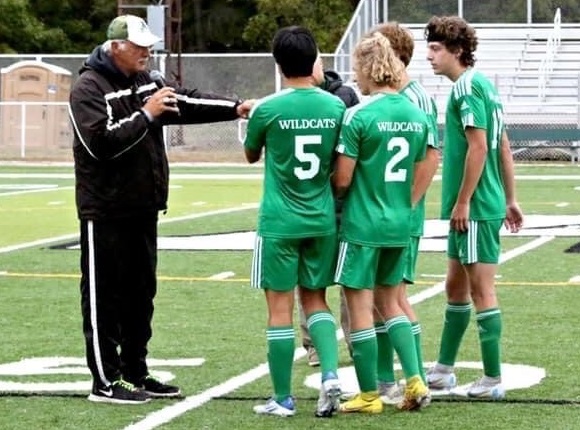
PHOTOS (Top) Recently-retired Alpena soccer coach Tim Storch, left, talks things over with one of his players. (Middle) Storch, holding the microphone, elevated the Wildcats’ girls and boys programs since taking over both in 2011. (Photos courtesy of Therese Shaw.)
Preview: Ready for Rematches
June 13, 2014
By Geoff Kimmerly
Second Half editor
Two of Saturday’s MHSAA Girls Soccer Finals are rematches of 2013 title games.
That alone tells the stories behind two of this weekend’s four championship games.
Clarkston Everest College/Waterford Our Lady actually will face Grandville Calvin Christian in the Division 4 Final for the third straight season – Calvin Christian won the last two championship meetings. Richland Gull Lake will look to repeat in Division 2 against Bloomfield Hills Marian, its opponent last season and the champion in 2012.
Among the four teams playing in Division 1 or Division 3, Utica Eisenhower is seeking its first MHSAA title while the other three have some recent history at the Finals – Hudsonville Unity Christian also was a 2012 champion, while Northville and Detroit Country Day both are seeking their first titles since 2004.
Below is Saturday's schedule, followed by a look at all eight contenders:
Division 1 at Williamston - Noon
Utica Eisenhower (18-2-1) vs. Northville (22-0)
Division 2 at Williamston - 3 p.m.
Bloomfield Hills Marian (19-0-1) vs. Richland Gull Lake (23-1-1)
Division 3 at Mason - Noon
Hudsonville Unity Christian (22-1) vs. Detroit Country Day (21-3-3)
Division 4 at Mason - 3 p.m.
Clarkston Everest/WOLL (17-1-1) vs. Grandville Calvin Christian (23-1)
Tickets cost $7. All Finals will be streamed live online at MHSAA.TV, with radio broadcasts available on MHSAAnetwork.com.
All statistics below are through at least the regular season, with most through teams' Regionals. (Click for links to brackets and scores.)
Division 1
NORTHVILLE
Record/rank: 22-0, No. 1
Coach: Eric Brucker, fifth season (85-11-10)
League finish: First in Kensington Lakes Activities Association Central and overall
Championship history: Two MHSAA titles (most recent 2004), two runner-up finishes.
Players to watch: Megan Buckingham, sr. F (22 goals, 20 assists); Jamie Cheslik, sr. F (32 goals, 16 assists); Emily Maresh, jr. GK (0.16 goals-against average, .972 save %, 18 shutouts); Gabby Mencotti, sr. M (7 goals, 4 assists).
Outlook: Four teams have scored one goal apiece on Northville this season. That’s it. Maresh replaced an all-state keeper who graduated in 2013 and has shined behind a strong defensive group. The Mustangs’ tournament run has included wins over No. 6 Novi, No. 9 Saline and honorable mention Okemos, and Novi scored the only goal Northville has given up during the playoffs. Cheslik is set to play next season at Michigan State University, Buckingham at University of North Carolina, Mencotti at Grand Valley Sate University and senior midfielder Suzie Redick at University of Detroit Mercy.
UTICA EISENHOWER
Record/rank: 18-2-1, No. 4
Coach: Mehrdad Nekoogar, 10th season (156-18-19)
League finish: First in Macomb Area Conference Red
Championship history: Division 1 runner-up 2009.
Players to watch: Caitlin Carroll, sr. M (14 goals, 5 assists); Paige Duda, jr. F (16 goals, 4 assists); Isabella Palazzolo, jr. F (10 goals, 11 assists).
Outlook: Eisenhower has won five straight league titles but won its first District championship since 2011. The Eagles eliminated No. 3 Rochester Hills Stoney Creek and honorable mention Grand Blanc among others during this tournament run, and beat honorable mention Okemos during the regular season – that last win as part of an 11-game shutout streak. Carroll earned an all-state honorable mention last season.
Division 2
BIRMINGHAM MARIAN
Record/rank: 19-0-1, No. 1
Coach: Barry Brodsky, 13th season (241-22-29)
League finish: Second in Detroit Catholic High School League Division 1
Championship history: Five MHSAA titles (most recent 2012), two runner-up finishes.
Players to watch: Kelly Sweeney, jr. F (20 goals, 11 assists); Hannah Redoute, fr. F (13 goals, 9 assists); Jaclyn Engel, jr. M (9 goals, 12 assists).
Outlook: Marian has won three titles over the last five seasons and once again has a champion’s resume’ – including wins over No. 7 Livonia Ladywood, No. 10 Lapeer West and honorable mentions Auburn Hills Avondale and Warren Regina during the tournament. The Mustangs have give up only five goals – and only one in the postseason, to Ladywood in the Semifinal. Sweeney and senior midfielder Annika Johnson made the all-state first team in 2013.
RICHLAND GULL LAKE
Record/rank: 23-1-1, No. 2
Coach: Jeff Corstange, third season (57-7-3)
League finish: First in Southwestern Michigan Athletic Conference East
Championship history: Two MHSAA titles (most recent 2013), four runner-up finishes.
Players to watch: Rachel Fouts, sr. M (12 goals, 13 assists); Maggie Harma, sr. GK (0.42 GAA, .940 save %, 17 shutouts); Tabitha Boze, sr. M (10 goals, 10 assists); Amanda Paveltic, jr. F (14 goals, 8 assists).
Outlook: Gull Lake may have stunned some by knocking off powerful Marian in the Final a year ago, but the Blue Devils’ return is no surprise. Fouts made the all-state first team last season, while Harma made the third team and both Boze and Paveltic earned honorable mentions. Three others have at least 13 goals, including leading scorer Kirsten Taylor, a junior, with 18. Just as Marian eliminated many of the best from the Detroit area, Gull Lake did the same on the west side of the state with tournament wins over No. 4 Stevensville Lakeshore, No. 9 Haslett and honorable mention Grand Rapids Christian. The lone loss was to Division 1 No. 8 Rochester Adams.
Division 3
DETROIT COUNTRY DAY
Record/rank: 21-3-3, No. 3
Coach: Bob Bukari, 28th season (record N/A)
League finish: Does not play in a league.
Championship history: Five MHSAA titles (most recent 2004), three runner-up finishes.
Players to watch: Jenna Staudt, jr. D; Michelle Manning, sr. F; Isabel Nino, fr. GK (Stats not submitted.).
Outlook: Country Day is annually in the Division 3 mix, but making its first championship game appearance since back-to-back runner-up finishes in 2005 and 2006. The Yellowjackets have eight straight shutouts, including against No. 5 Flint Powers Catholic, No. 6 Freeland and honorable mention Grosse Ile during the tournament. Manning made the all-state first team last season, and Staudt was second teamer.
HUDSONVILLE UNITY CHRISTIAN
Record/rank: 22-1, No. 2
Coach: Randy Heethuis, 25th season (464-86-28)
League finish: First in Ottawa-Kent Conference Green
Championship history: Seven MHSAA titles (most recent 2012), three runner-up finishes.
Players to watch: Bethany Balcer, jr. M (26 goals, 16 assists); Aubrey Schierbeek, sr. F (30 goals, 20 assists); Lauren Orr, jr. F (9 goals, 12 assists); Cassandra Besteman, jr. M (4 goals, 4 assists).
Outlook: This will be Unity Christian’s ninth championship game appearance in the last decade, and the Crusaders will be playing for their eighth MHSAA title during that time. They didn’t make it out of the Regional in 2013, but brought back six players this spring who earned all-state recognition – Schierbeek, Orr, Besteman, defenders Elly Brummel and Maddy VanDyke (three goals, five assists) and keeper Abby Veeneman (0.32 GAA, 11 shutouts). They’ve given up only one goal in the postseason, in the 5-1 District Final win over No. 4 Grand Rapids South Christian.
Division 4
GRANDVILLE CALVIN CHRISTIAN
Record/rank: 24-1, No. 2
Coach: Tim TerHaar, 14th season (232-61-20)
League finish: First in Ottawa-Kent Conference Silver
Championship history: Division 4 champion 2013 and 2012.
Players to watch: Camie Rietberg, jr. M (13 goals, 7 assists); Morgan Buursma, jr. D (8 goals, 5 assists); Sarah Klunder, sr. M (19 goals, 23 assists), Whitney Koets, (24 goals, 4 assists); Hilary Curry, jr. F (9 goals, 10 assists); Emily VanVliet, jr. F (16 goals, 15 assists).
Outlook: Calvin Christian has claimed the last two Division 4 titles and keeps winning with a proven formula – prepare during the regular season against bigger opponents, fill out a lineup with plenty of scoring options and dominate during the tournament. They’re scoring even more than a year ago, with 135 goals so far including another 17 off the bench from forward Laura Ramaker. Calvin Christian downed No. 3 Kalamazoo Christian, No. 4 Muskegon Western Michigan Christian and No. 8 Holland Black River during this tournament run, giving up its only goal of the postseason in the Quarterfinal to WMC. The lone loss was to Division 3 finalist Unity Christian.
CLARKSTON EVEREST COLLEGIATE/WATERFORD OUR LADY
Record/rank: 17-1-1, No. 1
Coach: Courtney Shegos, first season (17-1-1)
League finish: First in Detroit Catholic High School League Intersectional
Championship history: Division 4 champion 2010, runners-up 2013 and 2012.
Players to watch: Anna Robb, jr. F (19 goals, 7 assists), Alex Troy, fr. M (10 goals, 6 assists); Lindsay Straw, jr. M (17 goals, 18 assists); Megan Luttinen, sr. GK (0.35 GAA, 12 shutouts, .950 save %).
Outlook: Former Grand Blanc standout and Michigan State University captain Shegos took over the program this spring, and it hasn’t missed a beat led by three of its top offensive players and keeper from 2013. Robb made the all-state team last season while Straw, Troy and Luttinen earned honorable mentions. The lone loss came in the regular-season finale to Division 3 top-ranked Pontiac Notre Dame Prep, and Everest/Our Lady has given up more than one goal only twice – yielding two to Notre Dame Prep and two to Auburn Hills Oakland Christian in the District Final. Everest/Our Lady then came back to shut out No. 5 Grosse Pointe Woods University Liggett 5-0 in the Regional Semifinal.
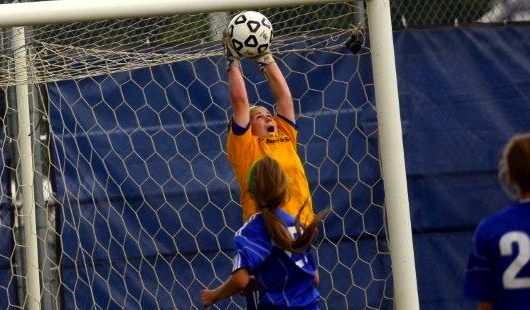
PHOTO: Clarkston Everest Collegiate/Waterford Our Lady’s Megan Luttinen makes a save during the 2013 MHSAA Division 4 Final. She’ll be in net again Saturday.