

Pioneer's Hills Leave 'Lasting Impression'
April 25, 2014
By Geoff Kimmerly
Second Half editor
More than 40 years coaching some of Michigan’s top high school athletes has earned Denny and Liz Hill thank-yous from a variety of sources now that they've announced their job is finally done.
Like from the former swimmer now in Washington, D.C., who wrote to Denny to explain – tongue-in-cheek, of course – how swimming at Ann Arbor Pioneer prepared her to handle the long hours and grouchy bosses that come with being a lobbyist in the nation’s capital.
Or from the group of parents who saw the Hills at a recent restaurant opening and thanked them for showing their kids that they too were key parts of Pioneer’s swimming and diving teams – even though those athletes weren't among the many MHSAA championship or All-America-level contributors.
“You get notes from people explaining the wonderful things you did for them, and you didn't realize what you’d done,” Denny Hill said. “I kept telling Liz (again, tongue-in-cheek), I don’t understand why all these kids come out. I’m mean to everybody. ... But I’m getting that (appreciation) back from kids, and mostly parents. The parents kept saying that no matter how good (their kids swam), they were part of the team, and we felt good about that. I think that’s important, especially at the high school level.”
All joking aside, there are few who have helped push an entire sport, statewide, to an elite level while keeping those high school values in mind like the first couple of Michigan high school swimming.
The Hills retired as Pioneer’s boys swimming and diving coaches during this winter’s postseason banquet. Denny served as head coach of the boys team for 45 years and the girls for 38 before leaving the latter after 2010 – combined, he has a dual meet record of 1,011-128-2 and led the boys team to 15 MHSAA championships and the girls team to 16. He also guided 240 athletes – including eventual Olympic medalist Kara Lynn Joyce – who earned All-America honors from the National Interscholastic Swim Coaches Association.
Liz, his wife of 31 years, served as his boys assistant for 14 seasons and co-head coach for seven and girls assistant for 23 years and co-head coach of that team for four. She was part of all the girls championships and the majority won by the boys.
Those accomplishments rightly have highlighted the tributes both have received locally and beyond over the last two months – including when Denny was inducted into the NISCA Hall of Fame in March. But they tell only one side of their contributions to the sport they've lived for half a century.
“Denny and Liz have left a lasting impression on high school swimming, both locally and nationwide. Their accomplishments with their teams can be seen in the trophy cases and record boards across the state, but they have done so much more for the swim community,” said Bloomfield Hills’ girls coach David Zulkiewski, who also serves as president-elect of the Michigan Interscholastic Swim Coaches Association.
“They have volunteered and dedicated hours to the improvement of the sport and to benefit current and future athletes. Their leadership roles with MISCA and NISCA have provided us with instruction, inspiration and guidance that will last into the future.”
Been there, seen it all
Denny Hill has seen it all, and Liz has seen most of it during their decades in the pool.
Denny graduated from Lansing Eastern High School in 1962, and then swam at Michigan State University until graduating in 1966. After a year of student teaching at Jackson Parkside and then 1967-68 as boys coach at Ferndale, Denny took over the Pioneer swimming and diving program. He also taught chemistry until retiring from the classroom in 2007.
 (Side notes: Denny’s father Harry Hill was a highly-respected labor leader and education activist Lansing and had a high school on the city’s south side named after him posthumously in 1971. Denny’s mother Berniece served as Lansing’s postmaster general during the late 1960s and 1970s.)
Liz, formerly Liz Lease, was a standout sprinter for the Pioneers until graduating in 1976, and then earned All-America honors at the University of Michigan before finishing studies in 1980.
She taught and coached in Texas for two years before returning to Ann Arbor, marrying Denny in 1983 and helping his teams from time to time until becoming an assistant for good a few years later.
Coaching together, they created a fine-tuned system. Liz would work with the younger or less experienced swimmers, and Denny worked with the advanced group. One year Liz had 44 girls in hers; often, Denny would work with 22-28. They’d come together to practice starts and turns and for meets, all getting a chance to compete in some fashion be it in additional heats or junior varsity competition.
After two runner-up MHSAA Finals finishes in three seasons from 1974-76, Pioneer’s boys won their first Class A title under Hill in 1977 – which ended up being the first of six straight championships and eight in nine seasons. The girls followed back-to-back runner-up finishes in 1983-84 with their first championship in 1985, and that win started a string of six in eight seasons. Pioneers’ girls also won Class A/Division 1 titles from 2000-08, the last two with Denny and Liz officially as co-coaches.
Pioneer athletes continue to hold all-MHSAA Finals records in the 50 and 100 freestyles (both by Joyce) plus the 200 and 400 relays.
“The thing that sticks out in my mind about Denny is that he always had a bigger vision of everything. His vision of a particular athlete’s potential, in and out of the pool, exceeded theirs,” said Eastern Michigan University men’s swimming coach Peter Linn, who has led the Eagles to 21 Mid-American Conference championships and swam for Denny Hill’s club teams as a youth and against Pioneer as a high school coach in Upper Arlington, Ohio; he also coached the Hills’ son Steven at EMU. “His vision of being the best high school team was more than just being state champions; it was about being national champions. He held everyone including himself accountable to the pursuit of that vision.
“In doing this, he and Liz not only succeeded in producing amazing teams and terrific individuals at Pioneer and in Ann Arbor, but they also raised the bar on high school swimming in Michigan – and the results were instrumental in raising the overall level of swimming in the state. They left you two choices: rise to the occasion and be your best, or get left behind.”
Far-reaching impact
The Hills and Linn’s friendship is like many in swimming – no MHSAA sport, arguably, has as many long-serving coaches and long-cultivated connections.
Maureen Isaac knew the Hills long before agreeing to coach the girls swimming and diving program at brand-new Ann Arbor Skyline in 2008 – her husband Stu Isaac was Liz Hill’s coach at U-M. But Maureen also ended up with four athletes who previously would've gone to Pioneer, and yet – “never once did (the Hills) not help me,” she said.
She first called Denny right after getting the job. That turned into him sending her all of Pioneer’s meet results from the previous year so she had some background on opponents coming into that first season. He and Liz continued to welcome Skyline athletes to their annual summer program, and never ran up the score against Skyline’s teams – although Pioneer could’ve won big those first few seasons.
Isaac remembers in particular the first meet against Pioneer, when its swimmers stayed in the pool until the last swimmer for both teams finished a race. It’s a practice her much-improved program has adopted, among others she’s admired from across town.
“I called them up literally to beg them to stay,” Isaac said. “I’m as competitive as the next guy; I want to win as much as the next guy. But how they've done it ... you look at the Facebook postings, the responses from alumni when they found out (the Hills) were leaving, and not one person was talking about winning a state title. They talked about the amazing influences (the Hills) had on their lives.”
That influence extends far beyond Ann Arbor.
Denny and Liz’s athletes and former assistants have gone on to coach at high school and college levels in Illinois, Oregon and Ohio among other states, with the recent Michigan footprint including South Lyon boys and girls coach John Burch and Saline former girls and current boys assistant Pete Loveland.
The Hills also have long played significant roles in their state and national coaching associations and the national rule-making body. Denny was on the National Federation of State High School Associations' rules committee during the 1970s when it was coordinated by now-MHSAA Executive Director Jack Roberts. Denny also remains a NISCA director for the zone including Michigan, Illinois, Indiana, Iowa and Wisconsin.
“For the 40 years I've been involved with high school swimming in Michigan, Denny Hill has been the coach that I have tried to emulate. His integrity and manner of coaching have been an inspiration to all of us,” said East Grand Rapids coach Butch Briggs, who has led boys and girls teams to a combined 28 MHSAA championships. “His quiet leadership and love for both the sport and his athletes has served as a model for all to aspire to. Although he will be missed, his legacy will continue to inspire those of us involved in Michigan high school swimming.”
The big picture
Liz Hill said she “just follows along in the shadows,” an extension of their program that has allowed more students to participate.
She’s being more than modest.
In addition to taking over as Pioneer’s co-coach, she continues to manage the Huron Valley Swim Club – which teaches and trains 300 aspiring swimmers. Denny and Liz have served as back-to-back presidents of MISCA – Liz is finishing up her term this spring – and she also will receive a NISCA outstanding service award next year.
Although swimming and diving is not in the public eye as frequently as more media-covered sports, it still has plenty of politics to hurdle. The Hills are known as voices of reason – voices the rest of Michigan and beyond has been wise to heed.
“A lot of times, people don’t always see the big picture. They think in terms of their own athletes, their own teams, and sometimes you have to look at what’s best for everyone,” Liz Hill said. “Denny has done so much for swimming, been involved for so long. Because he has had success, people tend to listen to what he has to say.”
Denny Hill said he likes to think that Ann Arbor has served as the capital of swimming in the state. He also played a giant role in the community’s non-school swimming scene, including starting Club Wolverine – recognized as one of the top programs of its type in the nation.
He’s taken high school teams all over Michigan, not only to have Pioneer face the best but hopefully to provide those opponents the opportunity to test themselves as well.
But even then, some of the favorite memories might be different than expected.
Like when former swimmer Eric Troesch, then an assistant coach, was able to jump into the EMU pool with the rest of the girls team after they won another MHSAA title – and despite suffering a serious spinal cord injury a year before that had left him temporarily paralyzed. Or this season’s boys team, which had a combined grade-point average of 3.6 and was made up, again, of the kind of students Denny would've taught in his chemistry classes.
This week, Hill remembered a conversation with Linn years ago that framed many of his and Liz's efforts.
“He said, ‘It sounds to me like we had more fun when we didn't have as good of teams than others we (had),’ and that hit home for me,” Hill said.
“I don’t think we have the pressure to win from the schools and parents; we’re not getting all the write-ups in the papers like for basketball and football, and the kids are doing it not so much for the glory of it, but for self-improvement. The kids look at the record book and it’s a motivation thing, and really for those kids they’re pretty motivated to go on and be the leaders of the country because they work hard, they strive for the team atmosphere type of thing, and they have a fine sense of community and helping people.
"I think that’s really neat.”
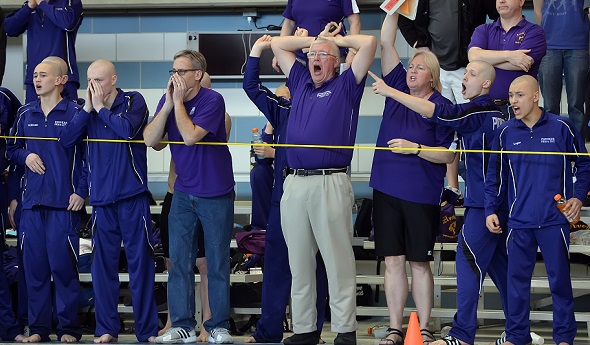
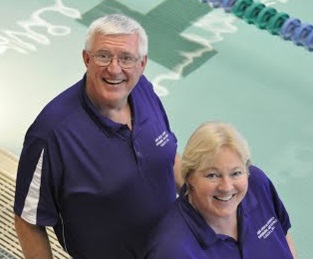
PHOTOS: (Top) Denny and Liz Hill (center) cheer on their team during the 2013 MHSAA Division 2 Finals. (Middle) The Hills are retiring after more than three decades coaching together at Ann Arbor Pioneer. (Top photo courtesy of HighSchoolSportsScene.com. Middle photo courtesy of Ann Arbor Pioneer Swimming and Diving.)
Team Effort Vaults Marquette Back to #1
By
Ryan Stieg
Special for Second Half
February 15, 2020
MARQUETTE – Going into Saturday’s Upper Peninsula Swimming & Diving Finals, it had been three years since the Marquette boys finished on top.
To end that streak, the Redmen would need their underclassmen to start fast on the blocks – and Marquette’s youth definitely did their part.
The Redmen rolled to the team win, racking up 344 points, well ahead of second place Sault Ste. Marie (227). The Blue Devils edged Houghton by eight points to get the runner-up spot, while Kingsford was fourth with 176.
Marquette’s depth also played a role in the victory as it had only two event winners with Liam McFarren taking the 100-yard freestyle and the Redmen winning the 200 free relay.
“With a crew that’s mostly freshmen and sophomores, this win means even more honestly,” Marquette head coach Nathan McFarren said. “It was a pretty impressive performance for this group of guys, and we had so much depth too. It was pretty incredible to watch these guys progress throughout the year, and I can’t wait to see it in four years.”
In regard to the Redmen’s depth, McFarren said his team is no longer strictly swimmers, but now includes a wide variety of athletes.
“We’ve lost a lot over the past few years, which has cost us, but this freshman class is huge,” he said. “It’s the biggest freshman class I’ve ever had, and it’s not all guys that have been swimming their whole lives. It’s football players and multi-sport players, so it’s pretty cool.”
 The Sault had a big day in the pool as it finished first in the other two relays (200 medley and 400 free), while Andrew Innerebner and Morgan Burd both won two events. Innerebner won the 50 free and 100 butterfly, and Burd finished on top in the 200 individual medley and 100 backstroke.
“Sometimes the kids just shock you,” Blue Devils head coach Steve Habusta said. “We expected great things, but I don’t think we expected this great of things. The boys were swimming lights out. Everybody is stepping up and doing it all through tragedy. … One of our swimmers lost his mom, so for our kids to step up and rally behind him, I think it’s a special day for everyone.”
Houghton notched three wins at the meet with Archer Olson earning victories in the 200 free and 500 free, while Davin Evans won the 100 breaststroke.
Even though the Gremlins were unseated as U.P. champs, head coach Erik Johnson was pleased with how the day went overall.
“When you come here with five boys qualified and eight or nine girls, it’s tough to get points,” he said. “But they all did really well. They all swam well, and I couldn’t be more proud of them. Our boys, we only graduate one senior and we’ll miss our girls seniors, but kids are ready to step up so we’re excited.”
On Friday night, Ishpeming Westwood’s Brock Sundberg repeated as the 1-meter diving champion with a score of 205.15. This was the third straight year a Patriots diver won the title.
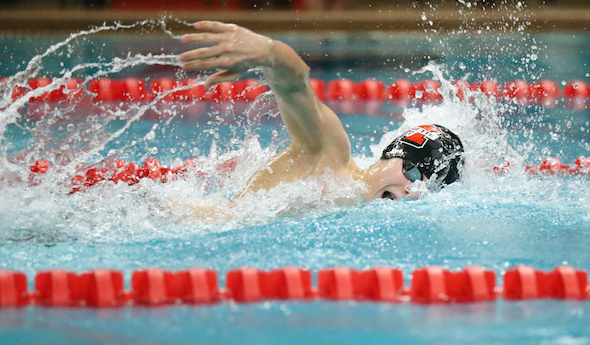
PHOTOS: (Top) Liam McFarren was one of two individual event winners for team champion Marquette, and here he swims the winning 100 freestyle. (Middle) Sault Ste. Marie's Morgan Burd swims to the championship in the 100 backstroke. (Photos by Jarvinen Photos.)