

Rally Champs 'Survive' Fun-Filled Forest
August 19, 2013
By Geoff Kimmerly
Second Half editor
As one of Michigan’s top high school swimming sprinters, Fenton senior Gabbi Haaraoja no doubt was in strong shape to start this summer.
But she and her Tigers teammates made sure to prepare for this month’s preseason “survival trip” with plenty of miles running and yards swimming a local lake.
All that training paid off during three days and two nights at Pigeon River Country State Forest near Vanderbilt as the team prepared for last week’s first day of practice and a run at a 10th-consecutive league championship.
And the Tigers have kicked off the title effort by being named winners of the MHSAA’s inaugural Prep Rally, a contest that was part of the MHSAA’s PLAY (Preparation Lasts All Year) initiative to encourage athletes to remain active during the offseason so they are prepared physically and acclimated to warm weather when practice begins in the fall.
“Being out in nature, it’s really pretty there. You appreciate it more,” Haaraoja said, then adding some tongue-in-cheek. “It definitely was fun. But it was a lot more work than what we were used to. I think I’m actually glad I’m a senior.”
 Athletes from Grosse Pointe Woods University Liggett and Beal City also were finalists. Participating athletes from Fenton’s girls swimming and diving team will receive tickets to an MHSAA Final of their choice, where they will be recognized for their achievement.
Fenton has taken similar training trips heading into all 14 seasons under coach Brad Jones. Others have included activities like canoeing and dune climbing, The last four years, the team journeyed to El Cortez Beach Resort in Oscoda for some time on Lake Huron together before practice began.
This season’s seniors asked to do something new. And it was a new experience for many in more ways than one.
The team left Aug. 11 and returned home two days later in time for the first day of practice. Jones took north 24 athletes, and some had never camped or slept outside. Six seniors made their fourth preseason trip with the team – but for 12 freshmen, this was their first experience as high schoolers.
That team demographic made this summer’s trip especially important for bonding. But it also had a desired effect physically – both heading into this fall and in setting preparation expectations for the future.
Pigeon River Country has 67 miles of trails, and the team hiked four or more miles between camp sites each day – making this the most physically taxing of the trips any of the Tigers had been on to start swimming and diving season.
“We were very up front that in August we’re taking this trip, and you need to be able to go 6-7 miles walking. We put that out there early on,” Jones said. “We have pretty good girls doing what they’re needing to do outside of (swimming) training. (But) we were pretty up front that you don’t put your backpack on and your hiking shoes on for the first time in August.”
Haaraoja said the hikes made it obvious quickly who had prepped during the summer and who needed to catch up. Seniors rotated throughout the line of teammates, so those who began a hike leading the group finished at the back with those working harder to keep in step.
Once in the woods, Jones split his athletes into four teams for a series of challenges that included building their own fires, cooking their own meals (they didn’t receive food until the fire was started) and breaking camp the next day. One trail ran past a small lake, and the athletes swam across it in a relay to earn more points. Another relay-type event involved filling buckets with water.
The challenge champions received ice cream.
“By the time we get home, everybody knows everybody else,” Jones said. “Once we get into training, the top girls are in one lane and the beginners are in another. So there’s not a lot of interaction. But this gives the whole team a chance to get to know each other.”
That’s the part Haaraoja said she’ll remember most fondly, while also appreciating the edge the added physical activity of the summer prep and trip should give the team this fall and in years to come.
“For the underclassmen, they realized where they should be at the beginning of the season next year so they don’t come into it completely out of shape,” Haaraoja said. “It helped our underclassmen learn what our goals were. They know what they’re working for.”
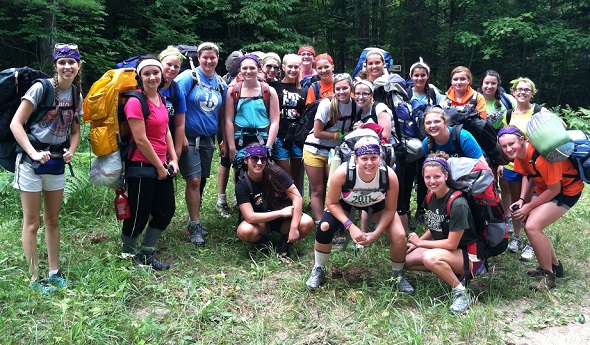
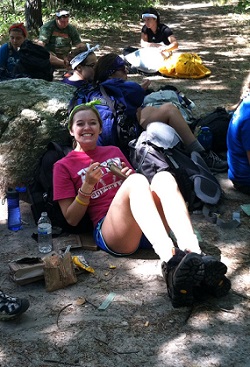
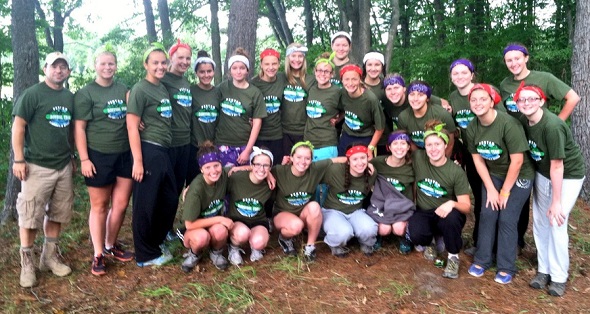
PHOTOS: (Top) Fenton's girls swimming and diving athletes take a moment for a photo during their three-day "survival trip." (Middle) The Tigers take a quick lunch break during a hike at Pigeon River Country State Forest. (Below) The Fenton athletes pose for one more photo wearing their "survivor" T-shirts. (Photos courtesy of Fenton coach Brad Jones.)

Rep Council Wrap-up: Spring 2014
May 15, 2014
By Geoff Kimmerly
Second Half editor
More tools to assist administrators in managing student transfers, including stiffer penalties for students switching schools for athletic-related reasons and for adults influencing those decisions, highlighted actions taken by the Representative Council of the Michigan High School Athletic Association during its annual Spring Meeting, May 4-5, in Gaylord.
The Spring Meeting of the 19-member legislative body of the Association’s more than 1,500 member schools is generally the busiest of its three sessions each year. The Council considered 17 committee proposals and also dealt with a variety of eligibility rule, postseason tournament and operational issues.
The Council built on changes to the MHSAA transfer regulation adopted at its 2013 Spring Meeting that increased the period of ineligibility to 180 days for a student making an athletic-related transfer, detailing more activities – centered on athletes following their non-school coach to a new school – that would lead automatically to the longer period of ineligibility even if not reported by the school losing the student.
Most notably, the maximum penalty of ineligibility for students and suspension for coaches partaking in undue influence was increased from up to one year to up to four years.
When a transfer is the result of parents’ divorce, or follows a student’s 18th birthday or enrollment as a residential student in a bona fide boarding school, school administrators will be required to attest on the MHSAA’s Educational Transfer Form that the transfer is not significantly related to or motivated by athletics.
These changes to the transfer regulation go into effect for the 2014-15 school year and come in addition to changes adopted at the Council’s Winter Meeting in March, addressing the increase of international students enrolling in MHSAA member schools outside traditional foreign exchange programs.
Beginning this fall, international students on either F-1 or J-1 visas, in order to be immediately eligible for athletics, must meet a residential exception or have been placed in a school through an Approved International Student Program (accepted for listing by the Council on Standards for International Educational Travel {CSIET} and approved by the MHSAA). International students placed through an Approved International Student Program will be immediately eligible for a maximum of the first two consecutive semesters or three consecutive trimesters at any secondary school in the United States, after which the student is ineligible for interscholastic athletic competition at any MHSAA member school for the next academic year. International students who do not meet one of the residency exceptions recognized by the MHSAA or are not enrolled through an Approved International Student Program may become eligible to participate at the subvarsity level only. Incoming freshman international students no longer will be automatically eligible.
Here is a summary of other actions taken by the Representative Council at the Spring Meeting which will take effect during the 2014-15 school year:
- In cases of serious injury or extended illness, including concussion or suspected concussion and symptoms of sudden cardiac arrest, students may be re-examined not only by a physician (MD or DO) but also a physician’s assistant or nurse practitioner. All may provide the written release necessary for an athlete to return to practice or competition. Previously, only physicians held that authority.
- Students who have completed their 12th-grade season in a sport may participate in one all-star contest in that sport, subject to specific conditions, without losing their remaining interscholastic eligibility in other sports. However, participation in a prohibited or second all-star event in that same sport will result in a loss of eligibility in all sports for up to one year
- Illinois was added to adjacent states Indiana, Ohio and Wisconsin, and Ontario, that do not fall under the mileage limitation for interstate competition. MHSAA member schools are not allowed to compete in any interstate meet, contest or scrimmage which involves travel of more than 600 highway miles round-trip for any participating team, unless those teams are only from Michigan and one or more of these contiguous states/provinces.
Sport Matters
- In baseball and softball, school uniforms may be worn by graduated seniors (with no remaining eligibility) who are selected to participate in all-star games conducted directly by the Michigan High School Baseball Coaches Association and Michigan High School Softball Coaches Association.
- In football, during subvarsity contests, the clock will start on the official’s ready-to-play signal rather than the snap following a change of possession.
- In girls lacrosse, a student or team is allowed to participate in a multi-team tournament in which the total allowable playing time for any team is no more than 150 running minutes (current total is 120 minutes) with no more than 25-minute running-time halves. This event will count as one of 18 regular-season contests.
- In girls and boys swimming and diving, dates of the Lower Peninsula Diving Regionals have been moved from Tuesday of the week of Finals meets to Thursday prior to Finals weeks.
Operations
- Ticket price increases from $7 to $8 were adopted for the following sports and MHSAA Tournament rounds: Baseball and Softball Semifinals and Finals, Bowling Finals (Team on Friday and Singles on Saturday), Girls Competitive Cheer (Friday and Saturday sessions), Girls Gymnastics Finals (Team on Friday and Individual on Saturday), Boys and Girls Lacrosse Finals, Boys and Girls Soccer Finals, Boys and Girls Track & Field Finals, Team Wrestling Semifinals and Finals and Girls Volleyball Finals. The cost of the three-session Team Wrestling Tournament pass was increased from $15 to $18, and ticket costs for three Ice Hockey rounds also were increased – Quarterfinals tickets from $5 to $6, Semifinals tickets from $6 to $8 and Finals tickets from $7 to $10, with the Semifinal and Final 6-session passes increased from $25 to $35. However, the 2014-15 school year will mark the 12th consecutive with no increases in MHSAA Regional tournament ticket prices for football and boys and girls basketball and the 11th consecutive year without increases at the District level of those tournaments. Tickets for both levels of all three sports will remain $5.
The Council also reviewed reports on membership, with 752 senior high schools and 725 junior high/middle schools in 2013-14; eligibility advancement applications, which totaled 14 for the year; the use of Educational Transfer Forms, which dropped 20 percent this year; school violations, attendance at athletic director and coaches in-service workshops, officials’ registrations, rules meetings attendance and officials reports submitted for the past three sports seasons. The Association’s $10.1 million budget for the 2014-15 school year also was approved.
The Representative Council is the 19-member legislative body of the MHSAA. All but five members are elected by member schools. Four members are appointed by the Council to facilitate representation of females and minorities, and the 19th position is occupied by the Superintendent of Public Instruction or designee.
The MHSAA is a private, not-for-profit corporation of voluntary membership by more than 1,500 public and private senior high schools and junior high/middle schools which exists to develop common rules for athletic eligibility and competition. No government funds or tax dollars support the MHSAA, which was the first such association nationally to not accept membership dues or tournament entry fees from schools. Member schools which enforce these rules are permitted to participate in MHSAA tournaments, which attract more than 1.4 million spectators each year.