

St Catherine's Hehs Earns NFHS Honor
By
Geoff Kimmerly
MHSAA.com senior editor
January 25, 2021
Longtime Detroit-area girls tennis coach Judy Hehs has been named one of 23 National Coaches of the Year for 2019-20 by the National Federation of State High School Associations (NHFS) Coaches Association.
Hehs was selected first at the state level and then from among the eight sections that make up the NFHS – Michigan is part of Section 4 with Illinois, Indiana, Iowa and Wisconsin. She previously had been named national Coach of the Year for girls tennis for 2014-15.
The following brief bio includes an excerpt from Hehs’ coaching philosophy, which nominees were asked to submit after being identified as candidates for the awards.
 Judy Hehs coached girls tennis at Bloomfield Hills Academy of the Sacred Heart from Fall 1996 through Spring 2019 and served as co-coach of six MHSAA Lower Peninsula Division 4 championship teams over her last eight seasons with the program. She was slated to coach the girls team at Wixom St. Catherine in Spring 2020, but that season was canceled due to COVID-19. She also coached Sacred Heart’s varsity girls basketball team from 1988-95 and two sports at Detroit Country Day – field hockey in fall 1987 and then junior varsity boys tennis (while also serving as the varsity assistant) from spring 1988-2000. Hehs was inducted in 2015 into the Michigan High School Tennis Coaches Association Hall of Fame and her girls tennis teams have a record of 169-80-18. She is principal at Wixom St. Catherine and in her 34th year as an educator.
“Let me share my ‘why do I coach’ philosophy: Do I coach to ‘give back?’ Do I coach to ‘make a difference?’ Do I coach for ‘selfish reasons?’ Do I coach because I ‘love it?’ I coach for all those reasons and more. The tennis court is my classroom now; it’s the place where I can teach tennis and valuable life lessons. The challenge isn’t in making great tennis players. It is about building great people. And building great people doesn’t mean we’re looking at wins and losses. Don’t get me wrong, winning is great and fun and helps to build a great team and program. But there is no better place than a tennis court to teach real life lessons – lessons about work ethic, teamwork, problem solving, independence, and the moment when effort turns into belief and belief turns into accomplishment. Athletics is a vehicle to becoming a better version of one’s self. I believe that participating in athletics can change lives, and not just the lives of the athletes whom we coach, but also the person whom we become through coaching. I had coaches in a variety of sports from elementary school through college who inspired me and motivated me to become a better version of myself. Every time I step on that tennis court, I hope to be that person in the lives of my players who inspires and motivates, and helps them become better versions of themselves. That’s why I coach.”
Four more Michigan coaches earned honors in Section 4. Dean Blackledge was honored in boys cross country after leading Hanover-Horton to its second Lower Peninsula Division 3 championship in three seasons in 2019. Kent Graves was the honoree for girls golf after leading Grand Rapids Forest Hills Northern to its third-straight LP Division 2 championship that fall. Livionia Stevenson’s David Mitchell was honored in ice hockey; Stevenson most recently won the Division 2 championship in 2012 and finished runner-up in 2015 and 2016. Dexter’s Michael McHugh was honored in boys swimming & diving; although the 2019-20 Lower Peninsula boys season didn’t conclude because of COVID-19, his teams have won four straight Division 2 championships.
The NFHS has been recognizing coaches through an awards program since 1982.
Perseverance Pays for East Grand Rapids
June 3, 2017
By Butch Harmon
Special for Second Half
HOLLAND – Refuse to lose would be the perfect theme for this year’s Lower Peninsula Division 2 Finals as time after time players came from behind to claim victory.
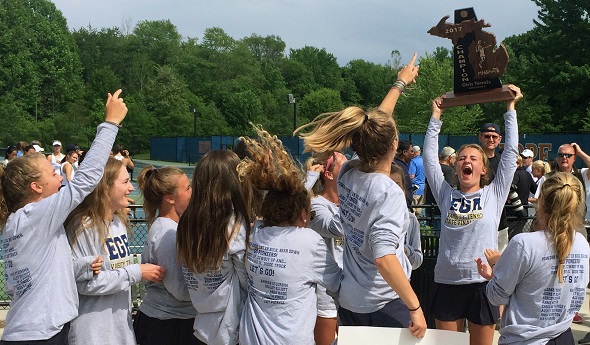
East Grand Rapids players were involved in many of the comeback wins, and that proved critical in the Pioneers winning their first Finals championship since claiming the Division 3 title in 2009.
East Grand Rapids finished with 31 points to edge second place Grand Rapids Forest Hills Northern by three, with Bloomfield Hills Marian placing third with 21 points.
East Grand Rapids knew it would take a total team effort to defeat its longtime local rival, as Northern has won nine MHSAA championships since 2002.
“We know that Northern is always good,” said East Grand Rapids coach Mickey Mikesell. “We’ve known them for a long time. I know their coach and kids very well.
“This title feels real good for my girls. Since we’ve moved up to Division 2 we’ve had some tough luck with injuries and other things, so to get one feels great.”
Strong play in singles fueled East’s drive to the title. East Grand Rapids singles players won three of the four flights including with a pair of come-from-behind wins.
At No. 1 singles, sophomore Sloane Teske battled back from dropping the first set to defeat Mason senior Olivia Hanover 3-6, 6-1, 6-3. Teske knew the road to victory would be a difficult one, as she lost to Hanover in last year’s semifinals.
“I just shrugged off losing that first set and moved on,” Teske said. “(Hanover) played a great match, and she made me work real hard to beat here. I just stayed confident and wanted it more.”
Teske’s win also helped the Pioneers clinch the overall team title.
“I’m so proud of our team and what we’ve done this year,” Teske said. “Everyone worked real hard for this.”
At No. 2 singles, top-seeded East Grand Rapids junior Hannah Stuursma played to form with a 6-0, 6-0 win against Kaitlyn Fox of Forest Hills Central. For Stuursma, her comeback involved battling back from injury. Stuursma battled back from a pair of foot surgeries during her sophomore season to win her first title this spring
“Coming off a foot injury, I was not very confident last year,” Stuursma said. “I was scared of hurting my foot again. This year my confidence level was so much higher. I’m really excited and real proud of how I played. I was pretty nervous, but I kept my confidence up.”
Stuursma’s title was the first of the day for the Pioneers.
“I’m so proud of our team this year,” Stuursma said. “Everyone really stepped up. We won so many big matches here, and I’m so proud of our team.”
Coming from behind was also the story for East Grand Rapids junior Audrey Olson at No. 3 singles. After dropping the first set 2-6 to Sema Colak of Okemos, Olson won the second set 6-2. In the third, Olson found herself trailing four games to one before rallying one more time to claim a 6-4 win and the title.
“This feels real great,” Olson said. “I started out down 2-6, and then I was down 1-4 in the third set. I had great support from my coaches and my teammates, and that made the difference. They told me to dig down deep, and I did.”
At No. 4 singles, Forest Hills Northern senior Felicia Zhang turned in a solid performance to win her second consecutive Finals flight title. Zhang turned back Gigi Kalabat of Bloomfield Hills Marian 6-0, 6-2.
“It’s a real great feeling,” Zhang said. “I wanted to win it most for the team. To win another title my senior year is indescribable.”
Zhang was not the only member of her family to win a championship, as her younger sister, freshman Abby Zhang, was part of Northern’s No. 2 doubles team that claimed a title. Abby Zhang teamed with senior Salonee Marwaha to hold off the East Grand Rapids duo of Annie Meye and Alivia Vencelj 7-5, 6-3.
Being able to win with her younger sister made Felicia Zhang’s title even sweeter.
 “She is a freshman, and this was our only chance to play with each other,” Felicia Zhang said. “It feels great.”
That feeling was shared by the younger Zhang.
“It feels great to win a state title my first time here,” Abby Zhang said. “It was also great to help send Salonee out with a state title in her last high school match.”
The doubles title was the second straight for Marwaha, who was part of Northern’s winning No. 3 doubles team last year. Like last season, Marwaha was paired up with a freshman.
“We didn’t know at the beginning of the season that we would be paired together,” Marwaha said. “At the beginning of the season we started a little sluggish, but we meshed so well together that it didn’t take long for us to get going. Abby did a great job. As a senior, I just told her to keep calm and be patient. She did a great job of that.”
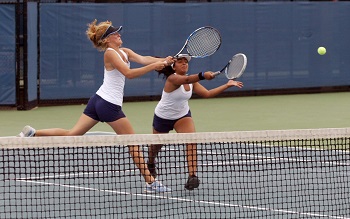
Northern won three of the four doubles flights, and no pair of players displayed a determination to win as strong as Northern’s No. 1 team of Maansi Dalmia and Claire Tatman. Just getting to the finals was an exercise in determination as Dalmia and Tatman outlasted Birmingham Seaholm’s Layla Bellissimo and Emily Hirsch in a semifinals match that lasted more than three hours. In a match that saw two tiebreakers, Dalmia and Tatman came away with a 6-7 (7), 7-5, 7-3 (3) victory.
The semifinal win sent Dalmia and Tatman into the finals, where they went up against top-seeded Yana Beeker and Kristin McLintock of Traverse City Central. The Northern duo had more than enough energy remaining, as they claimed a 6-4, 6-4 win.
“It’s the best feeling in the world,” Tatman said.
“I’m at a loss for words,” Dalmia added.
The title was a repeat for Tatman who teamed up with Marwaha to win No. 3 doubles last season.
“The semifinal match was super close,” Dalmia said. “It was over three hours and had two tie breakers. We knew we had to dig deep down to pull it off. We just took it one point at a time. I don’t feel that tired now, but I know later I will feel it.”
Refusing to lose was key to the semifinal and final wins for the duo.
“You just have to power through it,” Tatman said. “We practiced hard all season, and we knew in the end that we could do it if we kept powering through.”
Coming from behind was also the theme of the No. 3 doubles match. Nele Geiger and Sydney McLean of Forest Hills Northern rallied for a 4-6, 6-4, 7-5 win against Lily Trinch and Brooke Forte of Birmingham Seaholm.
The No. 4 doubles title also went three sets. East Grand Rapids’ Audrey DeVries and Kate Mackeigan outlasted the Bloomfield Hills Marian team of Ariano Kotsakis and Catherine Chinonis 6-0, 2-6, 6-4. DeVries and Mackeigan were runners-up at that flight last season.
PHOTOS: (Top) East Grand Rapids tennis players hoist their MHSAA championship trophy. (Middle) Forest Hills Northern No. 1 doubles players Claire Tatman and Maansi Dalmia pursue a volley Saturday. (Click to see more from HighSchoolSportsScene.com.)