


St Catherine's Hehs Earns NFHS Honor
By
Geoff Kimmerly
MHSAA.com senior editor
January 25, 2021
Longtime Detroit-area girls tennis coach Judy Hehs has been named one of 23 National Coaches of the Year for 2019-20 by the National Federation of State High School Associations (NHFS) Coaches Association.
Hehs was selected first at the state level and then from among the eight sections that make up the NFHS – Michigan is part of Section 4 with Illinois, Indiana, Iowa and Wisconsin. She previously had been named national Coach of the Year for girls tennis for 2014-15.
The following brief bio includes an excerpt from Hehs’ coaching philosophy, which nominees were asked to submit after being identified as candidates for the awards.
 Judy Hehs coached girls tennis at Bloomfield Hills Academy of the Sacred Heart from Fall 1996 through Spring 2019 and served as co-coach of six MHSAA Lower Peninsula Division 4 championship teams over her last eight seasons with the program. She was slated to coach the girls team at Wixom St. Catherine in Spring 2020, but that season was canceled due to COVID-19. She also coached Sacred Heart’s varsity girls basketball team from 1988-95 and two sports at Detroit Country Day – field hockey in fall 1987 and then junior varsity boys tennis (while also serving as the varsity assistant) from spring 1988-2000. Hehs was inducted in 2015 into the Michigan High School Tennis Coaches Association Hall of Fame and her girls tennis teams have a record of 169-80-18. She is principal at Wixom St. Catherine and in her 34th year as an educator.
“Let me share my ‘why do I coach’ philosophy: Do I coach to ‘give back?’ Do I coach to ‘make a difference?’ Do I coach for ‘selfish reasons?’ Do I coach because I ‘love it?’ I coach for all those reasons and more. The tennis court is my classroom now; it’s the place where I can teach tennis and valuable life lessons. The challenge isn’t in making great tennis players. It is about building great people. And building great people doesn’t mean we’re looking at wins and losses. Don’t get me wrong, winning is great and fun and helps to build a great team and program. But there is no better place than a tennis court to teach real life lessons – lessons about work ethic, teamwork, problem solving, independence, and the moment when effort turns into belief and belief turns into accomplishment. Athletics is a vehicle to becoming a better version of one’s self. I believe that participating in athletics can change lives, and not just the lives of the athletes whom we coach, but also the person whom we become through coaching. I had coaches in a variety of sports from elementary school through college who inspired me and motivated me to become a better version of myself. Every time I step on that tennis court, I hope to be that person in the lives of my players who inspires and motivates, and helps them become better versions of themselves. That’s why I coach.”
Four more Michigan coaches earned honors in Section 4. Dean Blackledge was honored in boys cross country after leading Hanover-Horton to its second Lower Peninsula Division 3 championship in three seasons in 2019. Kent Graves was the honoree for girls golf after leading Grand Rapids Forest Hills Northern to its third-straight LP Division 2 championship that fall. Livionia Stevenson’s David Mitchell was honored in ice hockey; Stevenson most recently won the Division 2 championship in 2012 and finished runner-up in 2015 and 2016. Dexter’s Michael McHugh was honored in boys swimming & diving; although the 2019-20 Lower Peninsula boys season didn’t conclude because of COVID-19, his teams have won four straight Division 2 championships.
The NFHS has been recognizing coaches through an awards program since 1982.
Preview: History-Making Opportunities
May 29, 2014
By Geoff Kimmerly
Second Half editor
Every athlete playing in this weekend’s Lower Peninsula Girls Tennis Finals will achieve a notable feat, be it personal or for her school.
But Bloomfield Hills Cranbrook-Kingswood’s Alexandria Najarian could finish Saturday at Kalamazoo College among the most accomplished players in MHSAA history.
Najarian is playing in Division 3 for her fourth No. 1 singles championship. Only two others – Grosse Pointe Woods University Liggett’s Dawn Martin from 1985-88 and Detroit Country Day’s Kendra Howard from 1990-93 – have won No. 1 singles titles all four years of high school.
Najarian’s storyline will be one of many to follow this weekend, with coverage of all four Finals publishing on Second Half later Saturday evening. Below is a brief look at top contenders at each tournament, with play beginning Friday morning. Click for more including brackets and seeds for all 32 flights.
DIVISION 1 at Midland Tennis Center
Top ranked: 1. Grosse Pointe South, 2. Clarkston, 3. Northville.
Grosse Pointe South is favored to win its second MHSAA championship in three seasons after tying for third a year ago with Clarkston, which tied for second in 2012 and won the title in 2011. Northville is seeking its first MHSAA girls tennis championship and finished fifth last season.
Grosse Pointe South: All but one flight is seeded fifth or higher, with three doubles pairs seeded among the top two of their respective flights. And the unseeded is No. 2 singles player Madie Flournoy, last season’s champion at No. 4. Brooke Willard, a semifinalist at No. 2 singles last season, is the fourth seed at No. 3 this weekend, and 2013 No. 3 singles runner-up Maggie Sweeney is now part of the fifth-seeded No. 1 doubles pair with Samantha Perry. Raven Neely is a contender at No. 1 singles entering as the third seed.
Clarkston: The Wolves’ strength again is singles, with all four flights entering this weekend seeded first or second. Last season’s No. 1 singles runner-up Lexi Baylis is the top seed at that flight and won No. 2 in both 2011 and 2012. Reigning No. 2 runner-up Isabella Spindler and reigning No. 3 champion Dana Olsen are second seeds at those flights, respectively. Paige Olsen – part of last season’s runner-up at No. 1 doubles and the No. 3 singles champion in 2012 – is the second seed at No. 2 singles. Her partner last season, Alex Whall, is teaming with Katie Hubregsen as the fourth-seeded pair at No. 1 doubles.
Bloomfield Hills: Although ranked No. 4 entering the postseason, Bloomfield Hills looks like a contender and brings tournament experience with Andover taking fourth and Lahser tying for sixth in Division 2 in 2013 (those schools merged last summer). The Black Hawks are seeded at all but one flight, with Mollie Fox – last season’s Division 2 No. 1 singles champ – seeded fifth in the top flight. Kerry Hu – the No. 1 singles runner-up for Andover in Division 2 in 2012 – is the third-seeded player this weekend at No. 2. Meryl Reams was the Division 2 No. 4 champion last season and is seeded fifth in that flight.
Utica’s Davina Nguyen: The 2012 No. 1 singles champion fell in the semifinals last season but is expected to get at least that far again entering this weekend as the second seed.
Port Huron Northern’s Lizzie Brozovich: Despite beating Spindler in straight sets in last season’s No. 2 singles championship match, Brozovich returns as only the sixth seed in the flight this weekend.
Midland Dow’s Caroline Szabo: Dow has the top seeds at Nos. 2, 3 and 4 singles, with Szabo at No. 2 expected to finish her freshman season as a champion.
Port Huron Northern’s Alexis Wirth and Fran Basha: Northern’s top-seeded pair at No. 1 doubles gave up only one set – and then one game in the championship match – in winning this flight in 2013.
Other returning flight champions: Farmington Hills Mercy’s Mackenzie Zierau (No. 2 doubles in 2013, part of No. 1 doubles with Clara Pilchak this season), Ann Arbor Pioneer’s Alyssa Roopas and Evie Vandewege (No. 3 doubles in 2013 and No. 4 doubles in 2012; No. 1 doubles this season), Northville’s Libby Quinn (No. 4 doubles in 2013, part of third-seeded No. 4 doubles with Chloe Page this season).
DIVISION 2 at Holland
Top ranked: 1. Birmingham Seaholm, 2. Bloomfield Hills Marian, 3. Grand Rapids Forest Hills Northern.
One of these three has won Division 2 each of the last 11 seasons, with Marian the returning champ, Seaholm the winner in 2012 and Forest Hills Northern finishing first in 2011. Seaholm was last season’s runner-up, with Forest Hills Northern finishing third.
Birmingham Seaholm: The Maples enter the weekend with five top seeds, including at three singles flights. All four singles players are back from last season – Labina Petrovska is the top seed at No. 1, Lauren Frazier is seeded second at No. 2, reigning runner-up Claire Markley is the top seed at No. 3 and Rachel Fenberg is the top seed at No. 4. The two doubles pairs that aren’t top seeds have championship experience – Jackie Meier is back at No. 1, this time with Laine Boitos, after Meier helped win No. 1 last season and Boitos was part of the runner-up at No. 2. Sam Lareau is playing No. 2 doubles with Caity Buechner after helping win the No. 4 doubles title in 2013.
Bloomfield Hills Marian: The Mustangs are seeded at all but No. 1 singles, and that unseeded player, Lauren Dietz, was the No. 2 singles runner-up a year ago. Reigning No. 3 champ Breann Lunghamer moved up to No. 2 and is the fourth seed, and reigning No. 4 runner-up Catherine Yaldoo moved up to No. 3 and is seeded third at that flight. All four doubles flights are seeded third or higher, with Tatyanna Dadabbo moving up to No. 1 to pair with Biance Emde after Dadabbo helped win the No. 2 doubles title a year ago and Emde was part of the pair that made the semis at No. 3.
Forest Hills Northern: All flights are seeded, with three in the top spot and another second. Victoria Minzlaff helped finish runner-up at No. 1 doubles last season and is part of the top-seeded pair this time with last season’s No. 2 singles player, Jessica Stevens. (Minzlaff was part of champions at No. 1 in 2012 and No. 4 in 2011.) Stephanie Nguyen, part of last season’s No. 3 doubles champion, is part of the top-seeded No. 2 pair with Hailey Jones. Madeline Bissett is the top seed at No. 2 singles after winning No. 3 in Division 3 as a freshman at Forest Hills Eastern two years ago (and finishing runner-up at No. 2 in Division 3 last season), and Claire Aleck is back at No. 1 singles and seeded second in that flight.
Fenton’s Madison Ballard: This season’s third seed at No. 1 singles won two matches at last season’s Final after entering unseeded.
Okemos’ Emily Struble: The champion at No. 2 singles the last two seasons is playing No. 1 this weekend and enters seeded fifth.
East Grand Rapids’ Jeanie Weinrich and Bridget Barrett: The Pioneers’ third-seeded No. 1 doubles pair is made up of half of last season’s pair (Weinrich) and last season’s No. 1 singles player (Barrett).
DIVISION 3 at Kalamazoo College
Top ranked: 1. Bloomfield Hills Cranbrook-Kingswood, 2. Detroit Country Day, 3. Allegan
Cranbrook-Kingswood is looking to extend a three-season winning streak and finish among the top two for the seventh straight year. The Cranes scored 39 points a year ago, with Allegan second at 23 and Country Day third at 19. Country Day, in 2010, was the last team to win before this run.
Bloomfield Hills Cranbrook-Kingswood: The Cranes have top seeds at six flights and the fourth seeds at the remaining two. Najarian’s history-making opportunity is detailed above, and No. 2 singles Anna Short also is a reigning champion. Briana Latica and Holly Meers were the No. 3 doubles champions last season and are playing this weekend at Nos. 2 and 3, respectively, and Lauren Lanzon and Emily Harvey won the No. 4 doubles title a year ago; Harvey is playing No. 3 singles and Lanzon No. 3 doubles. Meg Phyle was part of last season’s No. 1 doubles runner-up and is top-seeded at that flight with Amanda Simmons.
Detroit Country Day: Seven flights are seeded, led by a strong singles lineup. Madelyn Karoub is looking to finish her career with a third MHSAA singles title and is the top seed at No. 3. Haley Mullins was runner-up at No. 3 last season and is seeded second at No. 2, and Sarah Carroll was runner-up at No. 4 last season and is seeded second at that flight.
Allegan: The Tigers also are seeded at seven flights, with all four singles players fourth seeds or higher and a pair of strong doubles teams leading the way. Emmarie Gorby and Blake Day are the fourth seed at No. 1 doubles after finishing runner-up at No. 2 a year ago. Carlie Vanklompenberg and Taylor Orr are the top seed at No. 2 doubles after finishing runner-up at No. 3 a year ago.
Holland Christian’s Lisa Busscher and Anna Bosgraaf: Last season’s No. 4 doubles runners-up are seeded third at No. 2 this weekend.
Williamston’s Sara Daavettila: Playing high school tennis for the first time, Daavettila is the second seed at No. 1 singles and could give Najarian an interesting run if both make the championship match.
Williamston’s Caitlyn Chick and Delaney Nikolai: Although unseeded at No. 1 doubles, this pair was the runner-up at No. 1 in Division 4 last season.
DIVISION 4 at Grand Blanc/Holly
Top ranked: 1. Grosse Ile, 2. Ann Arbor Gabriel Richard, 3. Traverse City St. Francis
Grosse Ile, Ann Arbor Gabriel Richard and Traverse City St. Francis all are seeking their first MHSAA girls tennis championships. Grosse Ile finished just three points back of champion Bloomfield Hills Academy of the Sacred Heart last season, with St. Francis third and Gabriel Richard tied for fourth. Academy of the Sacred Heart, champion the last two seasons, is ranked No. 4.
Grosse Ile: The Red Devils are seeded at every flight with three top seeds and No. 4 doubles runners-up Rose Tucker and Casey Guthrie returning among favorites. Reigning No. 2 singles champion Brianne Riley is the sixth seed at No. 1, and reigning No. 3 runner-up Julia Formentin is the second seed at No. 2. Katherine Kuzmiak was part of the No. 2 doubles runner-up last season and is teaming with Luna Terauchi on the top-seeded pair at No. 3 this weekend.
Ann Arbor Gabriel Richard: The Fighting Irish are seeded at only four flights, but have the favorites at Nos. 1 and 2 singles, respectively, with top seeds Colleen O’Brien and Maddy Szuba. O’Brien was the No. 1 runner-up last season and the No. 2 champion in 2012 (playing for Greenhills), while Szuba made the semis at No. 3 last season.
Bloomfield Hills Academy of the Sacred Heart: The Gazelles appear in a slightly better position to earn points than Traverse City St. Francis with six seeds to St. Francis’ five and three among the top four seeds in their respective flights. Tate Lehmann is the third seed at No. 3 singles after winning No. 4 a year ago, while the team’s second-seeded pair at No. 1 doubles is a mix of Sarah Spangler from last season’s No. 2 champion and Gretchen Lemon from last season’s winner at No. 4. Kendall Lehmann is part of the fifth-seeded pair at No. 2 doubles, with Stella Betrus, after helping win the title at No. 3 in 2013.
Berrien Springs’ Arien Kissinger: The senior has won four matches at No. 1 singles as an unseeded player the last three seasons, but enters her last Finals as the second seed at this flight.
Kalamazoo Christian’s Audrey Bouma and Jessica Bouma: Last season’s champion at No.3 singles, Audrey, is the top seed in that flight, while Jessica is the third seed at No. 2 singles and won No. 3 in 2011.
Lansing Catholic’s Calla Ramont: The No. 3 singles champion in 2012 won a match at No. 1 last season and comes into this weekend as the third seed at the top flight.
Ludington’s Gabrielle and Stephanie Kelly: The sisters have teamed up at No. 1 doubles the last two seasons, winning a match at the 2013 Final and entering this one as the top seed.
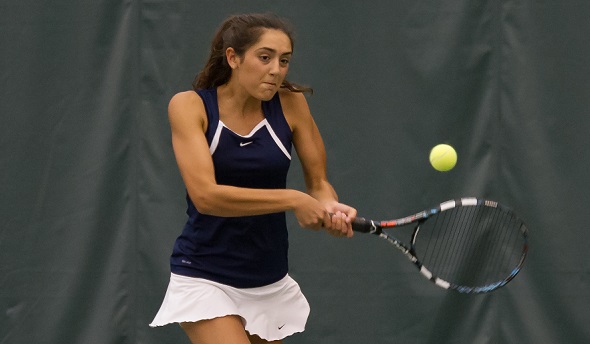
PHOTO: Cranbrook-Kingswood’s Alexandria Najarian, here playing in the No. 1 singles championship match at the 2012 LP Division 3 Final, will play for her fourth No. 1 singles title. (Click to see more at HighSchoolsSportsScene.com.)