

#TBT: Inkala Celebrated as Athlete, Coach
June 25, 2015
By Geoff Kimmerly
Second Half editor
The mid-Michigan and statewide tennis communities are mourning the death last weekend of longtime Okemos girls coach Al Inkala, who led the Chieftains to four MHSAA championships over a 20-season tenure that ended in 2013. He was 66 years old.
From 1994-2004, his Okemos girls tennis teams finished either first or second at their MHSAA Finals all but 1996, and his 1998-2001 teams won four straight Division 2 titles. But those were his only final chapters to a high school career that began as one of the most accomplished athletes of his time from the Upper Peninsula, where he played football, basketball, tennis, baseball and ran track for Wakefield before graduating in 1967.
A 6-foot-5 center, Inkala was a Class C all-state basketball selection as a senior, leading the Cardinals to the MHSAA Class C Semifinals with 33 points in an 85-60 Quarterfinal win over Gaylord. A three-year varsity basketball player, Inkala scored a school-record 540 points as a senior and a school-record 1,160 for his career. He also scored a school-record 42 points against Baraga during the 1966-67 season as Wakefield strung together its first undefeated regular-season finish. Inkala was second in his league in scoring after finishing first as a junior and made the all-U.P. Class C team after both of those seasons.
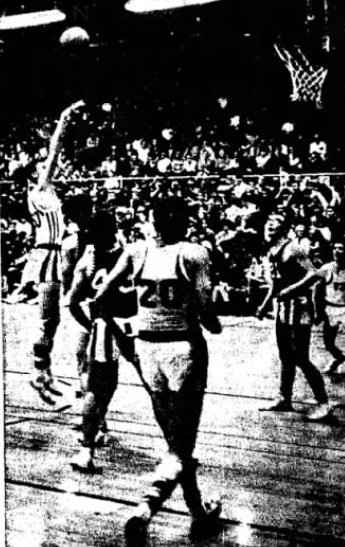 Inkala also was selected for the top senior basketball award for the Michigan-Wisconsin Conference by the largest margin ever accorded for the award to that point, and based not only on his athletic proficiency but also good sportsmanship.
His prowess extended far beyond the basketball court. In tennis, Inkala was undefeated at singles as a senior until his second match of the U.P. Finals – in those days, there was only one division in the Upper Peninsula, and only one flight for singles and one for doubles at all MHSAA Finals – as he led Wakefield to a fifth-place team finish. He was the singles champion in the Michigan-Wisconsin Conference.
Inkala ran four events – the 220-yard dash, 120-yard high hurdles and half-mile and mile relays – in helping Wakefield to its Regional track &field title in 1967. Wakefield then finished second as a team at the U.P. Class C Final, with Inkala taking fifth in the high hurdles.
As noted above, Inkala also played baseball and football; on the football team, he played both offense and defense and was the punter. Inkala also served as his class president, sung in the school chorus and was part of the conservation club at Wakefield High, about a 20-minute drive from the Wisconsin border.
He went on to play basketball at Northern Michigan University, serving as a team captain as a senior in 1970-71. He led the team in rebounding that winter and sits 30th on NMU’s single-season rebounding list and 12th on the career list, having played in 90 games over his four seasons.
On a personal note, Inkala was a huge help to me covering mid-Michigan girls tennis while at the Lansing State Journal from 1999-2011. He was the best of coaches when it came to being honest about his players’ abilities and making sure those from other schools got deserved recognition as well – especially during a period when his teams’ No. 5 singles and doubles players could’ve played the top flights for nearly every school in the surrounding area and likely beyond.
 The stories heard around our office this week focused on how he worked to give Okemos’ opponents the best experiences possible when facing his incredibly-talented teams.
Against those with just enough players to fill a lineup, or teams with most athletes in perhaps only their first few seasons of play, he’d fill his lineup with players who otherwise didn’t see the court when Okemos faced others of the state’s elite. The Chieftains shared their equipment and knowledge with many opponents, providing humble leadership in a tennis community that embodied a coach who gave the same always from the background and with little fanfare despite deserving much.
The Lansing State Journal talked to a number of his area counterparts this week; click here for that report.
Inkala died June 20. A memorial service will be conducted at 1 p.m. Sunday at Okemos Community Church.
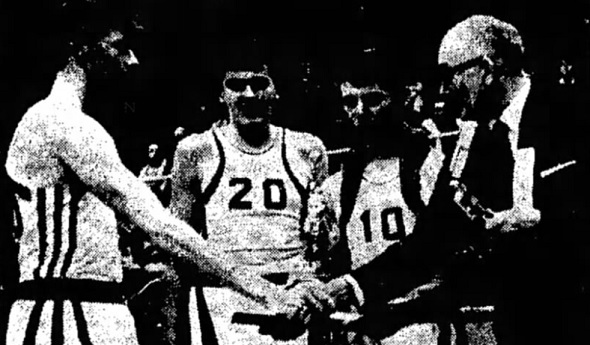
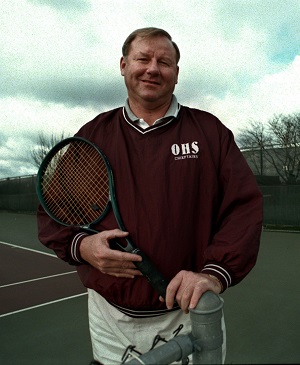
PHOTOS: (Top) Al Inkala, far left, accepts with his teammates the Class C District championship trophy during the 1967 season. (Middle) Inkala launches a free throw during the title game against Ontonagon. (Below) Inkala led his Okemos girls tennis teams to six MHSAA championships. (Top photos courtesy of the Ironwood Daily Globe; bottom courtesy of the Lansing State Journal.)
Rivalry Swings Back to Westwood as Patriots Earn 1st Finals Title Since 2021
By
Jason Juno
Special for MHSAA.com
October 1, 2026
NEGAUNEE — Ishpeming Westwood and Negaunee are 10 minutes apart, so they play plenty of tennis against each other whether it’s routine dual meets or the bigger ones with conference and Upper Peninsula championships on the line.
The Miners have been the one winning those meaningful meets lately with the last four U.P. Division 1 titles to their name.
This, however, was Westwood’s year.
The Patriots won the U.P. Finals on Tuesday for the first time since 2021, the last championship before Negaunee’s streak started, with wins in five of the day’s eight flights.
Their mentality was the key to their success this year, coach Sarah Zindler said, and it showed in the way they went up against the Miners.
“They weren’t scared to play Negaunee; they were excited to play Negaunee,” she said. “They were up for the challenge, they wanted to compete. When they were down in a match, they had that mentality of, ‘I can still win this,’ not the defeated (attitude) after you lose a point. That can sometimes be hard, especially for seniors on a U.P. Finals day where they know it’s their last matches.”
Eliisa Doney is one of those seniors. She talked about seeing Negaunee lifting up trophies in front of them in recent years. So, yeah, this one felt pretty good.
But regardless of the rivalry, she won at No. 2 singles after playing doubles the majority of her career. Her last memories of high school tennis at Westwood are pretty good.
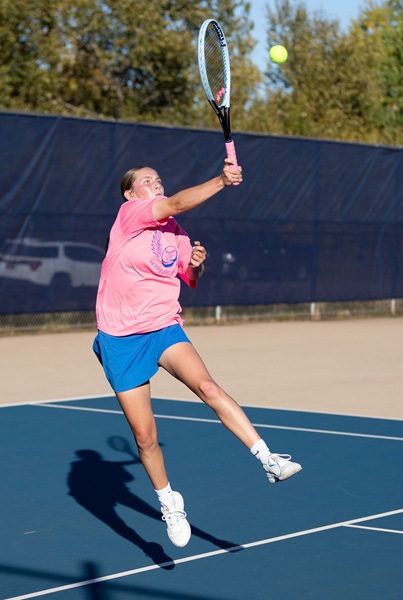
“I’ve never been (a U.P. champion) individually or as a team before, so it’s an incredible feeling that I’ve never felt before,” she said.
Doney played doubles as an underclassmen, missed her junior year with an injury and then filled a spot as Westwood battled other injuries this season. She beat Negaunee’s Addie Chapman 6-2, 7-5 in their flight final Wednesday.
“She just took on the challenge and her first couple matches were a little rocky, but she had that competitive attitude of, ‘I’m gonna figure it out,’” Zindler said. “And now she’s a U.P. champ.”
So are many of her teammates.
Westwood’s Emmi Carlson won No. 3 singles and finished the season with just one loss. Despite that, she trailed Negaunee’s Lucy Rogers 5-2 in the first set of the final.
“And she told us, ‘I got this, I’m gonna win this set 7-5,’” Zindler said. “And she won the set 7-5. And that’s how she’s been all season. If she loses three or four games, she’s like, ‘It’s fine, no big deal, I got this.’”
Carlson won 7-5, 6-2.
Westwood’s Isabel Belpedio beat Negaunee’s Katie Carlson in their final to become the No. 4 singles champion. Belpedio went undefeated in her first year on varsity.
“I played a calm, consistent game,” she said. “I just played my best, and I gave what I had. It feels pretty great … like all the hard work I put in definitely (paid) off.”
“She has also just been steady and confident and knows how to play her game, doesn’t try to do too much and doesn’t let the other girls get in her head,” Zindler added.
The No. 3 doubles team of Emerson Williams and Samiah LaFreniere came out on top over Negaunee’s Bree Helppi and Audrey Hahn in their final despite entering as the third seed. They had lost to Negaunee just last week.
Williams was a part of the winning No. 4 doubles team last year. Since then, she suffered an injury and had to play this entire season left-handed, which is her non-dominant hand.
“They played a great semifinal match, and then in finals just looked like they were confident. They played the net well, they played smart from the back,” Zindler said. “They weren’t the unexpected victory but the wild card that we really needed today for our team.”
The winning No. 4 doubles team was Westwood’s freshmen Jenna Marana and Brie Mahaffey, who just picked up a racket during the summer.
“From the start of the season until now, they have just continually grown and improved,” Zindler said. “I just kept saying, ‘You guys are going to be there, you just got to keep working on it.’ And today, they're the best four doubles team.”
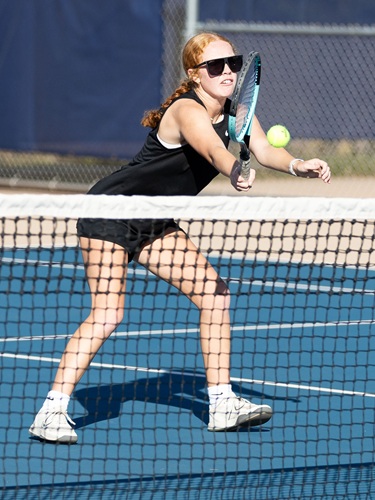
Kingsford junior Aubrie Moore repeated as a U.P. champion with a dominating 6-0, 6-0 win over Escanaba’s Anna Martin at No. 1 singles.
“I’m feeling good, I’m really happy and I’m glad,” Moore said. “It’s my second year, so I’m just really proud of myself. I think I really improved on my serving, and my forehand has gotten a lot better.”
Moore and the entire team played with “We play for her,” shirts with the initials GM in honor of her mom Ginger, who died after battling cancer earlier this year.
“Obviously my mom was by my side the whole time and helped me get through this and win,” Moore said.
Negaunee’s No. 1 doubles team of Paige O’Donnell and Olivia Richards won as juniors.
O’Donnell said Marquette has been tough for them and she was focused on doing well in their match to help out their entire team.
“We played Marquette a couple times, it’s always been super competitive, always super back and forth, usually going to some tiebreakers,” Richards said. “We were kind of expecting that going into it, but we saw their weaknesses in the first set and we knew we had to capitalize on those while also working together.”
Negaunee’s Maia Brunette and Aubrey Harper defeated Escanaba’s Isabella Noblet and Lily Benetti for the No. 2 doubles title.
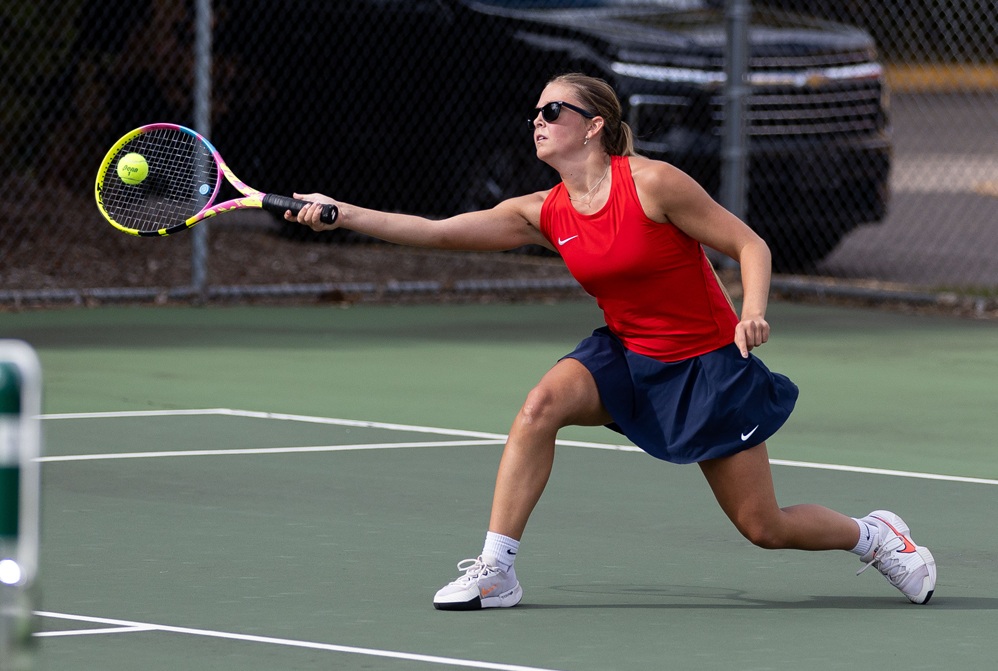
PHOTOS (Top) Ishpeming Westwood’s Eliisa Doney sends a forehand during a match Wednesday at No. 2 singles. (Middle) Kingsford’s Aubrie Moore returns a volley at No. 1 singles. (Below) Marquette’s Charlotte Thomsen reaches out to return a shot. (Photos by Jason Juno.)