

#TBT: Inkala Celebrated as Athlete, Coach
June 25, 2015
By Geoff Kimmerly
Second Half editor
The mid-Michigan and statewide tennis communities are mourning the death last weekend of longtime Okemos girls coach Al Inkala, who led the Chieftains to four MHSAA championships over a 20-season tenure that ended in 2013. He was 66 years old.
From 1994-2004, his Okemos girls tennis teams finished either first or second at their MHSAA Finals all but 1996, and his 1998-2001 teams won four straight Division 2 titles. But those were his only final chapters to a high school career that began as one of the most accomplished athletes of his time from the Upper Peninsula, where he played football, basketball, tennis, baseball and ran track for Wakefield before graduating in 1967.
A 6-foot-5 center, Inkala was a Class C all-state basketball selection as a senior, leading the Cardinals to the MHSAA Class C Semifinals with 33 points in an 85-60 Quarterfinal win over Gaylord. A three-year varsity basketball player, Inkala scored a school-record 540 points as a senior and a school-record 1,160 for his career. He also scored a school-record 42 points against Baraga during the 1966-67 season as Wakefield strung together its first undefeated regular-season finish. Inkala was second in his league in scoring after finishing first as a junior and made the all-U.P. Class C team after both of those seasons.
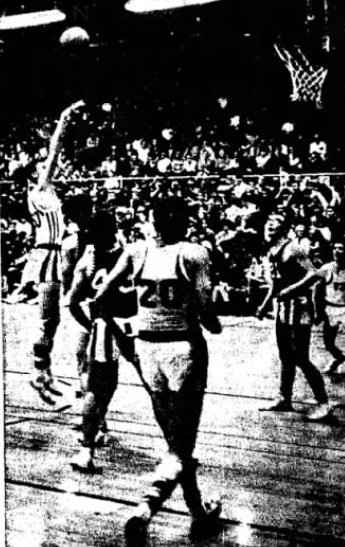 Inkala also was selected for the top senior basketball award for the Michigan-Wisconsin Conference by the largest margin ever accorded for the award to that point, and based not only on his athletic proficiency but also good sportsmanship.
His prowess extended far beyond the basketball court. In tennis, Inkala was undefeated at singles as a senior until his second match of the U.P. Finals – in those days, there was only one division in the Upper Peninsula, and only one flight for singles and one for doubles at all MHSAA Finals – as he led Wakefield to a fifth-place team finish. He was the singles champion in the Michigan-Wisconsin Conference.
Inkala ran four events – the 220-yard dash, 120-yard high hurdles and half-mile and mile relays – in helping Wakefield to its Regional track &field title in 1967. Wakefield then finished second as a team at the U.P. Class C Final, with Inkala taking fifth in the high hurdles.
As noted above, Inkala also played baseball and football; on the football team, he played both offense and defense and was the punter. Inkala also served as his class president, sung in the school chorus and was part of the conservation club at Wakefield High, about a 20-minute drive from the Wisconsin border.
He went on to play basketball at Northern Michigan University, serving as a team captain as a senior in 1970-71. He led the team in rebounding that winter and sits 30th on NMU’s single-season rebounding list and 12th on the career list, having played in 90 games over his four seasons.
On a personal note, Inkala was a huge help to me covering mid-Michigan girls tennis while at the Lansing State Journal from 1999-2011. He was the best of coaches when it came to being honest about his players’ abilities and making sure those from other schools got deserved recognition as well – especially during a period when his teams’ No. 5 singles and doubles players could’ve played the top flights for nearly every school in the surrounding area and likely beyond.
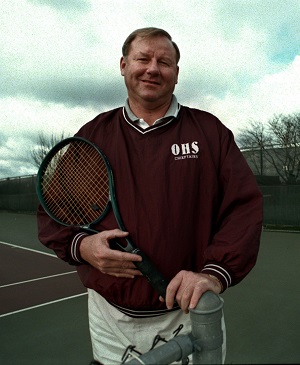 The stories heard around our office this week focused on how he worked to give Okemos’ opponents the best experiences possible when facing his incredibly-talented teams.
Against those with just enough players to fill a lineup, or teams with most athletes in perhaps only their first few seasons of play, he’d fill his lineup with players who otherwise didn’t see the court when Okemos faced others of the state’s elite. The Chieftains shared their equipment and knowledge with many opponents, providing humble leadership in a tennis community that embodied a coach who gave the same always from the background and with little fanfare despite deserving much.
The Lansing State Journal talked to a number of his area counterparts this week; click here for that report.
Inkala died June 20. A memorial service will be conducted at 1 p.m. Sunday at Okemos Community Church.
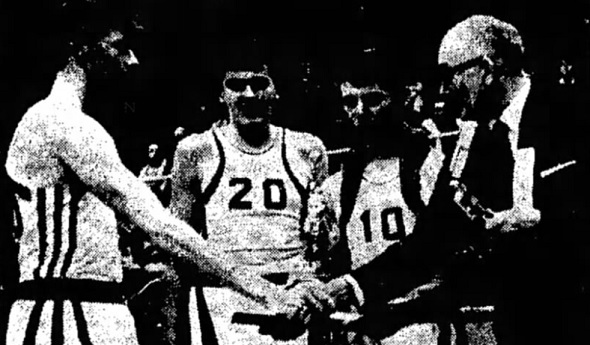
PHOTOS: (Top) Al Inkala, far left, accepts with his teammates the Class C District championship trophy during the 1967 season. (Middle) Inkala launches a free throw during the title game against Ontonagon. (Below) Inkala led his Okemos girls tennis teams to six MHSAA championships. (Top photos courtesy of the Ironwood Daily Globe; bottom courtesy of the Lansing State Journal.)
Tri-Captains Pace Striving Spring Lake
February 8, 2018
By Tom Kendra
Special for Second Half
Things are looking up for the Spring Lake boys basketball team.
 The Lakers have raised the bar in recent years, making their mark on the statewide level with two appearances in the MHSAA Class B Quarterfinals over the last three seasons.
This winter, led by a trio of tall, versatile and extremely intelligent captains in Sam Johnson (6-foot-8), Griffin Lorimer (6-4) and Jack VanWingen (6-2), Spring Lake has stepped up its schedule and its game in its quest to get back to the quarters – and perhaps further.
“When it gets to tournament time, it comes down to playing your best basketball of the year and making a run,” said Johnson, who scored a game-high 16 points on Wednesday as Spring Lake doubled up host Sparta, 50-25, for an Ottawa-Kent Conference Blue win.
“A big key in March is experience and leadership, and we definitely have plenty of that.”
Spring Lake (12-3, 6-2 in the O-K Blue), which hosts Allendale on Friday night in another conference game, showed it was going to be a force to be reckoned with early this year when it posted back-to-back tight wins over a pair of bigger schools in Rockford (48-46) and rival Grand Haven (69-66 in double overtime).
Bill Core, in his 17th year as Spring Lake’s head coach, said that in addition to good height on the front line, this may also be the smartest team he’s ever coached. Core said that intelligence helps this team make adjustments on the fly and smart decisions when the game is on the line.
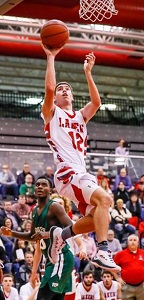 “Those three captains are all 4.0 kids, and they’re great role models,” said Core, who is assisted by Randy White. “They have high basketball IQs, and I trust them to make decisions and figure things out.”
Johnson is the player who draws the most attention from opposing teams at 6-8, with the ability to post up and step out and knock down mid-range jump shots.
Johnson, who plans to play basketball next year at Claremont McKenna College in California, leads the Lakers with 12 points and 7.5 rebounds per game. And don’t try to hack him and send him to the free-throw line. Johnson is shooting a team-best 80 percent on free throws.
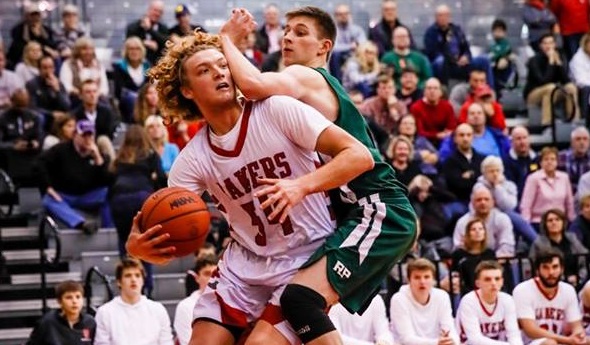
The most versatile of the three captains is Lorimer, who is hard to miss with his curly blonde hair and red shoes. He creates matchup problems with his inside-outside game, and currently averages 10 points and seven rebounds per contest.
Johnson and Lorimer are a 1-2 punch up front that most teams can’t match.
“We know one of the strengths of this team is that we’re deep in the post, and that makes it hard for teams to just focus on one guy,” explained Lorimer. “It’s good to have that balance. Plus, we’ve played together so long that we just know where the other guys are going to be.”
Lorimer’s versatility was perhaps best displayed last year at team camp in Rockford, where he was assigned to guard one of the state’s best big men in 6-9 Xavier Tillman (now at Michigan State) one day, then came back the next day and had to check standout guard Matt Beachler (now at Central Michigan).
But the most important of Spring Lake’s three captains might be VanWingen, a slasher who is the team’s best at breaking down defenses. VanWingen is adept at finding Johnson and Lorimer inside as well as kicking the ball back out to the arc to shooters Ben Arteaga, Kyle Wiersma and sophomore Cayden Ball.
“I think we’re a very well-balanced team,” said VanWingen, the top returning scorer off last year’s who is currently averaging 11.2 points, five rebounds and three assists per game. “Our big guys get a lot of attention, but we also have guards who can shoot it. It’s important that we trust each other and know that everyone is going to do their job.”
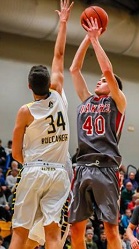 Spring Lake’s senior trio has been too much for almost everybody to handle, with the main exception being conference rival and possible Regional opponent Grand Rapids Catholic Central, which is ranked No. 6 in Class B.
The two teams met on Jan. 5 at Spring Lake in a much-anticipated showdown, but the Cougars swarmed the hosts in a lopsided 80-39 victory. The Lakers were much more competitive when the two teams played last week in Grand Rapids, but still lost, 59-40.
“We improved by 22 points the second game, and if we improve by another 22 points in the next game, we’ll win by three,” quipped Core, who knows his team will be a huge underdog if it’s fortunate enough to win the District it is hosting next month and possibly get another shot at GRCC in the Class B Regional opener at Grand Rapids West Catholic.
The Lakers can gain confidence by looking back to last year, when they lost to GR Catholic twice during the regular season, then stunned the Cougars in the Regional championship game. That win put Spring Lake in the Quarterfinals for the second time in three years, after it made a surprise run to the school’s first-ever boys basketball Quarterfinals appearance in 2015.
Lorimer believes this year’s team has the potential to make it three Quarterfinal appearances in four years.
“I really do think we have another level we haven’t reached yet,” said Lorimer, who plans to play next year at Trine University in Angola, Ind. “We may have for short stretches, but we haven’t strung it together for a whole game. That’s what we’re working on.”
 Tom Kendra worked 23 years at The Muskegon Chronicle, including five as assistant sports editor and the final six as sports editor through 2011. E-mail him at [email protected] with story ideas for Muskegon, Oceana, Mason, Lake, Oceola, Mecosta and Newaygo counties.
PHOTOS: (Top) Spring Lake senior Griffin Lorimer battles along the baseline in a victory earlier this season against Muskegon Reeths-Puffer. (Middle) Spring Lake senior Jack VanWingen glides in for a bucket in a victory over Muskegon Reeths-Puffer. (Below) Spring Lake senior Sam Johnson goes up for a shot during the Lakers' thrilling double-overtime win over neighboring rival Grand Haven earlier this season. (Photos by Tim Reilly.)