

#TBT: Inkala Celebrated as Athlete, Coach
June 25, 2015
By Geoff Kimmerly
Second Half editor
The mid-Michigan and statewide tennis communities are mourning the death last weekend of longtime Okemos girls coach Al Inkala, who led the Chieftains to four MHSAA championships over a 20-season tenure that ended in 2013. He was 66 years old.
From 1994-2004, his Okemos girls tennis teams finished either first or second at their MHSAA Finals all but 1996, and his 1998-2001 teams won four straight Division 2 titles. But those were his only final chapters to a high school career that began as one of the most accomplished athletes of his time from the Upper Peninsula, where he played football, basketball, tennis, baseball and ran track for Wakefield before graduating in 1967.
A 6-foot-5 center, Inkala was a Class C all-state basketball selection as a senior, leading the Cardinals to the MHSAA Class C Semifinals with 33 points in an 85-60 Quarterfinal win over Gaylord. A three-year varsity basketball player, Inkala scored a school-record 540 points as a senior and a school-record 1,160 for his career. He also scored a school-record 42 points against Baraga during the 1966-67 season as Wakefield strung together its first undefeated regular-season finish. Inkala was second in his league in scoring after finishing first as a junior and made the all-U.P. Class C team after both of those seasons.
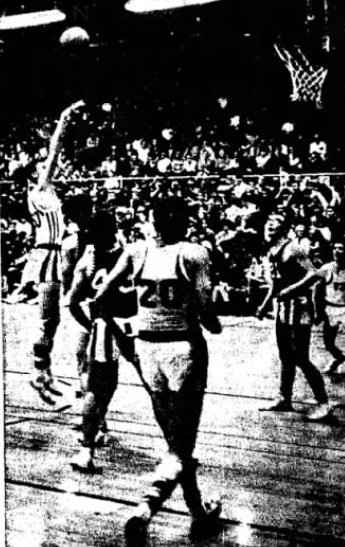 Inkala also was selected for the top senior basketball award for the Michigan-Wisconsin Conference by the largest margin ever accorded for the award to that point, and based not only on his athletic proficiency but also good sportsmanship.
His prowess extended far beyond the basketball court. In tennis, Inkala was undefeated at singles as a senior until his second match of the U.P. Finals – in those days, there was only one division in the Upper Peninsula, and only one flight for singles and one for doubles at all MHSAA Finals – as he led Wakefield to a fifth-place team finish. He was the singles champion in the Michigan-Wisconsin Conference.
Inkala ran four events – the 220-yard dash, 120-yard high hurdles and half-mile and mile relays – in helping Wakefield to its Regional track &field title in 1967. Wakefield then finished second as a team at the U.P. Class C Final, with Inkala taking fifth in the high hurdles.
As noted above, Inkala also played baseball and football; on the football team, he played both offense and defense and was the punter. Inkala also served as his class president, sung in the school chorus and was part of the conservation club at Wakefield High, about a 20-minute drive from the Wisconsin border.
He went on to play basketball at Northern Michigan University, serving as a team captain as a senior in 1970-71. He led the team in rebounding that winter and sits 30th on NMU’s single-season rebounding list and 12th on the career list, having played in 90 games over his four seasons.
On a personal note, Inkala was a huge help to me covering mid-Michigan girls tennis while at the Lansing State Journal from 1999-2011. He was the best of coaches when it came to being honest about his players’ abilities and making sure those from other schools got deserved recognition as well – especially during a period when his teams’ No. 5 singles and doubles players could’ve played the top flights for nearly every school in the surrounding area and likely beyond.
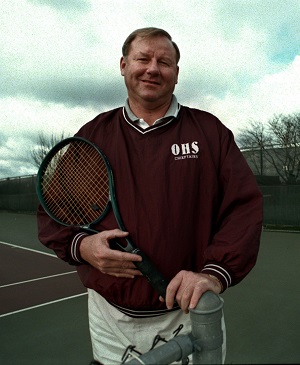 The stories heard around our office this week focused on how he worked to give Okemos’ opponents the best experiences possible when facing his incredibly-talented teams.
Against those with just enough players to fill a lineup, or teams with most athletes in perhaps only their first few seasons of play, he’d fill his lineup with players who otherwise didn’t see the court when Okemos faced others of the state’s elite. The Chieftains shared their equipment and knowledge with many opponents, providing humble leadership in a tennis community that embodied a coach who gave the same always from the background and with little fanfare despite deserving much.
The Lansing State Journal talked to a number of his area counterparts this week; click here for that report.
Inkala died June 20. A memorial service will be conducted at 1 p.m. Sunday at Okemos Community Church.
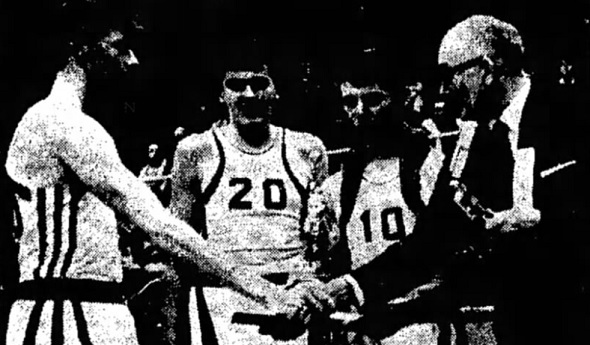
PHOTOS: (Top) Al Inkala, far left, accepts with his teammates the Class C District championship trophy during the 1967 season. (Middle) Inkala launches a free throw during the title game against Ontonagon. (Below) Inkala led his Okemos girls tennis teams to six MHSAA championships. (Top photos courtesy of the Ironwood Daily Globe; bottom courtesy of the Lansing State Journal.)
3rd-Year Standouts Have Howell Rolling
January 9, 2018
By Tim Robinson
Special for Second Half
For the best players on Howell’s boys and girls basketball teams, the third year has been the charm.
 Those players, Josh Palo and Lexie Miller, have combined talent and experience with confidence while leading their teams to fast starts this winter.
Palo is averaging 26 points per game for the boys, who are 5-1, while Miller is averaging 25 for the girls, who are 7-1.
Both are in their third full season on the varsity; Palo is a junior while Miller is a senior.
They also have this in common: Both would much rather talk about their team’s accomplishments.
“It’s all about the team,” said Miller, who has signed with Wayne State University. “I think we have improvements to make, but we’ve been watching film and can do better. I think we’ll get there if we keep working hard.”
Miller is part of a Highlanders team which features four seniors, including Miller, who have spent three full seasons on the varsity. They have been playing together for years.
Miller, who is 5-foot-6, also qualified for the MHSAA Division 1 cross country meet as a freshman before turning her attention to basketball fulltime. Her speed allows her to blow by defenders. She’s not afraid to put up 3s, nor is she afraid to drive to the basket.
But Howell girls coach Tim Olszewski said it’s her competitiveness and drive that help make her first among equals, and confidence that has made her a leader.
“(Two years ago) we had Erin Honkala, who would call team meetings and say, ‘Listen, this is exactly how things are going to go,’” Olszewski said. “Last year, as juniors, none of them wanted to grab the reins and do that. This year, we’ve got great senior leadership, with Lexie at the forefront of that. She will say something, and because of the way she conducts herself out on the court, you have to listen.”
Palo, a 6-2 junior, plays both guard positions for the Highlanders and does whatever is needed on defense.
“He’s kind of a jack-of-all-trades,” Howell boys coach Nick Simon says. “We do a lot of switching (on defense) and a lot of different things and he’ll play where needed on defense. He’s guarded the other team’s point guard in a couple of games, and he’s guarded the other team’s center a few times. He’s very knowledgeable about the game, and he understands how to play it. That allows him to guard guys down low and out on the perimeter.”
Palo scored 33 points in an overtime win at Linden in the Highlanders’ season opener, displaying the first results of a busy summer.
“I put in a lot of work over the summer,” he said. “I was always in the gym. Kip (teammate Kip French) has a little gym at his house with a shooting machine, and I was out there shooting every day this summer. That’s why I think I’m doing so much better this year. I have more confidence this year, knowing what I can do, when I can score and when I can get my looks.”
Simon led Howell’s boys to a Class A Quarterfinals four seasons ago. That run included the first time Howell had won a District title in nearly 20 years. The Highlanders have gotten to the Regionals the last two seasons, and Palo says he thinks his team can go farther.
“I really do,” he said. “We’ve got a good group of guys here, and we’re all bought in on what we’ve got to do. We’re going hard in practice every day, trying to get better. Everyone gets their role pretty well, and we always go into games confident. We never think we’re the underdog. We can always pull one out if we need to.”
Howell plays in the Kensington Lakes Activities Association, where boys and girls play at alternate sites on the same night.
As a result, neither Palo nor Miller has seen the other play often – but the rare impressions are lasting ones.
“Josh is really shifty,” Miller said, emphasizing the last word as a compliment. “His moves are really good. He finishes really well. I’m really impressed, honestly.”
“She’s real fast,” Palo said. “She can dribble pretty well. She could spot up and hit some 3s for us.”
Both will have opportunities to see the other play in the postseason. But as of now, they have their own dreams and team goals for which they are striving.
“It’s interesting to have a guy who’s had a breakout year and get him back for another year,” Simon said of Palo. “Traditionally, you see guys peak as seniors, and that’s when they come out of their shell. For a guy who’s in his third year on varsity (as a junior), I think that’s a huge advantage. You’re able to get him out of that shell a little earlier.”
Miller, while being the leading scorer on the Howell girls team, is far from the only offensive threat. Opponents who key on Miller learn that, to their dismay. By the time they adjust, often, Miller makes them pay at a key moment.
“She lives for the big moment,” Olszewski says. “She wants the ball in her hands. She’s definitely an ice-in-the-veins kind of kid, and I would have no problem giving her the ball in any situation at the end of a game.”
Palo and Miller both look to stand out in a team concept, and that drive could well determine the final destination for both teams this winter.
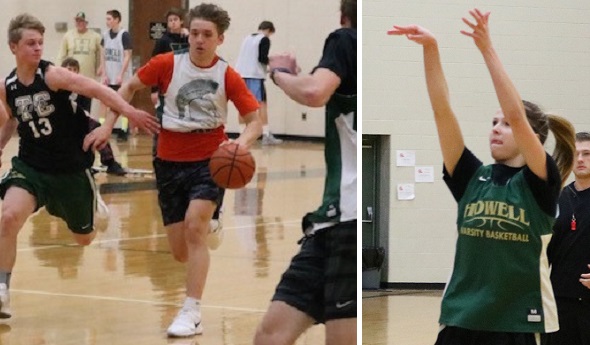
PHOTOS: (Left) Howell’s Josh Palo pushes the ball upcourt during a practice this winter. (Right) Lexie Miller works on her shooting; she’s averaging 25 points per game. (Photos by Tim Robinson.)