

#TBT: Inkala Celebrated as Athlete, Coach
June 25, 2015
By Geoff Kimmerly
Second Half editor
The mid-Michigan and statewide tennis communities are mourning the death last weekend of longtime Okemos girls coach Al Inkala, who led the Chieftains to four MHSAA championships over a 20-season tenure that ended in 2013. He was 66 years old.
From 1994-2004, his Okemos girls tennis teams finished either first or second at their MHSAA Finals all but 1996, and his 1998-2001 teams won four straight Division 2 titles. But those were his only final chapters to a high school career that began as one of the most accomplished athletes of his time from the Upper Peninsula, where he played football, basketball, tennis, baseball and ran track for Wakefield before graduating in 1967.
A 6-foot-5 center, Inkala was a Class C all-state basketball selection as a senior, leading the Cardinals to the MHSAA Class C Semifinals with 33 points in an 85-60 Quarterfinal win over Gaylord. A three-year varsity basketball player, Inkala scored a school-record 540 points as a senior and a school-record 1,160 for his career. He also scored a school-record 42 points against Baraga during the 1966-67 season as Wakefield strung together its first undefeated regular-season finish. Inkala was second in his league in scoring after finishing first as a junior and made the all-U.P. Class C team after both of those seasons.
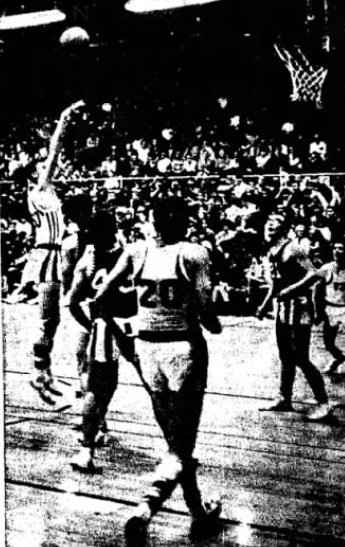 Inkala also was selected for the top senior basketball award for the Michigan-Wisconsin Conference by the largest margin ever accorded for the award to that point, and based not only on his athletic proficiency but also good sportsmanship.
His prowess extended far beyond the basketball court. In tennis, Inkala was undefeated at singles as a senior until his second match of the U.P. Finals – in those days, there was only one division in the Upper Peninsula, and only one flight for singles and one for doubles at all MHSAA Finals – as he led Wakefield to a fifth-place team finish. He was the singles champion in the Michigan-Wisconsin Conference.
Inkala ran four events – the 220-yard dash, 120-yard high hurdles and half-mile and mile relays – in helping Wakefield to its Regional track &field title in 1967. Wakefield then finished second as a team at the U.P. Class C Final, with Inkala taking fifth in the high hurdles.
As noted above, Inkala also played baseball and football; on the football team, he played both offense and defense and was the punter. Inkala also served as his class president, sung in the school chorus and was part of the conservation club at Wakefield High, about a 20-minute drive from the Wisconsin border.
He went on to play basketball at Northern Michigan University, serving as a team captain as a senior in 1970-71. He led the team in rebounding that winter and sits 30th on NMU’s single-season rebounding list and 12th on the career list, having played in 90 games over his four seasons.
On a personal note, Inkala was a huge help to me covering mid-Michigan girls tennis while at the Lansing State Journal from 1999-2011. He was the best of coaches when it came to being honest about his players’ abilities and making sure those from other schools got deserved recognition as well – especially during a period when his teams’ No. 5 singles and doubles players could’ve played the top flights for nearly every school in the surrounding area and likely beyond.
 The stories heard around our office this week focused on how he worked to give Okemos’ opponents the best experiences possible when facing his incredibly-talented teams.
Against those with just enough players to fill a lineup, or teams with most athletes in perhaps only their first few seasons of play, he’d fill his lineup with players who otherwise didn’t see the court when Okemos faced others of the state’s elite. The Chieftains shared their equipment and knowledge with many opponents, providing humble leadership in a tennis community that embodied a coach who gave the same always from the background and with little fanfare despite deserving much.
The Lansing State Journal talked to a number of his area counterparts this week; click here for that report.
Inkala died June 20. A memorial service will be conducted at 1 p.m. Sunday at Okemos Community Church.
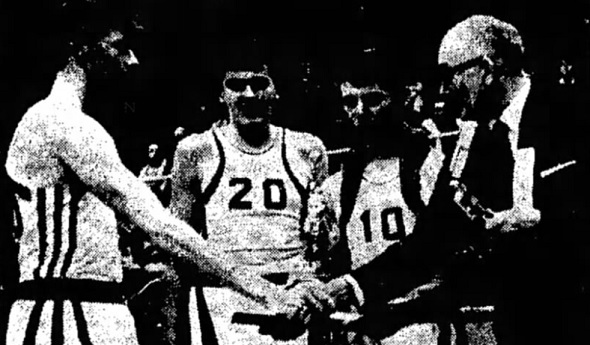
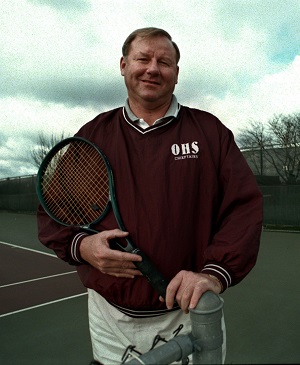
PHOTOS: (Top) Al Inkala, far left, accepts with his teammates the Class C District championship trophy during the 1967 season. (Middle) Inkala launches a free throw during the title game against Ontonagon. (Below) Inkala led his Okemos girls tennis teams to six MHSAA championships. (Top photos courtesy of the Ironwood Daily Globe; bottom courtesy of the Lansing State Journal.)
Future Set, Livers Aims for 'Giant' Finish
By
Pam Shebest
Special for MHSAA.com
November 15, 2016
KALAMAZOO — Letters, text messages and phone calls every single day.
 That might sound like a typical teenager, but Isaiah Livers was overwhelmed by all of the above during his junior year at Kalamazoo Central High School.
After committing to University of Michigan on Aug. 7, Livers has already noticed that this basketball preseason is much less stressful.
“Last year, I’d get out of practice and there would be like 10 messages (from coaches), at least, a day,” the 6-foot-8, 225-pound power forward said. “Then there’d be a phone call or two.
“Then I’d have to answer their messages, I’d have to call them back one by one. You have to find the time, manage your time, know when to call them back, not to be disrespectful.”
Livers received scholarship offers from more than 25 colleges, but was contacted by a ton more.
“If you don’t like the school, let them know you’re not interested,” he said of whittling down the list. “Sorry, but thanks for recruiting me.”
He’s not the only one whose cell phone was blowing up.
His father, Morris Livers, also was inundated with calls, especially after his son started playing in the Elite Youth Basketball League last May.
“That’s when it got crazy,” his dad said. “After that, my phone died all the time because it rang all the time. Colleges calling, leaving voice mails, dropping offers.”
Once Isaiah committed to Michigan, “I was so happy when it came to that,” his dad said. “I was in my (Gordon Water Systems) work truck and I was like, ‘I’m about tired of all these coaches calling my phone.’”
Navigating the process
Livers honed his court skills at a young age.
His dad, who played basketball at South Haven High School, was working out with his older son, Brandon, when 7-year-old Isaiah started soaking up the instruction.
But it wasn’t until Livers was a freshman that basketball became serious business.
 “That’s when the height came,” Morris Livers said. “To me, that’s the X factor. In ninth grade he grew at least six inches, it seemed, overnight. He was at least 6-4, 6-6.”
Central Arkansas was the first college to contact the Livers — when Isaiah was a freshman.
“I remember because it’s the school Scottie Pippen went to,” said Morris Livers, a diehard Chicago Bulls fan.
Most college coaches contacted K-Central coach Ramsey Nichols, Livers’ father or AAU coach Damon Allison before contacting the then-junior.
“They’d tell me, ‘This school is looking at you; they think you’re a great player,’” Livers said.
Having been through the college recruiting process himself when he played basketball at Benton Harbor High School, Nichols tries to help his players navigate it.
“I know it can be a hassle for them,” said Nichols, who also played at University of Detroit. “So I try to reassure them that it’s just a process, not to get too caught up in it; to make sure you keep things in perspective and to focus on what we need to do.
“It’s a relief to a certain extent when you sign early. You don’t have to worry about where you’re going. You can truly concentrate on winning a state championship with your team or whatever the goals you’ve set for yourself.”
Nichols said the college coaches already knew what Livers brought to the game but they were interested in more than just the athletics side.
“The first thing a lot ask is what kind of a kid he is,” Nichols said. “They ask about his character first. Of course, they are also going to ask how he is academically.
“They see that he can play basketball very well. But those are more important questions, how is he off the court and in the classroom.”
After committing, “It was probably the biggest relief,” Livers said. “I went out to eat and got congratulated. It felt really good.”
Not everyone was that happy about it.
“The (other players) got on me because they said ‘Dang, you committed. That means there’s no more schools flying in here to watch,’” he said, laughing.
“Last year, we had an open gym. (A college coach) walked in and one of my friends said, ‘I like that college; let me work hard.’”
Tasks at hand
Livers, who has played varsity all four years, averaged 14 points, 10 rebounds and 2.3 blocks per game last season as Kalamazoo Central finished 18-4 and won the Southwestern Michigan Athletic Conference East title.
“This year he’ll be a captain, being one of the elder statesmen now instead of being one of the younger guys,” Nichols said. “I think he’s stepping into that role now pretty well.
“He’s more vocal now. A lot of the things we go through, he runs it, like some of the drills. He’ll lead guys through, pull the young guys through.”
 Senior teammate Jeremiah Vincent said Livers helps his teammates shine as well.
“He can score, rebound, pass,” said Vincent, who hopes to play Division III college ball at Hope or Kalamazoo College. “He’s facilitates the ball real well.
“Once he gets going, he opens up for everybody else so it’s really nice to have him on the team. He’s definitely a really good team player.”
Last season, the Maroon Giants made it to the MHSAA Regional Semifinals before losing to Lansing Everett.
This season, “Everyone’s gonna have to dig deep,” Livers said. “We started off great last year. We were feeling like, ‘We’ve got this.’ I think what we did is we went to our mind and said we’ve got this game already.
“I know that’s what happened. I could see it in the faces when we went to the locker room. This year, we’re not taking anyone for granted. We’re gonna play to the best of our abilities.”
It’s impossible to not dream about the future. Nichols, who coached Denver Nuggets forward Wilson Chandler at Benton Harbor, said Livers has NBA potential.
“It’s obvious he has the ability to play on the next biggest stage by signing to play at the University of Michigan,” he said. “He has worked hard here and improved every year.
“If he continues to put in the hours to develop and hone his skills at the college level, I feel he may get an opportunity to play at the highest level.
“I don't know if he realizes how good he can be. I believe his best years as a basketball player are ahead of him. More importantly, Isaiah is a character guy who is a great teammate and committed to winning. He has done things the right way, so good things are going to follow him.”
And first up is the potential for an excellent high school senior season. This winter before each tipoff, Livers said he will be able to concentrate more on the game that night.
“Last year, pregame you ask yourself, ‘Why are these schools recruiting me; what are they looking for?’” he said.
“But when it comes game time, I think about playing my game. Biggest thing for me is winning. I don’t like losing.”
 Pam Shebest served as a sportswriter at the Kalamazoo Gazette from 1985-2009 after 11 years part-time with the Gazette while teaching French and English at White Pigeon High School. She can be reached at [email protected] with story ideas for Calhoun, Kalamazoo and Van Buren counties.
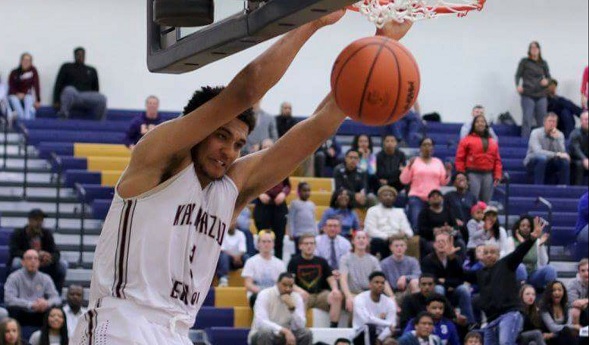
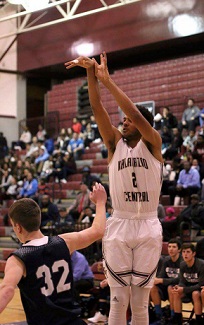
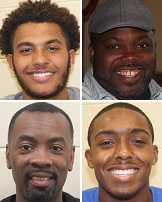
PHOTOS: (Top) Kalamazoo Central's Isaiah Livers dunks against Portage Central. (Middle) Livers follows through on a jumpshot. (Below) Clockwise, from top left: Isaiah Livers, Morris Livers, Jeremiah Vincent, Ramsey Nichols. (Action photos by Herbert Todd; head shots by Pam Shebest.)