

3 Upper Peninsula Athletes Among History-Makers in 1st Finals Adaptive Events
By
John Vrancic
Special for MHSAA.com
June 17, 2022
KINGSFORD — A trio of Upper Peninsula wheelchair athletes were among five statewide who concluded their seasons June 4 competing in first-time adaptive events at MHSAA Finals.
 This spring, the MHSAA Track & Field Regionals and Finals included its first adaptive 100, 200 and 400-meter dashes and shot put.
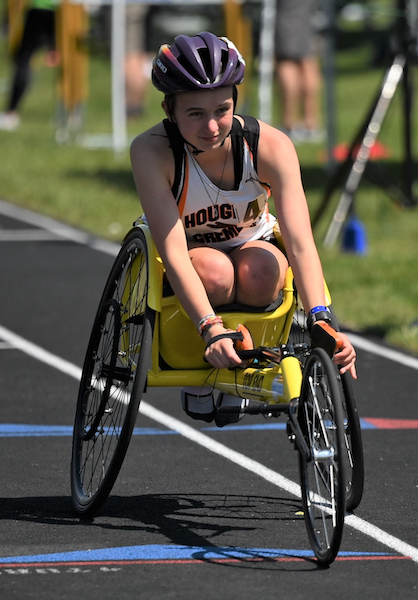
“Learning the technique and staying motivated is very challenging,” Houghton senior Maria Valet said after the Western Peninsula Athletic Conference meet May 31 at Calumet. “I go to regional competition downstate and in Indiana and Wisconsin. I also do little bit of weight training, but practice mostly on the track. I also work a little bit with Dean Juntunen (a longtime wheelchair racer from Ontonagon), who gives me some pointers. It’s good to have something to work for and see other people do it.”
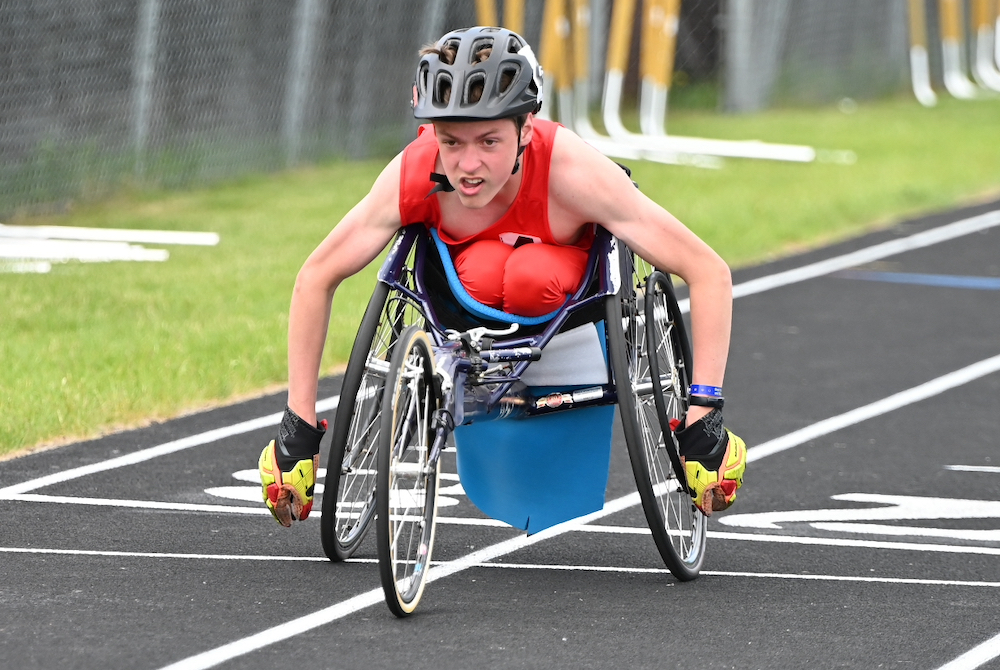
 Joining Velat at the Upper Peninsula Finals in Kingsford were Marquette freshman Jim Bennett and Sault Ste. Marie freshman Johnny Osborn.
Velat covered the 100 in 26.56 seconds, 200 (51.15) and 400 (1:35.96) and recorded a 10-foot toss in shot put.
Her effort in the 400 at the Finals was nearly a personal-best.
“My best time in the 100 is 25.7 and I’ve done the 200 in approximately 48 seconds,” she said. “I think the 100 is my hardest event because it’s harder to gain momentum.”
Velat will attend the University of Michigan and major in biology. She will also be on the track team.
Bennett shattered his previous best time in the 200 by more than 2½ seconds was clocked at 24.31 in the 100 and 1:39.74 in the 400.
“It feels real good to race against other people,” he said. “I haven’t had the opportunity to do this before. There are so many opportunities available. Colleges are looking for wheelchair racers.
 “Today was my best time in the 200 (47.52). It feels great to do that. I had my best time in the 100 (23.15) in Marquette. The longer distances are more challenging for me. Right now I’m building up.”
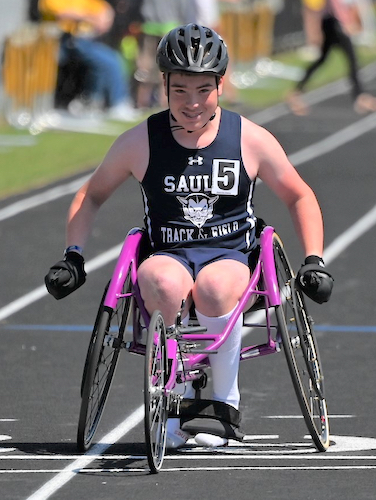
Osborn threw the shot 13-4 at Kingsford, missing his personal best by just two inches.
“It means a lot to me to get a chance to compete,” he said. “This helps bring out the competitive spirit. I do cross country, which gives me more endurance and definitely helps me for track. I also manage the basketball team at our school.”
Osborn finished the 100 in 33.18, 200 in 1:17.95 and 400 in 2:21.03.
In the Lower Peninsula, Chelsea junior Jacob Nelson competed in the Division 2 100 meters, and Grosse Pointe Woods University Liggett junior Jacob Juip competed in the Division 3 100 and 200.
 John Vrancic has covered high school sports in the Upper Peninsula since joining the Escanaba Daily Press staff in 1985. He is known most prominently across the peninsula for his extensive coverage of cross country and track & field that frequently appears in newspapers from the Wisconsin border to Lake Huron. He received the James Trethewey Award for Distinguished Service in 2015 from the Upper Peninsula Sportswriters and Sportscasters Association.
PHOTOS (Top) Marquette's Jim Bennett races during the UP Finals on June 4. (Middle) Houghton's Maria Velat competed in all four adaptive Finals events in UPD1. (Below) Sault Ste. Marie's Johnny Osborn also competed in all four events at Kingsford. (Photos by Cara Kamps/Run Michigan.)
Performance of the Week: East Kentwood's De-Mani Roberts
May 28, 2026
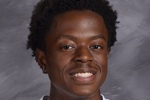 De-Mani Roberts ♦ East Kentwood
Sophomore ♦ Track
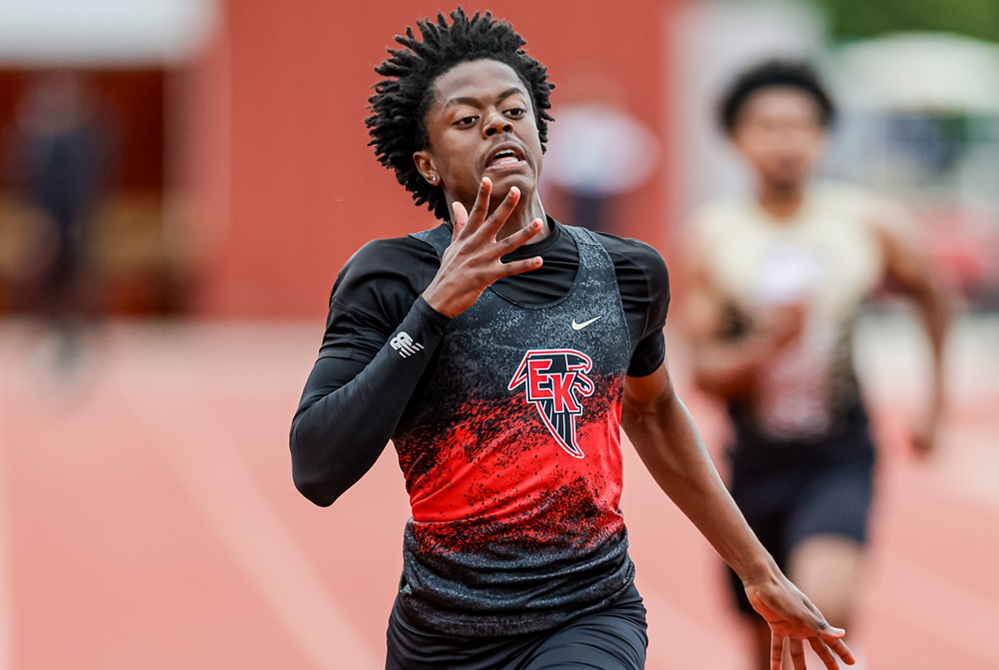
Roberts has made impressive strides in the second season of high school outdoor track, cutting nearly a half-second off his top 200-meter time from a year ago and more than a second off his freshman-year best in the 400 in helping East Kentwood become a favorite to win the team championship at Saturday's Lower Peninsula Division 1 Finals. Roberts won the 200 in a personal-best 21.26 seconds and ran on the winning 800 relay (1:26.83) as the Falcons won the Michigan Interscholastic Track Coaches Association (MITCA) Division 1 team championship last weekend.
That 200 time and his top 400 time of 47.55 seconds are both the fastest in the state in those respective races this spring, all divisions included. Roberts is undefeated in both races, a notable jump even as he finished 14th in the 200 and ran on three top-12 relays at last year's MHSAA Finals. That top 200 time also trails the current LPD1 Finals record by only 25 hundredths of a second, and he could make a run at Finals records in both individual races with half his high school career remaining. Roberts also has run cross country for East Kentwood the last two seasons.
@mhsaasports 🏃POW: De-Mani Roberts #eastkentwood #track #highschoolsports #performanceoftheweek #MHSAA ♬ Bright and fun upbeat pops, Kids, Animals, Pets, Fun, Cute, Happy, Playful, Upbeat(1465232) - SAKUMAMATATA
@mhsaasports 🏃POW: De-Mani Roberts #funfacts #tiktalk #performanceoftheweek #highschoolsports #MHSAA ♬ Girly and cute synth pop - SAKUMAMATATA
Follow the MHSAA on TikTok.
MHSAA.com's "Performance of the Week" features are powered by MI Student Aid, a division within the Department of Lifelong Education, Advancement, and Potential (MiLEAP). MI Student Aid encourages students to pursue postsecondary education by providing access to student financial resources and information. MI Student Aid administers the state’s 529 college savings programs (MET/MESP), as well as scholarship and grant programs that help make college Accessible, Affordable and Attainable for you. Connect with MI Student Aid at www.michigan.gov/mistudentaid and find more information on Facebook and X @mistudentaid.
Previous 2025-26 honorees
May 22: Taleon Guess, Temperance Bedford golf - Report
May 15: Zacchaeus Brocks, Detroit Catholic Central track - Report
May 7: Savanah Thompson, Howard City Tri County soccer - Report
April 30: Eliza Schwass, Ludington track - Report
April 23: Emily Postema, Ravenna softball - Report
April 16: Katie Berkshire, Gaylord track - Report
March 26: Kayla Hairston, Goodrich basketball - Report
March 19: Liam Smith, Otsego swimming - Report
March 12: Jack Sayen, Houghton hockey - Report
March 5: Devin Patrick, St. Clair Shores Lake Shore - Report
Feb. 26: Madison Nieuwenhuis, Plainwell wrestling - Report
Feb. 20: Sophie Ramey, Allen Park competitive cheer - Report
Feb. 13: Cam Ryans, Grand Rapids Northview basketball - Report
Feb. 6: Melanie Kolnitys, Midland Dow basketball - Report
Jan. 29: Stella Musialowski, Huron Valley United gymnastics - Report
Jan. 22: Baylor Perkins, Grand Blanc swimming - Report
Jan. 15: Delaney Vanier, Flint Kearsley bowling - Report
Jan. 8: Stevie Hall, Detroit Cass Tech basketball - Report
Dec. 18: Ethan Martha, Ishpeming Westwood basketball - Report
Dec. 11: Louis Smith, Three Rivers wrestling - Report
Dec. 4: Traverse Moore, DeWitt football - Report
Nov. 28: Elizabeth Eichbrecht, West Bloomfield swimming - Report
Nov. 20: Brady Kieff, Blanchard Montabella football - Report
Nov. 13: Ella Laupp, Battle Creek Harper Creek swimming - Report
Nov. 7: Hunter Eaton, Charlevoix cross country - Report
Oct. 31: Stephen Gollapalli, Lansing Christian tennis - Report
Oct. 23: Talya Schreiber, Pickford cross country - Report
Oct. 16: Avery Manning, Dexter golf - Report
Oct. 9: Brady Van Laecke, Hudsonville football - Report
Oct. 2: Sarah Giroux, Flat Rock volleyball - Report
Sept. 25: Sam Schumacher, Portage Central tennis - Report
Sept. 18: Kaylee Mitzel, Saline field hockey - Report
Sept. 11: Natasza Dudek, Ann Arbor Pioneer cross country - Report
Sept. 4: Kate Posey, Big Rapids golf - Report
PHOTO East Kentwood's De-Mani Roberts runs to a win in the 200 meters at the MITCA Division 1 championship meet. (Photo by Miles Postema.)