

Frankfort Relay Recipe Proven Winner as Panthers Seek to Extend Title Streaks
By
Tom Spencer
Special for MHSAA.com
April 7, 2026
FRANKFORT – Frankfort may not have written the recipe for winning MHSAA Finals relay championships.
 But they follow one that’s shown growing dominance in Division 4 over the last half-decade.
It starts with four student-athletes able to make strong friendship bonds. Then, lots of practice is added to develop muscle memory and mix in ways to maximize speed potential in the designated 30-meter exchange zone. And, perhaps finally, it is highly recommended to blend in near-perfect handoffs.
Frankfort has been crowned the LPD4 400-meter relay champion the last five years. The Panthers also have run the LPD4 Finals record time in the event, in 2024. And to top it off, the Panthers broke the 800 relay meet record in winning that race last spring.
The championships have come with different tight-knit combinations of runners over the years. Current junior Alice Luther, current seniors Addison Jarosz and Sofia Alaimo Schindler and 2025 graduate Gwyneth Dunaway won both championships together last season and the 400 title in 2024 as well, and first-place combinations also have included Addison Chownyk, Reagan Thor, Tara Townsend, Keyan Clapp, Grace Wolfe and Eliza Frary.
To finalize the recipe, the Panthers add optional ingredients – a golden baton and pineapple socks
Be sure though, it is the golden baton but not the same pineapple socks.
“I get different pairs, because I wear them for all my sports,” said Jarosz, now a senior, who’s been on the last three 400 relay champions along with fellow senior Alaimo Schindler. “They get worn down, but I've worn them since like seventh grade.”
Jarosz is not sure how her special socks-wearing got started. She only knows the first time produced satisfying results. She also runs middle distances with her socks on display for multiple laps.
 “I think I might have gotten them as a gift because I was in middle school and going through a phase of crazy socks and stuff,” Jarosz recalls. “I had good luck so now I always wear them.”
As for the golden baton, it’s currently stored in the home of Alaimo Schindler. It got there after last year’s team competed at the Nike Outdoor National Championships in Eugene, Ore. It’s there for safe keeping and only used for relays Jarosz and Alaimo Schindler race.
“We don't let anyone else use it but us – Addie and I have been running together since middle school, and that's the baton we use,” Alaimo Schindler said. “It's just special to us, and it has one tiny dent.”
The bonds – and skills – formed over the last three years by those two and Luther are expected to bode well for the Panthers again this year.
“I think that there's always kind of pressure going into state finals, but I think that we have great coaching and we all work really hard,” admitted Luther, who also runs hurdles. “Gwen's shoe is a hard one to fill, but I think that we have good candidates who are willing to work hard to do it.”
Sophomore Riley LeVack is expected to join Luther, Jarosz and Alaimo Schindler on the shorter relays at the Regional, which the Panthers will host in late May. LeVack filled in a handful of times last spring, helping the Panthers pick up key competition points as they collected team trophies as well.
“Getting on the relay team is a big deal for the girls because this won't go on forever, and it's going to be something they'll look back on and really appreciate how good they were in high school,” said sixth-year Frankfort head track & field coach Ed Schindler. “Sophia, Alice and Addie all had it where they joined a team that had already won the state, so now it's Riley’s turn to see if she can win the state championship with them.”
The composition of the 400 and 800 teams this year will be finalized in time for the Regional. Frankfort has won every relay over the last two Regionals on the way to claiming the team titles at those meets as well. The Panthers also won the Northwest Conference last season. Those team championships in both the league and Regional were the first won by the program over more than 50 years of competition.
 “All of our girls are really fast in relays because once we get to max speed, we're pretty good and manage 30 meters of exchange well,” Schindler pointed out. “We have a person on our 4x4 team that pole vaults and another one on our 4x8 that does too. They're all great athletes. When you have a good core group of maybe eight of your total 13 athletes that really score in big meets, that's gives you a shot at the state championship.”
Frankfort placed second to Fowler at last year’s LPD4 Final, its highest MHSAA Finals team finish. In addition to repeating as Regional champion, and keeping the Finals relay title strings alive, Frankfort has its eyes on a Michigan Interscholastic Track Coaches Association team championship.
The Panthers will start the season with lots of confidence they’ll repeat their relay dominance – even if new fourth runners don’t lead to faster times than last year.
“Last year when we were competing against other teams, we were winning by a few seconds, so we have that room and space for another runner who is just a few seconds behind Gwyn,” Alaimo Schindler said. “We're really close to each other, and we hand it down each year. So I'm still I'm very confident, and I think with a lot of practice, we will get to where we were last year.”
“Our handoffs are so good it gives us just that little bit of advantage and helps us get a little bit ahead,” added Jarosz. “It just amazes me sometimes that just that little bit can do a lot.”
 Tom Spencer is a longtime MHSAA-registered basketball and soccer official, and former softball and baseball official, and he also has coached in the northern Lower Peninsula area. He previously has written for the Saginaw News, Bay County Sports Page and Midland Daily News. He can be reached at [email protected] with story ideas for Manistee, Wexford, Missaukee, Roscommon, Ogemaw, Iosco, Alcona, Oscoda, Crawford, Kalkaska, Grand Traverse, Benzie, Leelanau, Antrim, Otsego, Montmorency, Alpena, Presque Isle, Cheboygan, Charlevoix and Emmet counties.
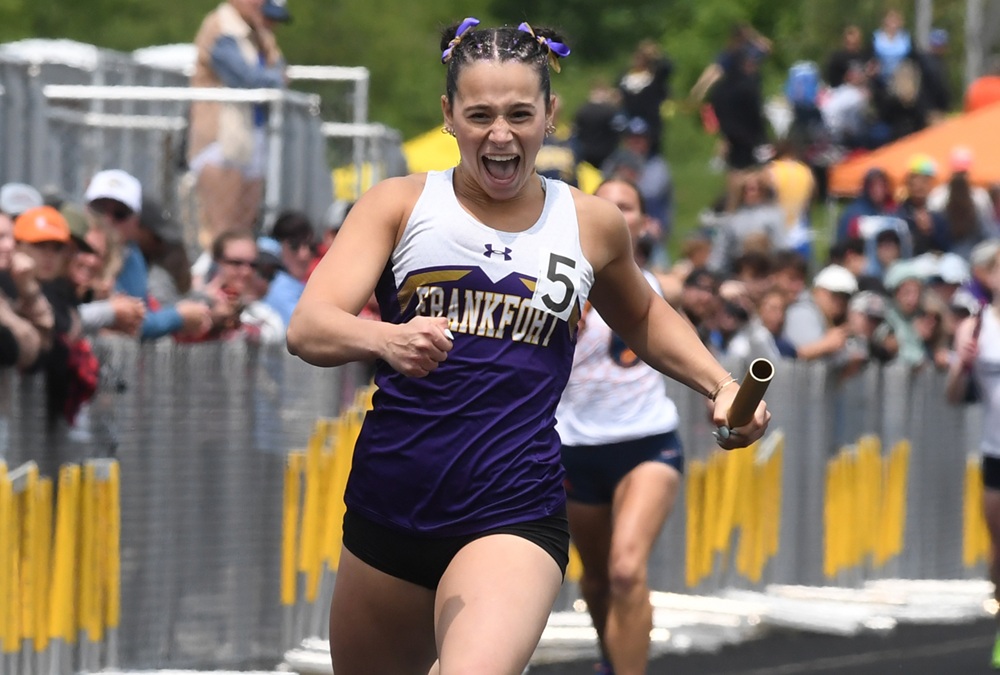
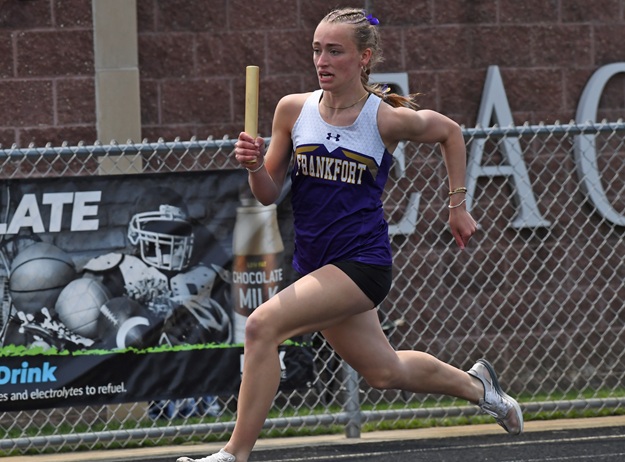
PHOTOS (Top) Frankfort's Sofia Alaimo Schindler crosses the finish line first in anchoring her 800 relay to last season's Division 4 championship. (Middle) Alice Luther rounds a curve during a winning relay. (Below) From left: now-graduated Gwyneth Dunaway, Luther, Alaimo Schindler and Addison Jarosz take a photo at last year's Finals holding their golden baton. (Photos by Ken Swart/RunMichigan.com.)
Hovey Leads Hart to Historic 3-Peat, Onsted's Ross Joins Prestigious 4-Win Group
By
Dean Holzwarth
Special for MHSAA.com
June 1, 2024
KENT CITY – Addison Hovey was a dual threat Saturday for the Hart girls track & field team.
The junior standout used blazing speed, combined with remarkable leaping ability, to help spark the Pirates to a third-straight title at the Lower Peninsula Division 3 Finals, held at Kent City High School.
Hovey captured wins in the 100 and 200, while also winning the high jump for a second straight year.
“Winning high jump was my main priority, and then top eight in the 100 and 200,” Hovey said. “But I’m honestly so surprised because I knew there were really good girls in those two events.
“I’m just really proud of how much work I’ve put in this season, and it showed today and paid off.”
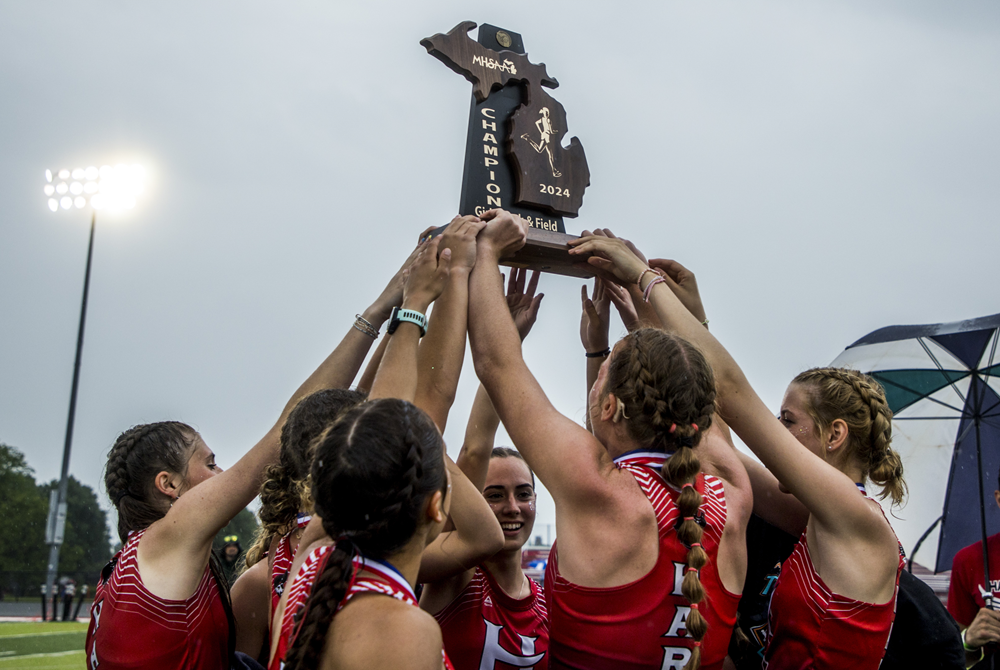
Hart became the first Division 3 girls team to win three consecutive championships. The Pirates finished with 53 points, while Onsted (40) was runner-up and Olivet (38) took third.
“It means the world to me and my team,” Hovey said. “No team in Division 3 had won three years in a row, so that’s huge. We lost one of our really good athletes, and she was a big part for us, so we knew there was going to be some pressure coming into this. I’m really proud of my teammates. The girls stepped up and helped me.”
 Last season’s 3,200 winner, Jessica Jazwinski, was unable to compete for most of this season.
“I really didn't expect this part way through the season,” Hart coach Calvin Ackley said. “Especially because a couple distance runners, one went out, and one was coming back from injury. Traditionally, we’ve been distance, distance at Hart. I never thought I’d see the day we would be dominating in sprints. That’s been exciting, and my coaches are fantastic.”
Hovey out-jumped Kalamazoo Christian’s Ellie VanDusen by eclipsing 5-foot-6 to tie the LPD3 Finals record. Hovey also recorded a personal-best time of 12.27 in the 100 and ended her day with an impressive 25.60 in the 200.
“I was so tired, but I just gave it my all,” Hovey said. “It was the last event of my last meet. Hopefully I feel better tomorrow.”
Ackley said Hovey’s improvement over the past few years has been remarkable.
“Absolutely amazing day,” he said. “She’s come a long way from a freshman kind of unsure of herself to an absolute beast.
“She’s an amazing athlete and has a great attitude. She doesn't worry about the little things that don't matter. She just focuses on what she needs to do, and she carried the team today. She just keeps progressing, and she’s a great basketball player, but a fantastic track athlete.”
Junior Emmry Ross also shined, winning all four of her events to single-handedly place Onsted second as a team. She racked up repeat victories in the 400 and 800, while also claiming titles in the 1,600 and 3,200 – becoming just the seventh girl all-time (and third in the Lower Peninsula) to win four events at an MHSAA Finals.
“Honestly, I went into today pretty nervous,” Ross said. “I was more nervous last night than I was today because today I just went in with the mindset of, ‘Do my best. You got here. You deserve this.’ I worked really hard this season, and I just went in and had confidence. It turned out to be a really good day, and it was fun because I got to run in the rain.”
Ross said running four events wasn’t grueling because of her preparation.
“I train for it,” she said. “I ran those four (events) at Regionals and two other meets before that, so I was used to it. It wasn’t a challenge because I’ve done it before.”
While those two combined to win the majority of Saturday’s individual running events, Kalamazoo Christian freshman Elli VanDusen (110 hurdles) and Olivet sophomore Emily Peters (300 hurdles) claimed titles as well. Monroe St. Mary Catholic Central (400), Olivet (800) and Jackson Lumen Christi (1,600 and 3,200) won the relays. Montrose freshman Addyson Stiverson (shot put) and Grayling senior Rylan Finstrom (discus) were first in the throws, Wyoming Potter’s House Christian junior Sohanny Gonzalez-Castillo won the long jump and Homer junior Emma Wildt won the pole vault.
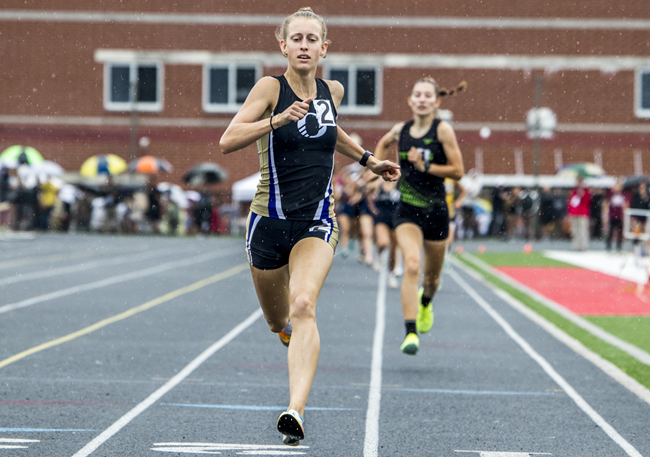
PHOTOS (Top) Hart celebrates its third-straight Division 3 championship Saturday at Kent City. (Middle) Onsted’s Emmry Ross crosses the finish line for one of her four individual victories. (Click for more from Jamie McNinch/RunMichigan.com.)