

Frazee Set to Finish Long Race to Return to Track After 2-Year Health Fight
By
Tom Spencer
Special for MHSAA.com
April 17, 2026
When Brooklynn Frazee next competes for Buckley girls track & field team, tears are going to flow.
 And that very well may be today.
“To be honest, I'm not looking for anything — I just want to see the joy on her face again,” said sixth-year Buckley coach Jolie King. “It gives me goosebumps. If you saw this kid run, and then to know what she's been through … the minute she gets on the track and completes the race, I'm going to cry. Yeah, I'm going to bawl on the track.”
Frazee, now a senior, is expected to run the sprints and long jump today when the Bears travel to Benzie Central for the 8-team Garland Invite. She hasn’t competed for the Bears since her sophomore year. As a freshman, she won the 100-meter dash with a personal-best 12.47 seconds and took second in the 200 as Buckley won the Lower Peninsula Division 4 championship, its first team Finals title in the sport.
There had been lots of preseason excitement the following spring, and thoughts of repeating for the Bears, who had Frazee and Aiden Harrand back – Harrand who won the 1,600 for the third time and the 800 and 3,200 as well during the 2023 team championship run.
But long before Harrand eventually became the LPD4 champion again in the 400 and 1,600 to close 2024, Frazee began to face constant illness and a major injury.
“I was competing well and felt ready for another strong season,” Frazee said of her early sophomore competitions. “But deep down, I knew something was wrong. I was battling non-stop illnesses like strep throat, pneumonia, low iron, aches and pains and fatigue. Even with all of that, I kept competing. I loved my sport, and I did not want to let my team down.”
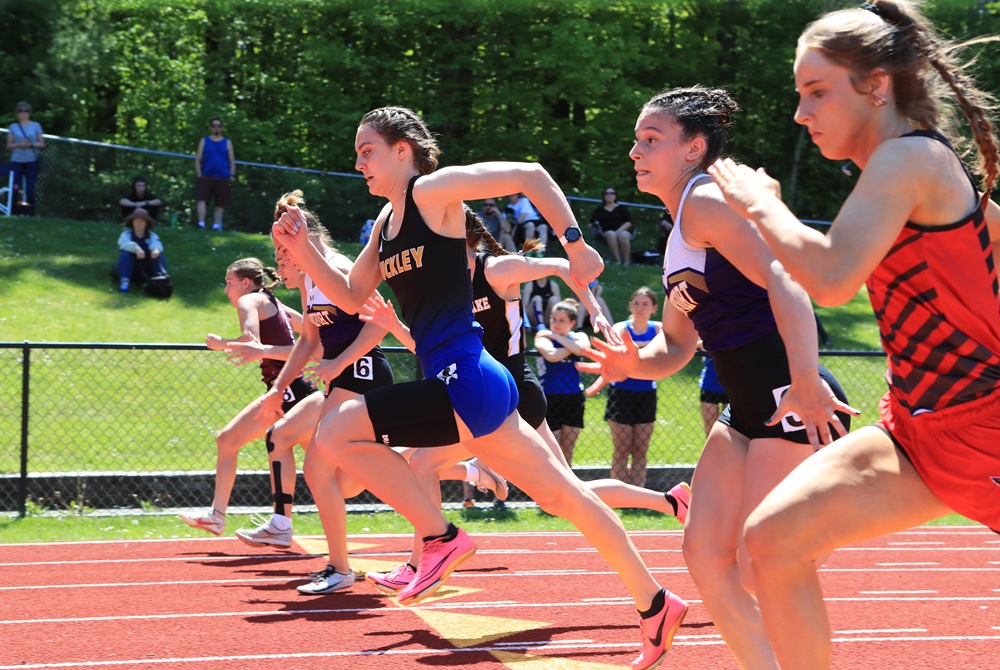
 Frazee wound up missing weeks of her sophomore season but kept her eye on qualifying for the Finals in hopes of repeating in the 100.
“The constant illnesses and stress on my body finally caught up with me,” she said. “I suffered level 3 out of 4 tears from my hips to my knees. Suddenly, I went from competing to being sidelined.”
Following brief breaks for recovery purposes, Frazee did manage to qualify for the 2024 Finals in the long jump, 100, 200 and 400-meter runs.
“After another week of rest, I made it to the state finals meet,” she recalled. “I fought through the pain and made the finals in the 100-meter dash and long jump. I missed qualifying for the 200-meter finals by just one spot. By then, my body was fading fast. I was unable to sprint in the 100 finals and just crossed the finish line. I was not able to run the 400 meter.”
That was the last time Frazee competed for Buckley.
She’s coming back after nearly two years of treatments that kept her out of track and basketball. She endured the two years while staying involved in Buckley sports as a team manager for cross country, track and basketball and while strengthening her already-strong faith.
“After the 2024 season, doctors thought it might be multiple sclerosis. I was also diagnosed with mono but when that didn't go away eventually, I received the diagnosis that changed my life,” Frazee said. “I don't really want to go into much detail about the diagnosis specifically, but it definitely changed my life. As treatments became harder, I was no longer able to help during the basketball and track seasons. I made it to a few track meets to cheer on my team, but many times I had to leave early because of the pain and fatigue.”
Buckley hoped to have Frazee back for its season-opening invitational last week. She ran indoor track races over the winter but returned from spring break sick. She’s missed the Bears’ first two outdoor meets but returned to school Wednesday.
“Friday is a go,” said Todd Frazee, Buckley’s athletic director and Brooklynn’s father. “The poor girl was so excited for her season to start, and then this virus hit. I can really feel for her.”
But now that Frazee is nearly back, King believes the Bears will be seeing an even faster senior on the track.
“Part of me is, like, holy cow this kid's faster now, stronger, and smarter and when we can get her on the track, she's going to blow people's minds,” King predicted. “But then the other part of me is, I don't want to do this to her. I'm not putting any of my hopes and dreams on this kid at all. I'm celebrating.”
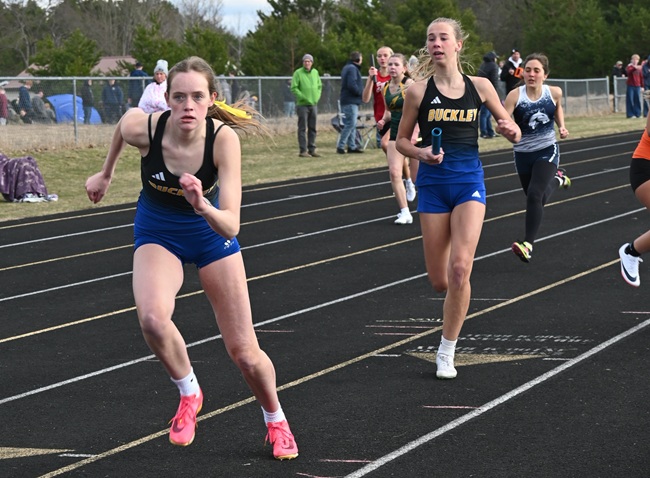 The senior speedster, who is also a member of the Buckley school record-holding 3,200 relay team, offers another perspective.
“I've gone from helping lead my school to its first state final championship as a freshman, to nearly losing sports completely,” Frazee acknowledged. “I'm fighting back to come back just as strong. My faith grew stronger and through everything I've faced, I believe that God was leading me toward a bigger purpose.”
Without Frazee, the Bears finished fourth in the team scoring at the 2024 Finals. Last year, after Harrand’s graduation the previous spring as well, Buckley qualified for just three events.
As sophomores last spring, Mikayla Kulawiak qualified in the high jump and finished fifth, and Maddie Snider qualified for the 100 hurdles. Kulawiak set the school high jump record at 5-foot-2 as this spring season opened up. The Bears also have seniors Addison Harrand and Kinsey Peer and sophomore Ariana Paris back from last year’s Finals-qualifying 3,200 relay.
Also, the top two finishers from Buckley’s third-place team effort at last fall’s LPD4 Cross Country Final – Brooklyn Griffin and Mirthe Breuker, an exchange student from the Netherlands – are running track and have the Bears excited for what lies ahead.
Griffin, just a freshman, is already bolstering the Bears in the 100, 200 and 400-meter races, along with the long jump and pole vault. She won the 400 at Wednesday’s Northwest Conference meet.
With Frazee likely returning, the Bears now have their eyes on the Regional hosted by conference rival Frankfort and ultimately the May 30 Finals at Hudsonville Baldwin.
“We're just taking one day at a time,” said King, who noted it’s been devastating to watch Frazee’s struggle. “Brooklyn’s is a tremendous athlete and a tremendous person, and my heart just breaks for her. She’s very focused and telling herself May 30th. We have to take it day by day. Actually, we take it minute by minute.”
Frazee echoed her coach.
“We have a small but mighty team this year, and our goal is not to win the small meets, but focus in on what really matters, as well as each of us have individual goals that we are excited to cheer each other on in achieving.” she said. “I'm excited for this season and this team as I know it'll be one to remember. My goal is May 30th, the state finals, and just to enjoy being back and able to compete.”
 Tom Spencer is a longtime MHSAA-registered basketball and soccer official, and former softball and baseball official, and he also has coached in the northern Lower Peninsula area. He previously has written for the Saginaw News, Bay County Sports Page and Midland Daily News. He can be reached at [email protected] with story ideas for Manistee, Wexford, Missaukee, Roscommon, Ogemaw, Iosco, Alcona, Oscoda, Crawford, Kalkaska, Grand Traverse, Benzie, Leelanau, Antrim, Otsego, Montmorency, Alpena, Presque Isle, Cheboygan, Charlevoix and Emmet counties.
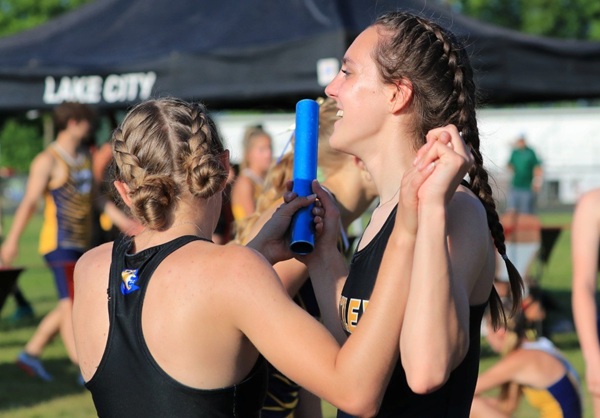
PHOTOS (Top) Buckley’s Brooklyn Frazee, middle, competes in a race during her sophomore season in 2024. (Middle) Frazee, right, celebrates with a teammate. (Below) The Bears’ Brooklyn Griffin, right, hands off the baton to Mirthe Breuker during a relay this spring. (Frazee photos courtesy of Todd Frazee. Relay photo courtesy of Jolie King.)

Zeeland East Claims Neighborly Title Tilt
June 2, 2018
By Dan D’Addona
Special for Second Half
ZEELAND — It was a battle of familiar opponents in a familiar place with the Lower Peninsula Division 2 girls track & field title on the line.
Zeeland East went toe-to-toe with Ottawa-Kent Conference Green rival Holland Christian on Saturday at Zeeland Stadium — and every point counted.
Led by strong field events and hurdles, the Chix held off the runner-up Maroons by just two points, 64-62.
“Coming into the season, we knew it was a possibility with how close it was. We didn’t think we were losing that many points, and we had Maleigh (Vanderbeek) get hurt and Lia (Maggini) get hurt and Kianna Em transferred, and we had to work for it. But our girls never took it for granted,” Zeeland East coach Josh Vork said. “They knew they had to come out and work. Every day at practice you could see it. They wanted this to be special.”
Detroit Country Day was third (42), followed by Lansing Catholic (40), Dearborn Divine Child (35.5), St. Clair Shores South Lake (23), Corunna (21), Bridgeport (20), Adrian (19) and Battle Creek Harper Creek (19) among the top 10.
It was a strong day for Zeeland East’s Suenomi Norinh. The senior won three events and finished second in a fourth.
Norinh won the high jump at 5-8, edging Divine Child’s Avery Budz (5-7). Zeeland East teammate Sophie Riemersma took fifth (5-5).
Norinh also won the long jump (18-1¾) and the 100-meter hurdles (14.63), taking second in the 300 hurdles (44.91).
“This means the world to us. We have been working so hard for this,” Norinh said. “I am so proud of my teammates. I was going to be really upset if we lost, and I am really, really happy that we won — going out with a bang.”
Divine Child’s Allie Filiatraut won the discus in 136-0, edging the Zeeland East duo of Taylor Waterway (135-0) and Aliyah Boeve (134-1). In the shot put, Whitehall’s Brianna Copley won with a throw of 42-5, holding off Boeve (40-9).
 With just five athletes scoring, Holland Christian kept it close until the end of the meet, winning the final relay to close within two points of the Chix.
Holland Christian’s Kayla Windemuller won the 1,600-meter run in a Division 2 meet-record time of 4:49.55.
Windemuller, Mady Vander Zwaag, Michelle Kuipers and Elizabeth Bruxvoort won the 3,200 relay in 9:10.01. Kuipers, Dolly Slenk, Bruxvoort and Vander Zwaag won the 1,600 relay (4:00.09).
Kuipers won the 800 (2:13.49), and Windemuller was fourth (2:14.68).
“Running with these girls, it is just like, ‘We got this.’” Kuipers said. “It was a lot of fun.”
Lansing Catholic sisters Olivia Theis (10:37.08) and Jaden Theis (10:48.52) went 1-2 in the 3,200, finishing ahead of Windemuller (10:58.87).
“It was all about the team,” Windemuller said. “We knew we had a chance at winning, but finishing second and getting a trophy is incredible. I am really happy I could run four events at a high level. I gave everything I had so I could score points for the team.”
Allendale’s Brianna Bredeweg set a Division 2 meet record to win the pole vault in 12-7.
Bridgeport’s Payten Williams won the 100 meters (12.06) and 200 (24.73).
Country Day’s Jasmine Powell, Taylor Aibana, Ahvon Mitchell and Alexis Officer won the 800 relay (1:45.10). The same quartet won the 400 relay in 49.14.
Ludington’s Emma Fountain won the 400 meters in 57.49.
Harper Creek’s Arabia Bacon won the 300 hurdles in 44.74, ahead of Norinh (44.91).
PHOTOS: (Top) Zeeland East's girls pose with their championship trophy Saturday after winning the LPD2 title. (Middle) Lansing Catholic's Jaden Theis (1), Olivia Theis (2) and Holland Christian's Kayla Windemuller (3) set the pace. (Photos by Janina Pollatz. Click for more from RunMichigan.com.)