

Frazee Set to Finish Long Race to Return to Track After 2-Year Health Fight
By
Tom Spencer
Special for MHSAA.com
April 17, 2026
When Brooklynn Frazee next competes for Buckley girls track & field team, tears are going to flow.
 And that very well may be today.
“To be honest, I'm not looking for anything — I just want to see the joy on her face again,” said sixth-year Buckley coach Jolie King. “It gives me goosebumps. If you saw this kid run, and then to know what she's been through … the minute she gets on the track and completes the race, I'm going to cry. Yeah, I'm going to bawl on the track.”
Frazee, now a senior, is expected to run the sprints and long jump today when the Bears travel to Benzie Central for the 8-team Garland Invite. She hasn’t competed for the Bears since her sophomore year. As a freshman, she won the 100-meter dash with a personal-best 12.47 seconds and took second in the 200 as Buckley won the Lower Peninsula Division 4 championship, its first team Finals title in the sport.
There had been lots of preseason excitement the following spring, and thoughts of repeating for the Bears, who had Frazee and Aiden Harrand back – Harrand who won the 1,600 for the third time and the 800 and 3,200 as well during the 2023 team championship run.
But long before Harrand eventually became the LPD4 champion again in the 400 and 1,600 to close 2024, Frazee began to face constant illness and a major injury.
“I was competing well and felt ready for another strong season,” Frazee said of her early sophomore competitions. “But deep down, I knew something was wrong. I was battling non-stop illnesses like strep throat, pneumonia, low iron, aches and pains and fatigue. Even with all of that, I kept competing. I loved my sport, and I did not want to let my team down.”
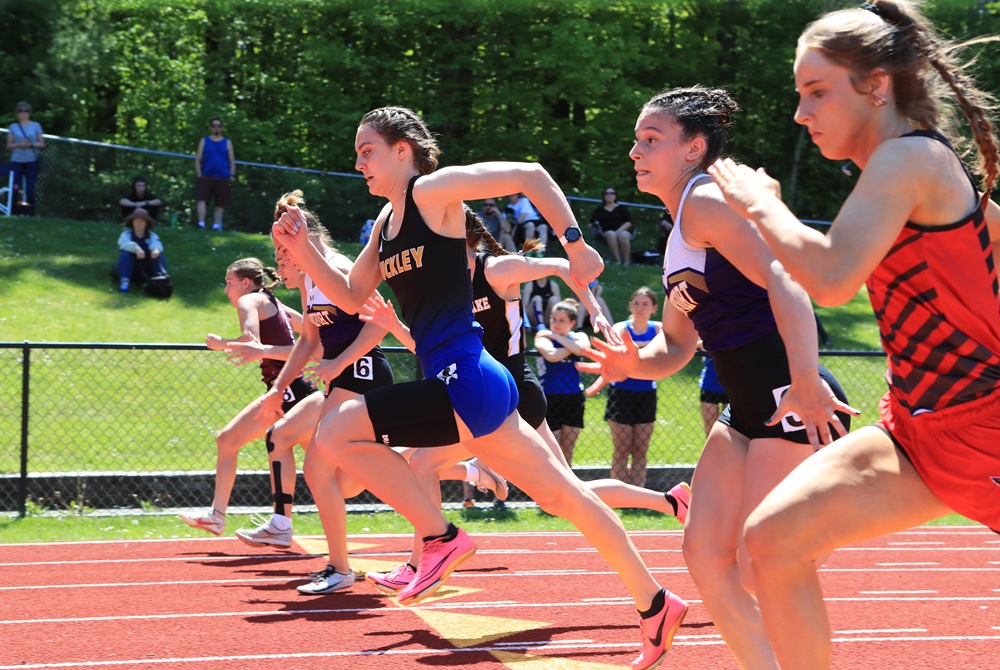
 Frazee wound up missing weeks of her sophomore season but kept her eye on qualifying for the Finals in hopes of repeating in the 100.
“The constant illnesses and stress on my body finally caught up with me,” she said. “I suffered level 3 out of 4 tears from my hips to my knees. Suddenly, I went from competing to being sidelined.”
Following brief breaks for recovery purposes, Frazee did manage to qualify for the 2024 Finals in the long jump, 100, 200 and 400-meter runs.
“After another week of rest, I made it to the state finals meet,” she recalled. “I fought through the pain and made the finals in the 100-meter dash and long jump. I missed qualifying for the 200-meter finals by just one spot. By then, my body was fading fast. I was unable to sprint in the 100 finals and just crossed the finish line. I was not able to run the 400 meter.”
That was the last time Frazee competed for Buckley.
She’s coming back after nearly two years of treatments that kept her out of track and basketball. She endured the two years while staying involved in Buckley sports as a team manager for cross country, track and basketball and while strengthening her already-strong faith.
“After the 2024 season, doctors thought it might be multiple sclerosis. I was also diagnosed with mono but when that didn't go away eventually, I received the diagnosis that changed my life,” Frazee said. “I don't really want to go into much detail about the diagnosis specifically, but it definitely changed my life. As treatments became harder, I was no longer able to help during the basketball and track seasons. I made it to a few track meets to cheer on my team, but many times I had to leave early because of the pain and fatigue.”
Buckley hoped to have Frazee back for its season-opening invitational last week. She ran indoor track races over the winter but returned from spring break sick. She’s missed the Bears’ first two outdoor meets but returned to school Wednesday.
“Friday is a go,” said Todd Frazee, Buckley’s athletic director and Brooklynn’s father. “The poor girl was so excited for her season to start, and then this virus hit. I can really feel for her.”
But now that Frazee is nearly back, King believes the Bears will be seeing an even faster senior on the track.
“Part of me is, like, holy cow this kid's faster now, stronger, and smarter and when we can get her on the track, she's going to blow people's minds,” King predicted. “But then the other part of me is, I don't want to do this to her. I'm not putting any of my hopes and dreams on this kid at all. I'm celebrating.”
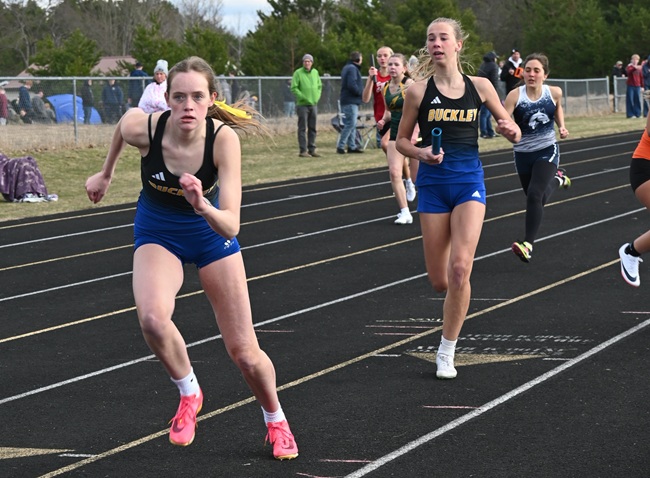 The senior speedster, who is also a member of the Buckley school record-holding 3,200 relay team, offers another perspective.
“I've gone from helping lead my school to its first state final championship as a freshman, to nearly losing sports completely,” Frazee acknowledged. “I'm fighting back to come back just as strong. My faith grew stronger and through everything I've faced, I believe that God was leading me toward a bigger purpose.”
Without Frazee, the Bears finished fourth in the team scoring at the 2024 Finals. Last year, after Harrand’s graduation the previous spring as well, Buckley qualified for just three events.
As sophomores last spring, Mikayla Kulawiak qualified in the high jump and finished fifth, and Maddie Snider qualified for the 100 hurdles. Kulawiak set the school high jump record at 5-foot-2 as this spring season opened up. The Bears also have seniors Addison Harrand and Kinsey Peer and sophomore Ariana Paris back from last year’s Finals-qualifying 3,200 relay.
Also, the top two finishers from Buckley’s third-place team effort at last fall’s LPD4 Cross Country Final – Brooklyn Griffin and Mirthe Breuker, an exchange student from the Netherlands – are running track and have the Bears excited for what lies ahead.
Griffin, just a freshman, is already bolstering the Bears in the 100, 200 and 400-meter races, along with the long jump and pole vault. She won the 400 at Wednesday’s Northwest Conference meet.
With Frazee likely returning, the Bears now have their eyes on the Regional hosted by conference rival Frankfort and ultimately the May 30 Finals at Hudsonville Baldwin.
“We're just taking one day at a time,” said King, who noted it’s been devastating to watch Frazee’s struggle. “Brooklyn’s is a tremendous athlete and a tremendous person, and my heart just breaks for her. She’s very focused and telling herself May 30th. We have to take it day by day. Actually, we take it minute by minute.”
Frazee echoed her coach.
“We have a small but mighty team this year, and our goal is not to win the small meets, but focus in on what really matters, as well as each of us have individual goals that we are excited to cheer each other on in achieving.” she said. “I'm excited for this season and this team as I know it'll be one to remember. My goal is May 30th, the state finals, and just to enjoy being back and able to compete.”
 Tom Spencer is a longtime MHSAA-registered basketball and soccer official, and former softball and baseball official, and he also has coached in the northern Lower Peninsula area. He previously has written for the Saginaw News, Bay County Sports Page and Midland Daily News. He can be reached at [email protected] with story ideas for Manistee, Wexford, Missaukee, Roscommon, Ogemaw, Iosco, Alcona, Oscoda, Crawford, Kalkaska, Grand Traverse, Benzie, Leelanau, Antrim, Otsego, Montmorency, Alpena, Presque Isle, Cheboygan, Charlevoix and Emmet counties.
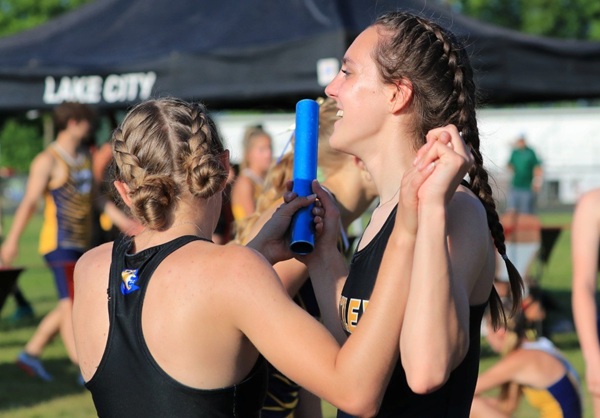
PHOTOS (Top) Buckley’s Brooklyn Frazee, middle, competes in a race during her sophomore season in 2024. (Middle) Frazee, right, celebrates with a teammate. (Below) The Bears’ Brooklyn Griffin, right, hands off the baton to Mirthe Breuker during a relay this spring. (Frazee photos courtesy of Todd Frazee. Relay photo courtesy of Jolie King.)
North Branch Cousins Carry on Family Tradition with Record-Setting Throws
By
Paul Costanzo
Special for MHSAA.com
April 16, 2025
Aubree Deshetsky wasn’t able to be there last week when her cousin, Eli Bickel, broke the 30-year-old North Branch discus record.
 She was there, however, when the former record holder, her dad Daniel Deshetsky, got the call.
“I was with my dad at a volleyball tournament in Louisville,” Aubree Deshetsky said. “We wanted (Eli) to break the record. It was cool to see him do that.”
Bickel not only knocked his uncle off the Broncos’ record board with his throw of 160 feet, 4 inches on April 11 at Davison, he joined Aubree as the school’s all-time leaders in the event. She had thrown 131-5 two days earlier, breaking her own school record.
The similarities go well beyond that. Both have committed to Division I universities in other sports. Deshetsky will be playing volleyball at Wofford (South Carolina), while Bickel has committed to play football at Michigan State.
And they’re both still juniors.
“I think for both of them, they’re not done,” North Branch athletic director and throwing coach Al Margrif said. “They’re both really motivated to be able to make their best marks this year. Eli, he puts in a lot of study. He watches a lot of film. He has a cousin that he talks to that’s a (collegiate) throws coach. He’s more technical and a student of discus. Aubree, she’s a super-fast learner. She’s just so athletic, and it just comes out so much.”
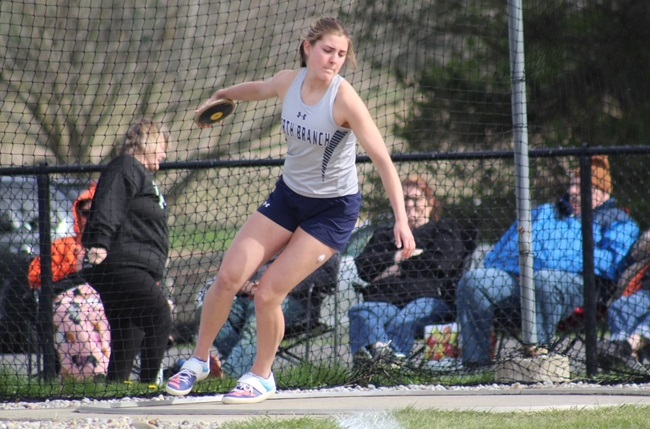 Deshetsky is a two-time Finals champion in volleyball, winning titles her freshman and sophomore seasons. She’s also a returning all-state thrower, having taken fifth in the shot put and sixth in the discus at the Lower Peninsula Division 2 Finals a year ago.
That’s despite never really being solely focused on throwing. During her freshman year, she ran the 200, 400 and 800 meters, multiple relays and also high jumped along with her throwing events.
As a sophomore, she cut back on some of those races and the high jump, but was part of North Branch’s 400-meter relay team, which qualified for the Division 2 Finals.
And all along, she’s been playing high-level club volleyball, which takes her around the country.
“I kind of (started throwing) because my dad threw in high school,” she said. “It’s just something my family has done. I was really a big high jumper and 800 runner in middle school and early high school, but once volleyball ramped up more, it was harder to train for those, so I focused more on the throwing side. I got serious into discus last year. But my coach, he literally puts us in events at the meets to get us the most points, so I just do whatever he asks and hope for the best.”
She threw 127-1 at the Blue Water Area Conference championship meet a year ago to claim the school record. That came last May, so to be well ahead of that right now in early April is a good sign for what she wants to accomplish this season.
“I was actually very surprised,” she said. “That meet was my first time throwing outdoors this year. We’ve just been practicing inside, but something that’s helped this year, our school has these foam rings and with rubber discs, I can basically do a full throw into a divider in the gym. But I honestly did not expect to throw that far. I’m kind of aiming for the 140 mark this year. I think starting out at 131 is a good starting point.”
Bickel, who will play on the offensive line at MSU, has been more focused on throwing since middle school. He started tagging along to throwing practices when his sister Natasha, a 2023 North Branch graduate who was Deshetsky’s volleyball teammate, began competing in high school, and realized pretty quickly he had a future in the sport. So much so that he originally thought throwing could be his path to becoming a college athlete.
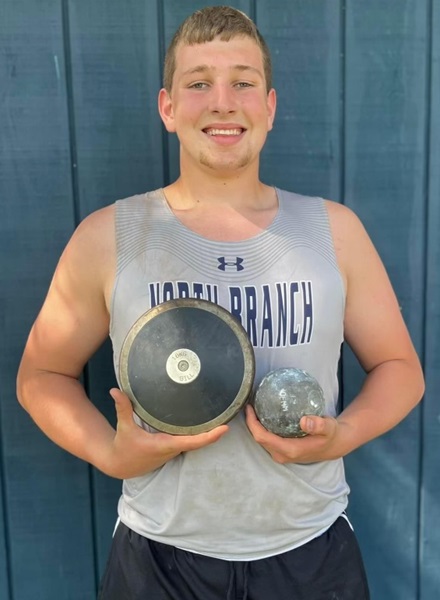 All along, he had his uncle’s record in his sights.
“It’s been a goal of mine,” Bickel said. “I knew I could do it. Last year was a frustrating year, because I hit that mark so many times in practice, but I never could in a meet. This was my first meet this year – I got cleared on Tuesday (after recovering from a torn meniscus), then the next day I threw 151 and felt good. Then Friday came and my first two throws, I was over-excited, but my next throw, I really connected.”
Bickel is a four-sport athlete at North Branch, as he wrestled and played basketball this winter. Even though he did get injured in January, he said the MSU staff has been supportive of him continuing to branch out.
“They actually encouraged it,” Bickel said. “They wanted people who could stay moving and be athletic on the offensive line.”
His football commitment could mean this is his final track season, however, as there’s a chance he will enroll early at MSU. That put some more urgency into breaking that record this season and getting back to the Division 2 Finals to make up for a disappointing finish a year ago.
He’s certainly on track to do that, as his record-breaking throw is currently the best in Division 2 this spring.
The best throw for Division 2 girls, meanwhile, belongs to Deshetsky.
It’s fitting for cousins who have had simultaneous success for so long.
“Our family is very close together,” Bickel said. “We actually do 4-H in the summer, and they show pigs out of our barn. I go to every one of her volleyball games that I can make it to. On the track side of things, there are times on a Saturday afternoon where I’ll ask her if she wants to go practice throwing, and she’ll do it.”
 Paul Costanzo served as a sportswriter at The Port Huron Times Herald from 2006-15, including three years as lead sportswriter, and prior to that as sports editor at the Hillsdale Daily News from 2005-06. He can be reached at [email protected] with story ideas for Genesee, Lapeer, St. Clair, Sanilac, Huron, Tuscola, Saginaw, Bay, Arenac, Midland and Gladwin counties.
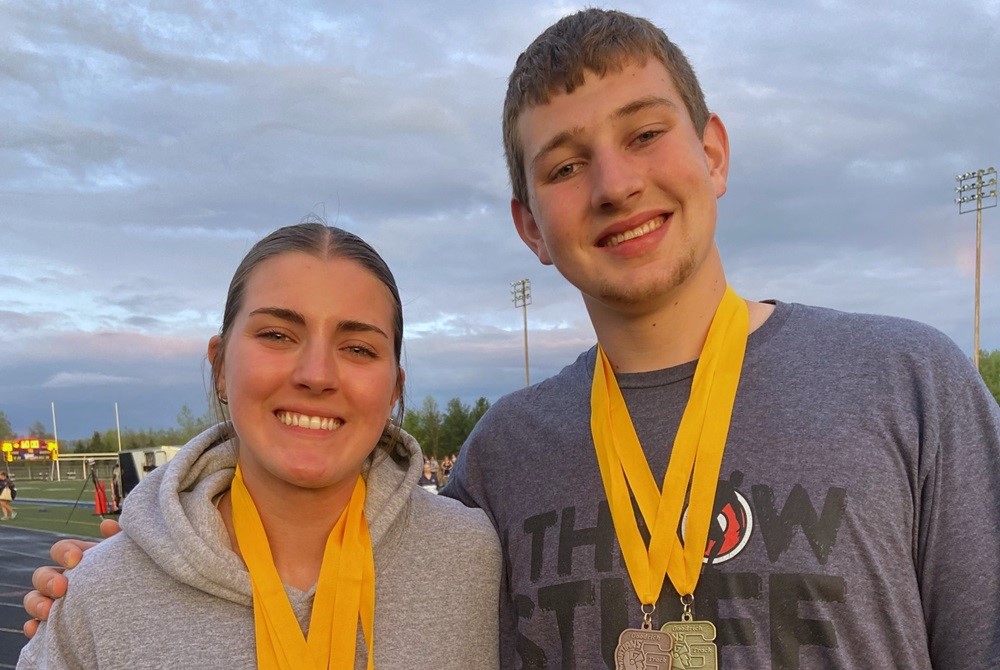
PHOTOS (Top) Cousins Aubree Deshetsky, left, and Eli Bickel take a photo together during a successful day last season at the Goodrich Invitational. (Middle) Deshetsky unwinds during a discus throw. (Below) Bickel holds up his discus and shot put. (Photos courtesy of the North Branch athletic department.)