

Gaylord Pole-Vaulting Pair Rewards Coach's Commitment with Conference Sweep
By
Tom Spencer
Special for MHSAA.com
May 15, 2026
The future of the Gaylord pole vaulting may be hanging in the balance.
 Success in the field event depends not only on speed and jumping ability — but also coordination, strength and balance.
The Blue Devils and veteran head track & field coach Matt Warren may have to struggle to keep the balance going next year. But it’s not the first time the program is facing the possibility of losing assistant coach Jeremy Savoie.
“It's hard if you don't have somebody who has passion for pole vaulting to coach, and Jeremy is a selfless human being,” Warren said. “He has the passion for helping and molding kids, and it comes through very, very, clearly, with the pole vault program. And when he steps down, it's going to be a big loss for us.”
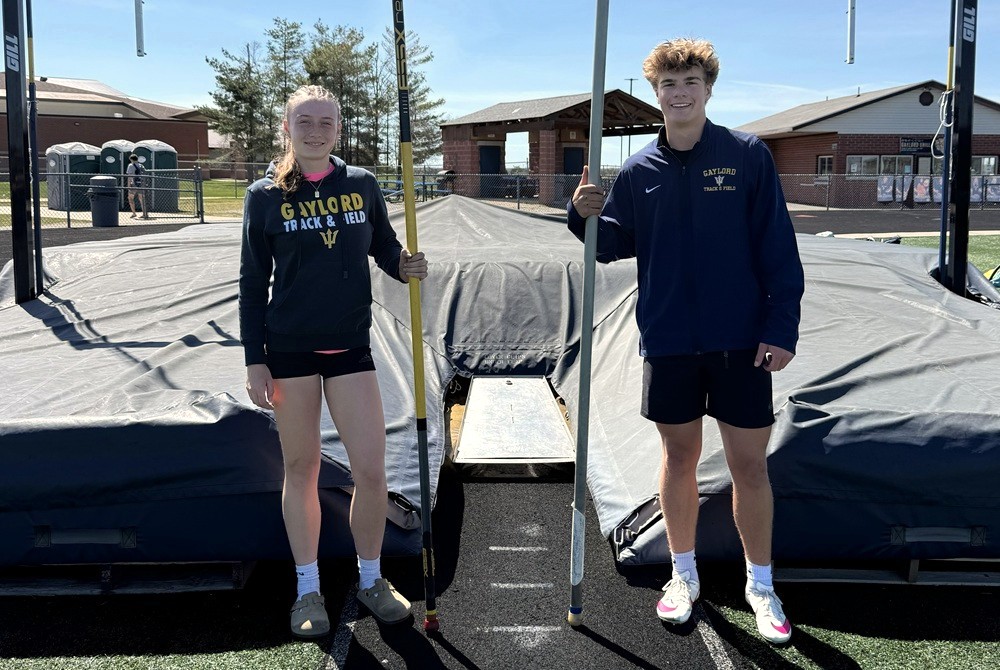
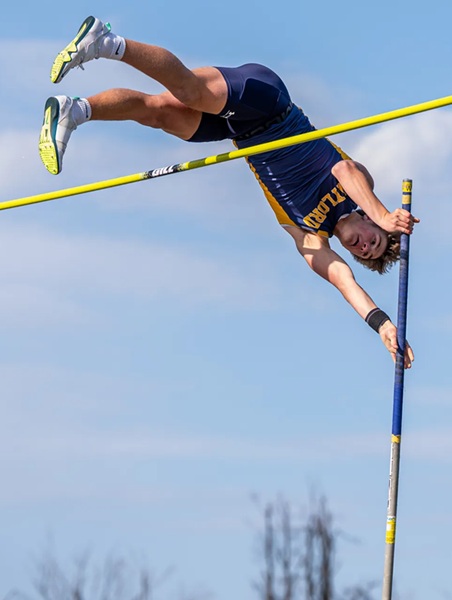
Savoie’s investment in pole vaulting has led to Gaylord capturing both Big North Conference individual championships for the first time in school history. Senior Lillian Mason, who set the school record earlier this year clearing the bar at 10-9, won the girls conference title on one of the most challenging days of a very challenging spring. Sophomore Calvin Cosby, also a school record-holder, won the boys league title. Cosby, who owns the boys record at 15-3, was third at the conference meet last year when Savoie’s son Nickolas was runner-up.
Savoie started coaching pole vault during the spring of 2000. A former high school vaulter himself, he got involved because of his family – the same family he struggles every day to balance along with work and coaching. He nearly walked away from coaching after last spring’s season when Nickolas, one of the best vaulters in the school’s history, graduated.
After receiving a letter from Mason, and talking things through with her family and his own, Savoie decided to stick around this year.
 “I was really done when Nickolas finished. … We had the whole emotional track banquet and low and behold, here we are again,” Savoie said. “Lillian started with me as a freshman. She had to really work at it, and over the last two years, she didn’t take any time off. She works at it year-round, lifts, runs, does the drills and just works her tail off.”
Now, though, Savoie’s youngest daughter plays junior varsity softball for the Blue Devils. He is finding himself caught at times between watching his daughter play softball, including summer ball, and helping other student-athletes in what has become another year-around sport.
In addition to family balance struggles, Savoie also has battled work-life challenges as a technician for a local auto dealership.
“It is a sacrifice on our family because for three months, I lose about 20 hours of work every week and I'm walking away from my own paycheck to help support my family and pay my bills,” Savoie acknowledged. “Fortunately, I still do good enough that it doesn't massively affect the family, but it is still a burden that you have to keep in check.”
And the guilt of missing his youngest and only daughter, Ava, at times in softball is adding to the toll.
“Ava made the high school team this year for JV, and now I have to deal with feeling guilty because I'm at practice and I'm not watching her play her game, or ‘Hey, coaches, I'm going to have leave today at 4 o'clock to go watch Ava,’” Savoie said. “The whole time I'm over there sitting there watching my daughter, cheering for her to do good with the softball team, I'm feeling guilty because I'm not with the kids, pole vaulting.”
The vaulters found themselves facing a significant head wind as Gaylord hosted the conference meet this year.
“Winning these Big North Championships – that's a big deal,” Warren said. “It was a very difficult weather day, so it was ‘who can adapt the most to deal with the conditions?’ That's good coaching there to be able to choose which pole is best in these conditions … how long should the run-up be and all of those things. So I was proud of the adjustments and being able to overcome adversity.”
Gaylord coaches now expect Cosby and Mason to make a run for Lower Peninsula Division 2 Finals championships May 30 at Hamilton. The record-holders already have met the qualification standard, so they won’t have to depend on qualifying during today’s Regional at Cadillac.
“I know Calvin wants to be the state champion, and obviously so does Lillian,” Warren said. “We’re in a challenging division for pole vaulters. There will be good competition, but they’re definitely looking both to get all-state honors.”
 Another Finals challenger will be Petoskey’s Sarah Bailey, a familiar conference foe and an offseason training partner. Bailey and Mason trained together all winter on Sundays at Boyne City High School. Boyne has the indoor vaulting equipment, and volunteer coaches from all over northern Michigan – including Savoie – are there to help student-athletes regardless of what schools they attend.
“There is a group of northern Michigan coaches that have decided to make pole vaulting a passion of theirs, not just Gaylord High School,” Warren said of the Sunday offseason training. “These kids buy into that stuff where they see coaches caring, giving of their time. There's a lot of good coaches that participate.”
Perhaps seeing one of his vaulters win a Finals title will keep Savoie around. The success and growth of junior newcomer Reese Summerland may help too. Summerland runs sprints and does the high jump as well for the Blue Devils.
“I didn't really come into this looking for really much out of it other than getting to spend time with my boys,” Savoie admitted, while noting he first coached when his son Anthony wanted to try vaulting as a freshman and Gaylord did not have coaches for it. “Reese is a junior this year, then Calvin's a sophomore, I still have some skin in the game. As long as the school's still willing to work with me to let me watch my daughter play softball, I have no reason to make the choice between the two.”
Savoie will leave the Blue Devils in good hands, should he not continue coaching.
“Jeremy is very committed but we're just going to have to carry on, and I’ve learned a lot from Jeremy,” Warren said, adding he expects the other coaches in the area to continue the offseason work. “That’s his program – that’s his baby. I believe this is going to be his last year, but you never know when you have someone the caliber of Calvin. I can’t speak more highly about Jeremy and what he’s accomplished in the last six years. Now we got other kids just trying the vault and, it's success that breeds success.”
 Tom Spencer is a longtime MHSAA-registered basketball and soccer official, and former softball and baseball official, and he also has coached in the northern Lower Peninsula area. He previously has written for the Saginaw News, Bay County Sports Page and Midland Daily News. He can be reached at [email protected] with story ideas for Manistee, Wexford, Missaukee, Roscommon, Ogemaw, Iosco, Alcona, Oscoda, Crawford, Kalkaska, Grand Traverse, Benzie, Leelanau, Antrim, Otsego, Montmorency, Alpena, Presque Isle, Cheboygan, Charlevoix and Emmet counties.
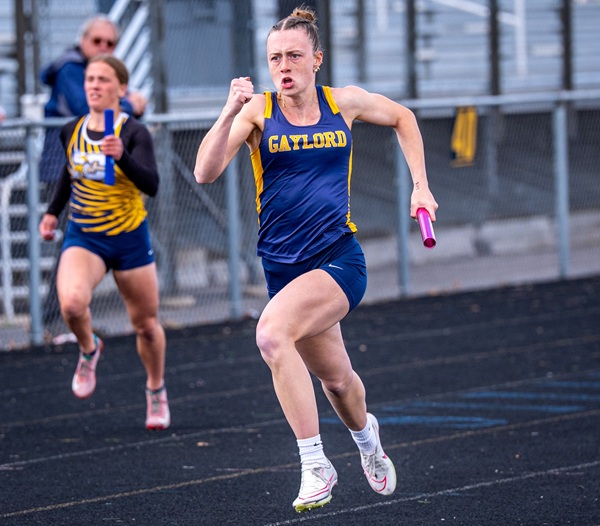
PHOTOS (Top) Gaylord’s Lillian Mason, left, and Calvin Cosby were the Big North Conference pole-vaulting champions this season. (Middle) Cosby clears the bar. (Below) Mason carries the baton during a relay. (Top photo courtesy of the Gaylord athletic department. Action photos by Dylan Jespersen/Gaylord Herald Times.)
Bark River-Harris Lands 3-Peat, Shamion Joins Elite 4-Event Winners Club
By
John Vrancic
Special for MHSAA.com
June 2, 2024
KINGSFORD — The Bark River-Harris girls completed their season-long mission here Saturday, earning their third straight Upper Peninsula Division 2 track & field championship with 127½ points.
West Iron County brought home the runner-up trophy with 82, and third-place Ishpeming had 71.
“The girls have been working hard for this,” BR-H coach Jason Lockwood said. “Three U.P. titles under their belt is incredible. Everybody contributed, which is instrumental in putting up that many points.”
BR-H senior and Bay College basketball recruit Lauren Zawada captured the 100-meter hurdles in 17.74 seconds and 300s (50.92) and helped the Broncos win the 1,600 relay at 4 minutes, 24.4 seconds.
“My starts are what helped me this time,” she said. “That was my first individual U.P. title, which gives me a pretty good feeling. I’m pretty excited.”
Fellow senior and Bay College basketball recruit Mckenzie Hoffmeyer won long jump at 16 feet, ½ inch, helped the Broncos win the 800 relay (1:49.92) and placed second in the 100 (13.03) and 200 in a personal-best 26.52.
“Even though I didn’t win the 100 or 200, I still got points for the team,” she said. “It feels pretty awesome for us to come together and win this three times in a row.”
Hoffmeyer was runner-up to West Iron County senior Danica Shamion, who took high jump with a record 5-1, the 100 at 12.65 and also set U.P. records in the 200 (26.17) and 400 (56.94). She’s one of just nine girls to win four individual events at a Track & Field Finals.
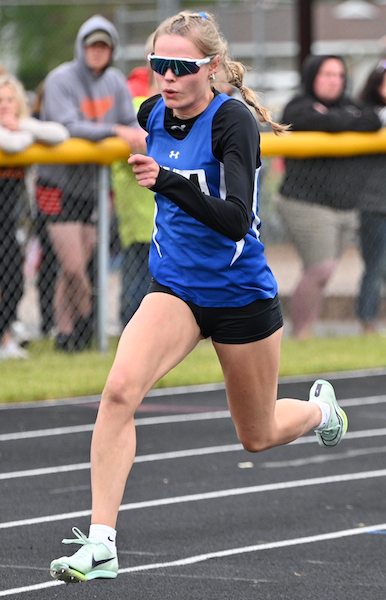 Shamion’s U.P. records took place four days after she set school records in the 200 (25.79) and 400 (56.74) and high jump (5-5) at Houghton.
“I went out with a bang, which is something I wanted to do as a freshman,” she said. “I kept thinking, ‘Take it one step at a time.’ The high jump runway was a little slippery (during brief rainfall). It was hard to get your grip.”
BR-H junior Marissa Ives, also part of the 800 relay, took third in the 200 (27.42) and fourth in the 100 (13.5).
“I think we did pretty good for having a young team (in the 800 relay),” she said. “The rain felt good during the race. It makes it a little harder coming out of the blocks, but it cools you off.”
Senior Julia Olson, who helped the Broncos win the 1,600 relay, set school records while taking fourth in the 400 (1:00.54) and 800 (2:29.2).
“This is honestly rewarding,” Olson said. “Part of this is due to our training in the weight room during the offseason. It really paid off. It’s also good to know I had good competition on top of it.”
Pickford sophomore Talya Schreiber won the 1,600 (5:19.16) and 3,200 (11:49.86) and was runner-up in the 800 (2:27.88).
“Lola (Korpi) is a great runner,” she said. “It definitely helps to have her here to push me. This feels really good. I’m happy to be here for our team. The atmosphere is awesome. Everyone is so nice.”
Ishpeming senior and Northern Michigan University recruit Korpi won the 800 (2:26.36) and placed second in the 1,600 (in a school-record 5:20.19) and 3,200 (12:12.63).
“I let her creep away from me a little too much and I couldn’t quite catch her in the 1,600,” said Korpi, who capped her career with 10 individual Track Finals titles. “She started her kick, too.
“I’m obviously happy with another school record. I feel I left my mark. I’m also happy for Talya. She worked so hard and helped me get my PR. Second place isn’t bad. I’m happy where I am.”
Sophomore Mya Hemmer added a first for Ishpeming in discus (114-6) and second in shot put (33-5¼), and Ironwood sophomore Emma Wardon took first in shot (34-5).
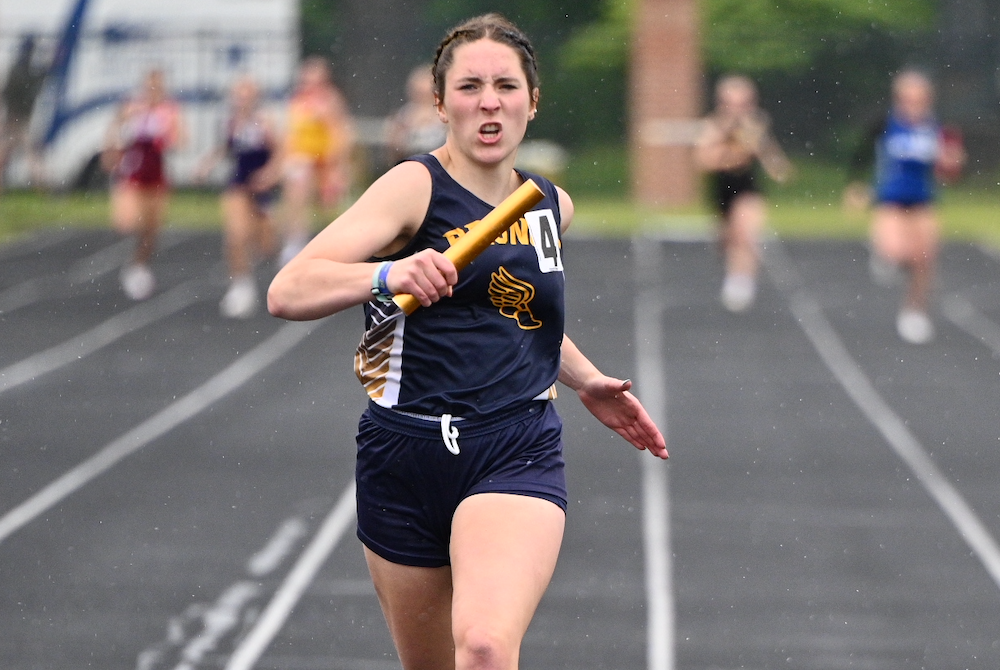
PHOTOS (Top) Bark River-Harris's Carli Erickson crosses the finish line far ahead of her competition in the 800 Relay. Other members of the winning team were Mckenzie Hoffmeyer, Julia Nault, and Marissa Ives. (Middle) West Iron County's Danica Shamion starts the 400, which she eventually wins. (Click for more from Cara Kamps/RunMichigan.com.)