

Glen Lake Grad Adds Pacific Ocean to Life's Journey in Completing World's Toughest Row
By
Tom Spencer
Special for MHSAA.com
August 18, 2026
Julie (Adams) Bennett has lots of memories from her days at Glen Lake High School. Many are great, some not so great.
 And, while she took all of them with her as she just rowed across the Pacific Ocean, her battle with anorexia was at the top.
“In our culture, thin is beautiful, and it always has been,” said Bennett, a 1982 Lakers graduate. “We grew up in the '70s with all of the magazines and all of the thin models. I was kind of a fat kid in junior high. You know, you get a little chunky, and then you grow taller. Well, I got chunky, but I never grew taller.”
Bennett found herself in a battle with anorexia, leading her to raise funds and awareness for the National Eating Disorders Association as she recently competed in and completed the World's Toughest Row. The crossing occurred after more than a year of preparation, and NEDA was one of four organizations the team supported as part of taking on the challenge.
“I was teased a lot for my weight in high school,” recalled Bennett, who experienced hurtful name-calling. “It isn't the only reason why I became anorexic, but I did. I know people who don't recover from anorexia. It takes their life. I was one of the lucky ones”
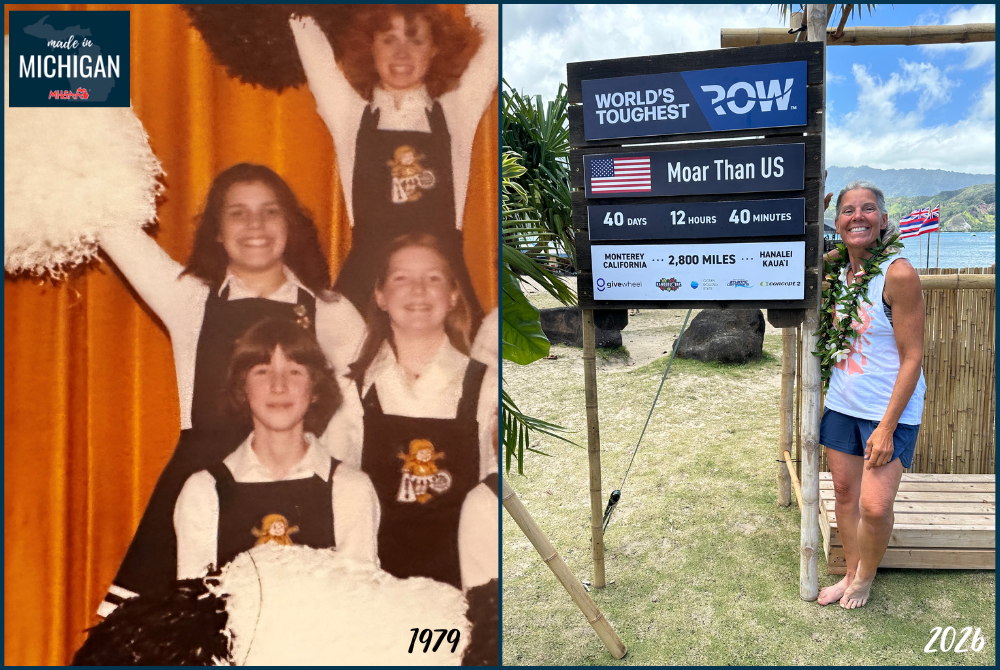
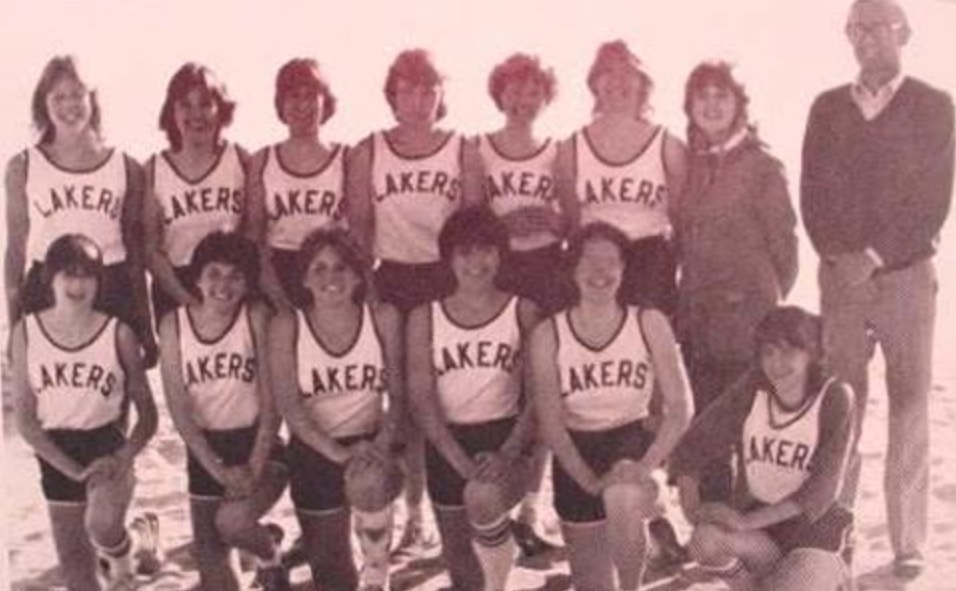
Bennett was a middle distance runner on the Lakers track team and a key member of the cheer team. Fall was spent supporting the football team and winter the basketball team as Title IX was just starting to impact sports opportunities for girls.
“When I was in junior high, there were no competitive girl sports,” Bennett said. “I know a lot of people look at cheerleading and think ‘oh they're just fluffy girls who are really girly and just want to cheer.’ But every summer, we did competitive cheer camps.”
Bennett picked up rowing when her youngest son, Steven, joined the sport as a freshman in high school in the Grand Rapids area. It wasn’t long before she began coaching adults and kids in the sport after years of teaching group fitness and yoga.
 Bennett points to positive role models, like her mother, Pam, and multiple coaches, as having played significant roles in her battle with overcoming anorexia.
“They really put me on a path to make wise decisions about the food that I eat and about physical fitness,” she said. “So I had always just had a much healthier relationship with exercising and food than I could have. I mean, I could have gone off the rails.”
Bennett believes high school sports allow student-athletes learn discipline. It was that same discipline that helped her complete the 2,800-mile trip across the Pacific Ocean just a few weeks ago.
Bennett, along Erin Enk-Wiese, Susan Katt and Jak Kazmarek, left Monterey, Calif., on June 9 after a five-day weather delay. The four rowers landed 40 days later in Kauai, Hawaii.
The average crossing time for crews of all sizes over the history of the World’s Toughest Row is 62 days. The first boat to conquer the world’s deepest ocean this year took 36 days. Bennett’s team, Moar Than Us, was thrilled the trip was pretty much free of challenging weather, injury and other significant incidents.
“The discipline of sports, and the coaching that I got, was what really set me on a path to – not just for rowing, but it really just set me on a path – to be disciplined about my physical fitness,” she said. “You really need the discipline, but you don't think that you do, because you think you know everything when you're 16. All of that discipline really, really helped me mentally and physically and put me on a journey of lifelong physical fitness.”
Bennett’s crew took turns taking two-hour shifts in daylight and three-year shifts in the dark. The boat always had two in the rowing seats and two below resting and recovering. They did start and finish the race with all four crew members playing a role up top.
Bennett, who went on the graduate from Hope College and land her first teaching job at Glen Lake, is quick to identify the key to coaching high school sports today, especially rowing. She’s on the coaching staff of the Grand Rapids Rowing Club, one of just a small number of high school-sponsored rowing clubs in Michigan.
 “You teach them to love the sport, and then you teach them how to do it,” Bennett said. “You have to teach them how to love it. I was an endurance person and rowing certainly is an endurance sport.”
Rowing is a natural sport for the 5-foot-4 former Laker, despite her undergoing hip replacement during her 40s.
She fondly remembers her track experience at Glen Lake. While she mostly ran the 400 and 800 along with relays, her coaches entered her in all field events in hopes she could pick up a point or two.
“I don't have quick-twitch muscles, so I was not good enough to be in the sprints, but I ran sprint relays,” acknowledged Bennett. “Because we were a small team, if there was a third place to be had, coaches would throw me in. I threw shot put a couple of times. I remember throwing shot put against Mesick. They could throw it twice as far, but I got the point in third.”
Bennett noted the Pacific crossing annually attracts sailors and navigators, along with a few others.
“It also attracts just people who are adrenaline junkies,” she said. “People who just want that jolt from doing something amazing.”
Bennett though, did it for other reasons, including raising awareness for anorexia.
“The best message that you can give somebody is that you can be any age, any gender, any size, and do it,” she said. “You can do difficult things, and you shouldn't shortchange yourself by not being mentally ready for that challenge.”
2026 Made In Michigan
Aug. 13: Basketball Takes 'The Judge' Worldwide, Home Again as Love of Game Lives On - Report
Aug. 11: Nearly 25 Years After Leading Unexpected Run, Morton Directing Life-Changing Mission - Report
Aug. 7: Significance of Historic Run, Relationships Formed Live On for 1973 Unity Champs - Report
Aug. 4: Work Ethic Continues to Drive Van Dyk's Endeavors as Co-Owner of Family Farm - Report
July 24: Hackett Mentor's Care Sparked Lifetime in Hoops for BCAM President White - Report
July 24: Mackey Leaving Court with 500+ College Hoops Wins, Many More Lessons Shared - Report
July 16: Country Day Two-Time Champ Moore Building Perennial Winner at Harvard - Report
July 9: Multi-Sport Career at TC West Helps Gillis Thrive as Pro in Game She Once Left Behind - Report
July 2: Inspired by Home, Eager to Give Back, Spencer Hosts Hoop City Alumni Games - Report
PHOTOS (Top) At left, Julie Bennett stands in formation with her Glen Lake cheer team in 1979. At right, Bennett stands next to a sign explaining the accomplishment after completing the Pacific Ocean crossing with her crewmates. (Middle) Bennett, front row and fourth from left, poses for a team photo with her high school track team. (Below) The Moar Than US team rows toward Hawaii, and celebrates its accomplishment. (Glen Lake photos courtesy of the Glen Lake yearbook staff. Moar Than US photos courtesy of World's Toughest Row, More Than US team and Bennett family.)
Generations of Dedication, Pride Fuel Milford's 34-Year Regional Hosting Run
By
Steve Vedder
Special for MHSAA.com
May 22, 2026
It may seem a bit of a stretch on the surface, but it makes perfect sense to Brian Salyers.
How can planning a wedding feature work much along the same lines as a school hosting an MHSAA Lower Peninsula Regional track meet for 34 straight seasons?
Easy, contends Salyers. Both take an immeasurable amount of planning.
"I have a couple friends who planned a wedding," said Salyers, Milford's girls track coach. "I told them I'd hosted a track meet, and they're so much alike. There are so many things you entrust other people with. There is so much work to be done, you're hoping things go smoothly."
Like a wedding, Salyers said Milford takes great pride in the event's final outcome. The meet's philosophy includes more than being a stepping stone of funneling deserving athletes along to the MHSAA Finals. At Milford, Salyers said organizers have worked diligently for more than three decades to ensure the participants not only leave with lifelong memories, but also that the meet brings together an entire community.
Volunteers from the school work alongside Milford natives not connected in any way to a track program in a multitude of roles from timing races to rototilling and raking long jump pits, selling dogs and T-shirts and taking tickets. Alumni from up to 45 years ago faithfully return to the school to pitch in whenever needed while also taking a moment to rehash old memories with former track teammates.
 Put it all together, Salyers said, and the meet is special.
"It's a melting pot," Salyers said of the mostly unpaid volunteers who work the meet. "It's like, who can come and do it this year? It's not always a fluid list because we pull from such a large group."
The large group has been banding together since 1993. Started by former Mavericks track and cross country coach Gene Balawajder, the school hosted its first Regional in 1988. After moving to a nearby site for a couple years, the Regional landed back at Milford for keeps 34 years ago. Whether it was those first Regionals in the late 1980s or the three and a half decades since, Salyers said the school and community's philosophy hasn't wavered: Take care of the athletes foremost, but also bring the community together to ensure that care happens by organization, identifying issues and swiftly taking action to solve problems.
Milford athletic director James Marszalek said the school handily recruits about 30 people for various positions, only a "handful," he said, who are paid. He said the key to ensuring a smooth meet begins with the volunteers and longtime meet organizer Chris Ceresa, a former athletic director and current assistant coach.
"The No. 1 thing is making sure we have competent people in the right positions and that we make sure it's a day the kids will remember," he said. "But it definitely takes an army."
Ceresa said much of the meet's success comes down to planning and the unselfishness of alumni. For instance, at this year's meet there were five alumni working the long jump, four on the throwing events and two on both the high jump and pole vault as well as many involved as timers.
Ceresa begins recruiting for the following year's Regional at the current event. There he seeks commitments from officials and event workers 12 months in advance.
"We take it very personally; the staff is very committed to the meet," he said. "If you talked to our colleagues at other schools, I think they would tell you they love to come here. It's quite a spectacle, a matter of pride."
The meet even features an unofficial system of where and how volunteers are used. Meet newcomers typically start out in smaller roles, eventually working themselves into the meet's most prestigious position: being an official timer for races. Unfortunately, when the meet became the last Regional in the state to go to electric timing more than a dozen years ago, there was no need for about 20 volunteers who worked as hand timers at the finish line.
 Milford boys track coach Eric Hincka ran in the meet as a junior and senior before graduating in 1998. He said while some Regionals typically run more smoothly than others, because of the hours upon hours of organization and the quality of the volunteers, the Milford event annually draws praise from visiting coaches and participants. And that's no accident, he said.
"Every year you hear horror stories of meets which have problems," he said. "We try our best to see that everything is done right so we don't run into problems. We want to honor the kids – it's our philosophy and we take pride in it.
"At Milford, it's multi-generational. Gene as the founder set the standard, and we're just trying to follow in his footsteps."
The athletes notice, Milford senior distance runner Kyle O'Rourke said. Headed to run at Michigan State next season, O'Rourke's pedigree in the meet is three-generational. His grandfather has clerked and also made T-shirts for volunteers while O'Rourke has had an older brother and sister run at the Regional. His mother also ran in the meet.
"It's touching for me to see all the old alumni to come back and work; a highlight of the season," said O'Rourke, a six-time all-stater in track and cross country. "They treasured their time here, and now many of them are part of a community that unites to make this meet run well.
"Yeah, it comes in handy (competitive-wise) that this meet is home for us. But there is also a certain pride in us hosting it. I think we all take pride in how we conduct ourselves at the Regional."
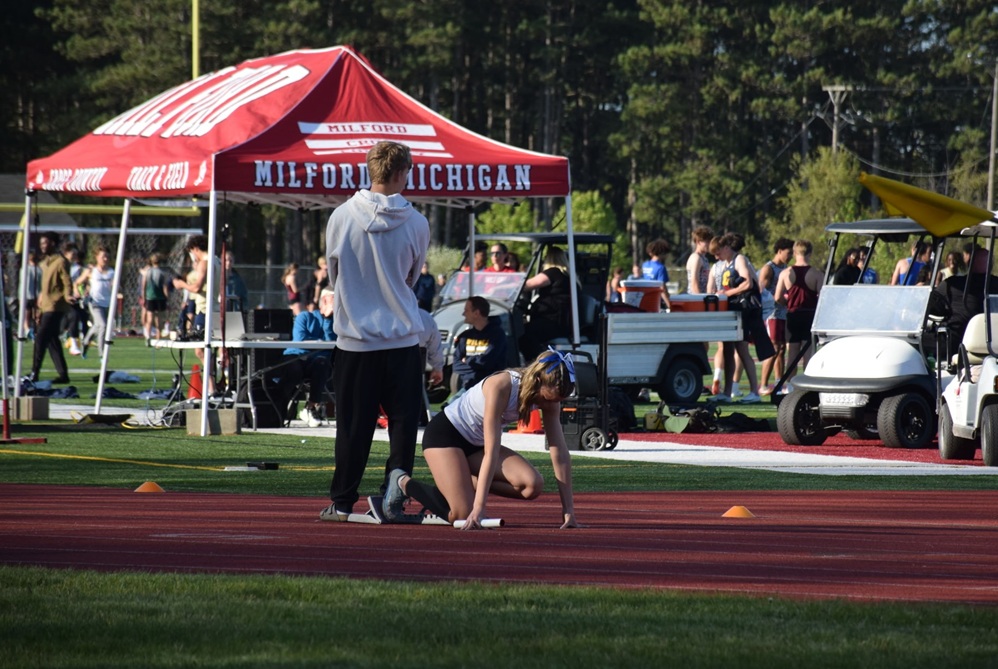
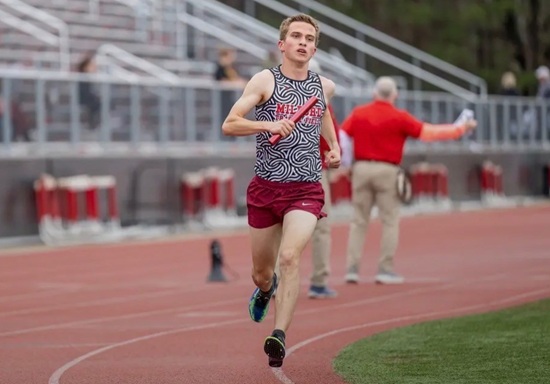
PHOTOS (Top) A relay runner sets up in a starting block during the Lower Peninsula Division 1 Regional hosted by Milford on May 15. (Middle) Runners move toward the starting line before their relay. (Below) Milford’s Kyle O’Rourke rounds a curve during a relay. (Photos courtesy of the Milford athletic department.)